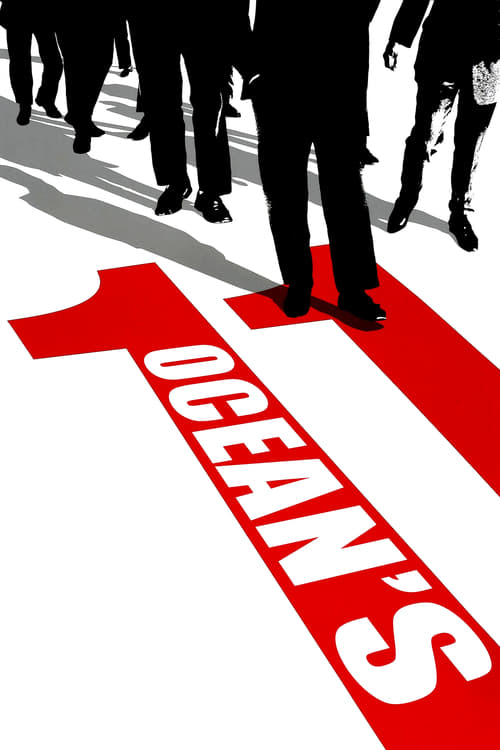
Ocean's Eleven
2001 · Steven Soderbergh
The perfect Friday-night crowd-pleaser — when you want to be entertained, feel clever, and watch beautiful people get away with something. Total comfort viewing.
What it's about
Danny Ocean walks out of prison and, within a day, is recruiting a crew of eleven specialists to rob the vault serving three Las Vegas casinos in a single night — over $150 million belonging to the ruthless Terry Benedict. Complicating matters: Benedict is dating Danny's ex-wife, Tess, and winning her back may be the real job. Recruitment, planning, and the long con unfold with maximum style.
The experience
Pure pleasure — fast, funny, effortlessly cool, with banter that snaps and a plot that clicks together like a watch. It's the rare thriller with zero dread; you grin through the whole thing.
Performances
George Clooney and Brad Pitt turn charm into a two-hander, Julia Roberts gives the caper a real romantic stake, and Andy García makes an icy, worthy adversary — the whole A-list ensemble plays like a band that's toured together for years.
The craft
Soderbergh directs with jazzy confidence: saturated Vegas color, split-second editing that hides and reveals exactly what the con requires, and a lounge-cool score that keeps everything gliding. The screenplay's misdirection is the real special effect.
Why it matters
It relaunched the heist movie for the 2000s, spawned a hit franchise, and became the modern template for the star-ensemble caper — proof a blockbuster could run on wit and style.
Snapshot
Ocean's Eleven is Steven Soderbergh's glossy, high-velocity heist comedy, a remake of the 1960 Rat Pack vehicle of the same name, repurposed as a vehicle for an A-list ensemble led by George Clooney, Brad Pitt, Matt Damon, Julia Roberts, and Andy García. Danny Ocean, freshly paroled, assembles eleven specialists to rob the vault that serves three Las Vegas casinos owned by Terry Benedict — who happens to be dating Ocean's ex-wife, Tess. The film fuses the procedural pleasures of the caper (recruitment, planning, the run of the con) with a romantic recovery plot, and it does so in a register of supreme lightness. Within Soderbergh's career it occupies a deliberate position: made immediately after the back-to-back prestige successes of Erin Brockovich and Traffic (both 2000, the latter winning him the Best Director Oscar), it represents his pivot to large-scale studio entertainment, executed with the same formal control he brought to his art-house and issue pictures. The result is one of the most influential mainstream entertainments of its decade and the launch of a franchise.
Industry & production
The film was produced by Jerry Weintraub — who held a personal connection to the Rat Pack original and to Las Vegas — and released by Warner Bros. through Village Roadshow and Soderbergh and Clooney's production company Section Eight. Section Eight, founded by the two in 2000, was structured to leverage their commercial clout into a slate that mixed populist studio fare with riskier auteur projects; Ocean's Eleven was precisely the kind of bankable tentpole that could subsidize that arrangement, and it became the company's signature commercial success.
The production's defining feature was its assembly of an unusually deep bench of stars willing to work within an ensemble rather than as solo leads — a casting coup widely attributed to Clooney's and Soderbergh's gravitas coming off their 2000 awards run. Filming took place substantially on location in Las Vegas, with cooperation from real casinos (the Bellagio prominently among them), lending the film an authenticity of place that the soundstage-bound original lacked. The fountains of the Bellagio supply the film's celebrated closing tableau.
The picture was a major commercial hit on release in December 2001, performing strongly enough to greenlight two sequels, Ocean's Twelve (2004) and Ocean's Thirteen (2007), and eventually a distaff continuation, Ocean's 8 (2018). Precise grosses should be checked against a reliable source rather than asserted here, but the film's status as a substantial box-office success and franchise originator is uncontested.
Technology
Ocean's Eleven was shot photochemically on 35mm film, consistent with mainstream studio practice in 2001, predating Soderbergh's later, well-documented embrace of digital capture (he would become one of Hollywood's most vocal champions of digital cinematography and editing later in the decade). The film's visual signature comes less from novel capture technology than from aggressive use of color processing in post — strong color timing and filtration that pushes Las Vegas toward saturated golds, ambers, and cool blues. This places it within the early-2000s vogue for emphatic, stylized color grading, then transitioning from photochemical timing toward the digital intermediate workflows that would soon become standard.
Equally relevant to the film's "technology" is its diegetic content: the heist turns on surveillance systems, hacked casino cameras, a (fictionalized) electromagnetic "pinch" device used to black out the Las Vegas power grid, and looped video feeds. The film treats casino security as a technological fortress to be defeated, and its plotting is organized around the manipulation of cameras and monitors — a self-aware engagement with the apparatus of watching that rhymes with cinema itself.
Technique
Cinematography
Soderbergh served as his own cinematographer under the pseudonym "Peter Andrews" (a name combining his father's and his own middle names), a practice he had adopted and would maintain across much of his subsequent work. The photography is glossy and mobile, favoring long lenses, rack focus, and a warm, lamp-lit palette that evokes both the neon glamour of the Strip and the burnished interiors of high-roller spaces. Soderbergh frequently shoots through foreground elements and reflective surfaces, and uses anamorphic-feeling widescreen compositions to stage the ensemble across the frame. The look is deliberately seductive — the cinematography sells Vegas as a fantasy of cool — while remaining legible and classical in its coverage of the elaborate plotting. The color stylization, with its split between warm interiors and cooler exteriors, is among the film's most imitated traits.
Editing
The editing, by Stephen Mirrione (who had cut Traffic for Soderbergh and won an Oscar for it), is central to the film's effect. The picture moves with brisk, confident rhythm, and it deploys elliptical, time-shuffling construction at key moments — most notably in the climactic robbery, where the audience is shown one version of events and then, through flashback, the concealed truth of how the con was actually executed. This withholding-and-revealing structure, a staple of the heist genre, is handled with particular elegance: the cut becomes the instrument of misdirection. Montage sequences for the crew's recruitment and preparation compress exposition into stylish, music-driven passages.
Mise-en-scène / staging
Soderbergh stages the ensemble with a relaxed, conversational blocking that lets star charisma breathe — characters lounge, banter, and move through luxurious spaces with practiced ease. The production design (Philip Messina) and the real Las Vegas locations supply an environment of opulence: casino floors, vaults, suites, and the Bellagio's exterior fountains. Costuming leans into tailored, retro-modern elegance, reinforcing the film's fantasy of effortless sophistication. The staging consistently prioritizes cool — bodies arranged for maximum poise — and the film's most famous image, the eleven men ranged along the fountain railing watching the water as Debussy's "Clair de lune" plays, is a masterpiece of compositional restraint after the kinetic heist.
Sound
David Holmes's score is a defining element: a jazzy, funk- and lounge-inflected soundtrack of grooves and breakbeats that gives the film its propulsive, retro-cool pulse and explicitly evokes the Rat Pack/Vegas heritage while sounding contemporary. The needle-drops and score are used to drive montage and to lacquer the proceedings with effortless style. The climactic use of Debussy's "Clair de lune" over the fountain scene is a deliberate tonal pivot — classical lyricism replacing the funk — that lends the ending unexpected grace. Sound design renders the casino and the technological set-pieces with clean, polished precision.
Performance
The film is, above all, a showcase for relaxed star performance. Clooney plays Danny Ocean with composed, slightly weary charm, a man whose plan and whose heart are equally at stake. Pitt's Rusty Ryan is the comic foil, perpetually eating and trading clipped, overlapping dialogue with Clooney — their rapport is the film's engine. Damon plays the eager rookie pickpocket; Don Cheadle (with a much-discussed Cockney accent) the explosives man; Carl Reiner and Elliott Gould bring veteran texture; Bernie Mac and Casey Affleck and Scott Caan and Eddie Jemison and Shaobo Qin fill out the crew with distinct comic notes. Andy García's Terry Benedict is a cold, controlled antagonist, and Julia Roberts's Tess supplies the romantic stakes. The performance style throughout is understated and ensemble-minded: nobody pushes, and the pleasure lies in watching famous faces underplay together.
Narrative & dramatic mode
The film operates in the classic heist structure: a precipitating motive, the assembly of a specialist team, an elaborate plan explained to the audience (partly), execution, complication, and a final reveal that retroactively reorganizes everything we have seen. Soderbergh layers a romance-of-reconciliation onto this armature — the robbery is also a scheme to win back Tess — so that the caper's success is double-coded as both financial and emotional victory. The dramatic mode is comic and ironic rather than suspenseful in a thriller's anxious sense; the film signals early that these are charming professionals who will likely prevail, and it invites the audience to delight in how rather than to fear whether. Crucially, the narration is unreliable by design: the audience is deliberately misled about the plan so that the final flashback can deliver the pleasure of revelation. This makes the film as much about storytelling sleight-of-hand as about robbery.
Genre & cycle
Ocean's Eleven sits at the intersection of the heist/caper film and the star-ensemble comedy. Its lineage runs through the caper tradition — Rififi (1955), The Killing (1956), Topkapi (1964), The Italian Job (1969) — but its tonal model is the lighter, glamour-forward strain epitomized by the 1960 original and by the elegant capers of the same era. Released in late 2001, it helped catalyze a revival of the glossy, fun heist film in the 2000s and stands as the foundational text of its own franchise cycle. It belongs, too, to the broader early-2000s vogue for slick, music-driven, ironic studio entertainment with strong design sensibilities. Within Soderbergh's filmography it inaugurates his "one for them, one for me" rhythm — alternating commercial projects with experimental ones — and the Ocean's films became his recurring commercial home base.
Authorship & method
The film is a paradigmatic Soderbergh production in its combination of populist material with rigorous craft and the director's habit of wearing multiple hats. As director he also shot the film (as "Peter Andrews") and, across his career, frequently edited under the pseudonym "Mary Ann Bernard," though on this picture the credited editor is Stephen Mirrione. This do-it-yourself authorial control — directing, photographing, and closely shaping the cut — is central to Soderbergh's method and gives his films their unified, controlled surface.
His key collaborators here form a recurring repertory company: Mirrione (editor, fresh off Traffic), composer David Holmes (whose work would define the sound of the whole Ocean's series), production designer Philip Messina, and screenwriter Ted Griffin, who adapted the premise of the original film (itself from a story by George Clayton Johnson and Jack Golden Russell) into a contemporary, wittily plotted screenplay. The producing partnership with Jerry Weintraub and the Section Eight partnership with Clooney complete the authorial picture: Ocean's Eleven is the product of a tightly knit creative team operating at the top of the studio system, with Soderbergh exercising unusually comprehensive control over the image and rhythm.
Movement / national cinema
The film is mainstream American studio cinema of the highest commercial order, not a product of any avant-garde or national-cinema movement. That said, Soderbergh is a director with deep roots in the American independent scene — his sex, lies, and videotape (1989) is often cited as a catalyst for the 1990s indie boom and for the rise of Sundance and Miramax-era specialty film. Ocean's Eleven represents the migration of an indie-pedigreed auteur into the center of Hollywood, carrying art-cinema sensibilities (formal play, controlled color, structural cleverness) into a tentpole format. Its self-conscious citation of the 1960 Rat Pack film also makes it a work in dialogue with a specifically American mid-century pop mythology of Las Vegas, masculinity, and showbiz cool.
Era / period
Made in 2001 and set in a contemporary Las Vegas, the film is a document of its moment: the turn-of-the-millennium reinvention of the Strip as a landscape of mega-resorts (the Bellagio, opened 1998, is emblematic), and the early-2000s studio appetite for glossy, design-conscious, star-driven entertainment. It arrived in December 2001, in the immediate aftermath of September 11, and its frictionless escapism — a fantasy of competence, camaraderie, and consequence-free pleasure — can be read against that backdrop, though one should be cautious about overstating an intention conceived and largely produced before the attacks. Stylistically it belongs to the period's transition from photochemical to digital post-production and to the height of the music-supervised, needle-drop-driven studio film.
Themes
At its center the film is about professionalism and mastery — the aesthetic and moral pleasure of watching experts do difficult things flawlessly. It romanticizes competence and teamwork, presenting the crew as a quasi-family bound by craft and loyalty. Closely related is the theme of performance and deception: nearly every character is playing a role, the plot is a con built of cons, and the film's own narration cons the viewer, making Ocean's Eleven a meditation on misdirection and showmanship that mirrors filmmaking itself. The Las Vegas setting foregrounds artifice, spectacle, and the manipulation of appearances. A second register is romantic and personal: Danny's robbery is inseparable from his desire to recover his marriage, so that the heist is also a story about second chances, parole both literal and emotional, and what a man will risk to win back what he lost. Finally there is cool itself as a value — the film treats style, poise, and grace under pressure as ends worth celebrating.
Reception, canon & influence
Critically, Ocean's Eleven was generally well received as a supremely entertaining, stylish piece of studio craftsmanship, widely praised for its cast chemistry, Soderbergh's polish, and Holmes's score, even as some critics found it slight or emotionally weightless by design. Specific review quotations and aggregate scores should be verified against primary sources rather than paraphrased from memory; the broad consensus of a warm reception and strong popularity is, however, well established. It was a substantial commercial success and quickly became a touchstone of early-2000s popular cinema.
Looking backward, the film draws on a rich heist lineage and, most directly, on the 1960 Ocean's 11, whose premise, Vegas setting, and ensemble-of-buddies conceit it reworks; it also inherits the genre architecture of caper classics in its planning-and-reveal structure. Looking forward, its influence has been considerable. It revitalized the glamorous heist-ensemble as a viable studio form and spawned a franchise (Twelve, Thirteen, Ocean's 8, and continued interest in further entries). Its template — large star ensemble, ironic comic tone, music-driven montage, withheld-then-revealed con, glossy stylized color — became a widely imitated mode for caper films and television in the 2000s. For Soderbergh personally it cemented a sustainable model of alternating commercial and experimental work and established a recurring creative ensemble (Holmes, Mirrione, Messina, Clooney, Pitt, Damon) that he would draw on for years. The Bellagio-fountain finale, set to "Clair de lune," endures as one of the most recognizable closing images in modern Hollywood cinema.
A Deleuzian reading
Start with the railing.
The full Deleuzian reading of Ocean's Eleven →
Reception
A polished crowd-pleaser and huge holiday hit in 2001, it's since climbed from 'slick fun' to the modern gold standard for the hangout heist movie — regularly invoked as proof of what a real movie-star movie looks like, and as peak commercial Soderbergh.
How Ocean's Eleven was received, from release to now →
Influences: the films it descends from and the films it influenced
- Ocean's 11 (1960) — The direct remake source: supplies the eleven-man Vegas casino-robbery premise and, crucially, the method of casting real-life star friends (the Rat Pack) so off-screen camaraderie reads as on-screen ensemble chemistry.
- The Killing (1956) — Its fractured, doubling-back chronology and god's-eye narration model the elliptical time-shuffling that lets Soderbergh replay the robbery from deliberately withheld angles.
- Rififi (1955) — Codifies the long, near-wordless planning-and-execution set piece whose step-by-step procedural rhythm underlies the vault/surveillance-pinch sequence.
- Bob le flambeur (1956) — Establishes the gambling-den-and-casino heist milieu and the laconic, underplayed criminal cool that the star ensemble adopts as its default register.
- Topkapi (1964) — Codifies the caper-comedy roster of specialists each recruited for a single discrete skill — the 'assembling the team' montage shape the film reproduces beat for beat.
- The Sting (1973) — Supplies the con-on-the-audience structure that withholds the real plan until a final reveal, plus a unifying period music identity (Joplin rags) prefiguring Holmes's wall-to-wall scoring.
- The Thomas Crown Affair (1968) — The glamorous-thief star vehicle whose split-frame, jazzy, fashion-plate surface establishes the heist-as-lifestyle-glamour register Soderbergh restages with stylized grading.
- Gambit (1966) — Opens with an extended, flawlessly executed heist that is then revealed to be the protagonist's imagined plan — the unreliable-narration/fantasy-rehearsal device the film uses to mislead viewers about what is actually happening.
- Out of Sight (1998) — Soderbergh's own template: David Holmes's funk-breakbeat scoring, freeze-frame and elliptical cutting, and Clooney's relaxed star underplaying carried wholesale into the Ocean's house style.
- The Limey (1999) — Pushes the time-scrambled grammar — dialogue laid over non-matching images, scenes replayed out of order — that becomes the con-concealing montage method here.
- Le Cercle Rouge (1970) — The professionalism-and-mastery ethic of expert criminals working in near-silent precision, the thematic spine of the film's 'competence as spectacle' tone.
- The Thomas Crown Affair (1999) — Crested the turn-of-millennium vogue this film seeded: the slick, jazz-scored, romance-tinged gentleman heist played for tailored cool rather than grit.
- Ocean's Twelve (2004) — Extends the same repertory company and Holmes-scored caper grammar into an even more self-aware, aggressively elliptical meta-heist that flaunts the withheld-reveal structure.
- Ocean's 8 (2018) — A gender-flipped franchise continuation that preserves the recruitment montage, glossy stylized grade, and withheld-then-revealed con as a transferable template.
- Logan Lucky (2017) — Soderbergh's self-described 'Ocean's 7-Eleven' reapplies the recruitment montage and reveal-withholding edit to a working-class register, proving the structure portable across milieu.
- Baby Driver (2017) — Extends the music-driven heist montage to its logical extreme, synchronizing cut rhythm and staging directly to needle-drops the way Holmes's score paces the recruitment and pinch sequences.
- Now You See Me (2013) — A slick ensemble whose magicians-as-thieves explicitly withhold the true con for a final-act reveal, inheriting the film's 'the audience was being played' architecture.
- Ocean's Thirteen (2007) — Direct formal parent: establishes the surveillance-insert vocabulary (fisheye inserts, low-res CCTV skew), the lounge-jazz score register via David Holmes, the parallel-action howdunit structure, and the ensemble calibration model that Thirteen inherits and refines with a more operatically matched villain.
- The Avengers (2012) — The assemble-the-specialists comedy of star wattage, sustaining breezy ensemble interplay and comic timing across a large cast without losing legibility of who does what.
- Avengers: Endgame (2019) — Supplies the heist-caper architecture Endgame's second act borrows wholesale: splitting an ensemble into specialist sub-teams assigned to parallel objectives, intercut toward a synchronized payoff.
- Cruella (2021) — Provides the heist-caper machinery — the con-crew ensemble, the withheld-plan reveal structure, and the slick mobile camera that Cruella grafts onto its revenge scheme.
- Ocean's Eight (2018) — Supplies the inherited house grammar executed here — the recruitment-montage assembly of specialists, split-screen coverage of simultaneous action, jewel-toned lounge palette, and the withheld-then-flashback reveal that re-shows the job to expose the trick the audience missed.
- Bullet Train (2022) — Codifies the withhold-and-recut reveal edit in which a late flashback re-screens an already-seen scene to expose the trick that was hidden the first time.
- Good Luck, Have Fun, Don't Die (2026) — The modern recruitment-ensemble template: each specialist introduced by function in a roving-handheld, jump-cut vignette, so the crew is legible as a mechanism before the plot begins — precisely why a senior casting director sits among this film's producers.
- The Italian Job (2003) — Rides the Ocean's-revived glossy ensemble-caper mode of the early 2000s — star team of specialists, ironic comic tone, slick stylized surface — into a parallel studio hit.
- Mission: Impossible (1996) — Extends the ensemble-heist craft — masks, role specialization, the choreographed-team vault job — that M:I revived from Geller's TV series for a new blockbuster generation.
- Nine Queens (2000) — Shares the retrospective-reveal edit that replays the heist to show the con the audience was never shown in real time; the Soderbergh–Clooney banner would go on to produce Nine Queens' remake.
- The Man from U.N.C.L.E. (2015) — Sibling in cool-wit ensemble heist editing that withholds the mechanics of the con until a late elliptical reveal, prizing style and chemistry over tension.
Similar films
- Ocean's Twelve (2004) — influence & lineage · often watched together
- Out of Sight (1998) — influence & lineage
- Rififi (1955) — influence & lineage
- Inception (2010) — often watched together
- Ocean's Thirteen (2007) — shared sensibility
- Casino (1995) — often watched together
- Mission: Impossible - Ghost Protocol (2011) — often watched together
- Heat (1995) — often watched together
All the films related to Ocean's Eleven →
Watch it with: curated runs of related films
- Schemers, Crews, and the Big Score — A run of witty crime pictures where somebody always has an angle — watch these together for intricate plans, colliding crooks, and heists that go gloriously sideways.