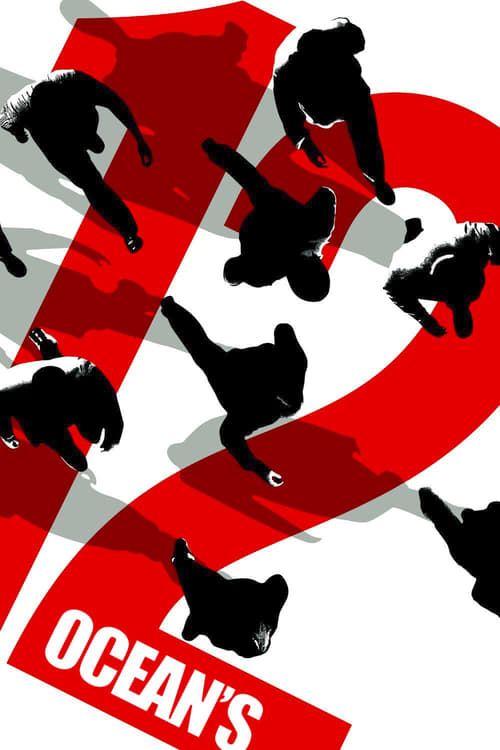
Ocean's Twelve
2004 · Steven Soderbergh
For a low-stakes evening when you want charm, banter, and beautiful places — a breezy hangout movie to relax into. Best approached in the mood for play rather than a clockwork caper.
What it's about
Three years after robbing Las Vegas of $160 million, Danny Ocean's crew get a visit from the casino owner they fleeced: pay it all back, with interest, or else. Broke and blown, the eleven decamp to Europe — Rome, Amsterdam, Lake Como — to pull new jobs, only to find a flamboyant rival master thief challenging them to a contest and a sharp Europol detective, with history inside the crew, closing in.
The experience
Loose, sunny, and playfully self-amused — less a tight heist machine than a hangout with movie stars riffing across postcard Europe. It zigs where you expect it to zag, and it's happiest when it's goofing off.
Performances
The pleasure is the ensemble — George Clooney, Brad Pitt, Julia Roberts, Matt Damon and company trading rhythms like a jazz band — with Vincent Cassel a delight as the preening rival thief.
The craft
Steven Soderbergh shoots Europe in warm, sun-flared, telephoto style and edits with a jazzy, digressive swing, turning a blockbuster sequel into something closer to a stylish lark about celebrity itself. David Holmes's grooving score does a lot of the lifting — it's a great-sounding film.
Why it matters
Divisive on release for refusing to simply repeat its hit predecessor, it has since been reclaimed as one of the boldest big-budget experiments of its era — a star-stuffed studio movie that plays like an in-joke about star-stuffed studio movies.
Snapshot
Ocean's Twelve is the sequel Steven Soderbergh made to his 2001 hit Ocean's Eleven, and it is among the strangest objects ever produced at this level of studio expenditure and star wattage: a $100-million-plus caper film that seems actively uninterested in being a satisfying caper. Reassembling virtually the entire ensemble — George Clooney, Brad Pitt, Matt Damon, Julia Roberts, Don Cheadle, Andy Garcia, Bernie Mac, Casey Affleck, Scott Caan, Carl Reiner, Elliott Gould — and adding Catherine Zeta-Jones as a Europol detective and Vincent Cassel as a rival master thief, the film displaces the franchise from neon Las Vegas to a sun-warmed, telephoto-flattened Europe of Rome, Amsterdam, and Lake Como. Where the first film was a frictionless machine, Twelve is a self-aware, digressive, in-joke-laden movie about celebrity, leisure, and the artifice of the heist genre itself — culminating in the now-notorious gag of Julia Roberts's character impersonating Julia Roberts. It divided critics sharply on release and remains the franchise's most contested entry, but it is also, of the three Clooney-era Ocean's films, the one most legibly authored by Soderbergh as a New Wave-besotted formal experiment smuggled inside a blockbuster.
Industry & production
The film was produced under Soderbergh and Clooney's Section Eight banner with veteran producer Jerry Weintraub, for Warner Bros. in association with Village Roadshow — the same configuration that had made Ocean's Eleven a substantial worldwide success and a franchise-launching property. The sequel's existence was less a planned continuation than an opportunity seized: the original was lucrative enough, and the cast's collective goodwill strong enough, that a reunion became feasible. The screenplay was written by George Nolfi (who would go on to script The Bourne Ultimatum and direct The Adjustment Bureau); the record indicates Nolfi's script was an existing heist project subsequently retrofitted to the Ocean's characters, which helps explain the film's slightly grafted-on quality and its center of gravity around the new European thief Toulour rather than the established crew.
Production took the company to genuine European locations — Rome, Amsterdam, Sicily, Monte Carlo, and the shores of Lake Como, near Clooney's own Villa Oleandra — and the shoot has been widely described, by the participants themselves, as something close to a paid working holiday for a group of friends. That atmosphere is not incidental gossip; it is arguably the film's true subject and its aesthetic, a movie about movie stars enjoying Europe that knows it is one. Released by Warner Bros. in December 2004, it performed strongly at the global box office despite middling reviews — grossing well over $300 million worldwide, with the bulk of that coming from international markets — confirming that star-driven brand sequels could absorb critical skepticism. A third film, Ocean's Thirteen (2007), course-corrected back toward Vegas and conventional caper mechanics, implicitly conceding that Twelve had strayed.
Technology
Ocean's Twelve is a photochemical film of the mid-2000s, shot on 35mm at a moment just before digital capture overtook studio production — and notably before Soderbergh himself became one of digital cinema's loudest evangelists later in the decade. Its technological signature is therefore not a tool but a method: Soderbergh's preference for small, fast, mobile crews and available or minimally augmented light, which let him move quickly through European locations and shoot in a loose, semi-documentary register. The reliance on long telephoto lenses, handheld operating, and heavy in-camera and post color treatment is a craft strategy rather than a hardware story. The one overtly "technological" set piece — Cassel's Toulour navigating a laser grid through a capoeira-like dance — is achieved as physical performance and staging rather than effects spectacle, in keeping with the film's general preference for analog wit over digital bombast.
Technique
Cinematography
Soderbergh shot the film himself, credited under his customary cinematographer pseudonym Peter Andrews. The look is a deliberate pastiche of late-1960s and 1970s European crime cinema: long lenses that compress space and isolate faces against softened backgrounds, restless handheld framing, sudden zooms and rack focuses, and aggressive color filtration that assigns near-monochrome palettes to locations — ambers and golds, sickly greens, cool blues — so that geography reads as mood. This is the same painterly, location-coded grading Soderbergh had pushed in Traffic (2000), here repurposed for pleasure rather than dread. The cumulative effect is to make the image itself feel like a quotation, a knowing evocation of Euro-thrillers and nouvelle vague travelogues.
Editing
Soderbergh also cut the film himself under his editing alias Mary Ann Bernard. The editing is the film's most divisive element: elliptical, fragmentary, fond of jump cuts, freeze frames, chapter-like intertitles, and withheld information. Crucial plot mechanics are deliberately elided and only retroactively explained, most flagrantly in the climactic reveal that the crew's apparent defeat was an elaborate long con executed off-screen. To detractors this is narrative bad faith — a heist film that refuses to show the heist. To admirers it is the point: an editorial structure modeled on the playful unreliability of the French New Wave, prioritizing rhythm, surprise, and texture over the clockwork legibility the genre conventionally promises.
Mise-en-scène / staging
The staging trades the first film's hermetic casino interiors for open, light-flooded European exteriors and the relaxed body language of vacationing stars. Compositions favor groups in conversation, the choreography of an ensemble at ease, and locations treated as objects of touristic delight. The production design and wardrobe lean into a continental, jet-set elegance. The film's most discussed staged sequence is the self-reflexive scene in which Roberts's Tess masquerades as the real Julia Roberts — staging celebrity itself as a heist tool, with Bruce Willis appearing as himself to complete the hall-of-mirrors gag.
Sound
David Holmes returned as composer, and his contribution is central to the film's identity. Holmes supplies an eclectic, groove-driven score steeped in European library music, lounge, funk, and 60s/70s soundtrack idioms, so that the music continuously evokes the vintage Euro-crime films the visuals are quoting. The soundtrack functions less as underscore than as a stylistic argument, knitting disparate locations into a single cool, retro mood. Dialogue is recorded and mixed for naturalistic overlap and throwaway wit, in keeping with the loose performance register.
Performance
Performance here is closer to hangout comedy than thriller acting. Clooney and Pitt play variations on their own star personas with self-deprecating ease; the script even jokes about Danny Ocean looking older. The ensemble's pleasure in one another's company is the film's emotional engine, and the looseness is calculated. Against this, Cassel brings genuine physical bravura as the Night Fox, and Zeta-Jones supplies a note of romantic-procedural friction as the Europol agent entangled with Pitt's Rusty. Roberts's meta-performance — a movie star playing a character playing that same movie star — is the film's boldest acting conceit, and one's tolerance for it largely determines one's tolerance for the film.
Narrative & dramatic mode
The plot's engine is debt: Andy Garcia's vengeful casino owner Terry Benedict tracks down each member of the crew and demands repayment of the stolen $160 million with interest, forcing the gang back into action across Europe, where they tangle with a rival thief, the Night Fox, and a relentless Europol detective. But the narrative mode is not really suspense; it is play. Information is systematically withheld and reordered, motivations are obscured, and the film repeatedly substitutes banter and digression for the procedural build-up the genre expects. The dramatic stakes are deliberately deflated by the climactic revelation that the heroes were never in real jeopardy — that the entire apparent failure was a con run on the audience as much as on the antagonist. This is a comedy of misdirection whose ultimate trick is structural: it withholds the very pleasures it pretends to set up, asking the viewer to find satisfaction in style, company, and the gag of the con rather than in earned tension.
Genre & cycle
Ocean's Twelve sits within the heist/caper tradition but pointedly at its meta-reflexive edge. The franchise descends from the Rat Pack Ocean's 11 (1960), and the caper genre's lineage runs through Rififi (1955), Topkapi (1964), The Thomas Crown Affair (1968), and the British comedies of grand theft. Soderbergh's first film honored the form's clockwork; the sequel deconstructs it. By foregrounding rival-thief one-upmanship, European glamour, and the artifice of the genre, Twelve belongs to the self-aware, star-ensemble caper cycle of the 2000s while simultaneously commenting on it. It is a caper about capers — and about the celebrity machinery that makes a caper bankable.
Authorship & method
This is unmistakably a Soderbergh film, and its authorship is literal: he directed, photographed (as Peter Andrews), and edited (as Mary Ann Bernard) it, exercising near-total control over its image and rhythm. The dual pseudonyms are not mere whimsy; they signal a one-person craft operation operating inside a studio tentpole. His key collaborators form a recognizable repertory: composer David Holmes, whose Euro-cool scoring is integral to all three Clooney-era Ocean's films; producer Jerry Weintraub, the showman who shepherded the franchise; and writer George Nolfi, whose pre-existing thriller script gave the sequel its unusual structure. Above all, the film is the product of Soderbergh's career-long oscillation between commercial entertainments and formal experiments — and Twelve is the rare case where he ran both modes simultaneously, using a blockbuster's resources to indulge nouvelle vague impulses. The result reads as a director using a hit franchise as a sketchpad.
Movement / national cinema
The film is American studio cinema in financing and stars, but its aesthetic allegiance is European. It self-consciously channels the French New Wave (jump cuts, freeze frames, playful intertitles, a fondness for digression and quotation) and the broader idiom of 1960s–70s continental crime and lifestyle cinema. The choice of Rome, Amsterdam, Sicily, and Lake Como is both narrative and cultural: the film positions itself as an American homage to a European art-and-genre tradition, a Hollywood ensemble vacationing inside the iconography of European movies. In this sense it is a transatlantic hybrid, mainstream in its body and art-house in its mannerisms.
Era / period
Released in December 2004, the film is a document of a specific mid-2000s studio moment: the high noon of the star-driven brand sequel, when an A-list ensemble and a recognizable franchise could greenlight an expensive picture on charisma alone. It arrives just before digital capture and franchise universe-building reshaped the industry, and it captures a particular flavor of post-millennial celebrity culture — the era of the magazine-cover movie star as global brand. Its meta-jokes about fame, paparazzi, and the public personas of Roberts and Willis are very much of their time, and read now as a knowing snapshot of mid-2000s celebrity self-awareness.
Themes
Beneath the caper plot, the film's persistent concerns are celebrity, performance, and identity-as-disguise. Nearly every character is playing a role — thieves posing as tourists, a star posing as herself, a detective who is also a daughter and a lover — and the film treats identity as the ultimate con. A second theme is leisure and friendship: the movie is openly about the pleasure of a group of talented people working together, and it elevates camaraderie above plot. A third is artifice itself — the film continually draws attention to its own constructedness, asking whether style and company can be sufficient reasons for a movie to exist. Its answer, defiantly, is yes, even as it acknowledges the audience it may lose by saying so.
Reception, canon & influence
Critical reception was notably divided and, on balance, cooler than for Ocean's Eleven. A significant body of reviewers found the film smug, self-indulgent, and willfully convoluted — a movie more interested in its own cleverness and its stars' enjoyment than in the audience's — with the Julia-Roberts-as-Julia-Roberts conceit serving as the flashpoint for these complaints. A smaller but committed group defended it precisely as a daring formal experiment, a New Wave riff that used blockbuster capital to do something genuinely odd. That split has hardened into the film's critical identity: it is the Ocean's entry that cinephiles either champion as the most interesting or dismiss as the most exasperating. Commercially it nonetheless succeeded, earning the franchise its third installment.
Its influences run backward to the Rat Pack original, to the European caper and crime traditions it quotes, and to the French New Wave whose editorial grammar it borrows; Soderbergh's own Out of Sight (1998) and Traffic (2000) are the proximate sources of its tone and color strategy. Forward, its legacy is more about the franchise and the mode than about direct imitation: Ocean's Thirteen explicitly retreated from its experiments, and the later Ocean's 8 (2018) extended the brand without its formal daring — which paradoxically isolates Twelve as the franchise's one true authorial detour. Among Soderbergh admirers it has undergone a measured critical reappraisal as a bold, divisive object, valued exactly for the qualities that alienated mainstream audiences on release: its refusal of genre obligation, its surrender to style, and its conviction that a heist movie could be, above all, about the pleasure of making one.
A Deleuzian reading
Start with the gag everyone remembers, the one people still cite as the moment the movie either won them or lost them: Julia Roberts's Tess walks through Rome pretending to be Julia Roberts.
The full Deleuzian reading of Ocean's Twelve →
Reception
Dismissed in 2004 as a smug, self-indulgent vacation movie the cast made for themselves, it's since been dramatically reappraised — a generation of critics and Letterboxd users now argue it's the most interesting film in the trilogy, the loose, jazzy one that was ahead of its audience.
How Ocean's Twelve was received, from release to now →
Influences: the films it descends from and the films it influenced
- Ocean's Eleven (2001) — Direct parent: establishes the self-operated craft unit (Soderbergh shooting as Peter Andrews, cutting as Mary Ann Bernard) plus David Holmes's Euro-lounge scoring and the loose hangout-ensemble blocking that Twelve inherits wholesale.
- How to Steal a Million (1966) — Extends both halves of the template — the laser-grid crossing as balletic set piece, and a con whose punchline is that the forgery was substituted before the heist began, so the theft the audience watched was decorative and authenticity was never at stake.
- Out of Sight (1998) — Source of the time-fractured, freeze-and-elide editing grammar and sun-flared telephoto intimacy that Soderbergh later folds into Twelve's withheld, non-linear heist construction.
- Traffic (2000) — Origin of the location-coded color strategy — assigning each city its own filtered palette/grade — which Twelve borrows to color-tag its European capitals.
- The Limey (1999) — Sibling experiment in associative, radically elided cutting where dialogue floats free of its image; the structural cousin to Twelve's elided-heist editing.
- Breathless (1960) — Ancestor of the jump-cut as a rhythmic, continuity-breaking device that Twelve deploys to flaunt its New Wave editorial debt.
- Band of Outsiders (1964) — Template for New Wave hangout-comedy crime — characters loitering and goofing between the mechanics of a caper, tone privileged over plot.
- Rififi (1955) — Founding model of the wordless, procedurally elided heist set-piece whose grammar of patient method-withholding Twelve inherits and then scrambles.
- Topkapi (1964) — Direct grandparent of the suspended-body gadget heist — the dangle-above-the-sensor acrobatic theft that Twelve restages as the laser-grid capoeira sequence.
- Charade (1963) — Ancestor of the glossy European caper built on shifting aliases and identity-as-disguise, romance braided through the con.
- The Thomas Crown Affair (1968) — Establishes the cool, design-forward gentleman-thief heist — jazzy scoring and style-as-subject — that Twelve treats as its mode rather than as suspense.
- The Sting (1973) — Ancestor of the meta-con structured to deceive the audience itself, withholding the real grift until a chaptered reveal — Twelve's misdirection-con architecture.
- Ocean's Thirteen (2007) — Descendant that explicitly retreats from Twelve's formal play, reverting to clean, linear Vegas heist mechanics while keeping the Andrews/Bernard/Holmes craft team.
- Ocean's 8 (2018) — Descendant that extends the brand's ensemble-caper template but drops the one-person self-shot/self-cut authorship, isolating Twelve as the franchise's formal outlier.
Similar films
- Ocean's Eleven (2001) — influence & lineage · often watched together
- Ocean's Thirteen (2007) — influence & lineage
- Out of Sight (1998) — influence & lineage
- Inside Man (2006) — influence & lineage
- Rififi (1955) — influence & lineage
- Heat (1995) — often watched together
- Casino (1995) — often watched together
- The Departed (2006) — often watched together