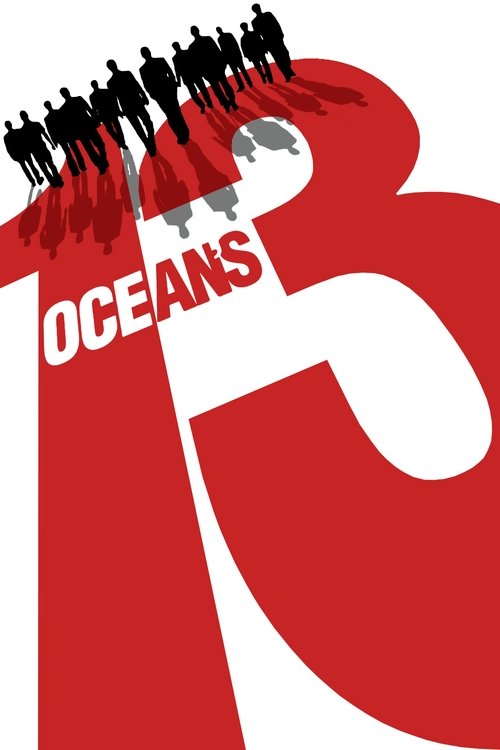
Ocean's Thirteen
2007 · Steven Soderbergh
For a low-stakes, high-style night when you want to hang out with the most charming people in the room — pure comfort viewing with a fizzy, up-tempo finish.
What it's about
When ruthless casino magnate Willy Bank swindles their beloved friend Reuben into a hospital bed, Danny Ocean reassembles his entire crew for a job that's about revenge, not money: rig Bank's brand-new Las Vegas casino to lose catastrophically on its opening night. The plan is so audacious they even have to go hat-in-hand to an old enemy to finance it.
The experience
Breezy, funny, and effortlessly cool — less a nail-biter than the pleasure of watching charming professionals run an elaborate machine while trading deadpan banter. It hums along at a confident clip and never asks you to sweat.
Performances
George Clooney and Brad Pitt have their double act down to a science of half-finished sentences and knowing looks, Al Pacino makes a deliciously vain villain, and Elliott Gould gives the film its unexpectedly warm heart as the wounded Reuben.
The craft
Steven Soderbergh shoots it himself in saturated candy colors — Vegas as a neon jewelry box — with playful split screens and a jazzy, retro-lounge score that keeps everything swinging. The screenplay's real craft is procedural: a dozen moving parts and a huge ensemble, all kept legible and light.
Why it matters
Received as a return to form that closed out the trilogy on a warm note, it stands as the modern benchmark for the star-packed ensemble caper and a late monument to old-school movie-star charisma.
Snapshot
Ocean's Thirteen is the concluding chapter of Steven Soderbergh's Ocean's trilogy — a high-gloss, ensemble caper film in which Danny Ocean (George Clooney) mobilizes his full crew to destroy the casino empire of Willy Bank (Al Pacino) after Bank swindles and nearly kills their friend Reuben Tishkoff (Elliott Gould). Produced by Jerry Weintraub for Warner Bros. and Village Roadshow Pictures, the film was widely received as a recovery of form after the comparatively chilly Ocean's Twelve (2004), returning the series to the Las Vegas milieu and the fraternal warmth that made Ocean's Eleven (2001) a mainstream phenomenon. More interested in procedural elegance and ensemble comedy than in genuine suspense, it sits at the confluence of the classical Hollywood caper tradition, the Rat Pack mythology that underlines the whole franchise, and Soderbergh's persistent formal curiosity about systems — how they are built, how they fail, and who profits from their failure.
Industry & production
The trilogy was a calculated revival of a brand long dormant. Lewis Milestone's original Ocean's 11 (1960) was less a tightly plotted heist film than a vehicle for the Rat Pack — Frank Sinatra, Dean Martin, Sammy Davis Jr., Peter Lawford, and Joey Bishop — whose collective persona was the real commodity. Jerry Weintraub, producer of the original, shepherded the 2001 remake and both sequels, providing continuity of commercial intention. Ocean's Thirteen was assembled with the explicit goal of returning to what worked in the first film: Las Vegas, the full ensemble, and a villain the audience could enjoy hating.
The production negotiated a characteristic late-studio-era challenge: assembling a cast whose collective fees would otherwise be prohibitive. Reported accounts — difficult to verify with precision — suggest that several principals accepted reduced upfront compensation in exchange for backend participation, a structure that suited Soderbergh's preference for keeping productions lean and retaining creative control. Warner Bros. and Village Roadshow had by this point developed a reliable working relationship with Soderbergh's Section Eight production company (co-founded with Clooney), and the franchise's proven commercial record gave the production unusual latitude.
Brian Koppelman and David Levien, who had written Rounders (1998), crafted the screenplay. Their script introduced Al Pacino as Willy Bank — a casino mogul of operatic self-regard — and Ellen Barkin as his formidable chief of staff, Abigail Sponder. The screenplay's structural conceit is particularly clean: the crew is not stealing money but engineering catastrophe, rigging Bank's new casino opening so that every system fails simultaneously. This shifts the film's dramatic pleasure from tension toward orchestral inevitability.
Jerry Weintraub's death in 2015 effectively closed the door on a fourth Ocean's film in this configuration, though the franchise continued with Gary Ross's Ocean's Eight (2018), which transplanted the ensemble model onto a predominantly female cast.
Technology
Soderbergh has shot under the cinematographer pseudonym Peter Andrews since Traffic (2000), and Ocean's Thirteen continues his sustained engagement with the digital intermediate process. The DI suite allowed him to push the trilogy's established visual grammar further: the casinos of Las Vegas are rendered in dense amber and gold, a saturated warmth that codes the space as simultaneously seductive and artificial, while the film's few exterior and travel sequences employ slightly cooler, more neutral tones that register as the "real" world against which the casino's hermetic theatricality is measured.
Soderbergh had been an early and vocal advocate of digital acquisition, shooting Bubble (2005) on the Sony CineAlta HD system. Whether Ocean's Thirteen was acquired entirely on film or incorporated digital elements is not definitively established in the public record; what is clear is that the DI grading work is decisive in shaping the film's visual identity. The color separation between interiors and exteriors, between day and night, and between different narrative threads is managed with a precision that would have been more cumbersome in a photochemical workflow.
The film also deploys a suite of period-appropriate surveillance-camera aesthetics — low-resolution inserts, fisheye lenses, skewed angles — that had become standard vocabulary in the post-Ocean's Eleven heist film. These inserts are less innovative than they were in the 2001 film but remain functional as a way of fragmenting space and implying the casino as a total surveillance environment that the crew must learn to inhabit and ultimately override.
Technique
Cinematography
As Peter Andrews, Soderbergh operates with a mobile, often handheld camera that favors proximity to actors rather than architectural distance. The Las Vegas casino floor — an environment designed to disorient and overwhelm — is handled with unusual spatial coherence; Soderbergh's framing tends to isolate characters within the crowd, producing a paradoxical sense of privacy within spectacle. Lens choices across the trilogy lean wide-to-normal, avoiding the telephoto compression associated with surveillance or alienation in favor of a more immediate, conspiratorial intimacy.
The film's palette acknowledges its Vegas antecedents — the warm tungsten interiors of old casino photography — while pushing saturation to a degree that tips from realism toward heightened stylization. This is consistent with the trilogy's self-conscious relationship to genre: the films know they are fantasies and dress accordingly.
Editing
Soderbergh edits under the pseudonym Mary Ann Bernard, a practice that keeps the directorial vision fully integrated through post-production. The editing of Ocean's Thirteen is rapid in the classic caper tradition — rhythmically confident, organized around parallel action — but rarely aggressive. The film eschews the puzzle-cutting that made Ocean's Eleven a formal exercise in favor of a more relaxed, comedic tempo. The intercut sequences during the casino's opening night, when all the heist's moving parts converge, achieve a satisfying contrapuntal density without becoming genuinely disorienting.
Mise-en-scène / staging
The film's staging is consistently alert to hierarchy and geometry. Bank's casino spaces are designed (production design by Philip Messina, a Soderbergh regular) as environments of control — high ceilings, clear sightlines, a panopticon logic that the crew must systematically subvert. Soderbergh stages the crew's interactions as a counterpoint to this: loose, informal, occupying corners and service corridors, the geography of the institution's blind spots.
The casting of Pacino introduces a theatrical energy that Soderbergh calibrates carefully. Where Pacino might easily overturn the film's cool register, Soderbergh keeps his set-pieces tightly bracketed, using Barkin as a grounding foil and resisting the temptation to give Bank scenery-chewing close-ups until the film has earned them.
Sound
David Holmes composed the scores for all three Ocean's films, and his work on Thirteen is a study in franchise continuity modulated by minor variation. His signature blend of lounge jazz, funk, and electronic texture — decisively associated with Ocean's Eleven — returns with additional orchestral weight appropriate to the film's slightly grander stakes. Holmes's music functions as the films' emotional weather system: where the score swells, the audience is invited to feel pleasure in the crew's competence; where it recedes, something has gone wrong. This is not subtle scoring, but it is precise in its function.
The film's sound design deploys the casino floor's ambient noise — slot machines, chips, ventilation — as a continuous presence that the crew's whispered communications must pierce. The contrast between this sonic mass and the intimate clarity of the crew's earpiece conversations is a recurring structural device.
Performance
The ensemble's particular achievement is calibrating individual performance registers so that the group reads as a coherent whole despite radical stylistic differences. Clooney anchors with effortless classical ease; Pitt's Rusty perpetually eating is a running gag that has, by the third film, become characterological shorthand; Damon's Linus is given the most substantial individual arc, negotiating a complicated sexual con involving Barkin's Sponder. The Malloy brothers (Casey Affleck, Scott Caan) are dispatched to a dice factory in Mexico in a subplot that riffs on Norma Rae (1979) — the workers organize a strike, the brothers find themselves emotionally invested — and the tonal incongruity is played entirely straight, with a deadpan commitment that makes it one of the film's genuinely strange pleasures.
Pacino's Bank is among the more self-aware villain performances of his late career: he plays the character's vanity and cruelty not with psychological depth but with the logic of the comedic antagonist, giving the film a figure whose humiliation the audience can desire without ambivalence.
Narrative & dramatic mode
Ocean's Thirteen operates in the mode of the "caper comedy" rather than the thriller: suspense is deliberately defused by the film's evident confidence in its own outcome. The audience is never seriously made to fear that the crew will fail; pleasure derives instead from witnessing the elegance of the plan's execution and the calibrated revelation of elements that were invisible in earlier sequences. This is the "howdunit" structure — not whodunit or whydunit, but the step-by-step unfolding of a mechanism already set in motion.
The film distinguishes itself from its predecessors by grounding its heist in personal loyalty rather than professional ambition or financial gain. The crew is not stealing money — they already have money. They are defending a friend and, by extension, upholding a code that the film treats as genuinely honorable. This ethical framing gives the caper structure an unusual emotional grounding: the heist is an act of fidelity.
The one formal complication — the crew's reluctant alliance with Terry Benedict (Andy Garcia), their antagonist from Ocean's Eleven — adds a layer of strategic irony without resolving into genuine dramatic tension. The film is comfortable with a moral calculus in which enemies can temporarily cooperate, and it treats this pragmatism as sophistication rather than corruption.
Genre & cycle
Ocean's Thirteen belongs to a specific cluster of 2000s heist films that together constitute a genuine genre revival. Following the critical and commercial success of Ocean's Eleven, the heist film — which had been in relative dormancy since the 1970s cycle associated with The Sting (1973) and its imitators — re-emerged as a prestige entertainment format. Films including The Italian Job (2003), Inside Man (2006), and The Bank Job (2008) all drew from the template that Ocean's Eleven helped re-establish: the ensemble cast, the procedural pleasure, the ethical framing through a sympathetic crew, and the villain as institutional power rather than individual malice.
Within the trilogy, Ocean's Thirteen represents the most generic iteration — the least formally experimental, the most willing to deliver exactly what the audience expects. This is not a failure but a specific accomplishment: the film succeeds precisely because it does not repeat the formal gambits of Ocean's Eleven or the European-inflected puzzlework of Ocean's Twelve. It returns, knowingly, to the pleasures of the original, and executes them with professional assurance.
The Rat Pack mythology remains structurally present. The trilogy's implicit conceit is that the ensemble itself — not the characters but the actors — constitutes a latter-day equivalent of the Sinatra circle: a cohort of famous men who enjoy one another's company and whose mutual ease is the real spectacle. This mythology was both the franchise's primary asset and a limitation, circumscribing its emotional range.
Authorship & method
Soderbergh's authorship of Ocean's Thirteen is characteristic of his broader practice: total control of the image chain (writing, directing, shooting, editing) combined with a deliberate stylistic subordination to genre, in which his formal choices serve the film's pleasures rather than announcing themselves as commentary. This distinguishes him from auteurs who use genre as a vehicle for personal expression and aligns him more closely with the classical Hollywood craftsman model — though his awareness of that model is thoroughly post-classical.
Koppelman and Levien's contribution as screenwriters is significant but difficult to isolate from Soderbergh's directorial presence. Their Rounders background gave them a functional understanding of how gambling environments create character — the behavioral codes, the ethics of the professional — and this informs the screenplay's confident use of procedural detail.
Philip Messina's production design is a consistent asset across the trilogy, creating casino spaces that are simultaneously specific and archetypal. David Holmes's score, discussed above, functions as a collaborator equal to any of the department heads.
Soderbergh's method on the Ocean's films was reportedly relaxed by the standards of his more demanding projects: the productions were well-resourced, the cast was experienced, and the material did not require the on-set experimentation of, say, The Girlfriend Experience (2009) or Bubble. This is reflected in a certain frictionless quality in the finished films — a sense that the machinery is running smoothly, without the productive tension of difficulty.
Movement / national cinema
Ocean's Thirteen is American studio cinema operating in one of its most comfortable registers: the prestige entertainment, high-budget, star-driven, competently made, and designed for broad international appeal. It participates in no national cinema movement in any meaningful sense and would resist being claimed by one. Its cultural geography is specifically Las Vegas — a space that is at once hyperbolically American and strangely placeless, a zone of fantasy outside the ordinary jurisdictions of geography or history.
The film's brief Mexican interlude (the dice factory subplot) introduces a non-American space that the film treats with affectionate comedy but not analytical depth. The workers' strike is used as plot mechanism and gag rather than political statement, and the film does not appear to intend otherwise.
Era / period
Ocean's Thirteen appeared in 2007, late in the long cycle of mid-2000s franchise filmmaking that the first decade of the new century consolidated as the dominant Hollywood commercial model. The film predates the full marketization of the cinematic universe concept — that would accelerate dramatically with Iron Man in 2008 — but participates in the franchise logic that the MCU would eventually systematize. The Ocean's trilogy demonstrated that a film built around cast chemistry and genre pleasure could sustain sequels without superhero IP, though the franchise did not ultimately survive the loss of its specific ensemble.
The film also appears in the context of Soderbergh's most prolific decade. Between 2000 and 2009, Soderbergh released Traffic, Solaris, the first two Ocean's films, Bubble, The Good German, and Che — a range of scale, genre, and ambition unusual in contemporary American cinema. Ocean's Thirteen is the most commercially calculating of this group and is best understood in relation to that larger project: a deliberately populist entry in a body of work otherwise committed to formal risk.
Themes
The film's governing theme is loyalty — not romantic loyalty but the fraternal loyalty of a professional cohort, the code of men who have chosen one another as obligations. Reuben's betrayal by Bank, and the crew's response to it, is treated as a matter of honor in the pre-modern sense: an offense against the group's collective identity that must be answered regardless of practical benefit. The crew gains nothing financially from their revenge; the film treats this as a sign of their virtue.
Running parallel is a sustained meditation on Las Vegas as a machine for the extraction of human hope. Bank's casino is presented as the apotheosis of a system designed to take money from those who believe, against all probability, that they can win. The crew's intervention — rigging the systems so that the house loses — is framed as a small, temporary correction to this order, a redistribution that the film refuses to sentimentalize. The gamblers who win on opening night will lose their winnings to other casinos; the crew knows this and acts anyway. There is a mild melancholy beneath the film's high-gloss surface that its comedic mode holds at a careful distance.
The question of institutional versus individual power recurs across Soderbergh's work — Traffic, Erin Brockovich, Contagion — and Ocean's Thirteen participates in this preoccupation. Bank is not simply a bad man but a bad system: his hotel is a mechanism that rewards the ruthless and punishes loyalty. The crew's victory is meaningful because it defeats the system rather than merely the man.
Reception, canon & influence
Ocean's Thirteen received broadly positive reviews upon release, with critics consistently noting its superiority to Ocean's Twelve and its willingness to deliver the pleasures that its audience sought. The critical consensus — difficult to summarize more precisely without citing specific reviews — was that the film was professionally accomplished genre entertainment that made no larger claims on the viewer's attention than it intended to fulfill. It was praised for Pacino's casting, the restored ensemble warmth, and the return to Las Vegas.
Commercially, the film performed solidly at the global box office, sustaining the franchise's viability if not dramatically exceeding it. Precise figures from different markets are available in industry records; the film was not a phenomenon on the scale of the first installment but confirmed the trilogy's durability as a commercial property.
The film's debts to prior cinema are legible at the surface. Milestone's Ocean's 11 provides not a structural template but a mythological one — the Rat Pack ethos, the Las Vegas milieu, the idea that men of a certain charisma can treat the casino as their private playground. The Sting (1973), with its period-dress, con-within-con structure, and gleeful audience manipulation, is a more immediate formal ancestor. Soderbergh has cited various French New Wave influences on his overall aesthetic — the Godardian interest in genre as quotation, the Truffaut warmth for characters — and these inform the trilogy's self-consciousness about its own pleasures, though they are not visibly thematized in Ocean's Thirteen specifically.
Looking forward, Ocean's Thirteen's influence is felt primarily through franchise structure rather than formal innovation. It demonstrated that a heist ensemble could sustain a trilogy while remaining stylistically consistent, and its model of the "closing chapter" — returning to origins, resolving the emotional stakes of the series, giving each character a concluding moment — was legible enough to be followed, consciously or not, by subsequent ensemble franchise entries. Ocean's Eight drew most directly on its visual and tonal vocabulary while reconstituting the cast entirely.
Within Soderbergh's own filmography, the Ocean's films occupy a deliberately populist position that he has consistently described as a form of professional pleasure rather than artistic ambition — films he wanted to make because he enjoyed making them, whose success underwrote the more difficult projects. Understanding Ocean's Thirteen as an act of professional generosity — entertainment offered on the audience's own terms, made with full craft and without condescension — may be the most accurate account of what it is.
A Deleuzian reading
The casino floor glows amber and gold, the color of old Vegas postcards pushed one notch past plausible, and somewhere in that roar of slot machines a member of Danny Ocean's crew is standing perfectly still, murmuring into an earpiece.
The full Deleuzian reading of Ocean's Thirteen →
Reception
Greeted in 2007 as the safe, crowd-pleasing apology for the divisive Ocean's Twelve — fun, forgettable, third-best of three. The twist since: as Twelve got reappraised as the secret masterpiece, Thirteen settled into 'the comfortable one,' the trilogy's easy rewatch rather than its conversation piece.
How Ocean's Thirteen was received, from release to now →
Influences: the films it descends from and the films it influenced
- Ocean's 11 (1960) — The Rat Pack's real-world lounge mythology — Sinatra's Vegas residency, the Sands performances — is imported as diegetic texture, establishing the model whereby the ensemble's offscreen collective identity is the film's primary commodity and the heist is secondary spectacle.
- Bob le Flambeur (1956) — A retired gambler's loyalty to a surrogate community motivates an ambitious casino heist, encoding loyalty-as-heist-motive directly into the genre's DNA; Melville's cool jazz underscoring of criminal milieu establishes the lounge-score register Ocean's inherits.
- Rififi (1955) — The howdunit structural template: the heist sequence is rendered in near-silence and real-time procedural detail, making methodology revelation the dramatic engine rather than withholding the how — a principle Ocean's Thirteen extends by making the methodology visible from the outset.
- Topkapi (1964) — Establishes the caper-comedy ensemble model in which a comedically overmatched outsider (Peter Ustinov's amateur fence) serves as tonal ballast against heist mechanics, prefiguring the comedic-antagonist calibration that Al Pacino's Willy Bank occupies.
- The Sting (1973) — Encodes loyalty-as-revenge-motive as the caper's structural engine (the mark killed Hooker's friend Luther), uses parallel-action editing to choreograph simultaneous con operations toward a single climax, and deploys period score (Joplin ragtime) as tonal register rather than dramatic underscore.
- Sneakers (1992) — Frames the panopticon — a total surveillance architecture that must be penetrated and overridden — as the heist's primary antagonist rather than a human villain, and builds ensemble calibration around a team of specialists whose distinct competencies must interlock precisely, a model Ocean's Thirteen adopts wholesale.
- Out of Sight (1998) — Soderbergh's proto-Peter Andrews style: DI warm palette for seductive interior sequences, handheld proximity to actors rather than architectural framing, and comedic calibration of genre-thriller material — the technical and tonal vocabulary he carries directly into the Ocean's trilogy.
- The Thomas Crown Affair (1999) — The immediate heist-revival precursor: split-screen parallel editing during the museum heist choreographs simultaneous operations as aesthetic spectacle, and the warm-saturated palette of luxury interiors codes the caper as pleasurable fantasy rather than social critique.
- Ocean's Eleven (2001) — Direct formal parent: establishes the surveillance-insert vocabulary (fisheye inserts, low-res CCTV skew), the lounge-jazz score register via David Holmes, the parallel-action howdunit structure, and the ensemble calibration model that Thirteen inherits and refines with a more operatically matched villain.
- The Informant! (2009) — Soderbergh applies the same DI warm-interior palette and howdunit structural revelation to a white-collar crime comedy, inverting the comedic-antagonist mode so the protagonist is himself the unreliable deceiver — extending the franchise's tonal method into a register of comic self-destruction.
- Now You See Me (2013) — Extends the howdunit as the film's primary formal device across a feature length: magic trick sequences are performed for the audience with the methodology withheld and revealed retroactively, using parallel-action editing of simultaneous operations and an ensemble of specialists calibrated for competitive comedic interplay.
- Logan Lucky (2017) — Soderbergh's explicit structural reprise: howdunit heist with ensemble calibration of regional specialists, parallel-action editing choreographing simultaneous operations during the NASCAR race-day sequence, and a country-music score functioning as the tonal register equivalent of Ocean's lounge jazz.
- Ocean's Eight (2018) — Franchise transplant that inherits the formal vocabulary wholesale — surveillance inserts, warm DI palette, parallel-action howdunit, panopticon staging of the Met Gala as the total-observation environment to be overridden — while demonstrating the portability of Soderbergh's ensemble-calibration model to a new milieu and cast configuration.
- Knives Out (2019) — Foregrounds the howdunit as structural conceit by revealing the crime in the first act and shifting dramatic pleasure entirely to the how, with an ensemble of comedic antagonists calibrated against each other and loyalty-as-motive serving as the narrative engine for the protagonist's deceptions.
- Traffic (2000) — Soderbergh as Peter Andrews developing the DI color-as-narrative-strand principle — each storyline assigned a distinct color temperature to mark its world — the same technique Ocean's Thirteen uses to separate the casino's amber hermetic interior from the cooler register of the outside world.
- The Italian Job (2003) — Heist-revival ensemble that uses parallel-action editing to choreograph simultaneous vehicle operations coordinated through surveillance feeds, with ensemble specialists calibrated for comedic interplay — a structural and tonal sibling assembled in the wake of Ocean's Eleven's commercial template.
- Ocean's Twelve (2004) — Descendant that explicitly retreats from Twelve's formal play, reverting to clean, linear Vegas heist mechanics while keeping the Andrews/Bernard/Holmes craft team.
Similar films
- Ocean's Eleven (2001) — influence & lineage
- Ocean's Eight (2018) — influence & lineage
- The Sting (1973) — influence & lineage
- Out of Sight (1998) — influence & lineage
- Ocean's Twelve (2004) — shared sensibility
- Casino (1995) — shared sensibility
- The Wolf of Wall Street (2013) — shared sensibility
- American Hustle (2013) — shared sensibility