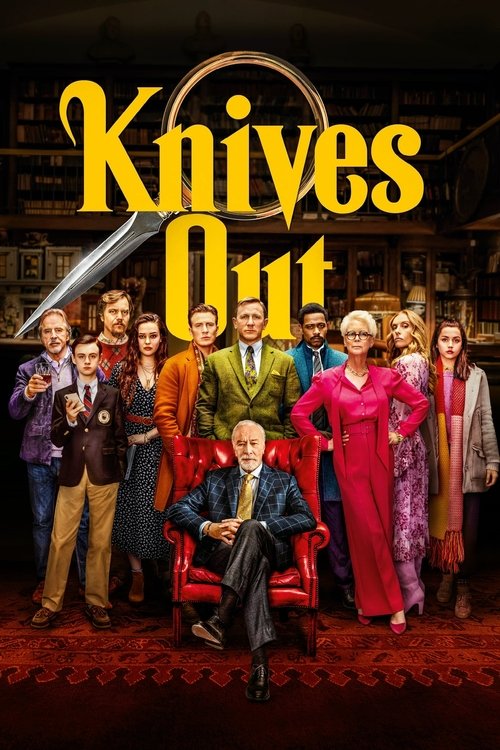
Knives Out
2019 · Rian Johnson
The perfect group-watch or rainy-Sunday movie — for when you want to play armchair detective, laugh, and be completely entertained. Comfort viewing that still respects your intelligence.
What it's about
Harlan Thrombey, a wildly successful crime novelist, is found dead in his gothic mansion the morning after his 85th birthday party — and his sprawling, backbiting family all had reasons to want him gone. Enter Benoit Blanc, a courtly Southern detective hired by an anonymous client, who sifts the household's lies with particular attention to Marta, Harlan's devoted young nurse. It's a classic country-house murder mystery with a very modern axe to grind about money, privilege, and who counts as family.
The experience
Pure pleasure — twisty, laugh-out-loud funny, and paced like a thriller, with a warm streak that sneaks up on you. It keeps pulling the rug without ever cheating, and it's the rare mystery that's as satisfying on the ride as at the reveal.
Performances
Daniel Craig has a blast as Benoit Blanc, deploying a molasses drawl and theatrical flourish that's the polar opposite of his stoic action persona. Ana de Armas is the film's quietly devastating heart, and the ensemble — Jamie Lee Curtis, Chris Evans, Toni Collette, Michael Shannon, Christopher Plummer — is a rogues' gallery of scene-stealers.
The craft
Rian Johnson's screenplay is the star: a clockwork structure that reshuffles the whodunit's rules midway and still plays fair. The mansion is a character in itself — all trophies, portraits, and that ring of knives — and the editing keeps a dense mystery moving like a caper.
Why it matters
An unlikely blockbuster that single-handedly revived the star-studded whodunit and introduced Benoit Blanc, the first major new screen detective in decades — spawning a franchise and a wave of imitators.
Snapshot
A postmodern whodunit that performs a structural sleight of hand: it answers its own central question—who killed Harlan Thrombey?—roughly forty minutes in, then reframes the mystery entirely. The result is less a puzzle film than a film about puzzles, one that uses the architecture of the country-house mystery to stage a contemporary argument about class, immigration, and inherited entitlement. Rian Johnson's sixth feature is at once his most accessible work and among his most formally rigorous. It became an unlikely blockbuster that revived a dormant genre and introduced Benoit Blanc, the first major recurring detective character in prestige American cinema in decades.
Industry & production
Knives Out was developed independently through Johnson's production company T-Street, with Ram Bergman producing—the same partnership that had sustained his career from Brick onward. Lionsgate acquired distribution rights and gave the film a wide theatrical release in November 2019. The choice to work outside a studio system for what was, on paper, a commercial genre picture was deliberate: Johnson had spent two years inside the industrial machinery of Star Wars: The Last Jedi (2017) and wanted to return to a project over which he held complete creative authority, including final cut.
The film was shot almost entirely on location in Massachusetts. The Thrombey estate—architecturally crucial to the film's sense of claustrophobic accumulated wealth—is the Ames Mansion at Borderland State Park in Easton, a late Victorian pile whose interiors and grounds provided the film with its dominant spatial grammar. Additional shooting took place in the greater Boston area. The production's roughly $40 million budget was modest by the standards of the cast assembled: Daniel Craig, Chris Evans, Jamie Lee Curtis, Michael Shannon, Don Johnson, Toni Collette, Ana de Armas, Christopher Plummer, LaKeith Stanfield, and others. The film's worldwide theatrical gross exceeded $300 million—a commercial result that validated the prestige whodunit as a viable theatrical proposition in the streaming era. Netflix subsequently acquired rights to two sequels in a deal reported to be in the range of $450 million, one of the largest acquisition deals for a film series at that time, though the precise terms remain undisclosed by the parties.
Technology
Cinematographer Steve Yedlin, ASC—Johnson's collaborator since Brick—shot the film digitally, continuing a technical practice Yedlin has developed into something approaching a personal philosophy. Yedlin is unusual among working cinematographers for his publicly argued position on digital capture: he has written at length about what he calls "display preparation," the idea that the perceived difference between film and digital is largely a function of how digital images are processed and displayed rather than any intrinsic property of the capture medium. On Knives Out, this manifests in images that feel texturally rich and grain-inflected without affectation—warm, dense interiors that read as materially present rather than clinical. Yedlin's approach resists the over-corrected, hyper-legible quality that can mark prestige digital productions; the film's imagery has weight.
The sound design and scoring pipeline were handled in the conventional Hollywood digital audio workflow, though as discussed below, the scoring philosophy was anything but conventional.
Technique
Cinematography
Yedlin and Johnson organize the film's visual grammar around the Thrombey estate as a labyrinthine container for secrets. The camera moves through the mansion's rooms and corridors with an ease that implies familiarity—the space is presented as already known to the camera before the audience has fully mapped it, mimicking the detective's relationship to a crime scene. Wide lenses keep multiple characters in focus simultaneously, appropriate for an ensemble mystery in which the significance of any figure at any moment is deliberately unstable. The film also makes pointed use of close-ups for moments of disclosure—faces caught in the act of realizing something, or failing to conceal something—and the transitions between these scales of observation are calibrated to withhold and release information in lockstep with the script's structural turns.
Color temperature is used expressively but with restraint. The mansion's interior palette runs to ambers and dark greens, evoking the brownish density of inherited objects, old wood, and the vague miasma of old money. The exterior sequences—particularly those involving Marta Cabrera moving through contemporary Massachusetts—feel comparatively cool and open, a spatial metaphor the film does not overstate.
Editing
Bob Ducsay, who had edited The Last Jedi for Johnson, cut the film. The editing strategy is rooted in classical Hollywood continuity but is selectively disrupted for emphasis. The film's most audacious structural move—the extended flashback that reveals what actually happened the night Harlan died—is presented with a temporal clarity that verges on the didactic, deliberately draining the initial mystery of suspense so that a different dramatic engine (Marta's dread, rather than the audience's puzzlement) can take over. The pacing across the film's three-act structure is uneven in a way that feels considered rather than miscalculated: the second act, in which Marta navigates her predicament, is more languid than the first or third, reflecting the texture of sustained anxiety rather than the kinetics of revelation.
Mise-en-scène / staging
The Thrombey estate does significant work as a mise-en-scène argument. Its rooms are packed with the accumulated objects of a lifetime of success—books, art, taxidermy, antiques—creating a visual environment that is at once welcoming and suffocating. The staging consistently positions the family members as creatures of this environment, comfortable within it in a way that Marta visibly is not; she is a figure who moves through the house but does not belong to it in the way the Thrombeys do. Harlan's private study, the film's key dramatic arena, is staged with particular care: it is a room built for one person's will, and its spatial organization reflects that autocratic logic.
Johnson is a careful director of eyelines and of the geometry of social power. The interrogation sequences—each family member interviewed by Blanc and the police—are staged with a formal symmetry that gradually becomes ironic as each "truthful" account reveals itself to be shaped by self-interest.
Sound
Nathan Johnson—Rian Johnson's cousin, and his primary musical collaborator across his career—composed a score that refuses to behave as genre convention would dictate. Where a conventional whodunit score would be atmospheric and suspenseful, Nathan Johnson's work is playful, at times almost parodically theatrical, leaning into the film's comedic self-awareness. Strings and woodwinds are used in ways that underscore the film's satirical relationship to its own genre machinery—the music signals to the audience that it is in on the joke even when the characters are not. This is a delicate balance; the score risks collapsing into camp but mostly avoids it by maintaining genuine affection for the traditions it is tweaking.
The ambient sound design of the mansion—its creaks, the weather outside, the acoustics of rooms full of objects—is handled with documentary fidelity, grounding the heightened comic-thriller material in physical space.
Performance
The ensemble is calibrated to distinguish between two registers: the Thrombey family members perform in a heightened, borderline-satirical mode appropriate to their function as types (the alt-right troll, the lifestyle influencer, the self-made mythology that turns out to be borrowed), while Marta (Ana de Armas) and Blanc (Daniel Craig) are allowed something closer to interiority. The contrast is structurally meaningful—the family are types in a mystery, while Marta and Blanc are people navigating one.
De Armas's performance is the film's emotional center and its most demanding acting challenge. Marta is reactive for much of the runtime, a character defined by the things she cannot do (lie, abandon her ethics) in a world that runs on both. De Armas makes this passivity active, finding the precise texture of someone who is both morally constrained and resourceful. Craig, meanwhile, performs Blanc as a form of inspired extravagance—the exaggerated Southern accent, the theatrical effusions about the case—while keeping the character's intelligence legible beneath the performance. It is a self-conscious star turn that understands itself as such, and it works because Craig commits fully while never losing Blanc's fundamental acuity.
Narrative & dramatic mode
The film's central structural gambit is its inversion of the whodunit's organizing question. The classical whodunit withholds the solution and builds toward revelation; Knives Out delivers what seems to be the solution—here is what happened, here is why, here is who—and then demonstrates that this apparent revelation is itself incomplete. The remainder of the film is structured around two simultaneous dramatic engines: will Marta's secret be discovered, and what secret is actually left to discover? The answer to the second question, when it arrives, repositions all prior events.
This is a structural move with roots in the "howdunit" format (associated particularly with television's Columbo), in which dramatic irony—the audience knowing more than the investigator—replaces suspense as the primary affective mode. Johnson fuses this with a genuine mystery plot (there is something Marta doesn't know and neither does the audience) to produce a form that is neither pure dramatic irony nor pure mystery but something between them.
Genre & cycle
Knives Out arrives at a particular historical moment in the country-house mystery's fortunes. The subgenre had been dormant as a major theatrical proposition for decades—sustained primarily in British television (the Poirot and Miss Marple adaptations, and their successors) and in occasional literary revivals. Kenneth Branagh's Murder on the Orient Express (2017) had demonstrated that the form could still command a wide audience, but that film hewed closely to Christie fidelity. Johnson's film is more interested in using the genre's furniture to make an argument: the country house as the site of inherited American capital, the family assembled for the reading of the will as a figure for class resentment, the detective as an outsider (Blanc is Southern, eccentric, vaguely European in his affect) who exposes the dysfunction that wealth obscures.
The film belongs to a cycle of prestige ensemble comedies that use generic scaffolding—mystery, thriller—to accommodate social satire. Its nearest relatives include Robert Altman's Gosford Park (2001), from which it borrows the below-stairs/above-stairs dynamic and the ensemble-as-social-specimen methodology, and, further back, the tradition of the screwball comedy-mystery that flourished in 1930s Hollywood. It also inherits from the Agatha Christie tradition more directly: Benoit Blanc is explicitly modeled on Hercule Poirot—the foreign detective, absurdly named, operating through eccentric ratiocination in a milieu of English (here, New England) social rigidity.
Authorship & method
Rian Johnson writes and directs all his features; the screenplay for Knives Out is an original work developed over several years and represents his most structured plotting to date. His method consistently involves genre as a vehicle for formal experimentation: Brick (2005) placed hardboiled dialogue in a high school setting; The Brothers Bloom (2008) was a con-artist film that turned on questions of performance and authenticity; Looper (2012) used time-travel mechanics to stage an argument about self-interest and sacrifice. Knives Out continues this pattern—the whodunit form is the container, but Johnson is interested in what the form can be made to say about contemporary American class dynamics that it could not say in its original cultural context.
Steve Yedlin's cinematography is an integral part of Johnson's authorial signature rather than a hired service. The two have developed a shared visual language across six features. Nathan Johnson similarly functions less as a for-hire composer than as a genuine collaborator in the film's tonal register.
Movement / national cinema
Knives Out is an American studio-adjacent film, but its generic affiliations are transatlantic. The country-house mystery is a distinctly British form; Johnson's appropriation of it is self-conscious, domesticating the genre to a New England setting (old money, Mayflower heritage, a particular strain of American patrician culture) while retaining its essential Englishness as an ironic marker. The film's America is one of performance and inheritance—the Thrombeys perform Americanness as self-reliance while living on Harlan's money—and the British genre form is the estranging lens through which this performance is viewed.
Era / period
The film is set contemporaneously in 2019 and is saturated with the period's political atmosphere without being a tract. The family's fractures map onto a recognizable landscape of culture-war division: one grandson is a self-described "alt-right troll," another is a liberal who recycles. Harlan's fortune is in mystery novels—a form of cultural capital that the film treats with mild irony. The question of immigration status—Marta's family's legal vulnerability is weaponized against her—is handled with some care: it is both a plot mechanism and a genuine source of moral weight. The film is sharply aware of its 2019 context without wearing that awareness ostentatiously.
Themes
The film's dominant argument concerns the mythology of American self-making and its relationship to what is actually inherited. Harlan Thrombey presents himself as a self-made man, and the film partially validates this—he is genuinely talented and worked hard. But the family that grew up on his success has mistaken inheritance for achievement, and the film is scathing about this confusion. The Thrombeys believe they earned what they have; they have not.
Immigration and legal status function as a structuring theme rather than a background note. Marta's situation—her mother's undocumented status is a vulnerability that the family leverages—makes explicit the asymmetry that the film's comedy of manners otherwise handles obliquely. She is embedded in the family's life (Harlan regards her with genuine affection) while remaining entirely outside its protections.
The film also meditates, somewhat more lightly, on truth and its mechanisms. Marta's inability to lie without physical consequence is a fairy-tale device that the film uses to underline the moral stakes of a story in which everyone else lies fluently and strategically.
Reception, canon & influence
Knives Out received widespread critical praise on release, with particular attention to Johnson's screenplay, for which he received an Academy Award nomination for Best Original Screenplay. The film appeared on numerous critics' year-end lists for 2019. It was generally understood as a return to form after the divisive reception of The Last Jedi—though the terms of that discussion tended to obscure that the two films are doing quite different things.
Backward: The film's most immediate antecedent is Agatha Christie—specifically the Poirot novels and their tradition of the foreign detective in an English country house. The influence is acknowledged rather than disguised; Blanc is presented as a Poirot figure, and the film's pleasure derives partly from audiences recognizing the archetype and watching it be repositioned. Robert Altman's Gosford Park is a proximate influence in terms of the ensemble-as-social-cross-section methodology and the treatment of domestic labor as a moral and narrative register. Further back, the film draws on the screwball comedy-mystery tradition of the 1930s and 1940s—Howard Hawks's His Girl Friday and The Big Sleep haunt its comic-thriller tonal blend, as does Billy Wilder's Witness for the Prosecution (1957) in its interest in how legal and investigative structures can be outmaneuvered by those who understand them best. The television series Columbo—in which dramatic irony rather than mystery provides the engine—is a structural precedent the film's design implicitly acknowledges.
Forward: The film's commercial and critical success directly revived the prestige whodunit as a theatrical genre. It prompted a sequel cycle (Glass Onion: A Knives Out Mystery, 2022) and inspired a wave of similarly structured ensemble mysteries across film and television. The Netflix acquisition for the sequels represented a significant recalibration of how major studios and platforms valued original IP in the mid-2020s. Ana de Armas's performance constituted something close to a star-making turn and shaped her subsequent casting. The film also contributed to a rehabilitation of Daniel Craig's public image as a performer capable of wit and lightness after years of Bond-era gravity. More broadly, Knives Out demonstrated that genre films built around original characters and properties—rather than franchises—could command both critical esteem and substantial commercial returns, a case study that continued to be cited in industry discussions about the economics of mid-budget original filmmaking.
A Deleuzian reading
The camera knows the house before we do.
The full Deleuzian reading of Knives Out →
Reception
A surprise sleeper smash in 2019 — $300M+ on a $40M budget against blockbuster competition — it's only grown since: Netflix paid roughly $450M for two sequels, and it now gets credit for single-handedly reviving the theatrical whodunit.
How Knives Out was received, from release to now →
Influences: the films it descends from and the films it influenced
- Gosford Park (2001) — Establishes the ensemble-across-class-lines staging method — tracking shots following servants through corridors as moral counterpoint to the drawing-room scenes above — which Johnson adopts as the visual grammar for the Thrombey estate, including the treatment of domestic labor as the film's moral register.
- Witness for the Prosecution (1957) — Supplies the structural template of a legal-investigative proceeding outmaneuvered by a figure who understands its rules better than its practitioners — with a mid-film revelation that retroactively reframes all prior scenes as deliberate performance rather than transparent testimony.
- Columbo (1971) — Provides the inverted-mystery structural device Johnson applies in the first act: crime and criminal are revealed upfront, replacing the 'who did it?' engine with dramatic irony — the audience watches investigators approach a truth they already possess, generating suspense from gap rather than withholding.
- The Big Sleep (1946) — Models the charismatic detective who navigates deliberately labyrinthine plotting through social wit and theatrical persona rather than procedural deduction — a mode in which the investigator's performance for suspects is itself the investigative instrument, which Johnson transposes directly onto Blanc.
- His Girl Friday (1940) — Establishes the screwball tonal register of rapid ensemble cross-talk where comedy emerges from structural information-asymmetry — characters speaking at cross-purposes, each withholding — rather than from isolated gags; Johnson's overlapping Thrombey dialogue operates in this mode.
- And Then There Were None (1945) — Establishes the country-house-as-moral-pressure-chamber template: isolated ensemble whose internal hierarchies and withheld secrets are progressively exposed by investigative pressure, with the estate functioning as a closed system that produces revelation rather than neutral backdrop.
- Murder on the Orient Express (1974) — Formalizes the Poirot-in-ensemble template as cinematic spectacle: star casting deployed strategically so each recognizable face functions as a readymade red herring, with the detective's climactic revelation staged as theatrical performance before a captive audience — a staging Johnson directly recreates.
- Clue (1985) — Treats the mansion's architecture as a narrative mechanism — rooms and corridors routing characters into choreographed near-misses — while deploying self-conscious genre awareness as the primary comedic register; Johnson refines both devices, shedding the anarchic multiple-ending structure in favor of a single controlled inversion.
- Brick (2005) — Johnson's foundational exercise in genre transposition as formal argument: hardboiled detective vocabulary transplanted wholesale into a contemporary high school, establishing his method of using genre conventions as social diagnostics — the container determines what the form can say that it could not say in its original cultural context.
- The Brothers Bloom (2008) — Develops the ensemble structure in which every character is simultaneously performing for and deceiving the others, with a theatrically scored con that cannot be trusted to be over — establishing the comedic-melancholic tonal register and Nathan Johnson's score-as-theatrical-counterpoint that carries directly into Knives Out.
- Sleuth (1972) — Stages the detective-investigation encounter as mutual theatrical performance — the revelation that the entire investigative scenario was itself a scripted game — making explicit the meta-theatrical dimension of the whodunit form that Johnson keeps implicit but structurally operative.
- Ocean's Thirteen (2007) — Foregrounds the howdunit as structural conceit by revealing the crime in the first act and shifting dramatic pleasure entirely to the how, with an ensemble of comedic antagonists calibrated against each other and loyalty-as-motive serving as the narrative engine for the protagonist's deceptions.
- Glass Onion: A Knives Out Mystery (2022) — Extends and stress-tests the structural inversion device: again reveals the solution midway and rebuilds the film on dramatic irony; again uses an enclosed compound as social argument — shifting the class target from WASP inheritance to tech-bro disruption-culture entitlement, demonstrating the form's portability across satirical targets.
- See How They Run (2022) — Literalizes the meta-generic self-consciousness Johnson keeps structurally implicit — set inside a Christie theatrical production, the film openly theorizes the whodunit's exhaustion — while adopting the same theatrically inflected score, wide-lens ensemble staging, and period-stylized color temperature Knives Out revived.
- Bodies Bodies Bodies (2022) — Transplants the country-house isolation-and-accusation structure into contemporary wealthy-youth social dynamics, repurposing whodunit suspense mechanics as a satirical argument about class performance and generational entitlement — the direct application of the mode Knives Out demonstrated could carry contemporary social critique.
- Wake Up Dead Man: A Knives Out Mystery (2025) — Establishes the series' revising-flashback architecture — a plausible narrated account shown early, then corrected on replay — plus Blanc's stylized drawling detective and the Yedlin/Ducsay/Nathan Johnson repertory craft this entry inherits wholesale.
- Parasite (2019) — Uses genre scaffolding (thriller, then horror) to stage a social argument about class stratification, with a bourgeois home whose architecture physically encodes the hierarchical structure — the sub-basement as hidden underclass — in exactly the way the Thrombey estate's layout maps inherited entitlement onto spatial arrangement.
- Ready or Not (2019) — Deploys the country estate as a physical argument about inherited wealth and entitlement, positioning an immigrant outsider's bewildered perspective as the audience surrogate navigating a closed, self-justifying family system — the same dramatic position Johnson assigns Marta, with genre (horror vs. mystery) as the variable.
- Star Wars: The Last Jedi (2017) — Carries forward Johnson's narrative subversion-of-expectation as structural engine and his continued editing partnership with Bob Ducsay, the cutting style honed on this film.
- The Invisible Guest (2017) — Descendant that revives the Christie locked-room interrogation with a partial-truth flashback shown early then re-contextualized, extending Paulo's confession-driven staging.
- The Sheep Detectives (2026) — The contemporary cozy fair-play revival: clues planted for the audience, a comic detective whose logic can be retraced, and reveal structured as retrospective montage.
- Scream (2022) — Contemporary whodunit revival whose solution doubles as a thesis about its own genre — the mystery-as-argument structure Vanderbilt and Busick build their Ghostface reveal around.
- Enola Holmes 2 (2022) — A revitalized whodunit built on a charismatic detective and audience-teasing withheld-then-replayed deductions, sharing Enola's playful, self-aware handling of mystery mechanics.
- The Housemaid (2025) — Revives the glossy mid-budget adult mystery around a domestic-help outsider set against a moneyed family, with a reveal that inverts class sympathies.
Similar films
- Glass Onion: A Knives Out Mystery (2022) — influence & lineage · same viewing thread
- Parasite (2019) — influence & lineage
- Wake Up Dead Man: A Knives Out Mystery (2025) — same viewing thread
- The Menu (2022) — same viewing thread
- The Outfit (2022) — same viewing thread
- Black Bag (2025) — often watched together
- Murder on the Orient Express (2017) — shared sensibility
- Get Out (2017) — shared sensibility
All the films related to Knives Out →
Watch it with: curated runs of related films
- Locked In With the Powerful — A run of elegant, twisty chamber pieces where the rich and the powerful gather in one sealed world — an island restaurant, a Greek estate, a gothic mansion, the sealed Vatican — and the social order gets carved up in front of you.