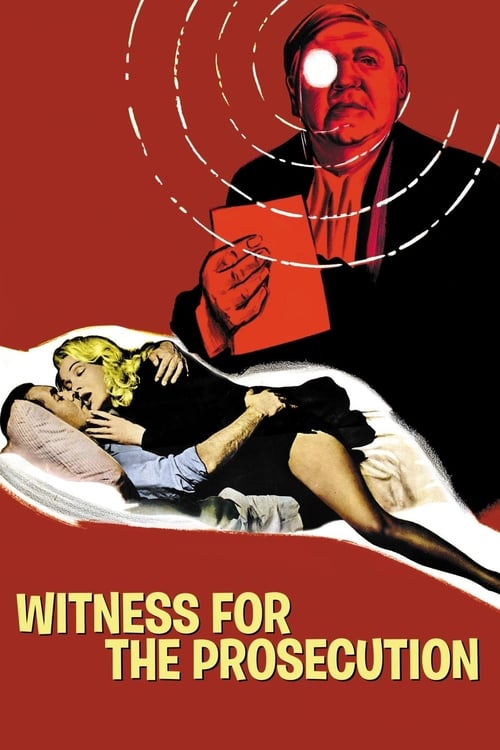
Witness for the Prosecution
1957 · Billy Wilder
For when you want to be completely, cleverly entertained — a rainy-Sunday classic that asks nothing of you but attention and rewards it with one of the all-time great endings. Total comfort, zero dust.
What it's about
Sir Wilfrid Robarts, a brilliant London barrister just out of hospital after a heart attack, is under strict orders to avoid stressful cases — so naturally he takes the most stressful one available: defending a charming, broke young man accused of murdering a rich widow who'd just written him into her will. The defense's whole case rests on the man's enigmatic German wife — who then turns up in court testifying for the other side. What follows is a duel of testimony, tactics, and nerve.
The experience
Pure pleasure — witty, brisk, and wickedly constructed, with courtroom scenes that play like a chess match and a running comic battle between the barrister and his fussing nurse. The final minutes will make you gasp, then grin.
Performances
Charles Laughton is magnificent — irascible, cunning, monocle glinting — and his real-life wife Elsa Lanchester matches him beat for beat as his exasperated nurse. Marlene Dietrich, as the wife, gives a performance whose full brilliance you can only appreciate once the film is over.
The craft
Billy Wilder turns Agatha Christie's stage play into pure cinema: razor-cut courtroom rhythm, dialogue that crackles, and a plot engineered like a Swiss watch where every casual detail turns out to be load-bearing. It famously ends by asking audiences not to reveal the ending — honor the pact.
Why it matters
A benchmark of the courtroom genre ever since — the film every twist-trial story gets measured against, and proof that Christie's stagecraft could become first-rate Hollywood filmmaking.
Snapshot
A barrister recuperating from a cardiac episode defies his doctor and nurse to defend Leonard Vole, a charming young American accused of murdering a wealthy widow who had recently changed her will in his favor. The trial turns on the testimony of Vole's wife Christine — who appears, shockingly, as a witness for the prosecution. Billy Wilder's adaptation of Agatha Christie's stage play is one of Hollywood's supreme examples of the mechanism thriller: a film whose pleasures are entirely structural, depending on the audience's willingness to be twice fooled. Its ending requires a confidentiality pact, and the film imposes one. Technically fluent, performed with exceptional range, and constructed with Wilder's characteristic sardonic precision, it remains among the finest courtroom pictures the American cinema has produced.
Industry & production
Witness for the Prosecution was produced by Arthur Hornblow Jr. and released through United Artists in December 1957, placing it at the tail end of the decade's cycle of prestige independent productions that United Artists had championed as an alternative to the studio-contract system. The source material was Agatha Christie's play, which had opened in London's West End in 1953 and reached Broadway the following year, where it ran for over 600 performances. Christie's original short story had appeared decades earlier, but it was the stage adaptation — tightly constructed around the mechanics of British courtroom procedure — that attracted Hollywood interest. The screenplay was credited to Wilder and Harry Kurnitz, working from an earlier treatment by Larry Marcus; Wilder's hand is unmistakable in the bantering confrontations between Sir Wilfrid Robarts and his nurse Miss Plimsoll, scenes with no equivalent in Christie's play that open the film's comic register and establish its tone of mordant wit beneath respectable surfaces. Casting was a coup of alignment: Charles Laughton, one of the great theatrical presences of the mid-century screen, as Sir Wilfrid; Marlene Dietrich, whose German-inflected biography the script deliberately activates, as Christine; and Tyrone Power, whose matinee-idol attractiveness the film weaponizes against the audience's sympathies, as Vole. Power died in November 1958, making this effectively his penultimate completed picture. The film was shot in Hollywood; no location work in Britain was undertaken.
Technology
The film was photographed in black and white — a deliberate choice in a period when color had become the default prestige format. Black and white allowed the cinematographer Russell Harlan to work with the high-contrast interiors — the wood-paneled courtroom, the lamplit solicitor's office, the Hamburg bar of the flashback sequence — in a manner that aligned with the film's morally chiaroscuro subject matter. No widescreen process was employed; Wilder shot in the Academy ratio, which concentrated attention on faces and kept the spatial grammar intimate even in the large reconstructed courtroom set. The sound recording was nominated for the Academy Award in its technical category, an acknowledgment of the film's dependence on the spoken word as its primary dramatic instrument: Christie's dialogue, the speeches of counsel, the rhythm of question and counter-question are the machinery through which the film operates.
Technique
Cinematography
Russell Harlan's lighting deploys contrast in ways that underline character duplicity. Christine Vole/Helm is consistently placed in pools of shadow even in nominally open settings, her face partially obscured at moments of maximum deception; Sir Wilfrid's overlit, almost brutally visible face codes him as a man incapable of real concealment. The Hamburg flashback uses notably harder, expressionist-inflected light, referencing both the ruin-and-survival atmosphere of postwar Germany and the cabaret tradition from which Dietrich's screen persona had originally emerged. The courtroom is photographed with restrained spatial coherence — Harlan avoids the distorting wide-angle close-ups that less disciplined directors use to telegraph tension, trusting instead in the blocking and the performances.
Editing
Daniel Mandell, Wilder's long-serving editor, cuts the trial sequences with rigor — no intercutting for manipulative emphasis, but rather a sustained attention to the procedural rhythm of examination, cross-examination, and reaction that mirrors the form of legal argument. The editing becomes perceptibly faster and more fragmented in the film's final minutes, as the mechanism snaps shut. Mandell received an Academy Award nomination for his work here. His method was built around restraint: the film's tension is generated by withholding cuts, not by multiplying them.
Mise-en-scène / staging
The reconstructed Old Bailey courtroom — built on a Hollywood soundstage — is the film's dominant spatial environment, and Wilder stages it with scrupulous fidelity to the architectural hierarchy of British legal ceremony: the elevated bench, the witness box set apart from the dock, the separation of counsel into prosecution and defense. This spatial order is itself a subject: the film is interested in the way institutional architecture regulates behavior and creates the conditions for deception. Wilder and Laughton together staged the courtroom sequences with a theatricality that acknowledges the spatial origin of the material while never becoming merely filmed theater. The opening hospital scenes are deliberately cramped — Sir Wilfrid confined, managed, supervised — so that the release into the courtroom reads as a physical liberation, even as it proves a trap.
Sound
Dialogue is the film's primary sonic material, and the sound mix is designed to subordinate everything to intelligibility and weight of speech. Laughton's voice — cavernous, precise, capable of sudden mock-deference — is mixed with consistent presence, so that even a murmured aside carries authority. Dietrich's voice, with its German accent carefully preserved and indeed foregrounded, is a constant reminder that Christine is not who she claims to be and not entirely where she appears to be. The score, relatively spare, does not press emotional responses onto sequences the dialogue is already managing.
Performance
The performances are the film's center of gravity. Charles Laughton's Sir Wilfrid is one of the great comic-dramatic performances in the Hollywood cinema of the 1950s: the character is simultaneously pompous and intelligent, vain and perceptive, a professional liar who is surprised to encounter a better one. Laughton calibrates the comedy — the battle with Miss Plimsoll over thermoses and medications — against genuine courtroom authority without ever feeling divided. Elsa Lanchester, Laughton's wife in life, plays Miss Plimsoll; the charge between them is unmistakably marital, their antagonism grounded in the particular exasperation of long intimacy. Dietrich operates on several layers simultaneously: loyal wife, vengeful testifier, and something else the film ultimately discloses. The Hamburg flashback, in which she sings and is rough-handled by soldiers, required her to inhabit a register far from the glossy Dietrich that audiences knew. Tyrone Power's challenge is to be sympathetic and finally opaque — to give the audience nothing to hold against him while concealing everything.
Narrative & dramatic mode
The film operates through dramatic irony and structural misdirection. The audience is given, at each stage, exactly the information required to form a confident interpretation, and at each stage that interpretation proves incomplete. Wilder's screenplay is a precise machine for sequencing these revelations: the discovery that Christine is appearing for the prosecution, the twist about the letters and the cockney woman, the final revelation that collapses the entire moral architecture of the preceding ninety minutes. The mode is not psychological in the manner of Hitchcock's thrillers — character interiority is not the subject — but procedural and geometric. Christie's plotting, and Wilder's faithful commitment to it, asks the audience to be more interested in how the trap was constructed than in the suffering of those caught in it. This is formally unusual: Hollywood dramatic convention typically insists on sympathetic identification as the precondition of suspense, but Witness for the Prosecution makes sympathy itself the instrument of manipulation.
The film's celebrated request — voiced at the conclusion, asking audiences not to disclose the ending to those who haven't seen it — is both a marketing device and a thematic statement: the film has demonstrated that the audience, like the jury, cannot be trusted with information it believes it has correctly processed.
Genre & cycle
Witness for the Prosecution is a courtroom drama, a genre with continuous American film history from at least the 1930s, but it belongs to the specific prestige-independent cycle of the mid-to-late 1950s that also produced Twelve Angry Men (Sidney Lumet, 1957, the same year) and Anatomy of a Murder (Otto Preminger, 1959). Where Twelve Angry Men treats the jury as the site of democratic and moral drama, and Anatomy of a Murder extends the courtroom into questions of legal ethics and sexual politics, Witness for the Prosecution turns the courtroom into a mechanism for entertainment pure and detached — closer to the puzzle tradition of the mystery novel than to the social-problem tradition of most American legal drama. This affiliation with Christie's whodunit structure distinguishes it from its generic contemporaries. It also belongs, less overtly, to the cycle of films adapting successful stage plays that characterized Hollywood's relationship to Broadway in the decade: the prestige adaptation as a cultural transaction.
Authorship & method
Billy Wilder was a writer-director who considered the screenplay the foundational act; the film grammar was in service of, never in competition with, the architecture of the script. His European formation — born in Austria, trained in German cinema, fled the Nazis for Hollywood in the 1930s — gave him a detached, sometimes clinical perspective on American social performance that inflected even his British-set material. He worked with a succession of writing partners (Charles Brackett until 1950, I.A.L. Diamond from 1957 onward); Harry Kurnitz, who co-wrote this screenplay, was a playwright and novelist with a gift for sophisticated comedy. The Wilder-Kurnitz collaboration produced dialogue that is more overtly theatrical than Wilder's work with Diamond, and well-suited to material originating in stage form.
Russell Harlan, the cinematographer, brought experience from westerns and genre pictures to material that required a different kind of visual intelligence — not spectacle but precision. Daniel Mandell's editorial discipline had been shaped by decades of Hollywood craftsmanship; he had cut films for Goldwyn and worked with Wilder long enough to internalize his preference for sequences that breathe. The production design — responsible for convincing recreation of the Old Bailey interiors on a Hollywood stage — represented a significant technical achievement; the historical record on the specific designer for this production is less thoroughly documented than for some of Wilder's later films.
Movement / national cinema
The film is nominally American — Hollywood studio system, American cast, American director — but it is culturally and thematically Anglophile. Its world is one of British legal tradition, wigs and gowns, the formality of barristers and solicitors, tea and deference and class. Wilder, as an outsider to both British and American culture, treats this world with a skepticism that a native director might not have risked: the grandeur of the legal ceremony is shown to be as manipulable as any other institution. The film's relationship to the British legal-thriller tradition — embodied in Christie herself — is one of admiration and ironic distance simultaneously.
Era / period
1957 is a pivotal year in Hollywood history: the studio system is visibly decomposing, television is an established competitor, and the prestige independent feature produced for United Artists represents one of the industry's adaptive strategies. Witness for the Prosecution, with its theatrical source, its star-laden cast of established names, and its explicit request that the audience protect its secret by returning to see it again with friends, is a film intelligently conscious of its commercial moment. It is also a film made before the ratings upheaval of the following decade, working entirely within the Production Code's limits while managing, through implication and structure rather than explicitness, a story of murder, sexual manipulation, and sustained deception.
Themes
The film is systematically concerned with performance and the indistinguishability of performance from truth. Every principal character performs a role for an audience — Sir Wilfrid in court, Christine in court, Vole to everyone, the cockney woman to Sir Wilfrid. The courtroom, the film argues, is not a venue for the discovery of truth but for the competition of performances; the side that performs most persuasively wins. Christine's betrayal of Vole is reframed at the end as a higher loyalty — a love so controlling it could not permit the natural operation of justice. This is a dark and somewhat disturbing moral: that the most devoted love is also the most thoroughly manipulative. Wilder does not sentimentalize this. The final reversal is not redemptive; justice is not done. The curtain comes down on the mechanism, not on a moral order restored.
Reception, canon & influence
The film received six Academy Award nominations — Best Picture, Best Director (Wilder), Best Actor (Laughton), Best Supporting Actress (Lanchester), Best Film Editing (Mandell), and Best Sound Recording — winning none in what proved a strong year for competition. Critical reception was enthusiastic; the screenplay's fidelity to Christie while extending her material through Wilder's characteristic comic-ironic register was widely praised. Laughton's performance was recognized as a late-career peak.
Looking backward, the film draws on the entire tradition of Christie adaptations and the British mystery play; on Wilder's own work in morally ambiguous melodrama, particularly Double Indemnity (1944), which is the earlier film most structurally comparable (both turn on the question of how far a woman will go for a man, and both reveal the answer to be further than the man deserves); and on the theatrical tradition of the well-made play, with its machinery of secrets and disclosures.
Looking forward, the film's "don't reveal the ending" strategy anticipates Hitchcock's celebrated embargo on late admission for Psycho (1960) and establishes a template for the management of twist-dependent films that extends to the present. Its influence on the prestige courtroom drama is less direct than Twelve Angry Men's — which was assimilated more thoroughly into American screen grammar — because Witness for the Prosecution's project is specifically anti-psychological and anti-social-realist in ways that proved harder to imitate. It has been remade — a 1982 television film directed by Alan Gibson preserved the basic structure — and the Christie play continues to be staged. The 1957 film remains the canonical screen version, its reputation secure if somewhat specialist: admired more intensely by those interested in the mechanism thriller as a form than by general audiences, for whom the twist, once known, removes the film's primary engine. That this problem is inherent to its design is part of what makes it an object of sustained critical attention.
A Deleuzian reading
Sir Wilfrid Robarts has the most visible face in the film.
The full Deleuzian reading of Witness for the Prosecution →
Reception
A hit on release with six Oscar nominations (and zero wins), it's since become one of those films the internet quietly canonized — perpetually lodged near the top of IMDb's ratings and a Letterboxd 'why is this so good' discovery, even as it stays under-discussed next to Wilder's flashier classics.
How Witness for the Prosecution was received, from release to now →
Influences: the films it descends from and the films it influenced
- Double Indemnity (1944) — Wilder's own structural precedent for the mechanism-thriller's sympathy-reversal: a duplicitous woman whose deception proves more complete than her male partner imagined, the entire prior action reframed by a retrospective reveal — the same architecture Witness deploys with Christine Vole replacing Phyllis Dietrichson.
- Shanghai Express (1932) — Von Sternberg develops Dietrich's performance method of playing a character who performs a constructed identity — the fallen woman revealed as something else — with expressionist chiaroscuro as her character marker; Wilder recruits this established Dietrich persona and its conventions wholesale, counting on audiences to misread her.
- The Letter (1940) — Tony Gaudio's chiaroscuro cinematography characterizes guilt and performed innocence simultaneously; the courtroom functions as an institutional stage where a woman's controlled, letter-perfect performance against withheld evidence is the entire dramatic engine — the structural template Witness inherits most directly.
- The Paradine Case (1947) — A courtroom drama organized around a multilayered female defendant who systematically deceives her defense counsel, deploying the witness stand as a stage for performance-indistinguishable-from-truth; Laughton's barrister and Gregory Peck's are both men undone by their own credulity before a controlled female performance.
- Stage Fright (1950) — Hitchcock embeds a false flashback — visualized testimony shown as objective fact — establishing the principle that expressionist reconstruction can itself be the lie; this direct precursor to Christine Vole's flashback sequences makes the audience's visual evidence unreliable by design.
- Les Diaboliques (1955) — Clouzot deploys the same sympathy-manipulation mechanism and 'do not reveal the ending' audience contract that Witness would codify two years later; the twist that retroactively reframes all prior action as an elaborate performance is structurally identical — and Clouzot's closing title card is the direct precursor to Wilder's embargo request.
- Psycho (1960) — Hitchcock directly adopted Wilder's 'do not reveal the ending' marketing embargo, extending it into a no-late-admission policy that became industry precedent; the sympathy-manipulation architecture of the first act — engineering identification with a character whose guilt is then systematically revealed — replicates Witness's structural move in a different genre register.
- Anatomy of a Murder (1959) — Preminger extends the prestige courtroom mechanism thriller into the full procedural architecture of a trial, with editing restraint that refuses both expressionism and sentimentality; the moral ambiguity of legal performance — the audience never certain whether the defendant's story is true — inherits Witness's refusal to resolve guilt outside the mechanism.
- Murder on the Orient Express (1974) — Lumet adapts Christie's mechanism structure for prestige ensemble cinema by deploying institutional spatial confinement — the sealed train compartment — as an interrogation stage; the Christie whodunit's procedural revelation architecture and its final collective-guilt inversion both derive from the template Witness fixed as the canonical Christie screen adaptation.
- Reversal of Fortune (1990) — Jeremy Irons' narration is explicitly framed as a performance of innocence — voice-as-character-marker constructing and undermining sympathy simultaneously — and the film withholds the truth of Sunny's inner state to replicate Witness's mechanism: the audience's prior sympathy is the trap, and the twist is the trap springing.
- Presumed Innocent (1990) — Pakula's mechanism thriller uses procedural courtroom staging — institutional spatial hierarchy, withheld physical evidence as editorial tension — to systematically manipulate audience sympathy toward a defendant whose performance of innocence is the film's central dramatic question, resolved by a final reveal that retroactively reframes all prior sympathy.
- Primal Fear (1996) — Edward Norton's dual-register performance — simultaneously naturalistic and theatrical, alternating registers of innocence and calculation — directly inherits Laughton's method of playing both sides of the comic-dramatic spectrum within a single character; the mechanism thriller's final reveal that the performed identity was the real one is Witness's sympathy-manipulation architecture in its most direct descendant form.
- Knives Out (2019) — Supplies the structural template of a legal-investigative proceeding outmaneuvered by a figure who understands its rules better than its practitioners — with a mid-film revelation that retroactively reframes all prior scenes as deliberate performance rather than transparent testimony.
- The Outfit (2022) — Wilder's adaptation of Christie's play constructs hidden identity as the load-bearing structural engine, staging a final revelation that retroactively reframes all prior dramatic information; Moore applies the same mechanism with the same theatrical ancestry and the same misdirected-sympathy technique.
- Judgment at Nuremberg (1961) — Establishes the postwar prestige courtroom as a theater of staged cameo testimony, each witness a self-contained performance turn pivoting on a reveal.
- Sleuth (1972) — Adapts a stage thriller's late-breaking reversal so the audience's certainty is detonated by a final disguise-and-deception reveal — the reversal-structure engine Shaffer reloads in Sleuth.
- The Verdict (1982) — Treats the courtroom as a theater of rhetoric and the summation as a constructed set-piece, the lineage The Verdict's closing argument culminates.
- My Cousin Vinny (1992) — Courtroom-as-showman's-theater, where the defense advocate's performative timing and the late reversal carry the suspense — the staging logic behind Vinny's escalating set-piece cross-examinations.
- Twelve Angry Men (1957) — Lumet's prestige courtroom drama uses institutional spatial constraint as the entire dramatic engine with procedural editing restraint and a dialogue-driven mix — the social-realist half of the same 1957 courtroom-drama cycle, whose assimilation into American screen grammar Witness resisted by being anti-psychological where Lumet's film is maximally psychological.
- Paths of Glory (1957) — Kubrick stages the military tribunal through institutional spatial hierarchy — wide ceremonial courtroom versus cramped accused space — as visible indictment of legal mechanism; the European outsider's clinical detachment from American institutional performance parallels Wilder's project, arriving at the same year from the same angle.
- Vertigo (1958) — Hitchcock's parallel exploration of performance-indistinguishable-from-truth uses systematic sympathy manipulation — the audience fully invests in the performed identity before the reveal reframes everything — deploying false memory reconstruction as a structural device in the same season as Witness, from the same cultural moment.
- 12 Angry Men (1957) — Wilder constructs a sealed courtroom chamber in which verdict inversion is the structural engine, arriving at the same mechanism from British stage conventions rather than American live television.
- Dial M for Murder (1954) — Wilder adapts Agatha Christie's stage play with near-total architectural fidelity, the courtroom functioning as a single bounded space whose geometry the camera diagrams; dramatic irony operates through the audience's foreknowledge of the defendant's guilt, deploying the same inverted-mystery machinery as Dial M in a legal rather than domestic register.
- The Invisible Guest (2017) — Adapts Agatha Christie's courtroom-confession structure where a final reveal retroactively rewrites every prior testimony — the same lawyer/client interrogation frame Paulo uses to stage his nested lies.
Similar films
- Double Indemnity (1944) — influence & lineage · same viewing thread
- Anatomy of a Murder (1959) — influence & lineage
- Murder on the Orient Express (1974) — influence & lineage
- Paths of Glory (1957) — influence & lineage
- Vertigo (1958) — influence & lineage · same viewing thread
- Psycho (1960) — influence & lineage · same viewing thread
- Diabolique (1955) — influence & lineage · same viewing thread
- Rear Window (1954) — same viewing thread
All the films related to Witness for the Prosecution →
Watch it with: curated runs of related films
- The Golden Age of Suspense — A run of immaculate mid-century crime pictures — Hitchcock plus his sharpest rivals — where guilt, obsession, and dangerous romance are staged in gorgeous black-and-white; watch them close together and the shared DNA of the perfect-murder plot lights up.