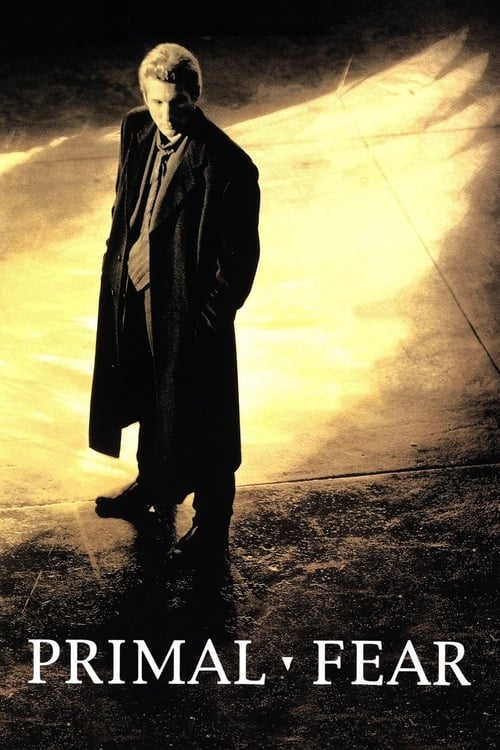
Primal Fear
1996 · Gregory Hoblit
For when you're craving a twisty, grown-up thriller for a Friday night — pure high-grade entertainment that also leaves a chill. Comfort-food genre filmmaking with one genuinely unsettling aftertaste.
What it's about
A hotshot Chicago defense attorney who takes cases for headlines lands the biggest one of his career: a stammering, seemingly gentle altar boy accused of savagely murdering the city's archbishop. The prosecutor is his ex-lover and former student, the Church is hiding things, and the deeper the case goes, the less anything looks simple. It's a courtroom drama that keeps pulling the floor out from under its own lawyer.
The experience
A slick, propulsive thriller that tightens steadily — courtroom sparring, buried secrets, and a mounting sense that someone in the room is playing everyone else. It ends on a note that people were still talking about years later; going in cold is the whole pleasure.
Performances
Edward Norton's film debut is the reason this movie is remembered — a performance of astonishing layered control that announced a major actor overnight and earned him an Oscar nomination. Richard Gere gives one of his best turns as the vain lawyer forced to actually look at what he's defending.
The craft
Classical, confident studio craftsmanship: a tight script that plants everything it later pays off, courtroom scenes that crackle, and a director who knows exactly when to let his young discovery off the leash. The construction is old-fashioned in the best way — every scene load-bearing, every reveal earned.
Why it matters
The film that launched Edward Norton and sharpened the 1990s legal-thriller boom into something darker — its final turn became a cultural reference point and a template for a generation of twist endings.
Snapshot
A Chicago defense attorney takes a pro-bono case that looks like a gift—a stammering, apparently guileless altar boy accused of butchering the city's archbishop—and discovers, too late, that the gift was a trap. Gregory Hoblit's theatrical debut is a slick, well-engineered legal thriller that would have been entirely competent and largely forgotten were it not for the film debut of Edward Norton, whose performance of layered dissociation—a mild, frightened boy folded around a cold, exultant predator—became one of the defining acting revelations of 1990s Hollywood. The film's architecture is classical in its carpentry and audacious in its final pivot, and it marks the point at which the mid-decade legal thriller cycle, feeding on John Grisham adaptations, began to interrogate rather than merely celebrate the defense counsel as hero.
Industry & production
Primal Fear originated as a 1993 novel by William Diehl, whose prior fiction had already found the screen in Burt Reynolds's Sharky's Machine (1981). Diehl's novel had the same essential mechanism as the film—the twist that Aaron Stampler's fragile, stuttering alter-ego is itself the fabrication, and that "Roy" is the originary self—and the property attracted interest precisely because that mechanism was so cinematically transferable. Paramount Pictures released the film in April 1996, positioning it for the spring adult audience that had supported the Grisham cycle; it performed solidly, generating a domestic theatrical run that recovered its budget with room to spare, though exact figures should be sourced from authoritative box-office records rather than cited here from memory.
Richard Gere, then in a career phase where he was searching for projects with sharper dramatic teeth, took the role of Martin Vail and also served as a producer, giving him a measure of creative control over the project. The collaboration between Gere and Hoblit apparently included significant input on the character's moral vanity—Vail's pleasure in his own performance as advocate is as important to the film's themes as the twist—though the specifics of their creative negotiation are not well-documented in the public record. Steve Shagan, a seasoned Hollywood screenwriter with credits stretching back to Save the Tiger (1973), handled an early draft; Ann Biderman, whose television work had given her a feel for procedural rhythms, co-wrote the final screenplay. The adaptation retains the novel's essential gambit while tightening the Chicago milieu into something more atmospherically consistent.
The casting of Aaron Stampler is the production's central legend. Norton was, at the time, a virtually unknown stage actor; by most accounts, the role was auditioned widely and contested, with more established names considered. Norton's reading reportedly stopped the process—the switch between Aaron and Roy, executed in the audition room, was apparently so startling that the decision was rapid. The record of the audition process has been cited by Norton himself in multiple interviews, though the precise roster of competing actors and the exact sequence of callbacks has acquired some embellishment across retellings.
Technology
The film is a product of mid-1990s Hollywood mainstream production, shot on 35mm with post-production techniques standard to the era. There is no significant technical novelty in its toolset. The editing is non-linear in the sense of standard dramatic cutting rather than any experimental deployment of the Avid systems that were, by 1996, well-established in Hollywood post-production. The courtroom sequences use conventional coverage—wide establishing shots of the gallery, two-shots across the counsel tables, close-ups calibrated to the emotional temperature of testimony—without any conspicuous stylistic intervention.
The film's color palette, the Chicago winter light filtered to a cool blue-gray that warm interiors occasionally interrupt, was achieved through a combination of practical location shooting and controlled interior lighting rather than any unusually sophisticated photochemical or digital manipulation.
Technique
Cinematography
Michael Chapman, whose earlier career had included collaborations of considerable distinction—Taxi Driver (1976) and Raging Bull (1980) with Scorsese, The Fugitive (1993)—shot Primal Fear with a workmanlike efficiency suited to Hoblit's television-trained instinct for clean, information-rich frames. Chapman's Chicago is functional rather than lyrical: the city becomes a backdrop of civic grandeur and institutional stonework—cathedral facades, courtroom columns, police precincts—that reinforces the film's interest in the outward respectability of power. The cinematography does not strain for visual poetry; its contribution is reliable clarity of spatial geography in complex scenes, particularly in the courtroom, where the blocking of multiple figures must be legible to a viewer tracking several competing agendas simultaneously. The one register where the camera earns its keep aesthetically is in the close-up work on Norton, particularly in the transitions between Aaron and Roy, where Chapman holds tight on the face long enough to let the physiological shift—the shoulders, the jaw, the eyes—work without editorial assistance.
Editing
David Rosenbloom's editing is structurally disciplined and dramatically efficient. The film's pacing—approximately 129 minutes—sustains pressure through a procedural rhythm that accumulates detail without becoming ponderous. The courtroom sequences are cut to emphasize the chess-game quality of examination and cross-examination, each cut a parry or thrust. The handling of the Aaron/Roy transitions is the editing's most demanding problem and its most interesting solution: Hoblit and Rosenbloom choose to cut away at the moment of transformation rather than staying with it, a strategy that respects Norton's performance by refusing to over-explain it and that keeps the audience epistemically off-balance in the same way Vail is. The film's final scene—where Vail stands stunned in a corridor, the camera slowly pulling back as Roy's smile lingers in his memory—is one of the few moments where the editing allows a beat to breathe past its informational utility, and it is the one beat the film genuinely earns.
Mise-en-scène / staging
Hoblit's television background is most visible in his staging: scenes are blocked and shot with a pragmatic concern for dramatic legibility over visual expressiveness. The courtroom is the film's primary arena, and Hoblit handles it with the confidence of a director who has spent years staging procedural space for Hill Street Blues and L.A. Law—the geography of authority (the bench, the jury box, the counsel tables) is always clear, and the power relationships among characters can be read from the frame without dialogue. The interrogation and interview scenes—Vail questioning Aaron, the psychiatrist (Frances McDormand, in a supporting role) assessing the defendant—are staged in confined spaces that externalize the psychological pressure of the situations without resorting to expressionist distortion. Hoblit's instinct throughout is legibility over style, which serves the material's genre mechanics efficiently and limits its visual ambition commensurately.
Sound
The sound design supports the courtroom thriller's rhetorical texture: dialogue is primary, and the acoustic treatment of the cathedral and courtroom interiors reinforces the film's institutional weight. James Newton Howard's score is conventionally deployed—strings and piano in the registers of suspense and pathos, with the restraint appropriate to a genre that relies primarily on dialogue for its tension. The score does not attempt to editorialize about the twist; it accompanies rather than anticipates. This restraint is correct: any musical underscoring that telegraphed Roy before the revelation would compromise the film's central effect.
Performance
The performance architecture is a study in hierarchy. Gere's Vail is the film's apparent center—charming, vain, professionally ruthless—and Gere plays him with the controlled volatility that had been his strongest register since American Gigolo (1980): a man whose elegance is a weapon and whose conscience is an inconvenience. Laura Linney, as prosecutor Janet Venable, brings a crisp formality that keeps Vail's domination of their scenes from becoming unchallenged, and her work in the cross-examination sequences is precise. Andre Braugher, as the state's attorney who competes with Vail for media oxygen, carries the film's political subplot with an authority the screenplay perhaps doesn't fully earn.
Norton's performance, however, is the film's event and the grounds of its continued discussion. His Aaron is built from a detailed physical vocabulary—a stammer calibrated to fluctuate under stress, a posture of habitual self-effacement, eyes that search for permission before speaking—that reads as thoroughly observed rather than assembled from acting-class pathology. The transformation into Roy is not the camp explosion one might fear: it is colder, faster, and more specifically physical than theatrical, the stammer disappearing as if a circuit had been thrown, the body redistributing its weight. The final scene, in which Roy permits the mask to drop for Vail alone, is the performance's culmination, and Norton executes it with a stillness that makes it more frightening than any of the earlier eruptions. That this was a film debut remains the performance's most frequently cited context.
Narrative & dramatic mode
The film operates in the mode of the dramatic irony thriller: the audience is, for most of its running time, positioned with Vail in good faith, sharing his investment in Aaron's innocence and his procedural satisfaction at dismantling the prosecution's case. The twist is withheld with structural discipline—the clues (Aaron's occasional hardness, the irregularities in his account, the psychiatrist's discomfort) are present but not foregrounded. The final revelation does not simply surprise; it retroactively recontextualizes the film as a story about a manipulator manipulating a manipulator. Vail, whose entire professional identity rests on reading people, has been completely deceived by the one person with most to gain from deceiving him. The moral geometry is clean: a lawyer who cares only about winning has won in the worst possible way.
This narrative mode—the legal thriller that turns on the attorney's complicity or victimization by the defendant's performance—connects Primal Fear to a specific tradition of courtroom drama in which the advocate's omniscience is systematically undone.
Genre & cycle
Primal Fear arrives at the apex and incipient exhaustion of the early-1990s legal thriller cycle, which had been energized by the succession of Grisham adaptations—The Firm (1993), The Pelican Brief (1993), The Client (1994)—and the cultural prominence of high-profile criminal trials, most obviously the O.J. Simpson proceedings of 1994–1995, which had turned courtroom procedure into national entertainment. These films shared a template: the brilliant lawyer or paralegal who outmaneuvers institutional corruption, with the law itself as a site of moral possibility. Primal Fear both exploits and corrodes this template. Vail is fluent in the genre's hero-advocate language, and the film delivers the pleasures of watching him work, but the ending repositions him as a fool, and the law as a system that can be played by anyone sufficiently committed to performance.
The film also participates in the dissociative identity disorder thriller tradition—a subgenre with roots in the pop-psychology 1970s (Sybil, The Three Faces of Eve) and continued through films like Dressed to Kill (1980)—though Primal Fear uses dissociation not as psychological case study but as narrative mechanism: the disorder is a cover story, Roy's invention, and the film's twist depends on the audience's willingness to accept the disorder as real before discovering it was always theater.
Authorship & method
Gregory Hoblit came to Primal Fear from a distinguished television career—he had directed and produced across Hill Street Blues, L.A. Law, and NYPD Blue, programs that were then redefining adult dramatic television. His feature debut demonstrates the strengths and limitations of that formation: he is confident with ensemble performance, procedural staging, and dramatic pacing; he is less interested in visual style as a carrier of meaning than a filmmaker trained in the theatrical feature tradition might be. The film is Hoblit's most successful feature by most measures, and his subsequent theatrical work—Fallen (1998), Frequency (2000), Hart's War (2002), Fracture (2007)—suggests a director more comfortable with mechanism than texture, drawn repeatedly to genre puzzles that reward structural ingenuity over emotional depth.
Michael Chapman's contribution as cinematographer has been discussed above. James Newton Howard, the composer, was among the most active Hollywood craftsmen of the period, with a catalog spanning prestige drama and genre entertainment; his score here is competent and unobtrusive. The screenplay by Shagan and Biderman transfers Diehl's mechanism efficiently, though the Chicago Church political subplot—corruption in real-estate development, complicity at the episcopal level—is less fully dramatized than the novel's treatment and functions mainly as tonal atmosphere in the film.
Movement / national cinema
Primal Fear is a product of mainstream American studio filmmaking at the height of 1990s Hollywood efficiency—high production values, star-driven marketing, genre polish calibrated to adult demographic audiences. It has no meaningful relationship to an independent or national cinema counter-tradition; its ambitions are entirely within the system of large-scale theatrical entertainment. Its Chicago setting gives it a municipal texture that distinguishes it visually from Los Angeles or New York thrillers, but the city functions as civic backdrop rather than social subject: the institutional corruption it depicts is schematic rather than particularized.
Era / period
The film belongs to the mid-1990s moment when American cinema was simultaneously processing the saturation of the legal thriller as a mass-entertainment form and the national preoccupation with media-spectacle justice. The Simpson trial's shadow falls over any 1996 film about a charismatic defense attorney performing innocence for cameras, and Primal Fear is more resonant for that context than it explicitly acknowledges. The period's broader fixation on performance, authenticity, and the constructed self—themes circulating through popular culture from television talk shows to identity politics discourse—provides a cultural substrate for the film's interest in personhood as fabrication.
Themes
The film's central preoccupation is performance and its relationship to identity. Roy performs Aaron for two years with sufficient consistency to deceive a legal system, a psychiatrist, and a defense attorney professionally committed to seeing through deception. The question the film opens without fully theorizing is whether the performance is distinct from the performer: if Roy sustains Aaron completely enough, for long enough, does the distinction between them finally matter? Hoblit does not pursue this philosophically—the film treats it as a thriller mechanism rather than an ontological problem—but the question lingers.
Secondary themes include the corruption of institutions (the Catholic Church, the legal system, city politics), the substitution of competitiveness for ethics in professional life, and the specific vanity of the trial lawyer as performer-for-hire. Vail's narcissism is the film's moral target: the ending punishes not his legal skill but his inability to imagine a performance more committed than his own.
Reception, canon & influence
Critical reception at release was warm, with reviewers largely concurring that the film delivered competent genre entertainment elevated by an extraordinary debut performance. Norton received an Academy Award nomination for Best Supporting Actor—a remarkable recognition for a film debut—and though he did not win, the nomination established him immediately as a major talent. The performance was widely cited in year-end criticism as the film's defining achievement, occasionally to the film's detriment as a whole object.
The backward influences on Primal Fear include the classical Hollywood courtroom drama (Anatomy of a Murder, 1959; Witness for the Prosecution, 1957), the Grisham cycle's popularization of the legal thriller format, and the dissociative-identity thriller tradition. The specific device of the defendant whose presented self is a strategic fabrication has precedent in crime literature—particularly in the inverted mystery tradition—though Diehl's deployment of it in a courtroom context was fresh enough to generate the property's commercial heat.
The film's forward legacy is principally a matter of careers. Norton's debut made him one of the most sought-after actors in Hollywood immediately, leading within two years to American History X (1998), for which he received a Best Actor nomination, and Fight Club (1999), cementing his position among the decade's most significant performers. The performance in Primal Fear is regularly cited in discussions of great screen debuts alongside those of early Brando and early Dustin Hoffman—a comparison that is perhaps hyperbolically generous but reflects the scale of the impact at the time.
The film itself has not entered the critical canon with particular firmness, occupying the respectable middle tier of genre craft: discussed when the legal thriller or the 1990s thriller cycle is under examination, cited as the originating context for Norton's career, but not actively championed as an overlooked or underappreciated work. Its twist has been absorbed into the culture with enough thoroughness that it is now routinely invoked as a reference point for the "unreliable defendant" structure, which may be the most durable form of its influence—less a film that shaped subsequent films directly than a film that sharpened a type.
A Deleuzian reading
Watch Edward Norton's face in the holding cell.
The full Deleuzian reading of Primal Fear →
Reception
A solid mid-90s hit that critics treated as a slick, standard-issue courtroom thriller — but it's since been reclaimed as the crown jewel of the 90s legal-thriller boom, kept alive almost entirely by the shockwave of its final minutes.
How Primal Fear was received, from release to now →
Influences: the films it descends from and the films it influenced
- Witness for the Prosecution (1957) — Wilder's screenplay codifies the attorney-deceived-by-defendant mechanism — the barrister who deploys his full professional skills for a client who has constructed a deception specifically to exploit those skills — which Primal Fear inherits as its central narrative trap; the final revelation that the attorney's brilliant work was the instrument of his own undoing is transposed almost structurally intact.
- Anatomy of a Murder (1959) — Preminger establishes the courtroom-as-chess-game coverage grammar — wide gallery establishment, two-shots across counsel tables, close-ups calibrated to testimony's emotional temperature — that Hoblit's trial sequences replicate directly; Preminger also pioneers the attorney whose theatrical showmanship is indistinguishable from his professional method, the advocacy-as-performance theme Primal Fear inherits.
- Psycho (1960) — Hitchcock's final-act psychiatric exposition of Norman Bates's split personality — the clinical explanation of DID as the key that unlocks the thriller's plot — is the structural template Primal Fear inherits and complicates by making the psychiatric reveal the trap rather than the resolution; the villain's apparent helplessness masking predatory control is the direct character grammar for Aaron/Roy.
- Taxi Driver (1976) — Chapman, director of photography on both films, develops his institutional cool palette here — the civic stonework of urban America rendered in blue-gray, the city as functional backdrop rather than lyrical subject — which he transposes directly to Primal Fear's Chicago cathedral facades, courtroom columns, and police precincts.
- Raging Bull (1980) — Chapman's close-up performance-capture technique — holding tight on the face through physiological transformation, letting shoulders, jaw, and eyes register the internal shift without editorial assistance — is developed in collaboration with De Niro here and applied directly to Primal Fear's Aaron/Roy transitions, where Hoblit and Chapman hold the frame long enough for Norton's physiological switch to complete.
- Dressed to Kill (1980) — De Palma codifies dissociative identity disorder as the twist-mechanism of the American genre thriller — the seemingly innocent subject revealed as the actual threat through a final psychiatric explanation — establishing the DID-thriller subgenre grammar that Primal Fear directly inherits, including the strategy of presenting the alternate identity as physically distinct in affect and bearing.
- The Verdict (1982) — Lumet establishes the morally compromised defense attorney — whose professional showmanship is inseparable from his personal vanity — as the legal thriller's protagonist through procedural accumulation of case detail as dramatic engine; Mamet's dialogue of feint and counter-feint in examination sequences establishes the cross-examination-as-parry rhythm that Hoblit's editing inherits.
- Jagged Edge (1985) — Marquand's film is the most direct structural precursor: the defense attorney personally compromised by trust in the accused, the final-act twist reversing the viewer's reading of the defendant's guilt, the attorney's professional investment weaponized against them by a calculating client who performed innocence specifically to exploit the lawyer's instinct to believe.
- The Good Shepherd (2004) — Runs the clerical-accusation/exoneration structure to a courtroom reversal, weaponizing the assumption of priestly innocence as plot mechanism — extending the 'faith-versus-evidence' and accused-cleric machinery the seed deploys.
- Fight Club (1999) — Fincher extends the DID-as-narrative-engine grammar with Norton himself as the vessel — the protagonist's alternate self as fabricated persona withheld through strategic editing and revealed in the final act, the viewer's complicity in the deception mirroring Vail's; Norton's physiological performance method, the body-level switch between identities, is the craft inheritance carried directly from Aaron/Roy into Tyler/narrator.
- Identity (2003) — Mangold directly extends the DID-thriller genre mechanism Primal Fear codifies — multiple alternate identities as plot engine, psychiatric revelation structuring narrative resolution — while adopting the cut-away-at-transformation editing strategy, withholding the identity switch from the viewer at the moment of transition to preserve the reveal's structural function.
- Fracture (2007) — Hoblit's explicit self-quotation: the attorney-deceived-by-defendant mechanism refined and reinverted — here the defendant deceives the prosecutor — with the same procedural accumulation as dramatic engine, the same deployment of close-up at the moment of dawning professional realization, and the same institutional cool palette marking civic power's outward respectability.
- Shutter Island (2010) — Scorsese inherits the psychiatric reveal as structural key and the investigator-deceived-by-constructed-identity mechanism — procedural accumulation leading to identity-collapse revelation, the institutional setting as containment space for the protagonist's manufactured persona — extending Primal Fear's grammar into the period psychological thriller through the same strategy of withholding the dissociative explanation until the film's final movement.
- Split (2017) — Norton's holding-cell switch set the modern benchmark for the persona change performed in one unbroken take with the camera refusing to cut away — precisely the shot length Shyamalan and editor Luke Ciarrocchi hold McAvoy inside.
- A Few Good Men (1992) — Reiner's film operates on identical courtroom-as-performance-space grammar — the cross-examination as theatrical set-piece where the attorney's deliberate showmanship extracts confession — sharing Hoblit's advocacy-as-performance theme, the same spatial coverage conventions for trial sequences, and the protagonist attorney whose personal moral vanity is the engine of both his effectiveness and his exposure.
- The Firm (1993) — Pollack's Grisham adaptation shares the institutional cool palette, the attorney-protagonist whose competence is tested by concealed institutional corruption, and the procedural accumulation of legal and investigative detail as dramatic engine — placing both films within the same mid-decade cycle where the defense counsel as hero is interrogated rather than merely celebrated.
- Sleepers (1996) — Contemporary inversion of Primal Fear's mechanism: where Vail is unknowingly deceived by his client, Levinson's attorneys knowingly orchestrate the court's deception; both films build their dramatic architecture on the gap between legal performance and actual truth, using procedural accumulation to sustain the audience inside a courtroom whose outcome has been predetermined by forces outside its view.
- The Invisible Guest (2017) — Legal-thriller whose entire case rests on a client performing a false persona to his own counsel, the lawyer-deceived-by-client reversal at the heart of Paulo's climax.
Similar films
- Anatomy of a Murder (1959) — influence & lineage
- Witness for the Prosecution (1957) — influence & lineage
- Psycho (1960) — influence & lineage
- American History X (1998) — shared sensibility
- Henry: Portrait of a Serial Killer (1986) — shared sensibility
- The Funeral (1996) — shared sensibility
- Doubt (2008) — shared sensibility
- The Godfather (1972) — shared sensibility