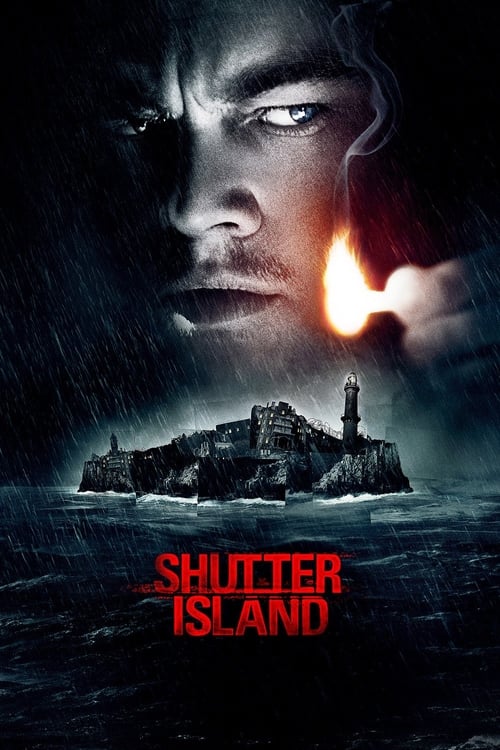
Shutter Island
2010 · Martin Scorsese
For a stormy night when you want a big, gothic puzzle to get lost in — one that demands your full attention and rewards a second watch. This is a challenge film disguised as a page-turner, best when you're up for having the rug moved under you.
What it's about
In 1954, U.S. Marshal Teddy Daniels ferries out to a fortress-like hospital for the criminally insane on a storm-battered island in Boston Harbor to investigate how a patient vanished from a locked cell. He's a World War II veteran carrying grief for his dead wife and memories he'd rather not have, and as a hurricane closes in, the doctors stop cooperating, his migraines and visions worsen, and the case starts bending around him. What began as a missing-person inquiry becomes a fight to hold onto his own footing.
The experience
Thick, brooding, and deliberately overheated — every corridor drips menace and the score practically shoves you into your seat. It plays as pulp mystery on the surface while a slow dread builds underneath, and it leaves you rattled and arguing about what you just saw.
Performances
Leonardo DiCaprio does some of his rawest work as Teddy, a man visibly fraying at the seams, while Ben Kingsley radiates silky, unreadable authority as the hospital's chief doctor and Michelle Williams haunts the edges of the film in brief, devastating appearances.
The craft
Scorsese goes full gothic: lashing rain, cliffside cell blocks, and dream sequences of eerie, painterly beauty shot with lush period richness. The soundtrack of ominous modern classical music is used like a blunt instrument — on good speakers those low brass drones are genuinely physical. It's a film built to swallow you whole in a dark room.
Why it matters
A major hit that proved the Scorsese–DiCaprio partnership could sell a dark, tricky psychological piece to a mass audience, and its much-debated final scenes have kept it alive in late-night arguments ever since.
Snapshot
Shutter Island is Martin Scorsese's foray into the gothic psychological thriller — a deliberately overheated, atmospherically dense puzzle-film that uses the machinery of pulp mystery to stage a serious meditation on trauma, guilt, and the limits of self-knowledge. Adapted from Dennis Lehane's 2003 novel, it follows U.S. Marshal Teddy Daniels (Leonardo DiCaprio), a World War II veteran who arrives in 1954 at Ashecliffe Hospital, a fortress-like institution for the criminally insane on a storm-battered island in Boston Harbor, to investigate the impossible disappearance of a patient. As his investigation unfolds amid a gathering hurricane, Teddy is besieged by migraines, hallucinations, and memories — of liberating Dachau, of his dead wife Dolores (Michelle Williams) — until the inquiry curdles into something far more destabilizing than a missing-person case. The film is at once a connoisseur's homage to the B-movie, to film noir, to the studio-era horror of Val Lewton, and to Hitchcock, and a genuinely anguished study of a mind that has built an elaborate fiction to survive an unbearable truth. The fourth collaboration between Scorsese and DiCaprio, it became one of the director's largest commercial successes and, after an initial reception that underrated it, has steadily gained standing as a major late work — a film whose every ostensible flaw of excess reveals itself, on reflection, as design.
Industry & production
Shutter Island was produced by Phoenix Pictures, the company of veteran producer Mike Medavoy, in partnership with Scorsese's own Sikelia Productions and Appian Way, the production company of Leonardo DiCaprio; Paramount Pictures financed and distributed. The project originated with the rights to Dennis Lehane's novel, a writer whose Boston-set crime fiction had already proved fertile ground for prestige cinema — Clint Eastwood's Mystic River (2003) and, later, Ben Affleck's Gone Baby Gone (2007) — and whose hardboiled regional sensibility suited Scorsese's interests. The screenplay was written by Laeta Kalogridis, who retained the structure of Lehane's twist-driven narrative.
The film reunited Scorsese with DiCaprio for the fourth time, following Gangs of New York (2002), The Aviator (2004), and The Departed (2006), the last of which had finally won Scorsese the Academy Award for Best Director. That partnership had by 2010 become one of the defining director-star collaborations in American cinema, and Shutter Island extended it into more frankly genre-bound territory than the prestige biopics and crime epics that preceded it. The supporting cast was assembled with characteristic density: Mark Ruffalo as Teddy's partner Chuck Aule, Ben Kingsley as the urbane chief psychiatrist Dr. Cawley, Max von Sydow as the German-accented Dr. Naehring (a casting choice that summons the actor's Bergman heritage and the film's Old World menace), Michelle Williams as Dolores, and Emily Mortimer, Patricia Clarkson, Jackie Earle Haley, and Ted Levine in smaller, vivid roles.
Production was based in Massachusetts. The most significant location was the decommissioned Medfield State Hospital, whose period-appropriate institutional architecture supplied much of Ashecliffe's exterior and grounds; additional work was done on coastal locations and on built sets. Paramount had originally slated the film for an October 2009 release, positioning it within awards season, but in the late summer of 2009 the studio shifted it to February 2010 — a move widely reported at the time as driven by budgetary and marketing considerations rather than any lack of confidence in the film. The February date, conventionally a graveyard for serious pictures, instead delivered Scorsese one of the strongest commercial openings of his career, and the film went on to substantial worldwide success; precise grosses should be checked against the financial record rather than asserted here, but it ranks among his biggest earners.
Technology
Shutter Island was shot photochemically on 35mm film, in keeping with Scorsese's lifelong commitment to celluloid and his and cinematographer Robert Richardson's preference for the medium's tonal richness. The film makes no claim to technological novelty in capture; its sophistication lies in the manipulation of image and sound in service of a subjective, unstable reality. Visual effects are used judiciously — to extend the island's stormy seascapes, to compose the burning and disintegrating imagery of Teddy's hallucinations, and to render the climactic deluge — but the film's effects are largely invisible, integrated into a deliberately old-fashioned, hand-crafted surface. The dream and flashback sequences depend more on in-camera technique, lighting, and editorial juxtaposition than on digital spectacle. Where the film is genuinely advanced is in its color grading and its sound design, both of which are calibrated to render the protagonist's deteriorating grip on the real; but these are refinements of established craft rather than instances of new apparatus, and it would misrepresent the production to claim otherwise.
Technique
Cinematography
The cinematography is by Robert Richardson, the three-time Academy Award winner who had become Scorsese's regular collaborator after The Aviator and who is among the most recognizable stylists in American film. Richardson's signature top-light — a hard, near-vertical key that haloes faces and blows out backgrounds — is deployed throughout, lending the institutional interiors an interrogative, expressionist intensity. The palette is consciously varied to mark the film's strata of reality: the saturated, almost lurid greens and reds of the hospital and the storm; the bleached, overexposed whites and the unnaturally vivid color of the dream sequences, where snow falls indoors and ash drifts through Dolores's embrace; the desaturated gray-blue of the Dachau flashbacks. Richardson and Scorsese embrace artifice openly — process-shot car interiors, theatrically heightened weather, deliberate continuity "errors" in the dream logic — so that the very texture of the image keeps signaling its own unreliability. The compositions quote film noir and gothic horror, with looming low angles, deep institutional corridors, and the play of storm light across stone, building a world that feels at once meticulously period-accurate and dreamlike.
Editing
The editing is by Thelma Schoonmaker, Scorsese's editor since Raging Bull (1980) and one of the most decorated figures in the field. Her work on Shutter Island is fundamental to its strategy, because the film's meaning is carried in its discontinuities. Schoonmaker structures the picture as a steadily destabilizing experience: the early reels proceed with the measured rhythm of a procedural, but the cutting grows increasingly to admit ruptures — abrupt intrusions of memory, mismatched details, glasses that appear and vanish, water that behaves impossibly — that on first viewing read as dream-logic and on second viewing reveal themselves as clues seeded in plain sight. The flashback and hallucination sequences are assembled with a fluid, associative montage that contrasts with the harder cutting of the investigation. The film's design rewards rewatching precisely because Schoonmaker's editing plants its revelations within its apparent excesses, and the long climactic explanation is paced to reframe everything that came before.
Mise-en-scène / staging
The production design is by Dante Ferretti, Scorsese's frequent collaborator and a master of period and gothic atmosphere, with costumes by Sandy Powell. Together they construct a fully realized 1954 of institutional brick, Cold War dread, and Old World menace — the Civil War-era fortifications repurposed as a mental hospital, the doctors' quarters with their fireplaces and brandy and recordings of Mahler, the spartan wards and the foreboding Ward C and lighthouse that organize Teddy's quest. Scorsese's staging is theatrical and frontal where the film wants the viewer to feel watched or managed, and disorientingly subjective where it enters Teddy's mind. The hurricane is staged as an externalization of psychic turmoil, and the recurring iconography — water and fire as the twin poles of Teddy's trauma, the lighthouse as the dreaded site of revelation, the matches struck in the dark of a mausoleum-like crypt — gives the mise-en-scène a dense symbolic charge. Powell's costuming subtly distinguishes the registers of reality, and the deliberately stylized, sometimes uncanny art direction keeps the audience, like Teddy, unsure of what is solid.
Sound
Shutter Island has no original score in the conventional sense. Instead, Scorsese's longtime music supervisor Robbie Robertson — the former guitarist of The Band — assembled the soundtrack from pre-existing works of modern and contemporary classical music, an inspired curatorial decision that gives the film its uniquely oppressive aural identity. The selections draw heavily on the avant-garde: works associated with Krzysztof Penderecki and György Ligeti, the desolate stillness of Morton Feldman's Rothko Chapel, John Cage, and, most memorably, Max Richter's "On the Nature of Daylight," whose aching string elegy underscores the film's emotional core. Period popular recordings — Dinah Washington, and other vintage songs that surface diegetically — puncture the dread with sudden, almost unbearable tenderness, mapping onto memories of Dolores. The result is a soundscape that lurches between drone-like menace and devastating lyricism, and the sound design more broadly — the assaultive weather, the institutional reverberation, the migraine-pitched ringing — keeps the listener inside Teddy's compromised perception. It is one of the most distinctive uses of compiled music in modern American film.
Performance
DiCaprio's Teddy Daniels is a performance of mounting strain, built to be re-read once the film's structure is understood. On a first viewing he plays a haunted but functional investigator; on a second, every twitch, evasion, and outburst registers as the labor of a man holding an unbearable reality at bay. It is among the most physically and emotionally taxing of his collaborations with Scorsese, and it anchors the film's gathering hysteria in a recognizable human anguish. Ben Kingsley's Dr. Cawley is the film's other pole — silken, paternal, unreadable, his benevolence and his potential malevolence held in perfect suspension. Mark Ruffalo's Chuck is a study in watchful, slightly off-key amiability whose meaning shifts entirely by the end. Max von Sydow brings a freight of European cinema history and quiet sinister authority to Naehring. And Michelle Williams, in limited screen time, makes Dolores both a tender memory and a figure of dawning horror, her presence the wound around which the whole film is organized. The ensemble is calibrated so that nearly every performance plays double.
Narrative & dramatic mode
The film's dramatic mode is the unreliable-narrator mystery, and its architecture is built entirely around a late revelation that recasts everything preceding it. Structurally it presents as a locked-room investigation — a marshal probing a disappearance inside a sealed institution, accumulating evidence of conspiracy, secret experiments, and official lies. But the investigation is gradually revealed to be a fiction within a fiction: Teddy Daniels is in truth Andrew Laeddis, a patient of Ashecliffe, and the entire scenario has been constructed by the hospital's doctors as a last, radical roleplay therapy designed to lead him to confront a truth he has psychologically annihilated — that his manic-depressive wife drowned their children and that he then killed her. The film thus belongs to the lineage of narratives whose first viewing and second viewing are different experiences, in which the audience is positioned inside the protagonist's delusion and made complicit in his refusal to see. Its closing movement — and its famously ambiguous final line, which raises the possibility that Andrew has chosen a lobotomy over the agony of sustained sanity — refuses the clean catharsis the thriller form promises, converting the genre's machinery of solution into a tragedy of self-knowledge and its unbearability. The mode is melodrama in the most serious sense: a drama of recognition, grief, and the mind's catastrophic defenses.
Genre & cycle
Shutter Island is a psychological thriller that operates as a deliberate anthology of older forms. It is a neo-noir in its rain-slicked paranoia and doomed investigator; a gothic horror in its island fortress, its storm, and its asylum dread; and, above all, a loving pastiche of the studio-era B-movie — the modestly budgeted genre pictures Scorsese has championed his whole life. It belongs to the cycle of "puzzle films" or "mind-game films" that flourished around the turn of the millennium, narratives organized around a reality-dissolving twist — a cycle whose touchstones include Jacob's Ladder (1990), The Sixth Sense (1999), Fight Club (1999), and Memento (2000). Within that cycle Shutter Island is distinguished by its self-conscious antiquarianism: rather than a contemporary setting, it reaches back to 1954 and to the visual grammar of the films noir and the horror pictures of that era. It also participates in the long tradition of the asylum film and of narratives about psychiatry, paranoia, and institutional power, inflected here by Cold War anxieties about brainwashing and state experimentation.
Authorship & method
Shutter Island is unmistakably a Martin Scorsese film, though it can look at first like a detour from his canonical subjects. Beneath its genre surface lie his most enduring preoccupations: guilt and the impossibility of expiation, the Catholic structure of sin and the longing for absolution, violence and its psychic aftermath, and the male protagonist trapped in a system — here literal — that he cannot master. The film is also the purest expression of Scorsese's cinephilia: a director who founded the Film Foundation to preserve film history here builds an entire feature out of his love for Val Lewton's RKO horror cycle, for Jacques Tourneur, for Otto Preminger's Laura, for the expressionist tradition, and for Hitchcock, whose Vertigo and Spellbound hover over the project. Scorsese's method here is one of total atmospheric control in collaboration with a remarkable repertory company of craftspeople: cinematographer Robert Richardson, editor Thelma Schoonmaker, production designer Dante Ferretti, costume designer Sandy Powell, and music supervisor Robbie Robertson, several of whom had worked with him for decades. The screenplay by Laeta Kalogridis preserved Lehane's twist structure and its emotional stakes. The film's deepest authorial signature, however, is the way it weds Scorsese's formal bravura to a story about a man who cannot bear to know himself — a theme that runs from Taxi Driver through Raging Bull to The Aviator's portrait of obsession and breakdown, of which DiCaprio's Teddy is in some ways a darker echo.
Movement / national cinema
The film belongs to no movement in the avant-garde sense; it is a work of American studio cinema by its most historically minded living master. But it is best understood within the tradition of the New Hollywood directors — the film-school-and-cinephile generation of the late 1960s and 1970s — and specifically within Scorsese's late-career standing as the keeper of that tradition's memory. It is American national cinema in dialogue with its own past: a Hollywood film about America at a particular historical moment (the early Cold War), made by a director whose other vocation is the preservation and canonization of film history. The film's European inflections — von Sydow's casting, the avant-garde European concert music, the expressionist lineage — situate it as an American work consciously drawing on a transatlantic inheritance, much as the classical Hollywood it pastiches was itself built by émigré talent.
Era / period
Shutter Island is set precisely in 1954, and its period setting is thematically essential rather than decorative. The year places the story at the height of the early Cold War, amid anxieties about brainwashing, psychological warfare, and clandestine government experimentation — fears the film weaponizes through Teddy's paranoid conviction that Ashecliffe is conducting sinister experiments on patients, complete with allusions to the House Un-American Activities Committee and to wartime atrocity. The period also captures a real pivot in the history of psychiatry: the film stages, through the contrast between the humane Dr. Cawley and the specter of the transorbital lobotomy, the mid-century collision between older surgical and custodial treatments of mental illness and the emerging era of psychopharmacology and psychotherapy. Teddy's identity as a liberator of Dachau roots the film in the unhealed trauma of the Second World War, and the flashbacks to the camp give the period setting a moral weight beyond genre atmosphere. The 1950s here is not nostalgia but a landscape of repressed historical and personal horror, the era's institutional confidence shadowed by everything it could not face.
Themes
The film's governing theme is trauma and the mind's defenses against it — the lengths to which a consciousness will go to avoid an unsurvivable truth, and the terrible cost of either sustaining the fiction or relinquishing it. Around this turn several linked concerns. There is guilt and the longing for absolution, the Catholic-Scorsesean question of whether the unforgivable can be borne; Andrew's choice, in the film's reading of its ambiguous ending, between living with knowledge and being unmade by surgery is a drama of penance and self-punishment. There is the unreliability of perception and memory, dramatized formally so that the audience experiences the instability rather than merely observing it. There is the trauma of war and historical atrocity, the Dachau memories binding personal grief to collective horror. There is the theme of institutional power and the ethics of psychiatry — the tension between cruelty and care, control and cure, embodied in competing models of treatment. And beneath all of it lies the film's most haunting proposition, condensed in its final line: that sanity and the knowledge it brings may be more unbearable than madness, and that to choose oblivion over an intolerable truth can look, from the inside, like mercy.
Reception, canon & influence
Shutter Island received a mixed-to-positive critical reception on its February 2010 release. Many reviewers admired its craft, atmosphere, and DiCaprio's performance while expressing reservations about its twist-driven structure, its length, and what some took to be overwrought excess; others found the ending gimmicky or guessable. This initial ambivalence has substantially reversed over the subsequent years. As audiences and critics returned to the film and recognized that its apparent flaws — the heightened artifice, the continuity oddities, the operatic excess — were in fact deliberate constructions legible only on a second viewing, its reputation rose markedly, and it is now frequently cited as one of Scorsese's most underrated works and a high point of the puzzle-film cycle. Commercially it was an immediate and significant success, among the strongest openings and biggest earners of the director's career.
Influences on the film reach backward to the studio-era genre cinema Scorsese reveres: the producer-driven horror of Val Lewton and the films of Jacques Tourneur; the films noir and the gothic melodrama of the 1940s and 1950s; Preminger's Laura; and Hitchcock, especially the trauma-and-identity dramas Vertigo and Spellbound. The avant-garde concert repertoire curated by Robbie Robertson supplies its sonic conscience, and Dennis Lehane's novel its narrative spine. Its influence forward is felt in the continued vitality of the reality-bending psychological thriller and in the film's growing status as a model of the rewatchable twist narrative whose structure rewards re-viewing. For Scorsese and DiCaprio it extended a partnership that would continue through The Wolf of Wall Street (2013) and Killers of the Flower Moon (2023), and it demonstrated that the director could bring his full formal authority to an unabashed genre exercise without diminishing it. More broadly, Shutter Island stands as a case study in critical reappraisal — a film initially received as accomplished but flawed that has come to be seen as a meticulously designed whole, and one of the most emotionally resonant entries in the modern cinema of trauma.
A Deleuzian reading
A woman in the interview room asks for a glass of water.
The full Deleuzian reading of Shutter Island →
Reception
In 2010 it was widely filed as 'minor Scorsese' — a pulpy genre detour that critics respected more than loved. It's since climbed into full fan-canon status, routinely defended as one of his most rewatchable films and a masterclass in atmosphere rather than a lesser work.
How Shutter Island was received, from release to now →
Influences: the films it descends from and the films it influenced
- Vertigo (1958) — Builds the obsessive-man-reconstructing-a-lost-woman engine through subjective camera and dream-vertigo, the trauma-and-identity template Scorsese explicitly works from.
- Spellbound (1945) — Establishes the psychoanalytic-detective structure in which the buried trauma IS the mystery to be excavated, with a stylized dream-sequence externalizing repressed guilt.
- Laura (1944) — Model of noir obsession with an absent/dead woman, the gliding camera through haunted interiors that Richardson's roving cinematography echoes.
- Cat People (1942) — Val Lewton producer-driven suggestion-horror: low-key top-light and withheld shadow make psychic dread rather than the monster the subject, a direct lighting debt.
- I Walked with a Zombie (1943) — Gothic atmosphere on an isolated island assembled from expressionist contrast and wind/sound design, the textural blueprint for Ashecliffe's storm-bound mood.
- Out of the Past (1947) — Flashback-narration noir in which a doomed man reconstructs his own undoing, the unreliable-retrospective architecture underlying Teddy's investigation.
- The Cabinet of Dr. Caligari (1920) — Originates the asylum-frame twist where the whole narrative is revealed as a patient's delusion, with expressionist artifice deployed as a literal map of a deranged mind.
- Shock Corridor (1963) — An investigator commits himself inside a mental institution to crack a case and loses his own sanity to it — the exact dramatic premise inverted by the twist.
- Jacob's Ladder (1990) — A traumatized soldier's hallucinatory reality functions as a guilt-defense against an unbearable death, built from clue-seeding flashback montage that only resolves at the reveal.
- A Beautiful Mind (2001) — Presents a schizophrenic's delusion as objective reality until the reveal forces wholesale reinterpretation of earlier scenes, the same double-reading performance design.
- The Prestige (2006) — Scorsese's Gothic institutional puzzle film deploys an unreliable narrator whose perception cannot be trusted and constructs a retrospective reveal that forces total rereading of prior events, sharing The Prestige's cold-desaturated forensic period palette and its staging of an enclosed moral theater in which identity is systematically dismantled.
- Primal Fear (1996) — Scorsese inherits the psychiatric reveal as structural key and the investigator-deceived-by-constructed-identity mechanism — procedural accumulation leading to identity-collapse revelation, the institutional setting as containment space for the protagonist's manufactured persona — extending Primal Fear's grammar into the period psychological thriller through the same strategy of withholding the dissociative explanation until the film's final movement.
- Inception (2010) — Casts DiCaprio again as a man wrecked by guilt over a dead wife navigating layered unreality, extending the trauma-bound protagonist lost in constructed worlds.
- Stonehearst Asylum (2014) — Period-asylum thriller turning on an inmate/doctor inversion and a who-is-actually-sane twist, directly extending the institutional puzzle-film template.
- Hamnet (2025) — First prominent placement of Max Richter's 'On the Nature of Daylight' in cinema, fixing the cue as a signifier of irrecoverable loss that Hamnet inherits as its emotional key.
- Angel Heart (1987) — Noir investigator hunting the killer he himself turns out to be, fusing gothic-horror dread with a buried-identity twist — the same neo-noir/horror hybrid.
- The Sixth Sense (1999) — Twist-revelation engineered for rewatchability, with clues planted so a second viewing reads as a different film — the rewatchable-twist craft Shutter Island perfects.
- Fight Club (1999) — Unreliable-narrator construction laced with subliminal clue-seeding that recontextualizes every prior scene once the protagonist's split is exposed.
- Memento (2000) — Puzzle-film whose very structure dramatizes a man manufacturing a false narrative to escape his own guilt — the cognitive-trap form Shutter Island shares.
- Black Swan (2010) — Subjective psychological disintegration rendered through expressionist body-horror imagery, releasing the same year with a parallel unreliable-perception aesthetic.
- The Game (1997) — A therapeutic constructed-reality in which an institution stages an elaborate environmental simulation for one patient's benefit — the premise that a protagonist's lived experience may be a managed design for psychological purposes directly extends The Game's CRS conceit into a clinical register.
- Forgotten (2017) — Extends dual-register performance across a full feature: DiCaprio's character performs functional competence over a fractured identity history, with performance cues calibrated so the enacted normalcy is plausible on first viewing and legible as performance on second.
Similar films
- Inception (2010) — influence & lineage
- Memento (2000) — influence & lineage
- Black Swan (2010) — influence & lineage
- The Cabinet of Dr. Caligari (1920) — influence & lineage · often watched together
- Vertigo (1958) — influence & lineage · often watched together
- Fight Club (1999) — influence & lineage · often watched together
- The Departed (2006) — often watched together
- The Revenant (2015) — often watched together