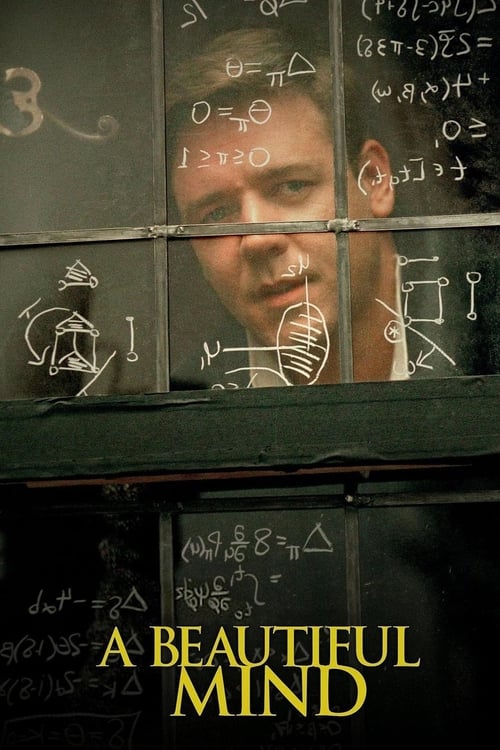
A Beautiful Mind
2001 · Ron Howard
For a night when you want a big, earnest, inspiring drama — the good-cry, against-all-odds kind — with enough mystery in the middle to keep your brain working.
What it's about
John Nash arrives at Princeton in the late 1940s arrogant, awkward, and hunting for one truly original idea — and finds it, launching a career that puts him at the front rank of American mathematics. Secret cryptography work for the government pulls him into a shadowy conspiracy, even as a romance with a brilliant student named Alicia offers him a life outside his own head. The film follows four decades in which his greatest gift and his greatest struggle turn out to be tangled together.
The experience
Sweeping and emotional in the classic Hollywood way, with a mid-film turn that genuinely pulls the rug out — it's a tearjerker that also plays tricks on your certainty. Expect to be moved and to argue about what you saw.
Performances
Russell Crowe carries the film across forty years of one man's life, from insufferable young genius to fragile elder, and Jennifer Connelly won an Academy Award as Alicia, giving what could have been a stand-by-your-man role real anger, exhaustion, and steel.
The craft
The film's boldest choice is to shoot Nash's inner life with the same photographic reality as everything else, so the audience stands exactly where he stands — a structural gamble that turns a biopic into something closer to a thriller. Ron Howard's polished direction and James Horner's swelling score aim straight for the heart and connect.
Why it matters
A blockbuster prestige hit that won four Academy Awards including Best Picture, it brought schizophrenia into mainstream conversation with unusual sympathy and stands as the high-water mark of Ron Howard's dramatic career.
Snapshot
A Beautiful Mind is Ron Howard's prestige biographical drama about John Forbes Nash Jr., the Princeton mathematician whose game-theoretic breakthroughs were shadowed by decades of paranoid schizophrenia. Adapted by Akiva Goldsman from Sylvia Nasar's 1998 biography of the same name, the film stars Russell Crowe as Nash and Jennifer Connelly as his wife, Alicia, and traces a forty-year arc from graduate-student arrogance through delusion to a late, hard-won equilibrium. Its central formal gambit is to render Nash's hallucinations as photographically real characters and events, so that the audience shares his epistemic predicament before the floor gives way. Released at the close of 2001 by Universal and DreamWorks, it became a major awards success, winning four Academy Awards — Best Picture, Best Director, Best Adapted Screenplay, and Best Supporting Actress for Connelly. It also became a flashpoint in debates about the ethics of the biopic, both for what it dramatized and for what it omitted. The film is best understood as a high-craft Hollywood synthesis of the awards-season character study, the "mind under siege" thriller, and the inspirational illness narrative.
Industry & production
The project originated within Brian Grazer and Ron Howard's Imagine Entertainment, the production company whose long partnership with Universal Pictures defined a particular strain of mainstream, star-driven, often fact-based studio filmmaking through the 1990s and 2000s. Grazer optioned Sylvia Nasar's biography, which had been a National Book Critics Circle Award winner and a Pulitzer finalist, and the film was developed as a co-production between Universal and DreamWorks SKG — a co-financing arrangement of the kind common among the majors at the time to share cost and risk on prestige titles. Akiva Goldsman, then better known for genre screenplays, was hired to adapt; Howard, fresh off Apollo 13, Ransom, and EDtv, came aboard to direct.
Casting Russell Crowe placed the film squarely in the awards conversation: Crowe was at a career peak, having just won the Best Actor Oscar for Gladiator, and A Beautiful Mind arrived as a deliberate pivot toward interior, non-physical performance. The film was shot largely on the East Coast, with Princeton University and locations evoking the campus and the postwar Northeast standing in for Nash's world; the production also recreated period interiors and academic spaces. It was positioned for a year-end qualifying release in December 2001 to anchor the studio's Oscar campaign, then expanded into wide release in early 2002. That campaign became unusually contentious. As the film gained front-runner status, press coverage surfaced controversies over its handling of Nash's biography — its compression and omission of episodes from his life, including aspects the film chose not to depict — and the awards season turned into a public referendum on biopic fidelity. The film nonetheless prevailed at the Oscars, and the episode is frequently cited in accounts of how aggressive (and adversarial) Oscar campaigning had become by the early 2000s.
Technology
A Beautiful Mind was made on the cusp of Hollywood's transition to digital intermediate finishing, but it remains fundamentally a photochemical, 35mm production in conception and execution. Its technological interest lies less in novel capture or post-production tools than in the disciplined use of conventional means to a perceptual end. The film's signal challenge was making invisible mental phenomena legible without resorting to obvious "unreality" cues. Rather than coding Nash's hallucinations with distorting lenses, filters, or overt effects — the genre-standard shorthand — the production rendered them with the same lighting, lensing, and staging grammar as the "real" scenes, so that the deception is total until the narrative reveals it. The most technically demanding visualizations are Nash's experience of mathematical pattern-finding: the film uses optical and compositing techniques to make numbers, glyphs, and connections surface within the photographed world (light glinting on glass, patterns resolving out of newsprint and starlight). These are restrained, motivated effects in service of subjectivity rather than spectacle. Practical period detail — typewriters, chalkboards, mid-century academic and domestic spaces — carries much of the world-building, with effects work reserved for the interior register.
Technique
Cinematography
The film was photographed by Roger Deakins, and it is among the clearest demonstrations of his range outside the Coen brothers' filmography. Deakins's strategy is one of seductive realism: the hallucinatory material is lit and composed to be every bit as solid and beautiful as Nash's documented life, which is precisely what makes the eventual reveal land. He uses warm, classical lighting for the Princeton idyll and progressively colder, harder light as Nash's condition and the conspiracy narrative tighten around him. The camera tends toward elegant, controlled movement and carefully balanced compositions rather than handheld immediacy, reinforcing the sense of a coherent, trustworthy world — a trust the film then weaponizes. Deakins also handles the recurring motif of pattern and abstraction, photographing ordinary surfaces so that the audience, like Nash, begins to read meaning into texture and light.
Editing
Cut by Howard's long-standing editing team, Daniel P. Hanley and Mike Hill, the film's construction is built around a single structural deception and its unwinding. The first act and beyond are edited as straightforward biographical drama and conspiracy thriller; the turning point reorganizes the audience's understanding of everything that came before. The editors' task is to sustain the realism of the delusion without cheating — the cutting cannot tip its hand — and then to manage the retroactive reinterpretation. After the reveal, the editing must keep the hallucinatory figures present (they do not simply vanish from Nash's life) while shifting the viewer's relationship to them. The film's later passages, spanning years of recovery and aging, depend on elliptical, time-compressing transitions that move through decades while keeping the emotional throughline intact.
Mise-en-scène / staging
Production designer Wynn Thomas built a world of postwar American academia — Princeton's gothic and collegiate spaces, the institutional surfaces of classrooms and offices, and the period domestic interiors of the Nashes' married life — that grounds the film's reality claim. The staging deliberately treats the imaginary characters as fully embodied participants in space: roommate Charles, the Department of Defense handler Parcher, and the young girl share rooms, doorways, and eyelines with Nash exactly as real people would. Recurring spatial motifs — the boardinghouse rooftop, the pseudo-secret drop site, the chalk-covered windows of Nash's obsessive code-hunting — externalize his cognition. The mise-en-scène also charts illness and aging through changes in dress, posture, and the cluttering or clearing of domestic space.
Sound
James Horner's score is central to the film's emotional and cognitive design. Built around soaring vocal textures (wordless soprano) and shimmering, arpeggiated figures, the music evokes both the beauty Nash perceives in abstract pattern and the vertiginous pull of his obsession; it lends the mathematical sequences a sense of rapture rather than mere cleverness. Horner modulates the same materials toward dread as the conspiracy thread intensifies. The sound design supports the realism strategy by treating hallucinated voices and events with full diegetic presence, so that nothing in the soundtrack flags them as unreal until the narrative does.
Performance
Crowe's Nash is the film's engine: a performance built on physical and vocal idiosyncrasy — averted gaze, halting and overly precise speech, a body that seems to compute rather than relate — that conveys both genius and social estrangement without caricature. The arc demands that he age across four decades and pass through florid psychosis into medicated, effortful stability, and the late performance is notably interior and restrained. Jennifer Connelly's Alicia anchors the film's emotional realism; her Oscar-winning turn carries the burden of the caregiver's exhaustion, fear, and loyalty, and the film's most affecting scenes are often hers. Paul Bettany (Charles), Ed Harris (Parcher), and Christopher Plummer (the psychiatrist Dr. Rosen) provide the surrounding architecture — Bettany and Harris as the warm and the menacing faces of delusion, Plummer as the voice of clinical reality that breaks the spell.
Narrative & dramatic mode
The film's dramatic mode is the subjective biopic organized as an epistemological trap. For its first long stretch it presents itself in two overlapping registers — the gifted-outsider campus drama and the Cold War cryptographic thriller — and invites the audience to accept both at face value. The decisive structural move is the revelation that a substantial portion of what we have watched is Nash's delusion, which forces a wholesale reinterpretation of prior scenes. This places A Beautiful Mind in the lineage of the "unreliable subjectivity" film, where the apparatus has colluded with a protagonist's distorted perception. After the reveal, the film shifts into a more conventional but emotionally weighted recovery-and-endurance narrative, structured around relapse, marital strain, and the slow reclamation of a functioning life and, ultimately, public honor. The throughline is less the solving of a mystery than the management of an incurable condition and the question of whether love and will can coexist with illness.
Genre & cycle
The film sits at the intersection of several cycles. It belongs to the prestige biopic boom of the late 1990s and 2000s, in which studios mined real lives — particularly those of troubled geniuses and historical figures — for awards-caliber star vehicles. It is also part of the "mental illness" cycle of turn-of-the-millennium Hollywood, alongside films that sought to dramatize psychiatric conditions for mainstream audiences. And it participates in the "tortured genius" tradition that links creative or intellectual brilliance to suffering and instability. Its conspiracy-thriller first half borrows the iconography of Cold War paranoia cinema, only to recode that iconography as symptom. The film's particular contribution to the cycle is its commitment to first-person hallucinatory realism as a structural rather than decorative device.
Authorship & method
Ron Howard's authorship is that of the classical Hollywood craftsman: clarity, emotional accessibility, and faith in star performance and clean storytelling over stylistic signature. His method here is to subordinate technique to a single conceptual hook — let the audience inhabit Nash's reality — and then to deliver the resulting drama with unobtrusive polish. The collaboration is highly significant. Akiva Goldsman's screenplay made the controversial but defining choice to dramatize the delusions as scenes rather than describe the illness clinically, and to compress and reshape Nasar's biography into a redemptive arc; this is the source both of the film's power and of its factual critiques. Roger Deakins's cinematography supplies the realism that makes the central conceit work. James Horner's score, one of his signature late-period works, fuses beauty and unease. Editors Daniel P. Hanley and Mike Hill — Howard's regular collaborators — manage the structural sleight of hand. Production designer Wynn Thomas builds the credible world. The film is thus a textbook case of studio authorship distributed across a stable creative team operating at a high level of craft in service of a producer-driven (Grazer/Imagine) prestige project.
Movement / national cinema
A Beautiful Mind is mainstream American studio cinema in its most awards-oriented mode; it is not affiliated with any movement and makes no claim to one. It belongs to the Hollywood tradition of the well-made, emotionally legible prestige picture — the lineage of the studio "quality film" engineered for both broad audiences and critical-institutional recognition. Its national-cinema interest is partly thematic: it is a distinctly American story of Cold War science, the prestige of postwar elite academia, and the national mythology of individual achievement redeemed through perseverance, which it frames in the uplifting register characteristic of Hollywood's self-image.
Era / period
The film is doubly periodized. As an artifact, it is a product of the early-2000s prestige economy: the era of aggressive Oscar campaigning, studio–studio co-financing, and the biopic as reliable awards vehicle. As a representation, it spans roughly the late 1940s through the 1990s, moving from the early Cold War — when game theory, cryptography, and the RAND-adjacent culture of strategic mathematics carried genuine geopolitical weight — through the institutional psychiatry of the mid-century and into Nash's late-life rehabilitation and recognition. The Cold War setting is not incidental: the period's atmosphere of secrecy, surveillance, and existential threat supplies both the plausible texture and the paranoid grammar that the film converts into the substance of Nash's delusion.
Themes
At its center the film is about the relationship between genius and madness, and it resists the romantic equation of the two: Nash's brilliance and his illness are entangled but not identical, and the drama insists that the disease is something to be survived rather than celebrated. It is preoccupied with the unreliability of perception and the terror of being unable to trust one's own mind — a theme it enacts formally rather than merely stating. It is, finally, a film about love as labor: Alicia's caregiving reframes the marriage plot as endurance, and the film locates redemption less in cure than in commitment. Adjacent themes include the social cost of intellect (Nash's isolation), the seductions of pattern and meaning (the wish to find hidden order, which is both the source of his mathematics and the engine of his paranoia), and the public-private gap between honored achievement and private suffering.
Reception, canon & influence
Critical reception was strong but not unanimous. The film was widely praised for Crowe's and Connelly's performances and for the audacity of its central device, and it was rewarded with the year's top industry honors — Best Picture, Director, Adapted Screenplay, and Supporting Actress at the Academy Awards, among other accolades. A significant strand of criticism, however, faulted it as emotionally manipulative and as a sanitized, conventionally uplifting treatment of a far messier life and illness. The most durable controversy concerned biographical fidelity: commentators and journalists scrutinized the film's omissions and compressions relative to Nasar's book and the historical record, and the dispute became part of the era's larger argument about the ethics and accuracy of the Hollywood biopic. Mental-health commentary was likewise mixed, debating whether the film's vivid dramatization of schizophrenia clarified or distorted public understanding of the condition.
Looking backward, the film draws on the Hollywood tradition of the inspirational true-story drama and on the visual and tonal vocabulary of Cold War paranoia cinema, repurposing the latter as the architecture of delusion. Looking forward, its influence is most legible in two areas. First, it reinforced the early-2000s viability of the "genius biopic" as a prestige template — the brilliant, afflicted, real-world protagonist as awards-season anchor — a model many subsequent films would follow. Second, its specific technique of staging mental illness as fully realized, photographically credible scenes, with the reveal as structural pivot, became a frequently cited reference point in discussions of how mainstream cinema represents psychosis and subjective experience. Within Ron Howard's career it stands as the high-water mark of his prestige period and his most decorated film. The record on its precise long-term standing is debated — admirers regard it as a moving, expertly built drama, while detractors see a polished simplification — and that very split is part of its place in the canon: a popular, multiply-awarded film whose reputation remains genuinely contested.
A Deleuzian reading
There's a little girl named Marcee who runs through John Nash's rooms for years.
The full Deleuzian reading of A Beautiful Mind →
Reception
A box-office hit and Best Picture winner in 2002, it has since become the poster child for 'the Oscars got it wrong' — losing esteem as Fellowship of the Ring, Mulholland Drive, and other 2001 films it beat climbed the canon, and as its heavy sanitizing of John Nash's real life drew more scrutiny.
How A Beautiful Mind was received, from release to now →
Influences: the films it descends from and the films it influenced
- Spellbound (1945) — Pioneers staging a disturbed mind's inner states as designed, photographed sequences (the Dalí dream) rather than clinical description — the foundational move of dramatizing delusion as scene.
- The Snake Pit (1948) — Locks the camera to the patient's distorted perception so the audience experiences psychiatric illness from inside it, establishing subjective-POV mental illness as prestige drama.
- The Manchurian Candidate (1962) — Supplies the Cold War paranoia visual grammar — brainwashing, conspiratorial surveillance, coded enemies — that Howard repurposes wholesale as the architecture of Nash's delusional codebreaking work.
- Repulsion (1965) — Films embodied hallucinations with documentary realism so the viewer cannot separate delusion from reality, the exact perceptual trap A Beautiful Mind builds its reveal around.
- Amadeus (1984) — Establishes the prestige genius biopic built on unreliable subjective narration and the genius-and-madness frame as a deliberate awards-architecture.
- Rain Man (1988) — Codifies neurological affliction performed by a star as the Oscar anchor — sympathetic dramatization of mental difference as the engine of a Best Picture campaign.
- Shine (1996) — Direct template: an afflicted real-world genius (a pianist undone by mental breakdown) restructured into a redemptive, performance-driven awards biopic.
- Pi (1998) — Mainstreams Pi's genius-into-madness narrative of a mathematician seeing patterns/numbers everywhere, where the apprehension of hidden numerical order is staged as both gift and psychosis.
- Awakenings (1990) — Directly inherits the prestige-true-neurological-story template: awards-courting, empathetic dramatization of a real brain-disordered subject, using a star's immersive performance to render an invisible neurological condition legible and moving.
- Harvey (1950) — Stages hallucinated companions with normal eyeline-continuity and shot/reverse-shot so the audience shares the delusion until the reveal, deploying Harvey's blocking-around-the-invisible device as a narrative trap.
- The Aviator (2004) — Extends the genius biopic by dramatizing mental illness as escalating embodied subjective episodes (Hughes's OCD compulsions) rather than describing it clinically.
- Shutter Island (2010) — Stages a full delusion as photographically credible scenes within a psychiatric setting, with the late reveal as structural pivot that recontextualizes the entire film — Goldsman's device taken to its limit.
- Black Swan (2010) — Films a psychotic break's hallucinations as literal on-screen events, collapsing the line between subjective and objective so the audience inhabits the unreliable perception.
- The King's Speech (2010) — Runs the affliction-plus-prestige template — an awards anchor built on a star's meticulous performance of impairment as the obstacle the drama resolves.
- The Imitation Game (2014) — The most direct heir: an afflicted-genius codebreaking biopic fusing Cold War secrecy and mental difference into the same awards-anchor architecture A Beautiful Mind perfected.
- The Theory of Everything (2014) — Reshapes a real scientific genius's life and disability into a redemptive, performance-led awards drama on the exact subjective-biopic model.
- The Amazing Spider-Man (2012) — Exemplifies composer James Horner's method that scores TASM — a lyrical piano-and-strings theme deployed as emotional undertow beneath the drama rather than as action bombast, carrying feeling the images underplay.
- Hidden Figures (2016) — Double debt: Wynn Thomas again designs the scholarly interiors, and the film codifies the convention Melfi borrows wholesale of shooting a mathematician writing on a transparent or vertical surface with the camera pushing in as the equation resolves and the face lights.
- Apollo 13 (1995) — The same Imagine/Grazer unit — Howard, editors Hanley and Hill, composer James Horner — executing the identical classical, self-effacing prestige craft in service of a single conceptual hook.
- The Sixth Sense (1999) — Builds the structural reveal that retroactively re-reads every prior scene by exposing that a character's perceived reality was never objectively there.
- Fight Club (1999) — Stages an imaginary companion as a fully embodied, photographically real character interacting with the world, then detonates a reveal that he never existed — the precise device of Charles and Parcher.
- Memento (2000) — Engineers structure itself to lock the audience inside a cognitively compromised protagonist's epistemics, so we share his unreliable subjectivity rather than observe it.
- Cinderella Man (2005) — Same Howard/Goldsman/Hanley-Hill workshop shaping a real life into accessible, uplift-oriented three-act dramaturgy.
Similar films
- The Aviator (2004) — influence & lineage
- Memento (2000) — influence & lineage
- The Imitation Game (2014) — influence & lineage
- Rain Man (1988) — influence & lineage
- Black Swan (2010) — influence & lineage
- Amadeus (1984) — influence & lineage
- Pi (1998) — shared sensibility
- Good Will Hunting (1997) — shared sensibility
All the films related to A Beautiful Mind →