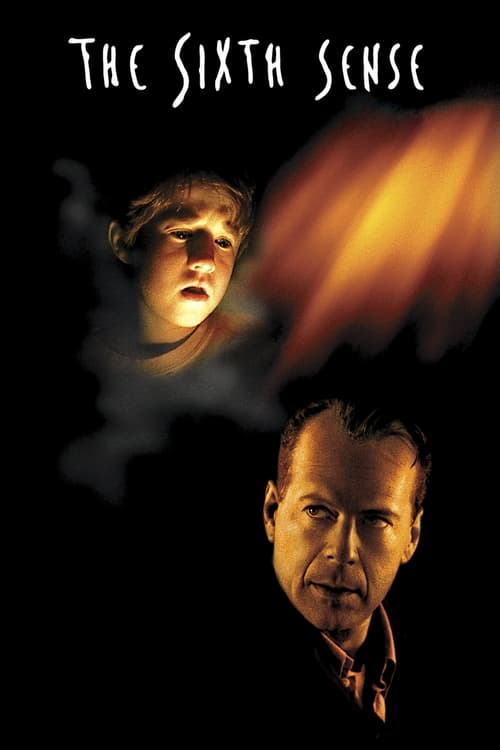
The Sixth Sense
1999 · M. Night Shyamalan
When you want to be spooked but also moved — a ghost story with a heart, best watched at night with someone you can grab. If you've somehow avoided knowing how it ends, protect that at all costs and clear an evening.
What it's about
A Philadelphia child psychologist, shaken by his failure to help a former patient, takes on the case of Cole, a withdrawn nine-year-old boy carrying a secret too frightening to tell anyone. As the doctor works to earn the boy's trust, he discovers Cole's problem is far stranger than anything in his training — the boy says he sees the dead. Meanwhile the doctor's own marriage is quietly falling apart.
The experience
A slow-burn chill rather than a jump-scare machine — hushed, mournful, and genuinely eerie, with moments of real dread and an emotional undertow that sneaks up on you. It's as much a sad story about a frightened kid and a struggling man as it is a ghost story.
Performances
Haley Joel Osment, at nine years old, gives one of the great child performances — terrified, precise, and heartbreaking — and Bruce Willis, cast against his action-star image, is all quiet restraint. Toni Collette is superb as Cole's exhausted, fiercely loving mother.
The craft
Shyamalan directs with unusual patience for a studio thriller: long still takes, muted colors, silences that make you lean in, and scares built on suggestion rather than noise. The screenplay is a piece of watchmaker's construction — every scene doing double duty in ways you only appreciate afterward. Watch it with good sound and no distractions; it's built on quiet.
Why it matters
A word-of-mouth phenomenon that became one of 1999's biggest hits, earned six Oscar nominations including Best Picture, and made Shyamalan a brand name — while making the engineered final-act twist a cultural obsession for a decade of thrillers after it.
Snapshot
The Sixth Sense is the film that made M. Night Shyamalan a brand name and, briefly, a synonym for the engineered cinematic twist. A supernatural drama disguised as a psychological thriller — or perhaps the reverse — it follows Malcolm Crowe (Bruce Willis), a Philadelphia child psychologist haunted by his failure to save a former patient, as he takes on the case of Cole Sear (Haley Joel Osment), a withdrawn nine-year-old who confides that he "see[s] dead people." Released by Hollywood Pictures (a Disney label) in August 1999, it became one of the year's defining commercial phenomena, riding sustained word of mouth to a position among the highest-grossing films of its year and earning six Academy Award nominations, including Best Picture, Best Director, and Best Original Screenplay. Its reputation rests on a final-reel revelation so widely discussed that it reshaped how a mainstream audience thinks about narrative reliability. Yet the film's durability owes less to the trick than to its patience: a restrained, grief-soaked chamber piece about loneliness, communication, and the unfinished business between the living and the dead.
Industry & production
The film arrived at a pivotal moment for both its director and its studio. Shyamalan, a Philadelphia-raised filmmaker of Indian descent then in his late twenties, had directed two little-seen features (Praying with Anger and Wide Awake) and contributed to the screenplay of Stuart Little. His spec script for The Sixth Sense became the object of a competitive bidding situation; the widely reported account is that Disney's Hollywood Pictures acquired it for a sum in the multi-million-dollar range while allowing Shyamalan to direct — an unusual concession for a young filmmaker, and one that the studio's subsequent fortunes vindicated. I flag the exact purchase figure as belonging to the realm of frequently repeated trade lore; the precise number should be treated with caution rather than cited as fact.
Production was Philadelphia-centric, a choice that became central to Shyamalan's authorial identity. Kathleen Kennedy, Frank Marshall, and Barry Mendel produced. The casting of Bruce Willis — a bankable action star deliberately cast against type in a quiet, interior register — gave the project commercial ballast; the discovery of Haley Joel Osment gave it its soul. The budget was modest by star-vehicle standards (generally reported around $40 million), and the film's theatrical performance vastly outstripped it, with a long box-office tail driven by audiences returning to re-watch the film through the lens of its ending. That second-viewing economy was itself a marketing asset, and the studio's campaign leaned on intrigue and the now-iconic tagline rather than on spoiling the premise.
Technology
Technologically, The Sixth Sense is a conventional late-1990s 35mm production rather than a showcase for innovation, and its restraint is the point. Shot photochemically, the film largely eschews the digital-effects spectacle then ascendant in Hollywood. Its supernatural manifestations are achieved through staging, makeup, framing, and sound rather than computer-generated imagery; the dead appear as ordinary-looking people bearing the physical marks of their deaths — practical prosthetic and makeup effects in the tradition of grounded horror rather than digital apparitions. This analog, low-spectacle approach was a deliberate aesthetic decision that aligned the film with a tradition of "quiet" supernatural cinema, and it has aged unusually well precisely because it did not stake its effects on a particular generation of software.
Technique
Cinematography
The cinematography, by Tak Fujimoto — a seasoned collaborator of Jonathan Demme whose credits include The Silence of the Lambs — is fundamental to the film's mood and to its concealment of information. Fujimoto and Shyamalan favor a cool, desaturated Philadelphia palette of muted blues and grays, against which the color red is rationed and weaponized: red marks moments where the ordinary world has been breached by something hidden — a doorknob, a balloon, a sweater, the church-red of significant objects. This is a disciplined motif rather than a gimmick, and it rewards the attentive viewer on a second pass.
Equally important is the film's commitment to wide shots, long takes, and a relatively static, contemplative camera. Shyamalan tends to let scenes play in masters, holding actors at a measured distance and trusting blocking over coverage. This restraint serves the narrative architecture: by avoiding aggressive shot-reverse-shot patterns in key scenes, the film can stage two characters in a shared frame while quietly withholding the nature of their interaction. The camera's patience reads as classical good taste on first viewing and as deliberate misdirection on the second.
Editing
Andrew Mondshein's editing is the film's most underappreciated technical achievement, because its job is to be invisible in exactly the right places. The picture's celebrated construction depends on a contract with the audience that is maintained through what is shown and, more crucially, what is omitted. The cutting establishes a deliberate, unhurried rhythm appropriate to a grief narrative, and it carefully manages eyelines and reaction shots so that the audience reads scenes one way the first time and another way the second. The film's closing sequence, which recontextualizes earlier material, functions as an editorial argument: a montage of revisited moments that retroactively reorganizes everything the viewer thought they understood. Mondshein received an Academy Award nomination for the work, an unusual honor for editing whose virtuosity lies in concealment.
Mise-en-scène / staging
Shyamalan's staging is theatrical in the best sense — built on blocking, distance, and the meaningful placement of bodies in domestic and institutional spaces. Interiors are central: the Crowe home, Cole's apartment, the basement, the school, the hospital. These rooms are rendered with a quiet realism that grounds the supernatural in the everyday. The director's preference for keeping the camera back and letting performers move within the frame turns ordinary spaces into stages on which presence and absence are negotiated. Recurring motifs — cold spots, breath made visible, objects displaced — are staged practically and economically, so that the uncanny erupts from the mundane rather than being imposed upon it.
Sound
Sound is arguably the film's primary instrument of fear. The score by James Newton Howard — the first of many collaborations between composer and director — is restrained and elegiac, more concerned with sorrow than with shock, deploying strings and a haunting choral coloration that lends the supernatural a register of mourning rather than menace. Between the musical cues, the sound design exploits silence and low-frequency texture: the sudden drop in room tone, the unexplained whisper, the ambient signal that the temperature has changed. The film teaches the audience to listen for what should not be there, making aural attention itself a source of dread. This emphasis on the sonic over the visual is one reason the horror lands without graphic display.
Performance
Performance is where the film's emotional credibility is won or lost, and The Sixth Sense is built on a remarkable child-adult duet. Haley Joel Osment, eleven at the time of filming, delivers one of the most acclaimed child performances in modern American cinema — a turn of unusual containment and gravity that earned him an Academy Award nomination for Best Supporting Actor. His Cole is not a precocious movie-child but a frightened, exhausted boy carrying an unbearable burden; the performance's restraint makes its breakthroughs devastating. Bruce Willis, cast against type, gives a muted, melancholy performance that subordinates his star persona to the material's quiet demands. Toni Collette, as Cole's overwhelmed single mother Lynn, grounds the film's most cathartic scene — a parked-car exchange that converts the supernatural premise into a statement about a parent's love — and earned her own Best Supporting Actress nomination. Olivia Williams, as Crowe's wife Anna, performs a role whose full meaning is legible only in retrospect.
Narrative & dramatic mode
The Sixth Sense is the definitive popular example of the modern "puzzle film" or twist narrative, in which the story is engineered so that a final revelation forces a wholesale reinterpretation of everything preceding it. Its dramatic mode, however, is not that of the thriller but of the chamber drama: a small cast, interior spaces, and a structure organized around the slow building of trust between psychologist and child. The supernatural plot is a vehicle for a therapeutic one — the film is, on its surface, about a doctor trying to help a patient he previously failed.
The screenplay's craft lies in its rigorous use of dramatic irony and controlled information. It is structured so that withheld knowledge is never technically falsified, only framed to invite a particular misreading — a contract that the most admiring analyses praise for playing fair, and that skeptics scrutinize for cheats. Beyond the famous turn, the script practices a quieter narrative discipline: it braids Cole's arc, Crowe's marital estrangement, and the procedural of helping a single ghost (the poisoned girl) resolve her business, so that the film's climax is emotional rather than merely clever. The result is a narrative that survives the spoiler, because its real subject is grief and the difficulty of being heard.
Genre & cycle
The film sits at the intersection of supernatural horror, psychological thriller, and domestic melodrama, and it helped define a turn-of-the-millennium cycle of "prestige" or "quiet" ghost stories that pursued atmosphere and emotion over gore. It belongs in conversation with Alejandro Amenábar's The Others (2001) and Hideo Nakata's Ringu (1998) and the broader J-horror wave then cresting — films that located dread in stillness, in the domestic, and in the unfinished dead. The Sixth Sense demonstrated that a PG-13 supernatural drama, marketed on mystery rather than spectacle, could achieve blockbuster scale, and it catalyzed a late-1990s/early-2000s appetite for the twist-driven thriller, a cycle that includes The Others, Memento (2000), and the broader popular fascination with the unreliable narrative that defined the period.
Authorship & method
The Sixth Sense is the cornerstone of M. Night Shyamalan's authorial identity, establishing the signatures that would define — and eventually typecast — his career: the Philadelphia setting; the high-concept supernatural or science-fictional premise treated with somber sincerity; the patient, master-shot visual style; the foregrounding of children and damaged fathers; the recurrent theme of faith, fate, and communication across thresholds; the director's own Hitchcock-like cameo; and, above all, the structural twist. The film inaugurated his most fruitful collaborations. Composer James Newton Howard would score nearly all of Shyamalan's subsequent films, forming one of the more consistent director-composer partnerships in contemporary Hollywood. Cinematographer Tak Fujimoto, editor Andrew Mondshein, and producer Barry Mendel were essential to translating the script's reticence into image and rhythm.
Shyamalan's method as a writer-director is notable for its control: he conceives these films as constructed objects in which every early scene is engineered to pay off later, an approach that demands precise collaboration from his department heads, particularly in cinematography and editing, where the concealment of information is a technical task. The film's success briefly positioned him, in the press of the era, as a designated heir to Spielberg and Hitchcock — a framing that set expectations his uneven subsequent career (Unbreakable, Signs, The Village, and beyond) would both honor and strain.
Movement / national cinema
The film belongs to mainstream American studio cinema of the late 1990s, but it is inflected by Shyamalan's specifically Philadelphian, regional sensibility — a deliberate alternative to Los Angeles and New York shooting that gave his work a distinctive, slightly out-of-time East Coast atmosphere. It is also legible within the broader globalization of horror at the millennium: while not a product of any organized movement, it ran parallel to, and arguably anticipated the American appetite for, the J-horror aesthetic of restraint and domestic haunting that Ringu and its successors would soon export. As the work of a first-generation Indian American filmmaker who reached the commercial summit of Hollywood, it also occupies a notable place in the history of Asian American authorship in mainstream cinema, though the film itself does not foreground that identity in its text.
Era / period
The Sixth Sense is a quintessential film of 1999 — a year often cited as a high-water mark for American cinema, alongside The Matrix, Fight Club, Magnolia, Being John Malkovich, and American Beauty. Many of that year's signature films share a preoccupation with unstable reality, hidden truths, and narrators or protagonists who do not understand their own situations, and Shyamalan's film is the most populist expression of that millennial mood of epistemic uncertainty. Arriving on the cusp of the digital transformation of the industry, it represents a late, confident statement of analog, craft-based, character-driven studio filmmaking, even as the blockbuster landscape around it was tilting toward digital spectacle.
Themes
The film's deepest theme is grief and the unfinished business of the dead — the idea that the departed linger because something remains unresolved, and that the living, too, can be trapped by what they have not faced. It is, fundamentally, a story about the failure and recovery of communication: Cole cannot tell his mother his secret; Crowe cannot reach his wife; the dead cannot be heard by the living. Healing, in the film's moral logic, comes through being truly listened to — the therapeutic and the supernatural converge on the same act of attention. Related motifs run throughout: fatherhood and mentorship (Crowe as surrogate father, Cole's absent one); the loneliness of the misunderstood child; faith and the threshold between worlds; and the redemptive turn by which fear becomes empathy, as Cole learns to help the dead rather than flee them. The parked-car scene between Cole and his mother distills the whole: the supernatural is ultimately a language for expressing love that could not otherwise be spoken.
Reception, canon & influence
Critical reception was strong and, in retrospect, somewhat overtaken by the film's cultural ubiquity. Reviewers praised its mood, its restraint, and especially Osment's performance; the screenplay's construction drew admiration for its audacity, with some skeptics debating whether it played entirely fair. The Academy's response was emphatic: six nominations, including Best Picture, Best Director, Best Original Screenplay, Best Supporting Actor (Osment), Best Supporting Actress (Collette), and Best Film Editing — though, in a competitive year, it converted none into wins. Commercially it was a sensation, sustained over months by the rare phenomenon of audiences returning to study a film they already knew the ending to.
Looking backward, the film draws on a deep lineage of supernatural and psychological cinema. Its DNA includes the restrained ghost stories of the past — Jack Clayton's The Innocents (1961) and the Val Lewton/Robert Wise tradition of suggestion over display — and the architectural plotting of Alfred Hitchcock, whose engineering of audience knowledge Shyamalan openly admired. The conceit of a protagonist who misapprehends his own condition belongs to a long tradition of revelation narratives in literature and film, and the film's therapeutic frame connects it to a strain of psychological drama in which diagnosis and haunting blur.
Looking forward, The Sixth Sense exerted outsized influence. It helped legitimize the twist as a mainstream commercial engine and made "I see dead people" and the very notion of "the twist ending" objects of pop-cultural shorthand — to the point that the film's reputation now contends with the spoiler-saturation it helped create. It accelerated the cycle of quiet, prestige supernatural dramas (The Others most directly) and validated the PG-13 atmospheric ghost story as a studio proposition. It launched Shyamalan as an auteur-brand whose name itself promised a structural surprise, shaping audience expectations for an entire subsequent body of work and a generation of imitators. And it stands as a case study, frequently taught, in how editing, cinematography, and performance can be marshaled to manage audience knowledge — a film whose craft is inseparable from its most famous trick, and whose emotional sincerity is the reason that trick still moves people after it can no longer surprise them.
A Deleuzian reading
Breath.
The full Deleuzian reading of The Sixth Sense →
Reception
A sleeper that nobody saw coming — it opened in August 1999 as a modest supernatural drama and snowballed into the second-biggest film of the year, earning six Oscar nominations including Best Picture. It's since become the yardstick every twist ending gets measured against, and the peak from which every Shyamalan comeback narrative is charted.
How The Sixth Sense was received, from release to now →
Influences: the films it descends from and the films it influenced
- The Innocents (1961) — Establishes the model of ambiguity-by-staging — ghosts framed in deep-focus CinemaScope so the audience is never told whether the haunting is real or the protagonist's projection, the same restraint Shyamalan uses to hide his reveal in plain sight.
- Cat People (1942) — The Val Lewton method of horror by suggestion — withholding the supernatural object and letting sound and negative space imply it — is the production grammar Shyamalan inherits for his PG-13, display-averse hauntings.
- The Haunting (1963) — Wise extends Lewton's suggest-don't-show technique to the architectural ghost film, treating the house's empty rooms and off-screen sound as the scare — the elegant atmospheric reticence Fujimoto and Mondshein reproduce.
- Carnival of Souls (1962) — The direct structural ancestor: a protagonist who fails to grasp she is already dead, the film's events reread once that condition is revealed — the precise mechanism of Malcolm Crowe's arc.
- Vertigo (1958) — Hitchcock's engineering of what the audience knows versus what the hero knows — restricting POV to a deluded male protagonist — is the openly-admired blueprint for Shyamalan's information-management plotting.
- Psycho (1960) — Demonstrates the legitimacy of the third-act revelation that retroactively rewrites every prior scene, plus the director-as-brand cameo Shyamalan adopts wholesale.
- Don't Look Now (1973) — The template for grief-coded supernatural cinema built on a recurring red-color motif (the dwarf's coat / Cole's accents) and associative editing that seeds a fatal premonition the protagonist misreads until the end.
- The Shining (1980) — Pairs a psychically gifted child who communicates with the dead with deliberate, gliding master-shot coverage — the marriage of a 'sixth sense' child and patient camera Shyamalan stylizes.
- Jacob's Ladder (1990) — A wounded man moving through a haunted world that is the afterlife he hasn't accepted — the dead-protagonist reveal fused to a therapeutic, grief-processing frame.
- The Usual Suspects (1995) — Shyamalan inherits Singer's retroactive-recontextualization architecture as the film's primary structural mechanism—the reveal forces a complete mental re-cut of every prior scene—extending the Usual Suspects' final-minutes re-editing into a design premise engineered from the first shot.
- Diabolique (1955) — Modern apotheosis of the twist-as-audience-contract and the retroactive POV reframe — its marketing of secrecy is the direct heir of Diabolique's anti-spoiler closing plea.
- The Crying Game (1992) — Cuts every scene twice-readable so the reveal is hidden in plain sight, and reproduces the platform release with a 'don't tell the ending' pledge as distribution strategy — both inherited from The Crying Game's rollout.
- The Others (2001) — The most direct heir: a hushed, PG-13 prestige ghost story whose climactic reveal that the living family are the dead deploys the same withheld-knowledge editing strategy.
- The Devil's Backbone (2001) — Extends the suggestion-over-display ghost as an emblem of unresolved grief and trauma, the spectre treated with somber sincerity rather than as a monster-movie threat.
- A Tale of Two Sisters (2003) — Builds an entire domestic horror on unreliable perception whose twist forces a full rewatch-rereading, inheriting Shyamalan's 'fair-play' clue-planting and concealment editing.
- The Orphanage (2007) — Carries forward the grief-driven, child-centered quiet ghost story with a delayed revelation that recontextualizes the mother's search — Shyamalan's emotional sincerity over shock.
- The Babadook (2014) — Inherits the 'haunting as metaphor for grief' lineage Sixth Sense mainstreamed, using restrained sound design and a child performance to externalize bereavement rather than gore.
- Hereditary (2018) — Descends through the grief-as-horror and elegiac-restraint strain, marshalling long static master shots and a child performance to manage dread and a late structural reframing of the family's fate.
- Identity (2003) — Codifies the fair-play retroactive-reframe twist of its era — clues seeded so the final reveal forces a re-read of the whole film — the 'twist-film' grammar Identity openly adopts.
- Intacto (2001) — Models the withholding editorial rhythm — an elliptical-revelation cut that retroactively reorganizes the whole film — that Nacho Ruiz Capillas deploys for Intacto's reveals.
- Kishkindha Kaandam (2024) — Perfected the terminal reveal that recontextualizes every prior frame, rewarding rewatch by re-reading visual information the camera had shown plainly but the viewer misinterpreted.
- The Black Phone (2022) — Its restrained supernatural grammar — the dead seeking a living child to complete their unfinished business, revealed through withheld information — underpins the film's coaching-ghosts conceit and refusal of spectacle.
- Maharaja (2024) — Plants the decisive clue in plain sight and reserves a single final revelation that reinterprets earlier scenes, the object-in-plain-sight / retroactive-reveal grammar Maharaja adopts.
- Marrowbone (2017) — Built the twist as a mourning device rather than a gotcha, serviced by a closing montage of re-screened earlier shots; Marrowbone's reprise-reveal reproduces both the montage form and its consoling, non-punitive tone.
- Unbreakable (2000) — Shyamalan's immediate self-extension — same Philadelphia setting, Fujimoto master-shots, James Newton Howard elegiac score, damaged-father/child dyad, and engineered final-scene twist, made as a deliberate companion.
- Shutter Island (2010) — Twist-revelation engineered for rewatchability, with clues planted so a second viewing reads as a different film — the rewatchable-twist craft Shutter Island perfects.
- Open Your Eyes (1997) — Crests the same late-1990s mind-game cycle with a retrospective twist that retroactively rewrites every prior scene, the puzzle-film grammar of delayed disclosure Open Your Eyes helped seed.
- A Beautiful Mind (2001) — Builds the structural reveal that retroactively re-reads every prior scene by exposing that a character's perceived reality was never objectively there.
- Donnie Darko (2001) — The reveal-that-reorganizes-the-whole-film design, engineering a melancholy supernatural twist that rewards and demands a second viewing.
- The Machinist (2004) — Pioneers the mise-en-scène-as-clue twist that forces a wholesale rereading of every prior scene once the protagonist's misperception is exposed.
- Signs (2002) — Same Fujimoto muted palette and motivated long-take camera plus Tulliver's withholding cut, building the retrospective-design reveal where late information re-reads earlier scenes.
Similar films
- Unbreakable (2000) — influence & lineage · same viewing thread
- The Shining (1980) — influence & lineage
- Jacob's Ladder (1990) — influence & lineage
- The Others (2001) — influence & lineage
- The Innocents (1961) — influence & lineage
- Signs (2002) — same viewing thread
- Split (2017) — same viewing thread
- The Exorcist (1973) — shared sensibility
All the films related to The Sixth Sense →
Watch it with: curated runs of related films
- Shyamalan's Wounded Believers — A run of Shyamalan's ordinary-people-meet-the-extraordinary parables — grief, faith, and hidden gifts surfacing in quiet Pennsylvania lives — that reward being watched in sequence as the twist-craft and the belief questions deepen from one to the next.