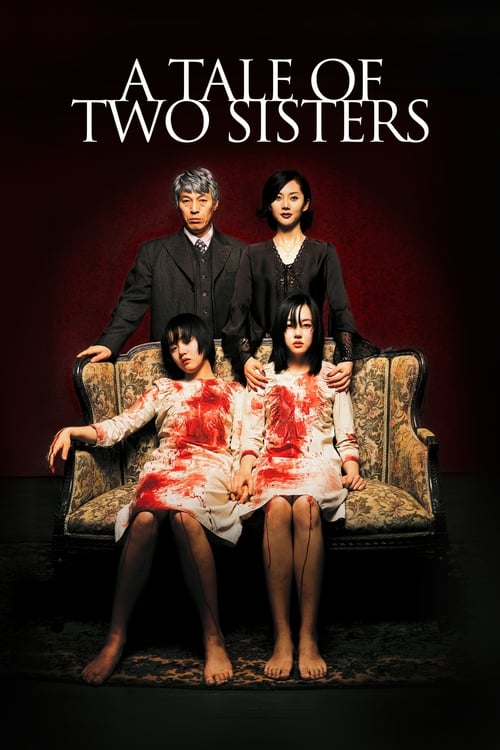
A Tale of Two Sisters
2003 · Kim Jee-woon
For when you want a real scare that also breaks your heart — horror you feel in your chest, not just your nerves. A challenge, not a comfort watch, and best taken in one sitting with full attention.
What it's about
Two sisters come home to a remote country house after a stay in a mental institution, and nothing about the homecoming feels right. Their father is withdrawn, their young stepmother is by turns brittle and cruel, and the house itself seems to hold something that won't stay quiet. As strange occurrences pile up, the family's buried history starts pushing its way to the surface, and it gets harder to tell what's haunting and what's memory.
The experience
Slow-building dread punctuated by genuinely frightening jolts — but the real weight is grief, and it lands hard. It's the rare horror film that leaves you sad as much as scared, and the ambiguity keeps working on you after the lights come up.
Performances
Im Soo-jung is ferocious and fragile as the older sister, and Yum Jung-ah makes the stepmother unforgettable — a performance that swings from porcelain politeness to something much more unnerving.
The craft
Kim Jee-woon builds the whole film out of interiors — wallpaper, hallways, the space under furniture — until the house feels like a character with secrets. The production design and sound are meticulous, wringing menace from floral patterns and silence; watch it in the dark with good speakers and it gets under your skin. Its withholding structure rewards a second viewing, where every scene reads differently.
Why it matters
A high point of the Korean horror wave of the early 2000s and a breakthrough for Kim Jee-woon, it traveled internationally, drew a Hollywood remake, and helped establish Korean genre cinema's reputation for marrying craft with real emotional stakes.
Snapshot
A Tale of Two Sisters (Janghwa, Hongryeon) is a Korean psychological horror film written and directed by Kim Jee-woon, released in mid-2003. It loosely adapts Janghwa Hongryeon jeon, a Joseon-era folktale about two sisters destroyed by a cruel stepmother that had been filmed repeatedly in Korea since the silent era. Kim retains the folktale's emotional skeleton — sisterhood, a hostile stepmother, a passive father, drowned grief — but transposes it into a contemporary, ambiguously gothic domestic space and structures the whole around a withheld revelation. The film follows Su-mi, returning to a remote country house after time in a psychiatric institution, her younger sister Su-yeon, their tense father, and their stepmother Eun-joo, as eerie occurrences and escalating cruelty blur memory, guilt, and the supernatural. It became one of the most commercially and critically successful Korean horror films of its era, a touchstone of the early-2000s East Asian horror wave, and the basis for the 2009 American remake The Uninvited. Its reputation rests less on shock than on dread, design, and a structure built to be reread.
Industry & production
The film was produced within the resurgent South Korean film industry of the early 2000s, a period of rapid commercial expansion, rising production values, and growing international visibility following crossover successes such as Shiri (1999) and Joint Security Area (2000). It was produced by the company associated with Kim Jee-woon's earlier work and distributed theatrically in Korea by a major domestic distributor; specific contractual and budget figures are not reliably documented in the public English-language record, and I will not invent them. What is well established is that the film opened strongly and became, by the accounts of the period, among the highest-grossing domestic horror films Korea had produced to that point, a commercial milestone for the genre within that national market.
Its production sits at a moment when Korean genre cinema was being aggressively licensed and remade abroad. The film's overseas rights were sold internationally, it circulated widely on the festival and arthouse-horror circuit, and Hollywood acquired remake rights, resulting in DreamWorks' The Uninvited (2009). This pattern — a polished Korean genre film with strong design and a high-concept twist being optioned for an American remake — was characteristic of the early-to-mid 2000s traffic in Asian horror that followed the success of remakes of Ringu and Ju-on. Kim Jee-woon was already an established director, having made the dark comedy The Quiet Family (1998) and the wrestling comedy The Foul King (2000); A Tale of Two Sisters marked his decisive turn toward tonal seriousness and visual maturity, and consolidated his standing as a major figure of the so-called Korean New Wave.
Technology
The film was produced and exhibited photochemically, shot and finished on 35mm in the conventional manner of Korean studio features of 2003, before digital intermediate workflows and digital projection became standard in the territory. Its effects are predominantly practical and in-camera: makeup and prosthetic work for the film's spectral and corpse imagery, staged physical gags, and careful art-direction rather than heavy digital compositing. Where the film achieves its uncanny atmosphere, it does so largely through controlled lighting, color, set construction, and sound design rather than visual-effects technology. This restraint is itself significant: the film belongs to a horror tradition that derives terror from composition, off-screen space, and timing rather than from CGI spectacle, and its technological conservatism is inseparable from its aesthetic of suggestion. I have not found reliable detail on specific camera or lens packages, so I will not assert them.
Technique
Cinematography
The cinematography, by Lee Mo-gae — a frequent Kim Jee-woon collaborator — is among the film's most celebrated elements and central to its reputation. The visual scheme is unusually saturated and decorative for a horror film: warm woods, patterned wallpapers, floral fabrics, and a palette of greens, reds, and deep ambers that render the house both beautiful and oppressive. The image is composed with a painterly, almost storybook richness that sets a constant ironic tension against the dread of the narrative. Framing favors symmetry, doorways, and thresholds — characters are repeatedly seen through frames-within-frames, isolated within the architecture. Lee uses controlled, often slow camera movement and carefully motivated light sources to keep the supernatural latent within the everyday; the horror tends to emerge from the edges and depths of well-lit, beautifully appointed rooms rather than from darkness alone. This combination of beauty and menace is a defining signature of the film.
Editing
The film's editing strategy is governed by its withheld structure. Time, memory, and reality are deliberately destabilized: scenes are constructed so that their full meaning is legible only retrospectively, and the cutting both conceals and seeds the eventual revelation. The pacing is patient, weighted toward dread and atmosphere rather than rapid shock-cutting, with sustained takes that let unease accumulate before release. Jump scares exist but are rationed and timed for maximum effect against long passages of quiet. The reordering and reinterpretation of events — what the audience believes it has witnessed versus what it later understands to have happened — is the film's principal formal achievement, and the editing is the instrument that makes its ambiguity coherent rather than merely confusing.
Mise-en-scène / staging
Production design (by Cho Geun-hyun, per the standard credits) is arguably the film's signal accomplishment. The house is a fully realized character: a richly furnished, period-inflected domestic interior whose wallpaper, upholstery, kitchen, and corridors are saturated with pattern and color. The decor's prettiness is weaponized — the very abundance of floral and ornamental detail becomes claustrophobic and sinister. Staging exploits the geography of the house relentlessly: bedrooms, the space under the sink, hallways, and a recurring threshold-crossing dread organize the film's set pieces. Objects and rooms carry concealed meaning that the staging both displays and hides. The mise-en-scène's fusion of the domestic and the gothic — a horror located inside the apparatus of bourgeois family comfort — is the film's thematic argument made visible.
Sound
Sound design is essential to the film's terror and is handled with notable subtlety. The film is attentive to small domestic sounds — footsteps, the rustle of fabric, dripping, the mechanics of the house — and to silence, using restraint to make sudden intrusions land harder. The score, by composer Lee Byung-woo, is lyrical and mournful rather than conventionally frightening, foregrounding melancholy and loss; its delicate, melodic theme underlines the film's grief-stricken core and stands in deliberate contrast to its scare set-pieces. This pairing of a tender score with horror imagery reinforces the film's identity as a tragedy of family and memory wearing the clothes of a ghost story.
Performance
Performance is pitched toward interiority and slow revelation. Lim Soo-jung as Su-mi anchors the film with a performance that must register protectiveness, fragility, defiance, and concealed damage; Moon Geun-young plays the younger sister Su-yeon with vulnerability; and Yum Jung-ah as the stepmother Eun-joo gives the film its most volatile, theatrically charged presence, modulating between brittle propriety and menace. Kim Kap-soo plays the remote, evasive father. The performances are calibrated to the film's structure: actions and affect that read one way on first viewing acquire different meaning on reflection, and the cast sustains that double legibility. Yum's stepmother in particular became one of the film's most discussed elements, a portrait of cruelty whose nature the film deliberately complicates.
Narrative & dramatic mode
The film operates in a mode of sustained ambiguity, withholding a stable account of reality until late and then forcing a retrospective reinterpretation of everything preceding. Its dramatic engine is not the question "what will happen?" but "what is actually happening, and what already has?" The narrative braids domestic melodrama — a fractured family, a resented stepmother, sibling devotion — with gothic horror and the psychological case study, refusing to let any one register settle. It is structured around grief and guilt as much as around fear, and its scares are frequently expressions of psychological states rather than autonomous supernatural threats. The film trusts the audience to sit in confusion, planting details whose significance is deferred, and its emotional payoff is closer to tragedy than to the cathartic punishment of a conventional ghost story. This commitment to unreliability and delayed comprehension is what distinguishes it from the more linear shock structures of much contemporaneous horror.
Genre & cycle
A Tale of Two Sisters belongs to the early-2000s wave of East Asian horror that achieved global visibility in the wake of Japanese films like Ringu (1998) and Ju-on (2002). Within that cycle it represents a distinctly Korean strand, one rooted in domestic and familial trauma, gothic interiors, and folktale source material rather than in the technological-curse or urban-legend templates prominent in Japanese horror. It is at once a ghost story, a psychological thriller, and a family melodrama, and it helped define a recognizable Korean horror sensibility characterized by lush visual design, emotional gravity, and twist-driven structure. It is frequently cited as one of the defining films of the K-horror boom and, more broadly, as part of the early-2000s international vogue for Asian horror that fueled a wave of Hollywood remakes.
Authorship & method
The film is the work of Kim Jee-woon as writer-director, and it crystallizes his authorial method: genre virtuosity married to formal control and tonal ambition. Across a career notable for restless genre-hopping — horror here, the western pastiche The Good, the Bad, the Weird (2008), the noir-thriller I Saw the Devil (2010), the period gangster film The Age of Shadows (2016), and a brief English-language studio film, The Last Stand (2013) — Kim is consistently identified with meticulous mise-en-scène, precise control of tone, and a willingness to push genre forms toward extremity or melancholy. A Tale of Two Sisters is widely regarded as one of his finest and most personal achievements.
The film is also a collaboration with key craftspeople central to its identity: cinematographer Lee Mo-gae, whose color and composition give the film its painterly dread and who worked with Kim across multiple films; composer Lee Byung-woo, whose mournful score supplies the emotional undertow; and a production-design team whose construction of the house is inseparable from the film's meaning. Kim's adaptation method is itself notable — he excavates a centuries-old, much-filmed folktale and reconstructs it as a modern psychological puzzle, keeping the archetypes (sisters, stepmother, father, drowning, injustice) while replacing the folktale's supernatural moral economy with ambiguity and trauma.
Movement / national cinema
The film is a product of the Korean New Wave / Korean cinema renaissance of the late 1990s and 2000s, the same industrial and creative ferment that produced Park Chan-wook, Bong Joon-ho, and Kim Ki-duk and that brought Korean cinema to sustained international prominence. It exemplifies that movement's combination of commercial ambition, technical polish, genre fluency, and authorial seriousness. Its engagement with a canonical Korean folktale also situates it within a specifically national tradition: Janghwa Hongryeon jeon had been adapted for the screen many times across Korean film history, and Kim's version is both a continuation of and a radical departure from that lineage, modernizing a story deeply embedded in Korean popular culture.
Era / period
Made and set in the early 2000s, the film reflects its moment in several ways: the maturation of Korean genre filmmaking, the global circulation of Asian horror, and an industry confident enough to mount a horror film of this design ambition for a mainstream audience. Yet its aesthetic deliberately resists contemporaneity — the house, costumes, and decor evoke an unfixed, slightly anachronistic gothic past, lending the film a timeless, fairy-tale quality at odds with its modern psychological framework. This temporal ambiguity is purposeful: by loosening the film from a specific present, Kim heightens its folktale resonance and its dreamlike unreliability.
Themes
The film's central concerns are grief, guilt, memory, and the family as a site of horror. Its true subject is loss and the psyche's refusal to accept it — mourning that curdles into haunting, and guilt that manifests as both ghost and delusion. Sisterhood and the protective bond between siblings sit at its emotional center, set against the figure of the stepmother and the failure of the father, reworking the folktale's archetype of domestic cruelty. The film repeatedly stages the home — the supposed seat of safety and care — as a place of menace, making the bourgeois domestic interior itself the locus of dread. Running through all of this is the instability of reality and perception: the film dramatizes how trauma distorts memory and how the mind constructs and conceals the truths it cannot bear. Its horror is ultimately psychological and tragic, an account of a wound that cannot be closed.
Reception, canon & influence
Critically, A Tale of Two Sisters was strongly received both in Korea and internationally and has since been canonized as one of the finest Korean horror films and a high point of the early-2000s Asian horror wave. Commentary has consistently praised its visual design, its atmosphere, its emotional depth relative to genre norms, and its ambitious structure, while some viewers have found its deliberate ambiguity demanding — a divisiveness that is itself a mark of its refusal of easy genre satisfaction. It retains a durable reputation among horror critics and cinephiles as a model of mood-driven, design-led horror.
Looking backward, the film draws on the centuries-old Korean folktale Janghwa Hongryeon jeon and its long screen tradition; on the gothic tradition of the haunted domestic interior; and on the broader contemporaneous Asian horror cycle, particularly the atmospheric, ghost-centered Japanese horror that had reframed the genre internationally. Its emphasis on the wronged female figure and the family curse connects it to deep currents in both Korean folklore and the wider horror canon.
Looking forward, its most concrete legacy is the American remake The Uninvited (2009), which adapted its premise for a Hollywood audience to a markedly cooler critical reception, underscoring by contrast the original's particular achievements in design and tone. More diffusely, the film helped cement the international template of Korean horror as a cinema of lush visuals, family trauma, and twist-driven structure, and it remains a frequently cited reference point in discussions of K-horror and of Kim Jee-woon's career. Within Kim's filmography it functions as the work that established his seriousness and visual signature, prefiguring the controlled extremity and formal command of his later genre films.
A Deleuzian reading
You remember the wallpaper before you remember the plot.
The full Deleuzian reading of A Tale of Two Sisters →
Reception
A box-office hit in Korea in 2003 and a standard-bearer of the early-2000s K-horror wave, it has since climbed from 'great Asian horror import' to consensus canon — now a fixture on best-horror-of-the-century lists and a gateway film for Korean cinema.
How A Tale of Two Sisters was received, from release to now →
Influences: the films it descends from and the films it influenced
- The Innocents (1961) — Deep-focus CinemaScope renders the haunted house through a repressed woman's perception so the apparitions may be projection — the template for sustained is-it-real ambiguity anchored in a single unreliable psyche.
- The Haunting (1963) — Generates terror almost entirely from sound, off-screen suggestion and a breathing, sentient architecture rather than visible ghosts — the house-as-character method central to the film's design.
- Repulsion (1965) — Turns the domestic interior into an externalization of a woman's collapsing mind, the rooms physically warping to register psychological disintegration.
- Psycho (1960) — Builds horror on a split-identity structure withheld until a final explanatory reveal — the architecture of twist-driven, unreliable-retrospection psychological horror.
- Don't Look Now (1973) — Structures editing associatively around grief and plants a withheld revelation that recodes the entire narrative, fusing mourning to a formal twist.
- The Shining (1980) — Symmetrical, architecturally exact framing and slow gliding camera convert a domestic space into a malevolent character and a maze of the family's pathology.
- Whispering Corridors (1998) — Launched the K-horror boom and codified its template of the wronged-female ghost and an institutional/domestic space charged with buried trauma.
- Ringu (1998) — Established the contemporaneous Asian-horror cycle's slow dread pacing and vengeful wronged-woman figure that this film inherits and refines.
- The Others (2001) — Sustains domestic-gothic ambiguity and delivers a withheld revelation that reframes which members of the household are actually dead.
- Mulholland Drive (2001) — Kim Jee-woon applies Lynch's structural recontextualization device — the climactic revelation that one female character is a projection of another's guilt, retroactively reframing all prior scenes — within Korean gothic melodrama's spatial and chromatic vocabulary, demonstrating the template's portability.
- Audition (2000) — Builds to a fractured-chronology revelation whose reordering retroactively destabilizes everything previously seen — the structural sleight-of-hand Audition modeled for art-horror.
- The Sixth Sense (1999) — Builds an entire domestic horror on unreliable perception whose twist forces a full rewatch-rereading, inheriting Shyamalan's 'fair-play' clue-planting and concealment editing.
- The Orphanage (2007) — A grief-driven, design-led domestic ghost story in which a mother's mourning organizes and motivates the entire haunting.
- The Uninvited (2009) — Direct Hollywood remake transposing the stepmother/sisters/drowning archetypes and the reality-collapsing final twist.
- The Babadook (2014) — Literalizes maternal grief as a domestic monster, making the house and the family's pathology the true site of horror rather than an external ghost.
- Goodnight Mommy (2014) — Pairs siblings against an ambiguous maternal figure whose true status is withheld, leaning on double-legibility performances and a late reframing twist.
- Crimson Peak (2015) — Deploys painterly saturated color and a sentient gothic house bound to a wronged female figure — the lush, design-forward gothic this film helped popularize.
- Hereditary (2018) — Uses dollhouse-precise mise-en-scène and withheld revelations built on inherited family trauma, treating the house as a controlling character.
- Memoir of a Murderer (2017) — Develops Korean thriller's grammar of unreliable perception by staging events whose ontological status — real occurrence or hallucinatory episode — remains undecidable, training the viewer to distrust scene-level evidence; Memoir inherits this staging of perceptual irresolution and routes it through voiceover rather than image.
- Forgotten (2017) — Established the Korean domestic psychological thriller template: shallow depth of field isolating figures within enclosed family space, a revelation structure that retroactively reframes every prior family interaction, and the home as a site of identity dissolution rather than safety.
- Dark Water (2002) — Channels maternal and family trauma through a water/drowning motif and a damp, decaying domestic interior — design-led melancholy horror released in the same wave.
- The Wailing (2016) — Extends Korean design-led horror's refusal of resolution, sustaining deliberate ambiguity over any single supernatural or psychological explanation.
- Lady Vengeance (2005) — Contemporary Korean release within the same CJ Entertainment-adjacent production ecosystem; Kim and Chung share an approach to color-saturated, precisely composed wide frames in horror-melodrama hybrids — genre hybridization as formal rather than merely tonal strategy.
- Mad Detective (2007) — Kim Jee-woon commits to the same perceptual-neutrality: the camera adopts the disturbed narrator's reality as cinematically neutral with no visual signposting, placing viewers in the protagonist's epistemological position — the identical formal commitment that structures Mad Detective's staging of Bun's visions.
- A Bittersweet Life (2005) — Kim's prior collaboration with the same craft team — contrast-driven lighting and Ryu Seong-hee's meticulous production design building dread through immaculate, oppressive interiors.
- The Devil's Backbone (2001) — Shares the art-horror project of grounding a ghost in trauma and guilt with painterly composition and a slow-burn unfolding, proving the literate, sorrowful ghost film as an international mode.
- Marrowbone (2017) — The closest structural analog: a survivor who stages a dead sibling as a living presence, a dual antagonist split between external tormentor and dissociated self, resolved by a reprise that re-blocks earlier two-shots as one-shots.
Similar films
- The Wailing (2016) — influence & lineage · often watched together
- The Shining (1980) — influence & lineage
- The Others (2001) — influence & lineage
- Hereditary (2018) — influence & lineage
- Memories of Murder (2003) — same viewing thread
- Memoir of a Murderer (2017) — same viewing thread
- The Host (2006) — same viewing thread
- Mother (2009) — same viewing thread
All the films related to A Tale of Two Sisters →
Watch it with: curated runs of related films
- New Korean Cinema — Watch these in a run and you feel one national cinema flip between monster movie, revenge thriller, gothic horror, and slow-burn procedural without ever loosening its grip on class, history, and family.