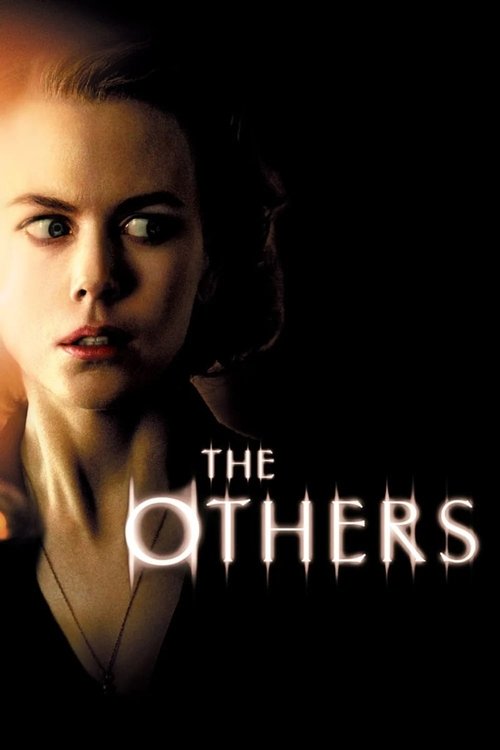
The Others
2001 · Alejandro Amenábar
For a classy, old-fashioned scare on a dark night — gothic shivers over gore, ideal when you want to be spooked without being brutalized. Comfort-food horror for people who love a proper ghost story.
What it's about
In the last days of the Second World War, on the fog-bound island of Jersey, a devout and tightly wound mother named Grace keeps her country house in permanent darkness because her two children have a rare, dangerous sensitivity to light. When three new servants arrive and doors start opening that should be locked, Grace becomes convinced the house holds intruders she cannot see — and sets out to protect her children at any cost.
The experience
Hushed, candlelit dread from the first minute — a film of whispers, locked doors, and curtains that must never be opened, where the fear comes from what you almost hear. It tightens slowly and steadily until the quiet itself feels dangerous.
Performances
Nicole Kidman is riveting as Grace — brittle, imperious, and increasingly desperate, holding the entire film together with a portrait of maternal certainty starting to crack.
The craft
Alejandro Amenábar wrote, directed, and composed the score, and the whole film is an exercise in restraint: candlelight and fog doing the work of monsters, silence doing the work of shrieks. Watch it in a genuinely dark room — the photography depends on it.
Why it matters
A major international hit that proved the classical, suggestion-based ghost story could still grip modern audiences, and it announced Amenábar as a filmmaker of rare control in his first English-language feature.
Snapshot
The Others is a gothic ghost story in which a devout, high-strung mother named Grace shutters herself and her two photosensitive children inside a fog-bound country house on the island of Jersey in the final days of the Second World War, only to discover — in the film's celebrated reversal — that she and the children are the dead, and the "intruders" haunting them are the living occupants who have moved into the home. Written, directed, and scored by the Spanish-Chilean filmmaker Alejandro Amenábar, then in his late twenties, it was his first English-language feature and a deliberate exercise in classical restraint: a haunted-house picture that withholds gore almost entirely and builds dread from darkness, hush, and the slow corrosion of a mother's certainty. Anchored by Nicole Kidman in one of the defining performances of her career, the film became both a substantial international commercial success and a critical landmark, and it remains a touchstone in the post–Sixth Sense cycle of twist-driven supernatural dramas.
Industry & production
The Others sits at an unusual industrial crossroads. It was a Spanish-led production — financed substantially through Sogecine, the film arm of the Spanish media group Sogecable, with Amenábar's longtime producer Fernando Bovaira — that nonetheless qualified, through Tom Cruise's involvement, as a transatlantic prestige venture. Cruise's company, Cruise/Wagner Productions (with partner Paula Wagner), came aboard as a producing entity, and Dimension Films, the genre label of Miramax under Bob and Harvey Weinstein, handled U.S. distribution. The Cruise connection carried an irony the press dwelt on: Cruise had starred in Vanilla Sky (2001), Cameron Crowe's remake of Amenábar's own Abre los ojos, and his marriage to Kidman dissolved during the year the two films appeared, so that the producer was overseeing his soon-to-be-former wife's breakout English-language vehicle.
The film was shot in Spain rather than the Channel Islands it depicts, principally at the Palacio de los Hornillos in Cantabria and at studio facilities, with the northern Spanish landscape standing in convincingly for damp, occupied Jersey. Made on a modest budget by Hollywood standards, it returned many times its cost in worldwide release, performing strongly in both the United States and Europe — a rare instance of a Spanish production company reaping the profits of a global English-language hit. Its commercial reach was matched by institutional recognition at home: at Spain's Goya Awards it won the major categories including Best Film and Best Director, becoming the first wholly English-language film to be named Best Film by the Spanish Academy, a result that provoked some debate about national-cinema definitions.
Technology
Technologically the film is conservative by design, shot on 35mm photochemical film and finished without the heavy digital intervention that was becoming fashionable at the turn of the millennium. Its most demanding technical problem was self-imposed: the children's fictional sensitivity to light requires that the house be kept perpetually dim, lit by candle, oil lamp, and the gray leak of daylight through curtained windows. This forced the production into low-light cinematography that had to read as naturalistic candle- and lamp-light while remaining legible on film stock of the period's sensitivity. The solution lay in careful exposure, lens choice, and lighting craft rather than in digital brightening, and the discipline of the conceit — every room entered only after the one behind is locked and darkened — became both a narrative engine and a production constraint. Visual effects are sparing and largely invisible, used to support atmosphere (fog, the séance, a handful of apparitions) rather than spectacle. The film is, in this sense, a demonstration that a haunted house could still be built in 2001 out of light, sound, and architecture rather than computer-generated imagery.
Technique
Cinematography
The photography is by Javier Aguirresarobe, the distinguished Basque cinematographer, and it is central to the film's reputation. Working within the dark-house premise, Aguirresarobe cultivates a muted, almost monochromatic palette — slate grays, browns, the sickly cream of lamplight — punctuated by the deep black of unlit rooms and corridors. Frames are frequently underlit and composed around pools of candlelight, so that the surrounding darkness becomes an active, threatening field rather than mere absence. The camera tends toward stillness and slow, deliberate movement, gliding through the house's enfilade of locked rooms and emphasizing the architecture as a trap. Exteriors are smothered in fog, dissolving the boundary between house and world and reinforcing the sense of a sealed, liminal space. The cinematography won Aguirresarobe a Goya and is routinely cited as a model of expressive low-key lighting.
Editing
Edited by Nacho Ruiz Capillas, the film is paced with patience, favoring duration and held tension over the rapid cutting common to contemporary horror. The construction is meticulous in its management of information: the editing must plant the clues to the reversal — the postmortem mourning photographs, the unexplained appearances and disappearances, the housekeeper's knowing calm — without tipping the audience, and then, in the climactic recognition, retroactively reframe them. The cutting holds on Kidman's face through long passages of rising panic, trusting performance to carry suspense, and reserves its sharper rhythmic shocks for the few set pieces (the séance, the discovery of the gravestones) where the supernatural breaks through.
Mise-en-scène / staging
Mise-en-scène is arguably the film's primary instrument. The single principal location — a large, cold Victorian house — is staged as a labyrinth of doors that must be locked and unlocked in sequence, a ritual of containment that externalizes Grace's need for control. Production design by Benjamín Fernández dresses the interiors with period heaviness: dark wood, shrouded furniture, religious imagery, the muffling drapery that keeps out the light. Costuming places Grace in austere, buttoned 1940s dress, her rigidity legible in her clothing. Fog, candle flame, and the recurring motif of curtains and covered objects supply a visual grammar of concealment that rhymes with the plot's central withholding. The staging consistently isolates the family within frames bounded by doorways and shadow, the house itself dramatized as both refuge and tomb.
Sound
Sound design carries much of the fear. The film exploits silence and the small, ambiguous noises of an old house — footsteps overhead, a piano sounding in an empty room, children's voices, the rustle of fabric — as the chief evidence of the "haunting," much of which is later reinterpreted. Amenábar, who composed the score himself, keeps the music spare and largely orchestral, deployed in restrained washes rather than the stinging cues of a conventional shocker, so that quiet becomes the dominant register and the rare swell of music or sudden diegetic sound lands with force. The aural strategy is of a piece with the visual one: dread is generated by what is half-heard at the edge of perception.
Performance
Nicole Kidman's Grace is the film's center of gravity — a portrait of brittle maternal authority cracking under strain, her piety, fear, and barely suppressed hysteria held in tense balance until the final unraveling. The performance is large but controlled, and it was widely regarded as a turning point that, alongside Moulin Rouge! the same year, established her as a leading dramatic actor. The two children, Alakina Mann as the sharp, skeptical Anne and James Bentley as the timid Nicholas, give unusually composed performances crucial to the film's plausibility. Fionnula Flanagan, as the housekeeper Mrs. Mills, supplies a watchful gravity whose meaning only resolves at the end, while Christopher Eccleston appears briefly and spectrally as Grace's war-lost husband.
Narrative & dramatic mode
The film operates in the mode of the dramatic ghost story by way of psychological mystery, and its architecture is built entirely around a concealed truth and its revelation. For most of its length it is structured as a haunting investigated from the inside — Grace gathering evidence that something is in the house with them — a frame that the ending inverts so that the audience must reread every prior scene. This is dramatic irony deferred rather than deployed: the picture deliberately withholds the orienting knowledge that conventional irony grants the viewer, and only at the close confers it, retroactively. The mode is closer to tragedy than to thrill-ride horror — the recognition scene is one of grief and acceptance, the discovery of a fact about oneself that cannot be undone — and the emotional payload is the mother's confrontation with what she has done and what she and her children now are.
Genre & cycle
The Others belongs to the gothic haunted-house tradition and, specifically, to the early-2000s cycle of "quiet," twist-ending supernatural dramas catalyzed by M. Night Shyamalan's The Sixth Sense (1999), whose central conceit it shares in transmuted form. Within that cycle it stands out for its classicism: where much contemporary horror trended toward visceral excess, Amenábar reached back to the restrained, suggestion-based ghost film. It is frequently grouped with The Sixth Sense and Guillermo del Toro's The Devil's Backbone (2001) — another Spanish-language gothic of the same year, also set against war — as part of a turn-of-the-millennium revival of the literary, atmospheric ghost story, distinct from the slasher and torture cycles that would soon dominate the genre.
Authorship & method
The film is unusually concentrated in its authorship: Amenábar wrote the screenplay, directed, and composed the score, exercising a degree of control closer to the auteur model of the art film than to studio horror. Coming off Tesis (1996) and Abre los ojos (1997), both preoccupied with perception, mediation, and the instability of what we take to be real, The Others extends his recurring interest in characters who do not know the true nature of their own situation — a thematic signature that links it directly to the reality-doubt of Abre los ojos. His method here is one of subtraction: withholding light, withholding music, withholding the orienting fact, trusting atmosphere and a single great performance.
Among collaborators, cinematographer Javier Aguirresarobe is the decisive creative partner, his low-key lighting realizing the film's conceit and earning him international attention that led to a substantial Hollywood career. Editor Nacho Ruiz Capillas shaped the film's patient suspense and the precise timing of its reveal; production designer Benjamín Fernández built the house-as-labyrinth; and the ensemble of Kidman, Flanagan, and the two children supplied the human texture without which the mechanism would be merely clever. The relative thinness of the public record on the day-to-day collaboration means much of the working method must be inferred from the finished film rather than documented in detail.
Movement / national cinema
The film is a product of the resurgent Spanish cinema of the 1990s and 2000s, and of Sogecine's strategy of mounting ambitious, internationally oriented productions. Amenábar emerged alongside Alejandro González Iñárritu, del Toro, and others as part of a broader flourishing of Spanish-language genre filmmaking with crossover ambitions, and The Others exemplifies a distinctive strain of that movement: the Spanish gothic, with its Catholic preoccupations, its interest in war's domestic aftershocks, and its literary sensibility. That it is set in the British Channel Islands and performed in English complicates any simple national reading — its Goya sweep prompted exactly that argument — but its financing, authorship, and craft personnel are overwhelmingly Spanish, and it is best understood as a Spanish film working in an English-language, transnational register.
Era / period
The story is set in 1945, in the immediate aftermath of the Second World War and the German occupation of the Channel Islands, a historical specificity that is not incidental: the absent, war-claimed father, the brief reappearance of the husband returning from the front, and the pervasive atmosphere of loss and limbo are all bound to the period. Produced and released in 2001, the film also belongs to a precise moment in industry history — the brief window when a mid-budget, star-driven, adult-oriented supernatural drama could be a global theatrical hit, before the genre's center of gravity shifted. Its period setting supplies both its mournful texture and a sense of a closed, candle-lit world standing apart from modernity.
Themes
At its core the film is about grief and the refusal to accept death — the haunted house as a figure for denial, the locked rooms as the compartments of a mind that cannot admit what has happened. Maternal love curdled into control is its central psychological subject: Grace's protectiveness, her insistence on darkness and discipline, is revealed as inseparable from the catastrophe at the story's origin. Faith and doubt run throughout — the children's catechism, Grace's anxious Catholicism, the terror of limbo and judgment — so that the ghost story doubles as a drama of religious dread about what awaits after death. The film also explores perception and self-knowledge, the Amenábar signature: the horror of discovering that one's entire understanding of one's situation is wrong, and that the monsters are oneself. Light and darkness, concealment and revelation, the living and the dead — the picture's oppositions all resolve into a single meditation on the difficulty of letting go.
Reception, canon & influence
The Others was both a critical and popular success on release, praised for its elegance, atmosphere, and Kidman's performance, and admired specifically for reviving the suggestion-based ghost film at a moment of genre excess. It swept the major Goya Awards and earned Kidman wide acclaim during a banner year for her, helping consolidate her standing as a leading actor; the record is unambiguous that it ranks among the more commercially successful Spanish-originated productions and among the best-regarded ghost films of its decade.
Its lines of influence run clearly backward. The film is openly indebted to Henry James's The Turn of the Screw (1898) and, still more directly, to its great screen adaptation, Jack Clayton's The Innocents (1961), from which it inherits its governess-and-children gothic, its ambiguity, and its black-and-shadow visual restraint. The Sixth Sense (1999) is the proximate model for its central reversal, and the broader tradition of the literary, atmospheric haunted-house film — including Robert Wise's The Haunting (1963) — stands behind it. Amenábar's own Abre los ojos supplies the authorial preoccupation with characters deceived about their own reality.
Forward, the film helped sustain and legitimize the early-2000s cycle of restrained supernatural dramas and confirmed a commercial appetite for intelligent, twist-driven ghost stories. It launched cinematographer Aguirresarobe into an international career and raised Amenábar's profile to the point that his next film, Mar adentro (2004), would win the Academy Award for Best Foreign Language Film. Within the genre, The Others endures as a reference point for how to frighten through darkness, silence, and dramatic withholding rather than spectacle — a modern classic of the form whose final revelation remains one of the most discussed in contemporary horror.
A Deleuzian reading
Grace carries the keys everywhere.
The full Deleuzian reading of The Others →
Reception
A sleeper smash in 2001 — a $17M gothic chamber piece that quietly grossed over $200M — and it's only climbed since, now routinely cited as proof the classical, no-gore ghost story never stopped working.
How The Others was received, from release to now →
Influences: the films it descends from and the films it influenced
- The Innocents (1961) — Freddie Francis's deep-focus monochrome and pools-of-black framing of a governess alone with children in a vast house is the direct visual template Aguirresarobe translates into low-key candlelit interiors, down to dread built from off-screen space at the edge of the frame.
- The Haunting (1963) — Establishes the rule The Others obeys absolutely — never show the ghost; manufacture terror from a banging door, a breathing sound, and the house itself, letting suggestion and sound design do what spectacle would cheapen.
- The Uninvited (1944) — The prototype of the 'serious' atmospheric haunted-house drama in which a family inhabits and is gradually read by the house, treating ghostliness as a problem of grief and history rather than a monster to be defeated.
- Rebecca (1940) — Supplies the female-gothic grammar of the labyrinthine house governed by an absent presence and a controlling caretaker, where architecture and locked rooms encode psychological withholding.
- The Sixth Sense (1999) — The proximate model for the reversal: a meticulous editing scheme that plants clues in plain sight so the final revelation retroactively rewrites every prior scene — the dead unaware they are dead.
- Abre los ojos (1997) — Amenábar's own authorial blueprint — a protagonist confidently misreading the true nature of their reality — carried forward as method, the director again withholding the orienting fact from character and audience alike.
- Carnival of Souls (1962) — Earliest sustained use of the unreliable-orientation conceit where the protagonist is already deceased and shunned by a world she cannot reach, the disorientation itself functioning as the horror engine.
- The Spirit of the Beehive (1973) — Founds the Spanish-gothic register of hushed honey-lit interiors and a grave, watchful child, where dread is a matter of stillness, framing and the threshold between the real and the imagined.
- Don't Look Now (1973) — Models grief-driven haunting structured by editing — fragmentary withheld images that only cohere at the lethal reveal, training the audience to misread a recurring figure until the cut delivers the truth.
- The Shining (1980) — Available-light, symmetrically composed prestige haunted-house horror sustaining ambiguity about the supernatural until the architecture itself reveals the truth — the Overlook method transplanted.
- Diabolique (1955) — Combines slow institutional-house dread, score-restraint, and an are-they-already-dead reversal — an explicit late descendant of Clouzot's design for terror through patience and withheld information.
- Thesis (1996) — Matures the Amenábar restraint aesthetic — dread built from sound and the deliberately unshown — into a full horror grammar first tested in Tesis's off-frame atrocities.
- The Orphanage (2007) — The clearest direct descendant: a grieving mother, a haunted house-as-labyrinth, suggestion-based scares and a sorrowful twist, consciously extending Amenábar's subtraction-based aesthetic into the next Spanish generation.
- A Tale of Two Sisters (2003) — Builds an entire ghost drama on unreliable orientation and withheld clues, the precise reveal reframing the household's grief — the same trust in a patient, deceptive edit over jump-scare mechanics.
- The Babadook (2014) — Extends the maternal-grief-as-haunting line, externalizing a controlling, denying mother's psychology into the house and a suggested presence kept mostly off-screen and in shadow.
- The Woman in Black (2012) — Revives the period haunted-house picture in The Others' key — muted palette, a single grand house, dread accumulated through silence and glimpses — proving the suggestion-based ghost film as commercial form.
- The Awakening (2011) — A WWI-aftermath ghost story whose skeptic-investigator is undone by a twist about her own place among the dead, directly echoing The Others' fusion of period grief, faith-and-doubt, and orientation reversal.
- Hereditary (2018) — Carries forward dread built from grief, maternal control and the house-as-labyrinth, using slow withholding and precise sound rather than spectacle to make the domestic interior itself the source of terror.
- The Invisible Man (2020) — Amenábar builds sustained dread through ambient room tone and withheld revelation rather than monster display — footsteps, breathing, temperature change — establishing the textural-score-plus-sound-design approach that Wallfisch and Whannell systematize as their primary atmospheric carrier.
- Oddity (2024) — A single-location chamber ghost story built as a mystery whose final twist recontextualizes every prior scare, proving the whodunit-reveal architecture can govern a slow-burn haunting — Oddity's exact ambition.
- Marrowbone (2017) — Javier Aguirresarobe's sealed-house grammar — permanently drawn curtains, banished photographs, a household rulebook that turns out to describe the protagonists — is the cycle-parent for Marrowbone's covered mirrors and perspective inversion.
- The Devil's Backbone (2001) — Released the same year, it advances the identical Spanish-gothic ghost tradition — wartime setting, restrained apparition, the dead seeking acknowledgment — through atmosphere and tragedy rather than shock.
- Crimson Peak (2015) — Foregrounds the female-gothic house-as-character with concealment grammar — locked wings, buried secrets, a deceived heroine — the architecture itself withholding and disclosing the plot.
- Forgotten (2017) — Deploys threshold geometry systematically — doors, windows, and corridors as contested boundaries between competing versions of reality — and uses retroactive coherence to transform the entire preceding film into evidence of an identity state the audience did not recognize.
- Orphan (2009) — A transnational Spanish-helmed prestige horror built entirely around a fair-play final reversal — the 'narrative machine whose payoff reframes everything before it' that Collet-Serra engineers.
Similar films
- The Innocents (1961) — influence & lineage
- A Tale of Two Sisters (2003) — influence & lineage
- Hereditary (2018) — influence & lineage
- The Devil's Backbone (2001) — influence & lineage
- The Babadook (2014) — influence & lineage
- Rebecca (1940) — influence & lineage
- Carnival of Souls (1962) — influence & lineage
- Thesis (1996) — shared sensibility