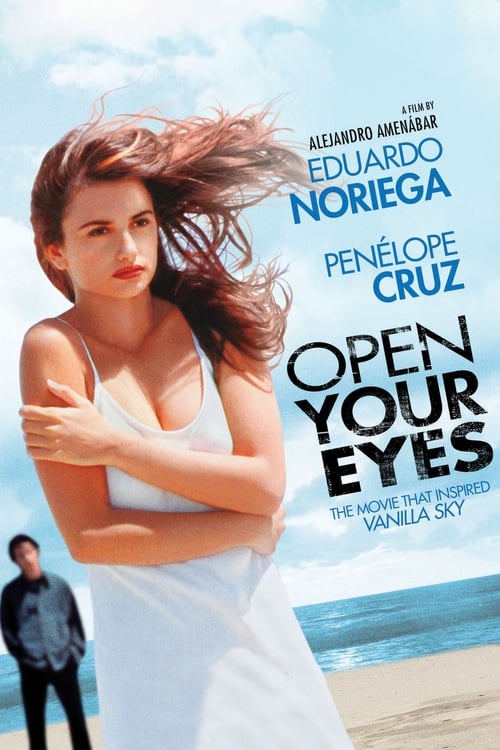
Open Your Eyes
1997 · Alejandro Amenábar
For a night when you want a puzzle that plays fair but still floors you — a thriller to argue about afterward. More brain-teaser than comfort watch; go in fresh, spoil nothing.
What it's about
César is 25, rich, gorgeous, and used to getting any woman he wants — until a spurned lover's car crash destroys his face and, with it, the easy life built on it. He falls hard for a woman he's just met right as everything unravels, and soon he's telling his story from a psychiatric cell, trying to piece together how a golden boy ended up accused of something terrible. The catch: his memories, his dreams, and reality itself refuse to stay in their lanes.
The experience
A slow-tightening knot of a film — seductive and glossy at first, then increasingly slippery and paranoid as you lose your footing along with César. It keeps you guessing to the end and then makes you want to rewind and watch it again with new eyes.
Performances
Eduardo Noriega charts César's fall from swaggering charm to raw desperation with real conviction, and a young Penélope Cruz gives the love story its warmth and ache.
The craft
Amenábar was only twenty-five when he made this, and the confidence is startling: a fractured, dream-logic structure that hides its rules until a late reveal reframes the whole picture, told with sleek visuals that make Madrid feel both glamorous and eerily empty. The storytelling itself is the special effect — every scene is doing double duty you only appreciate in hindsight.
Why it matters
It announced Amenábar as a major international talent, became a touchstone of the late-'90s wave of reality-bending thrillers, and was famously remade in Hollywood — though many swear by the original.
Snapshot
Abre los ojos is Alejandro Amenábar's second feature, made when the Chilean-born Spanish director was only twenty-five — the same age as his protagonist. It is a psychological puzzle-thriller dressed in science fiction, built around César (Eduardo Noriega), a vain, wealthy young Madrileño whose face is destroyed in a car crash engineered by a spurned lover, and whose subsequent experience of love, disfigurement, imprisonment and madness turns out to rest on an unstable ground of dream, memory and commercial fantasy. Narrated in fractured retrospect from a psychiatric cell, the film withholds the rules of its own reality until a late revelation reframes everything that came before. It arrived at a pivotal moment for both Spanish cinema and for the international "mind-game" film, and it remains best known to Anglophone audiences through Cameron Crowe's 2001 Hollywood remake, Vanilla Sky — a fame that has tended to obscure how assured, original and structurally daring the Spanish original was.
Industry & production
Abre los ojos was a Spanish-French-Italian co-production, anchored on the Spanish side by Sogecine (the film arm of the Sogecable/PRISA media group) together with Las Producciones del Escorpión, the company of veteran director-producer José Luis Cuerda. Cuerda had been an early champion of Amenábar and produced his 1996 debut Tesis, and the continuity of that relationship is central to understanding how a director so young was entrusted with an ambitious, effects-inflected second feature. The picture also drew French (Les Films Alain Sarde) and Italian co-production partners, a typical configuration for a mid-budget European art-genre film of the period seeking to spread risk and widen distribution.
The production followed directly on the unexpected success of Tesis, a thriller about snuff films and the ethics of looking that swept the 1996 Goya Awards and announced Amenábar as the most precocious talent of his generation. That success bought him the latitude to attempt something formally riskier. Abre los ojos was a commercial success in Spain and traveled the festival circuit, but precise budget and box-office figures are not something I can state reliably, and I will not invent them. What is securely documented is its competitive presence — it featured at international festivals and was nominated across multiple Goya categories — and, decisively, that it attracted the attention of Tom Cruise, whose admiration led to the Cruise/Wagner-produced American remake and effectively underwrote the next phase of Amenábar's career.
Technology
The film's premise is its technology. Its hinge is cryonics and a fictional corporation, Life Extension (in the Spanish, "Life Extension"/the cryogenic-suspension firm), that sells the wealthy a posthumous virtual existence — a lucid, curated dream spliced onto frozen death. This places Abre los ojos squarely within the late-1990s cultural fascination with simulated reality, immortality-through-technology and the porousness of the perceptual world, a current it shares with The Matrix, eXistenZ and The Thirteenth Floor, all of which it predates. Crucially, Amenábar treats the technology as a narrative and philosophical device rather than a spectacle: the film contains relatively little overt science-fiction imagery, and its "future tech" is revealed largely through exposition late in the story. In terms of production technology, Abre los ojos was shot and finished as a conventional late-1990s 35mm feature; its disorienting effects derive far more from editing, performance and sound design than from optical or digital trickery.
Technique
Cinematography
The cinematography is by Hans Burmann, a seasoned Spanish director of photography. The visual scheme is deliberately clean and naturalistic rather than expressionistic — a controlled, glossy realism that makes the later eruptions of the uncanny more destabilising, because the world never announces itself as unreal. The celebrated opening, in which César wakes and drives into a Madrid emptied of all human life — the Gran Vía utterly deserted — is staged as a stark, sunlit anomaly: nothing is distorted, yet everything is wrong. This strategy of locating dread inside ordinary, well-lit spaces rather than shadow is consistent across Amenábar's early work and is a key to the film's particular unease.
Editing
Editing is the film's true engine, credited to María Elena Sáinz de Rozas. The narrative is told in shuffled retrospect — the present-tense frame of César's interrogation by the prison psychiatrist Antonio (Chete Lera) interleaved with recovered, unreliable memories — so that the cut is constantly responsible for the viewer's disorientation. Time loops, repeats and contradicts itself; scenes recur with altered outcomes; the seam between lived event and implanted dream is deliberately impossible to locate until the film chooses to expose it. The structure is genuinely interrogative, withholding the ontological "rules" so that re-evaluation, not surprise alone, becomes the dominant viewing experience.
Mise-en-scène / staging
Amenábar exploits the contrast between César's seductive pre-crash world — the bachelor apartment, the nightclub, the affluent surfaces of bourgeois Madrid — and the clinical spaces of confinement, hospital and prison that dominate the film's second half. The most charged object in the staging is César's prosthetic mask, worn to conceal his ruined face: a literalisation of the film's preoccupation with the image one presents to others. Masking, mirrors, photographs and faces recur as motifs, and the staging repeatedly forces César (and us) to confront reflective surfaces that no longer return a stable self.
Sound
Amenábar, self-taught as a composer, wrote the film's score himself (with orchestration/collaboration by Mariano Marín), as he had for Tesis — an unusually complete authorial signature for a director so young. The film also makes pointed use of source music; the recurring presence of pop songs anchors emotional memory and was carried over conceptually into the remake's celebrated soundtrack. Sound design participates directly in the storytelling, with the disjunction between heard and seen worlds — voices, glitches, the audio texture of the "dream" — used to seed doubt about which layer of reality is being experienced.
Performance
Eduardo Noriega, who had been the charismatic antagonist of Tesis, carries the film through an extraordinarily demanding arc — from glib seducer to disfigured pariah to a man unsure whether he is alive, dreaming or dead — much of it played from behind a mask that strips him of the very beauty the character (and the film) has been trading on. Penélope Cruz plays Sofía, the woman César loves; the role's mixture of luminous tenderness and unnerving instability made enough of an impression that she was invited to reprise it in Vanilla Sky, a rare instance of an actor playing the same character in both an original and its foreign-language remake. Najwa Nimri is the obsessive, dangerous Nuria, Fele Martínez (also from Tesis) plays César's friend Pelayo, and Chete Lera grounds the frame narrative as the psychiatrist whose patient reasoning the audience comes to share.
Narrative & dramatic mode
The dramatic mode is the unreliable-retrospect puzzle: a confessional frame (the prison interrogation) that motivates a non-linear, contradictory reconstruction of events, culminating in a revelation that recontextualises the whole. This is melodrama and noir fused with metaphysical science fiction — a love story and a murder mystery that turn out to be, on a deeper level, an inquiry into whether anything we have watched occurred at all. The film trusts the viewer to tolerate sustained uncertainty, refusing the reassurance of a stable diegesis until very late, and even then leaving its closing leap pointedly ambiguous. The dominant emotional register is paranoid grief: a man mourning a self and a love he cannot verify.
Genre & cycle
Abre los ojos sits at the intersection of psychological thriller, neo-noir and "soft" science fiction, and belongs to what Thomas Elsaesser would later theorize as the "mind-game film" and what others have called the puzzle film or the reality-bending cycle. Its release in 1997 is significant: it stands at the leading edge of the late-1990s wave of films obsessed with simulated or unstable reality — The Truman Show (1998), The Matrix, eXistenZ, The Thirteenth Floor, Fight Club and The Sixth Sense (all 1999) — rather than following it. Within Spanish cinema it also belongs to a homegrown tradition of genre-literate thrillers that Amenábar himself was helping to revitalize, pulling Spanish film away from purely social-realist or heritage modes toward internationally legible genre craft.
Authorship & method
The dominant authorial intelligence is Amenábar's, and Abre los ojos is a near-total expression of it: he directed, co-wrote and composed. The screenplay was written with Mateo Gil, his regular collaborator from Tesis, and the Amenábar–Gil partnership — intricate, twist-driven, intellectually playful — is one of the defining writing teams of contemporary Spanish cinema. Among key collaborators, cinematographer Hans Burmann supplied the deceptively transparent visual surface; editor María Elena Sáinz de Rozas executed the film's temporal architecture; and producer José Luis Cuerda provided the institutional protection that let a twenty-five-year-old attempt this. The recurrence of personnel across Tesis and Abre los ojos — Noriega, Martínez, Gil, Cuerda — gives the early Amenábar films the cohesion of a small, trusted ensemble. The method is notable for its precocious completeness: Amenábar's authorship of the music in particular meant the films were scored from within their own conception rather than handed to an outside composer.
Movement / national cinema
The film is a landmark of the 1990s renaissance of Spanish genre cinema. Emerging alongside figures such as Álex de la Iglesia and the slightly senior Pedro Almodóvar (whose international standing helped make Spanish cinema commercially visible), Amenábar represented a younger, genre-fluent sensibility less interested in the legacies of Francoism and the movida than in Hitchcock, Hollywood and metaphysical suspense. Abre los ojos demonstrated that Spanish cinema could produce internationally exportable, formally sophisticated entertainment — a proof of concept that the remake rights to Hollywood literally confirmed. At the same time, its dream/reality conceit resonates with a deep current in Spanish letters: the baroque tradition of Calderón de la Barca's La vida es sueño (Life Is a Dream), whose proposition that lived experience may be indistinguishable from dreaming the film modernizes into the age of cryonics and virtual reality.
Era / period
1997 places the film at the threshold of the millennial anxiety that would soon saturate cinema — pre-9/11, mid-internet-boom, amid a broad cultural preoccupation with simulation, surveillance and the dissolving boundary between the authentic and the constructed. The film's vision of selfhood as something curated, purchasable and infinitely revisable anticipates concerns that the following decade's digital culture would make ubiquitous. Its image-obsessed protagonist, undone by the loss of his face, reads in hindsight as a premonition of a culture organized around the maintenance of personal image.
Themes
The film's central themes are the instability of reality and perception; the tyranny of the image and physical beauty (César is destroyed, literally and psychologically, by the loss of his face); vanity, narcissism and their punishment; the unreliability of memory and the constructed nature of the self; love as something that may be projection or dream rather than reciprocal fact; and the technological dream of escaping death, with its attendant horror that an engineered paradise may curdle into a nightmare one cannot wake from. Underpinning all of these is an old philosophical question rendered in pop-genre terms — how do I know I am awake? — to which the film offers no comforting answer. Its very title is an instruction the film keeps issuing and undercutting: every time César (or the viewer) "opens his eyes," the reality on the other side is in doubt.
Reception, canon & influence
Critically, Abre los ojos consolidated Amenábar's reputation as a prodigy and was widely received as a confirmation that Tesis had been no fluke; it competed at Goya level and circulated internationally as a calling-card of the new Spanish cinema. (I'd flag that granular contemporaneous review and grosses are uneven in the easily verifiable record, and I won't fabricate specifics.) Its single most consequential reception event was Tom Cruise's enthusiasm, which produced Cameron Crowe's Vanilla Sky (2001) — with Cruise as the César figure and, remarkably, Penélope Cruz reprising Sofía. The remake is the main channel through which the story reached a mass American audience, and the comparison between the two has become a small critical genre in itself, generally crediting the original with greater control and ambiguity.
Looking backward, the film's influences are legible: Hitchcock (especially the romantic-obsessional vertigo of identity and image), the science-fiction tradition of Philip K. Dick's questioned realities, the meditative time-and-memory cinema descending from Chris Marker's La Jetée, and the Spanish baroque inheritance of La vida es sueño. Looking forward, Abre los ojos is now routinely cited as an early, influential entry in the reality-bending "mind-game"/puzzle-film cycle that crested at the end of the 1990s, and as the launchpad for one of European cinema's major contemporary careers: Amenábar went on to the English-language gothic The Others (2001) and to Mar adentro (The Sea Inside, 2004), which won the Academy Award for Best Foreign Language Film. Within that trajectory, Abre los ojos stands as the moment a young Spanish director proved he could build an entire world on the suspicion that the world might not be real — and make audiences, in two languages, want to keep their eyes open anyway.
A Deleuzian reading
César wakes, gets in his car, drives into the center of Madrid — and the city is empty.
The full Deleuzian reading of Open Your Eyes →
Reception
A hit in Spain and a festival favorite in 1997-98, it spent years overshadowed by its Hollywood remake Vanilla Sky — but the tide has fully turned, and it's now routinely cited as the superior original and a precursor to the late-90s reality-bending thriller wave.
How Open Your Eyes was received, from release to now →
Influences: the films it descends from and the films it influenced
- Vanilla Sky (2001) — A near shot-for-conceit remake that imports the cryonics-virtual-life premise, the disfigurement mask, the lucid-dream glitch reveals, and Penélope Cruz reprising Sofía, the main channel carrying the original's craft to a mass audience.
- The Others (2001) — Extends Amenábar's signature withheld-reality architecture — a protagonist living inside a false ontological frame revealed by a final reversal — into English-language gothic, again with director-composed score.
- The Sea Inside (2004) — Extends Amenábar's interest in a confined, immobilized body whose subjectivity and imagined flight transcend physical entrapment — the cryo-suspended César's predicament reworked in realist drama, again director-scored.
- Vertigo (1958) — Supplies the romantic-obsessional template in which a man's idealized image of a woman warps his grip on reality, executed through subjective POV and a fixated camera that Amenábar borrows for César's pursuit of Sofía.
- La Jetée (1962) — Models the meditative time-and-memory architecture in which a present is reconstructed from frozen instants, prefiguring the cryogenic memory-implant frame that structures Open Your Eyes' non-linear retrospect.
- Vertigo (Spiral) of identity — Spellbound (1945) — Provides the psychoanalytic interview framing device — a haunted man narrating fragmented trauma to a clinician who reorders it — which Amenábar adopts as César's masked sessions with the prison psychiatrist.
- Blade Runner (1982) — Establishes the neo-noir science-fiction register where memory may be manufactured and the protagonist's own status is in doubt, the Philip K. Dick questioned-reality strain Open Your Eyes inherits.
- Tesis (1996) — Amenábar's own prior feature with the same Gil screenplay partnership, Noriega lead, and Cuerda production, establishing the twist-driven puzzle construction and director-composed scoring method carried directly into this film.
- Persona (1966) — Pioneers the mask-and-mirror motif of dissolving, exchangeable identities filmed in clinical close-up, the formal vocabulary behind César's literal prosthetic mask and split self.
- The Matrix (1999) — Sibling entry in the millennial simulation-anxiety cycle, dramatizing the same suspicion that lived reality is a constructed virtual layer that can be exited, arriving two years after Amenábar's version.
- The Thirteenth Floor (1999) — Contemporary sibling built on nested simulated worlds and a protagonist discovering his reality is a generated construct, sharing the neo-noir-scifi mood and reveal mechanics of Open Your Eyes.
- eXistenZ (1999) — Sibling that stages reality as a recursive game-world whose 'glitches' betray its artificiality, the same diegetic-malfunction device Amenábar uses to signal the dream's seams.
- The Sixth Sense (1999) — Crests the same late-1990s mind-game cycle with a retrospective twist that retroactively rewrites every prior scene, the puzzle-film grammar of delayed disclosure Open Your Eyes helped seed.
- Mulholland Drive (2001) — Descendant that builds a feature on the suspicion that its first two acts are a dying mind's wish-fulfillment dream, extending the unreliable-retrospect and image-tyranny architecture into surrealist register.
- Inception (2010) — Descendant that systematizes the lucid-dream-with-rules and ambiguous-awakening structure, inheriting the layered virtual-reality puzzle and the 'is he still under?' open ending.
Similar films
- Vanilla Sky (2001) — influence & lineage · same viewing thread
- Thesis (1996) — influence & lineage
- Mulholland Drive (2001) — influence & lineage
- Total Recall (1990) — influence & lineage · same viewing thread
- Eternal Sunshine of the Spotless Mind (2004) — same viewing thread
- Close Your Eyes (2023) — shared sensibility
- Amores Perros (2000) — shared sensibility
- The Secret in Their Eyes (2009) — shared sensibility
All the films related to Open Your Eyes →
Watch it with: curated runs of related films
- Waking Up Inside the Illusion — Watch these in a run when you want the same jolt over and over — an ordinary man realizing the calm reality around him was built, dreamed, or erased, and clawing his way toward waking up.