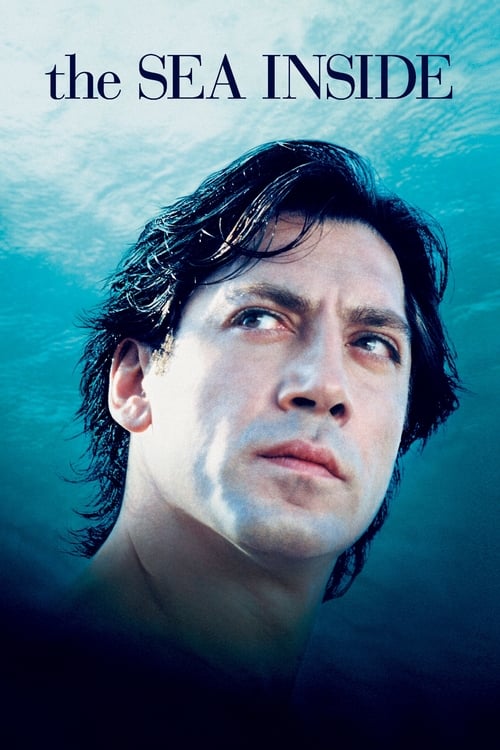
The Sea Inside
2004 · Alejandro Amenábar
For when you want a good cry that also makes you think — a film about death that leaves you oddly full of life. Emotionally heavy but generous; bring tissues and someone to debate with afterward.
What it's about
Ramón Sampedro, a Galician ship mechanic and self-taught poet, was left quadriplegic by a diving accident in his twenties; the film finds him decades into a public legal fight for the right to end his own life on his own terms. Around his bed orbit the people who love him and disagree with him — his weary family, his lawyer Julia, and Rosa, a local woman determined to convince him life is worth living. Based on a true story, it's an argument about dignity conducted through relationships rather than speeches.
The experience
Far warmer and funnier than the subject suggests — Ramón charms everyone who enters his room, and the film earns its tears through wit and tenderness rather than misery. It's a weepie with a spine, and it will make you argue with yourself on the way out.
Performances
Javier Bardem, in his mid-thirties, plays Sampedro across decades under heavy prosthetics and does it almost entirely from the neck up — a magnetic, mischievous, fully inhabited performance that never asks for pity.
The craft
Amenábar directs, co-writes, and scores, balancing chamber-drama intimacy with soaring flights of imagination built around the recurring image of the sea — the camera periodically escapes the bedroom the way Ramón's mind does. The Galician coastline gives the film its visual counterargument: all that beauty, just out of reach.
Why it matters
It won the Academy Award for Best Foreign Language Film and pushed the euthanasia debate into Spain's mainstream, confirming Amenábar as one of European cinema's major directors.
Snapshot
Mar adentro ("The Sea Inside," though the Spanish also carries the sense of "out to sea") is Alejandro Amenábar's fourth feature and his return to Spanish-language filmmaking after the English-language gothic success of The Others (2001). It dramatizes the real life of Ramón Sampedro, a Galician sailor and self-taught poet who was left quadriplegic by a diving accident in his mid-twenties and who spent roughly three decades — from the late 1960s until his death in 1998 — arguing publicly and legally for the right to end his own life. The film is at once an intimate chamber drama, a courtroom-adjacent argument about autonomy and dignity, and a lyrical meditation on freedom rendered through the recurring image of the sea. Javier Bardem, then in his mid-thirties, plays Sampedro across a wide age range under heavy prosthetic makeup, in a performance that anchors the film. Critically celebrated and heavily awarded — it won the Academy Award and Golden Globe for Best Foreign Language Film and swept the Spanish Goyas — The Sea Inside stands as one of the signal achievements of post-Almodóvar Spanish cinema and the film that consolidated Amenábar's reputation as a mainstream auteur of unusual technical control.
Industry & production
The film emerged from the commercially confident Spanish film industry of the early 2000s, produced through Amenábar's own company Himenóptera together with Fernando Bovaira's Sogecine (the film arm of the Sogecable/PRISA media group), with additional co-production participation reflecting the pan-European financing model then standard for prestige Spanish projects. Amenábar and Bovaira had a working relationship extending back through his earlier films, and The Sea Inside was conceived as an ambitious, awards-oriented "quality" production rather than a genre entertainment — a notable pivot for a director who had built his name on the thriller (Tesis), science-fiction romance (Abre los ojos), and supernatural gothic (The Others).
The subject matter was, by design, freighted. Sampedro was a genuinely divisive public figure in Spain; his 1998 death by potassium cyanide, which he had arranged with help and partly documented, became a landmark in the country's debate over euthanasia. Adapting his story — including drawing on his own writings, notably the collection Cartas desde el infierno ("Letters from Hell") — placed the production inside a live moral and political controversy in a country whose relationship to the Catholic Church remained culturally central. The film was Spain's official submission to the Academy Awards and became, in industry terms, an emphatic national success: it dominated the Goya Awards ceremony, taking the major prizes (Best Film, Director, Actor for Bardem, Original Screenplay, and a sweep of technical and supporting categories) in numbers that were reported as record-setting for the ceremony. At the Venice Film Festival it took the Grand Jury Prize (the festival's second-tier "Silver Lion"–level honor), and Bardem received the Volpi Cup for Best Actor. Beyond the statuary, the film also served as a launching platform: Belén Rueda, cast as the lawyer Julia, made her feature debut here after a career in Spanish television and would go on to lead J.A. Bayona's The Orphanage.
Technology
The Sea Inside was made on 35mm film with conventional early-2000s production technology; its innovation is not in capture format but in the orchestration of illusion. The central technological problem was time and the body. Bardem, a physically robust actor decades younger than the man he plays across much of the story, had to convincingly inhabit Sampedro as a middle-aged quadriplegic whose vitality is confined entirely to the face and voice. This was solved through extensive prosthetic aging and facial makeup — a sustained, unglamorous application discipline that lets Bardem register both illness and the strange, undimmed charisma the real Sampedro was said to have possessed.
The film's most conspicuous technical set piece is a fantasy of flight in which Ramón, freed in imagination from his bed, sweeps out over the Galician landscape and down to the sea. This sequence combines aerial photography with the compositing techniques of the period to stage a fluid, unbroken movement from confinement to release — the film's whole thesis about interiority made kinetic. It is characteristic of Amenábar that the picture's one overtly "effects-driven" moment is not spectacle for its own sake but the literalization of the title: the sea that lives inside a man who cannot walk to it.
Technique
Cinematography
The photography is by Javier Aguirresarobe, one of the most accomplished Spanish cinematographers of his generation (later widely employed in Hollywood on films such as The Road and Woody Allen's Vicky Cristina Barcelona). His work here is built on a controlled tension between confinement and expanse. The interiors of the Sampedro farmhouse — and above all the bedroom that is Ramón's entire physical world — are shot in warm, close, often low-key light that emphasizes texture, faces, and the small distances a bedbound man can perceive. Against this, the Galician exteriors and seascapes open into cool, luminous breadth. Aguirresarobe repeatedly organizes the frame around windows, thresholds, and the horizon line, so that the sea functions less as scenery than as a structuring absence — always visible, never reachable. The flight sequence is the release valve for this pent-up spatial grammar.
Editing
Amenábar is credited with editing his own films, and the cutting here serves a fundamentally intimate, dialogue-driven drama built around long scenes of argument and persuasion. The rhythm is patient rather than propulsive, giving conversations room to develop the film's competing ethical positions; the major exception is the flight fantasy, which the editing releases into lyrical momentum. Where the record on precise post-production credits is best confirmed against the film's titles, Amenábar's hands-on authorship across writing, scoring, and cutting is the consistent through-line of his career.
Mise-en-scène / staging
The staging is organized around a single, radical constraint: the protagonist cannot move. Amenábar turns this into the film's formal engine. Because Ramón is fixed, the drama is generated by who enters his room and where they place themselves relative to his bed — the lawyer Julia, the working-class Rosa, family members, the visiting quadriplegic priest who comes to talk him out of dying. Blocking becomes argument: proximity, eye level, and the act of leaning in or withdrawing carry the emotional and moral weight that another film would give to physical action. The farmhouse itself, with its stairs and thresholds that Ramón can never cross, is staged as a map of everything foreclosed to him.
Sound
Amenábar composed the score, as he does for his films, and the music is integral rather than decorative. The film reaches for the operatic in its key emotional passages, using grand vocal music to lift the fantasy sequences into transcendence — a deliberate contrast with the hushed, room-tone naturalism of the domestic scenes. Voice is the other great sonic subject: Ramón's instrument of survival is his speech, and the sound design foregrounds the intimacy of the spoken word, the poetry he dictates, and the silences of a house organized around a man who cannot rise.
Performance
The film is, finally, a monument to performance under constraint. Bardem must convey a full interior life — wit, seduction, despair, tenderness, stubbornness — using only face, eyes, and voice, and he does so without sentimental pleading; his Ramón is charming, sometimes maddening, never merely pitiable. Around him the film builds a precise ensemble: Belén Rueda as Julia, the lawyer with her own degenerative illness, whose bond with Ramón shades toward love; Lola Dueñas as Rosa, the local woman who wants to prove to him that life is worth living; and the supporting family and activist figures who embody the ordinary people caught in an extraordinary argument. The interplay of these performers — several recognized in Spain's awards that year — turns a potentially static premise into sustained human drama.
Narrative & dramatic mode
The dominant mode is realist chamber drama with a strong argumentative spine. Rather than a plot of external events, the film advances through a series of encounters in which different characters press Ramón to choose life or help him toward death, each embodying a distinct worldview — secular autonomy, religious sanctity of life, romantic attachment, familial duty. It is essentially a drama of persuasion, closer to the tradition of the philosophical debate-play than to biographical spectacle. Into this Amenábar folds two counter-modes: the lyrical (the flight fantasy, the sea imagery, the dictated poetry) and, notably, the comic — the confrontation between Ramón and the paralyzed priest is staged with genuine wit, the film refusing to let its gravity curdle into solemnity. The overall structure is retrospective and elegiac, moving toward an ending the historical record has already fixed.
Genre & cycle
The Sea Inside sits within the biographical drama and the "social issue" or right-to-die film, a small but recurring cycle in world cinema that treats terminal illness, disability, and assisted death as dramatic and ethical terrain. It belongs to a broader early-2000s wave of prestige international dramas engaging euthanasia and dignity at the end of life. Within Amenábar's own filmography it is the outlier — the one film with no genre-fantastic apparatus — yet it shares his abiding preoccupations with mortality, perception, and the boundary between life and its ending. Against the euthanasia-themed films around it, The Sea Inside is distinguished by its refusal of both tragedy-of-victimhood and easy uplift: it insists on Ramón's agency and humor as much as his suffering.
Authorship & method
Amenábar is among the most complete of contemporary auteurs, typically functioning as director, co-writer, composer, and editor — a concentration of craft roles that gives his films their unusual tonal unity. Born in 1972 to a Chilean father and Spanish mother and raised in Spain, he had by his early thirties already produced a remarkably assured run: Tesis (1996), Abre los ojos (1997, later remade in Hollywood as Vanilla Sky), and the international hit The Others (2001) with Nicole Kidman. The Sea Inside was co-written with Mateo Gil, his longtime writing partner across those earlier films, and the screenplay's balance of moral seriousness and dry humor bears their shared signature. His key collaborators here — cinematographer Javier Aguirresarobe and the ensemble cast — execute a method that is precise and controlled rather than improvisatory: Amenábar's films are architected, and the emotional effects are engineered with a craftsman's deliberation. The score, again by the director's own hand, is the clearest emblem of his integrated authorship.
Movement / national cinema
The film is a central document of contemporary Spanish cinema in the era after Pedro Almodóvar had made Spanish film internationally legible. Amenábar belongs to the generation that emerged in the mid-to-late 1990s — technically polished, genre-literate, commercially ambitious, and fluent in an international idiom — a cohort that also includes figures like Guillermo del Toro (Mexican, but working within the same Spanish-language prestige ecosystem) and, slightly later, J.A. Bayona, whose career the film indirectly helped seed through Belén Rueda. The Sea Inside also engages Spanish national identity directly: its Galician setting, its grappling with the legacy of Catholic moral authority, and its intervention in a specifically Spanish public controversy over euthanasia root it firmly in the country's social fabric even as its themes travel universally.
Era / period
Made in 2004, the film belongs to a moment when Spanish cinema was enjoying sustained international visibility and when end-of-life autonomy was becoming a prominent public debate across much of the Western world. It looks backward across the three decades of Sampedro's confinement — from the late 1960s to 1998 — and the production reconstructs that span through makeup and performance rather than elaborate period recreation, keeping the focus on the enduring interior life rather than changing external decades. Its release coincided with, and contributed to, an intensifying Spanish conversation about the legal status of assisted death, a debate that would continue to evolve in the country for years afterward.
Themes
The governing theme is freedom — specifically the paradox of a man whose body is wholly immobilized but whose mind, will, and desire remain unbounded; the "sea inside" is the film's image for that undrowned interior liberty. From this flow its other concerns: the autonomy of the individual over his own death; the tension between the sanctity of life (voiced through Catholic and disability-rights objections) and the dignity of self-determination; love in its unconsummated and sacrificial forms, as both Julia and Rosa are drawn into Ramón's orbit; and the redemptive, defiant power of art, since Sampedro's poetry is his means of transcending the bed. The film is careful to dramatize the opposing case rather than caricature it — the priest, the family who love and tend him, the people who insist his life has value are given real weight — so that Ramón's choice registers as a genuine ethical argument rather than a foregone conclusion.
Reception, canon & influence
Critically, The Sea Inside was received as a major work and a career-defining film for both Amenábar and Bardem, praised above all for its performances and for handling incendiary material with intelligence, restraint, and unexpected humor; the most common critical reservation concerned whether its polished, emotionally orchestrated approach softened the hardest edges of its argument. Its awards profile is among the most decorated of any Spanish film: the Academy Award and Golden Globe for Best Foreign Language Film, the Venice Grand Jury Prize with Bardem's Volpi Cup, and a commanding sweep of the Goya Awards including the top categories.
Looking backward, the film's influences lie less in cinematic homage than in its sources: the writings and public persona of Ramón Sampedro himself, the tradition of the humanist social-problem drama, and Amenábar's own recurring fascination with mortality and the thresholds of consciousness carried over from Abre los ojos and The Others. Looking forward, its legacy is threefold. It cemented Amenábar's standing as a Spanish auteur capable of prestige drama, not only genre; it was a pivotal credit in Bardem's trajectory toward international stardom and, a few years later, his own Academy Award; and it launched Belén Rueda, thereby feeding the next wave of Spanish-language genre and drama cinema. More broadly, the film became a durable reference point in cultural debates over euthanasia and the right to die, invoked well beyond film circles — a rare instance of a movie that entered a society's ongoing moral argument as a participant rather than merely a chronicler.
A Deleuzian reading
A window with the sea in it, and a bed that cannot be moved toward the window.
The full Deleuzian reading of The Sea Inside →
Reception
In 2004–05 it swept everything in sight — Venice's Grand Jury Prize, the Foreign Language Oscar, a record haul at the Goyas — and today it's remembered a bit more quietly: less as a canonical masterpiece than as the prestige tearjerker that proved Javier Bardem could carry a film with only his face.
How The Sea Inside was received, from release to now →
How to watch The Sea Inside: what to notice on a first viewing
- Watch who leans toward Ramón's bed and who hangs back. Every visitor chooses a distance from the bed, and that distance is their position in the argument. Julia leans in. Others hold back. Amenábar lets blocking do what dialogue elsewhere would. Since Ramón cannot move, where a person stands becomes the only way the film can show what they believe.
- Notice how often a window frames the sea in the distance. Aguirresarobe keeps building the shot around a threshold and a horizon: warm, close interiors, then a strip of cool bright water that never gets nearer across the whole film. The sea stands for a freedom the frame can show but never hold, since Ramón can never reach it.
- Watch Bardem's face for the smallest shift in feeling. Since Ramón cannot move his body, Bardem plays wit, seduction, tiredness, and stubbornness in millimeters of expression, never asking for pity. This is Ramón's only instrument left: a face and a voice carrying everything his body no longer can.
- Listen for how quiet the house is until the music swells. Amenábar's own score stays hushed and room-toned through the domestic scenes, then turns operatic and vocal whenever the film opens into fantasy or flight. The shift in music marks the difference between Ramón's confined daily life and the freedom his mind still reaches for.
- Notice the stairs in the farmhouse that Ramón never climbs. The house is staged like a map of what is foreclosed to him: thresholds, doorways, a staircase, all just out of reach of a man fixed in one room. Ordinary architecture becomes a diagram of everything his body can no longer do.
The whole guide to watching The Sea Inside, with the keys for a rewatch →
Influences: the films it descends from and the films it influenced
- Rear Window (1954) — The template for immobility-as-formal-engine married to window-threshold framing: the entire film is organized around a wheelchair-bound protagonist whose only access to the world is the rectangle of a window he cannot pass through.
- Johnny Got His Gun (1971) — A wholly immobilized protagonist whose sole expanse is interior fantasy, establishing the confinement-versus-expanse cut between a static body and a liberated imagination that Amenábar's flight sequence inherits.
- Whose Life Is It Anyway? (1981) — The direct right-to-die-drama forebear: a bedbound quadriplegic wins his case through verbal advocacy, structuring the film as a drama-of-persuasion staged entirely around a motionless body.
- My Left Foot (1989) — Prototype of a whole film carried by performance restricted to the face and a single controllable limb — Day-Lewis's physical confinement as engine, the disability-performance precedent Bardem builds on.
- A Matter of Life and Death (1946) — Pioneers flight-fantasy compositing as an operatic escape from the bounds of the mortal body, the effects-driven set-piece grammar Amenábar reprises in the soaring coastal flight to Nessun Dorma.
- Abre los ojos (1997) — Amenábar's own total-auteur method (direct/co-write with Mateo Gil/compose) plus a face-in-confinement subjectivity fixated on the thresholds of consciousness, carried forward wholesale.
- The Diving Bell and the Butterfly (2007) — The purest heir to face-and-voice-only performance and locked-in subjectivity, cutting between a paralyzed body and memory/imagination as the film's only expanse.
- The Orphanage (2007) — The seeded-Bayona credit: launched from Amenábar's orbit with Belén Rueda (whom Mar adentro introduced) as lead, inheriting the engineered, meticulously orchestrated emotional architecture.
- You Don't Know Jack (2010) — Continues the right-to-die drama as a film that enters the euthanasia debate as participant, built around the advocate's persuasion rather than mere chronicle.
- The Theory of Everything (2014) — A film engined by prosthetic/progressive-disability performance — Redmayne's controlled physical degeneration into immobility carrying the drama, the direct descendant of Bardem's prosthetic-aged, motion-restricted turn.
- Me Before You (2016) — Popularizes the right-to-die drama-of-persuasion for a mainstream register, structuring the film around a quadriplegic's chosen assisted death and deploying the comic-counter-mode to soften it.
- Agora (2009) — Amenábar's own follow-through on the prestige-auteur standing Mar adentro cemented: the same integrated dir/compose/edit control and engineered emotion redeployed to large-scale historical drama.
- Talk to Her (2002) — The post-Almodóvar Spanish melodrama of tenderness and care staged around immobile bodies in a bed, sharing the blocking-as-argument and emotional operatic register two years before Amenábar.
- Million Dollar Baby (2004) — The same-year right-to-die-drama twin: pivots to a newly quadriplegic protagonist whose plea for death is staged as intimate persuasion, dramatizing autonomy-versus-sanctity-of-life in restraint.
- The Intouchables (2011) — Extends the comic-counter-mode within disability drama — mining dry humor from the caregiver/quadriplegic relationship so warmth undercuts pathos, exactly Amenábar's tonal safeguard against melodrama.
- Amour (2012) — Immobility-as-formal-engine taken to austerity: a euthanasia endpoint staged inside a single confined apartment with patient dialogue rhythm, the same interior drama minus Amenábar's operatic release.
- The Teacher Who Promised the Sea (2023) — Builds an entire Spanish drama on the sea as governing metaphor of longing and liberation — the same symbolic device Font organizes around a teacher's unkept promise.
Similar films
- Talk to Her (2002) — influence & lineage
- Amour (2012) — influence & lineage
- The Diving Bell and the Butterfly (2007) — influence & lineage
- Biutiful (2010) — shared sensibility
- Pain and Glory (2019) — shared sensibility
- Before Night Falls (2000) — shared sensibility
- Bitter Christmas (2026) — shared sensibility
- Afternoons of Solitude (2025) — shared sensibility