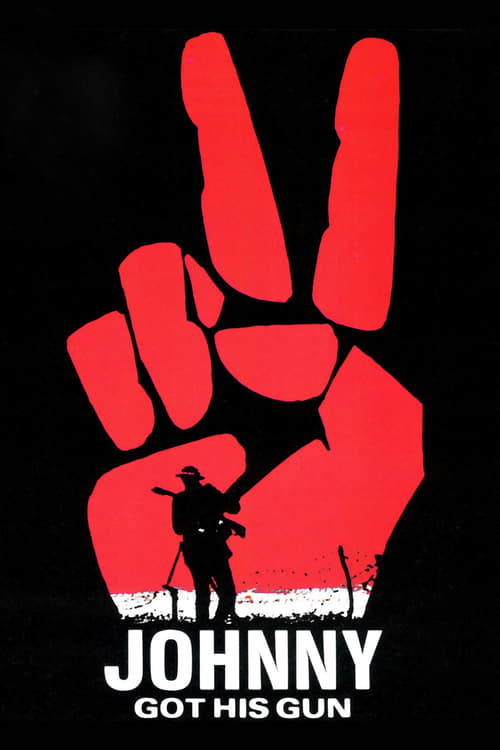
Johnny Got His Gun
1971 · Dalton Trumbo
For when you want to be challenged and genuinely shaken — a film to reach for when you're ready to confront what war costs, not when you need cheering up. One of those experiences you're glad to have had and careful about recommending lightly.
What it's about
Joe Bonham, a young American soldier in the First World War, survives an artillery blast that takes his arms, legs, sight, hearing, and speech — leaving a fully conscious mind sealed inside a body the hospital staff believe is vegetative. The film moves between his sterile hospital present and the flood of memory and dream he escapes into: his girl, his father, his small-town life before the war. Written and directed by Dalton Trumbo, adapting his own famous 1938 anti-war novel.
The experience
Harrowing and haunting in a way few war films are — there's no combat spectacle, just the intimate horror of a trapped consciousness and the tender, sunlit memories it clings to. It's slow, strange, and devastating; it will wreck you and you won't shake it for days.
The craft
Trumbo — the blacklisted screenwriter of the Hollywood Ten, directing for the only time in his life — splits the film between stark hospital scenes and warm, associative flashbacks and dreams, letting the contrast do the arguing. The structure itself is the statement: nearly everything happens inside one immobilized man's head, and the film makes that interior world vivid.
Why it matters
A touchstone of American anti-war cinema that found new generations through the Vietnam era and beyond — famously reaching younger audiences decades later through Metallica's 'One' video — and the sole directorial work of one of Hollywood's most storied blacklist survivors.
Snapshot
Johnny Got His Gun is one of the strangest and most singular entries in the American anti-war tradition: a film adapted, more than three decades after the fact, by a blacklisted screenwriter from his own 1938 novel, and directed by that same writer in what would remain his only turn behind the camera. Dalton Trumbo — a member of the Hollywood Ten, jailed for contempt of Congress and forced to write for years under pseudonyms and fronts — brought to the screen the story of Joe Bonham, a young American doughboy of the First World War who survives an artillery blast that strips him of his arms, legs, sight, hearing, speech, and most of his face, leaving a conscious mind sealed inside an unresponsive body. The film alternates between the sterile hospital present and the flooding, associative past of memory and dream, building toward Joe's discovery that he can communicate at all, and the institutional refusal that meets his plea. Released at the height of the Vietnam War and awarded a major prize at Cannes, it is at once a period piece about 1918 and an unmistakable dispatch from 1971.
Industry & production
The film was an independent production made outside the major studio system, and its very existence is a coda to the blacklist that had structured Trumbo's career. Trumbo had wanted to film his novel for decades; a well-documented earlier attempt in the early 1960s paired him with Luis Buñuel on an adaptation that never reached production, a collaboration whose surrealist inheritance is visible in the finished film's dream logic. When Trumbo finally directed the picture himself, he did so on a modest budget with a cast willing to work for a project of conviction rather than commercial promise.
Because it was an independent effort rather than a studio release, the granular production record — precise budget, shooting schedule, distribution deal — is thinner and less consistently documented than for a major studio picture of the era, and I will not invent figures for it. What is firmly established is the arc of its reception into the marketplace: the film premiered to significant attention at the 1971 Cannes Film Festival, where it won the Grand Prix (the Grand Prize of the Jury) and the international critics' FIPRESCI prize, a festival validation that gave a difficult, non-commercial picture a foothold with audiences primed by the era's anti-war sentiment.
Technology
Technically the film is conventional for its moment — 35mm photography, standard color processes — and its innovations are aesthetic rather than mechanical. Its one structurally important choice is the deliberate deployment of two visual registers, monochrome and color, as a narrative and psychological instrument rather than a mere stylistic flourish. The film uses the resources of early-1970s color cinematography not to maximize spectacle but to distinguish orders of reality: the drained, near-monochrome world of the hospital body versus the saturated, tactile world of what that body remembers and imagines.
Technique
Cinematography
The film's governing visual idea is the split between the present and the interior. The hospital reality — Joe under sheets, the medical staff moving around a form that reads as an object rather than a person — is rendered in a cold, desaturated, near-clinical register, while the memories and fantasies of Joe's earlier life and his hallucinated encounters bloom into color. The camera in the present tends toward stillness and confinement, mirroring the immobility of its subject; the past sequences move more freely. The credited cinematography sustains this two-world scheme with restraint, letting the contrast between registers, rather than showy camerawork, carry the meaning.
Editing
Editorially the film is built on intercutting and association rather than linear chronology. Because Joe has no external means of marking time — no light, no sound, no body — his consciousness collapses past and present, and the cutting follows that subjectivity, moving between the hospital, boyhood and courtship memories, scenes with his father, and surreal interludes. The rhythm is deliberately unhurried and, at times, static; the editing privileges the accumulation of interior states over momentum. This is central to both the film's power and the objections some viewers have raised against it, and the two are inseparable: the sense of entrapment is produced precisely by the refusal to let the film "move on."
Mise-en-scène / staging
The staging is organized around a body that cannot move and a mind that cannot stop. The hospital room — the bed, the sheeted form, the mask over the ruined face — is the film's fixed point, a space of enforced passivity. Against it, Trumbo stages the homefront and prewar past (family, a father figure, a young woman, working life) and a set of frankly theatrical dream tableaux, most famously the recurring appearances of Christ, staged as an almost matter-of-fact companion who cannot finally offer deliverance. The contrast between the antiseptic institutional present and the more expressionist, sometimes absurdist dream staging is the film's core compositional strategy.
Sound
Sound is arguably the film's most essential technical element, because its protagonist's entire existence is interior. Joe's consciousness is carried by voiceover — an inner monologue that is our only access to a character who cannot speak or be spoken to. The soundtrack must therefore render a subjectivity with no exterior. Equally important is the motif of Morse code: the tapping of Joe's head against the pillow, by which he finally attempts to signal the outside world, turns rhythm and percussion into the film's decisive dramatic event. The score, discussed below, works with this scheme rather than against it, and the film's most harrowing effects come from the gap between what we hear inside Joe and the silence in which the staff operates around him.
Performance
Timothy Bottoms, in the same year as his breakthrough in The Last Picture Show, carries a nearly impossible role: for most of the running time he must act without a face, a voice heard by others, or a moving body, conveying Joe almost entirely through voiceover and through the younger, whole self of the memory sequences. The supporting cast is notable both for its quality and its resonances. Jason Robards plays Joe's father with weathered gravity; Donald Sutherland appears as a laconic, unsettlingly casual Christ; Marsha Hunt plays the mother — an actress herself damaged by the blacklist, a piece of casting that carries obvious meaning given Trumbo's history; and Diane Varsi appears among the hospital staff as a figure of tentative compassion. The performances are pitched toward sincerity and restraint rather than melodrama.
Narrative & dramatic mode
The film's mode is subjective and interior to an almost radical degree. Its dramatic engine is not external action but the progressive orientation of a trapped consciousness: Joe must first understand what has happened to him, then determine whether he is even alive and awake, then discover that time is passing, and finally conceive of communication as possible at all. The narrative braids three strands — the near-static hospital present, the remembered past, and the dream/fantasy plane — and lets them comment on one another. It is, structurally, a memory play and an internal monologue given cinematic form, closer to a first-person novel (which it was) than to conventional screen drama. The climax is not a rescue but a request — Joe's tapped-out plea to be either put on public display as a testament to war or else killed — and the institutional response to that plea supplies the film's devastating final movement.
Genre & cycle
Johnny Got His Gun belongs squarely to the anti-war film, and within that tradition it occupies a distinctive place. Where the canonical WWI anti-war films — All Quiet on the Western Front foremost among them — dramatize the horror of combat itself, Trumbo's film almost entirely brackets the battlefield, placing its single act of violence offscreen or at the margin and dwelling instead on the aftermath, the ruined survivor, the price paid by the body that lives. It is thus part of the long anti-war cycle by inheritance and part of the Vietnam-era protest culture by timing. Its 1971 release placed it in dialogue with a broader wave of films skeptical of American militarism, and audiences unmistakably read Joe's WWI catastrophe as a mirror for the maimed of a contemporary war.
Authorship & method
The film is inseparable from Dalton Trumbo's biography. He wrote the source novel in the late 1930s; it was published in 1939 as the Second World War began, and Trumbo's own political relationship to the book shifted with history — its pacifist, anti-interventionist argument sat uneasily against the war against fascism, and it went out of print for a period before being revived as an anti-war touchstone during Vietnam. That the man who then directed the film was one of the most famous casualties of Hollywood's anti-Communist purge — imprisoned, blacklisted, and only belatedly restored to open credit — gives the project the character of a lifelong reckoning finally realized on his own terms.
As method, this is auteurism of a peculiar kind: a writer of enormous craft (Trumbo's screenwriting résumé, credited and uncredited, includes some of the most polished studio work of his generation) directing for the only time, adapting his own material, and importing the surrealist sensibility of his aborted collaboration with Buñuel into the dream sequences. Among the key collaborators, the score is credited to Jerry Fielding, a composer closely associated with the hard-edged American cinema of the period, and — like several of the film's participants — himself a figure who had been touched by the blacklist. The editing and cinematography were handled by craftspeople working in an independent, resource-limited context; the below-the-line record for this production is less fully documented than for a studio release, and I flag that rather than embroider it. The decisive authorial signature throughout is Trumbo's own — the voice, the argument, and the structure are his.
Movement / national cinema
The film is American, but it sits awkwardly inside any single movement. It is contemporaneous with New Hollywood and shares that era's willingness to experiment with structure, subjectivity, and downbeat endings, yet it is not a young filmmaker's picture — it is the late, singular work of an old-guard screenwriter whose formation predates the postwar art cinema whose devices he borrows. It is best understood as American independent cinema inflected by European modernism (the Buñuelian dream logic) and driven by a distinctly American political history: the blacklist, and the anti-war politics of the Vietnam moment. That hybrid lineage — Depression-era literary radicalism, mid-century surrealism, and 1971 protest culture — is what gives the film its unusual texture.
Era / period
Two eras press on the film at once. The story is set in and around 1918, the last year of the First World War, and its imagery of homefront innocence and industrial slaughter is period-specific. But the film is a document of 1971, and its meaning was received through that lens: a nation years into an unpopular war, a culture saturated with anti-war argument, and a moment in which a film about a soldier reduced to a living remnant could not be read as anything but current. The doubling of periods — a WWI subject filmed as a Vietnam-era statement — is fundamental to how the film works.
Themes
The film's central theme is the dehumanization worked by war, concentrated into a single, extreme image: the soldier reduced to consciousness without agency, alive but unable to live. From that image radiate its other concerns. There is the theme of the body and its betrayal — the horror not of death but of survival as pure entrapment. There is class: Joe is an ordinary working man whose life, love, and labor the war consumes on behalf of interests not his own, and the film is pointed about who pays war's costs. There is communication and isolation — the agony of a mind with no channel to the world, and the terrible arrival of Morse code as a means of speech. There is a strand of religion, embodied in Sutherland's Christ, who offers companionship but not salvation, dramatizing a world in which no divine consolation answers the suffering. And underlying all of it is an argument about the state's relationship to the individual it sacrifices: the institutional decision that meets Joe's final plea is the film's bleakest and most political statement.
Reception, canon & influence
Critically, the film's reception was divided in a way that has largely persisted. Its Cannes honors signaled serious international regard, and many viewers responded to its emotional and political force; other critics found it static, talky, or didactic, faulting the very deliberateness and interiority that its admirers prize. It was never a mainstream commercial success in the manner of a studio release, and it settled into the status of a passionately held cult film — a work more revered by those it reaches than broadly popular.
Looking backward, the film's influences are literary and cinematic at once: Trumbo's own 1938 novel and the interwar anti-war literature it belongs to; the great WWI anti-war films that precede it; and the European surrealism channeled through the Buñuel connection. Looking forward, its most conspicuous legacy runs through popular music: Metallica acquired rights to use footage from the film for the 1988–89 song and video "One," whose lyric directly evokes Joe Bonham's predicament and which introduced the film's imagery to a mass audience that would otherwise never have encountered it — one of the more striking instances of a cult film being carried forward by another medium entirely. The novel and its themes have continued to be revived on stage as well, including later theatrical adaptations built around the character's monologue. Within film history, Johnny Got His Gun endures less as a widely imitated stylistic model than as a touchstone — the definitive cinematic statement of war experienced not as combat but as the unbearable condition of what combat leaves behind, and the final testament of one of Hollywood's most consequential blacklisted voices.
Reception
It split critics and died at the US box office in 1971 even after winning the Grand Prix du Jury at Cannes, then spent years nearly impossible to see — until Metallica's 'One' video dragged it back into circulation and it hardened into a cult anti-war touchstone.
How Johnny Got His Gun was received, from release to now →
Influences: the films it descends from and the films it influenced
- All Quiet on the Western Front (1930) — Establishes the WWI soldier's-eye dehumanization template — the anonymous body ground up by the trench — that Trumbo answers by moving the horror off the battlefield and into the surviving, maimed remnant.
- J'accuse (1938) — Gance's pacifist device of the war-mutilated returning as living accusation directly prefigures Joe Bonham as a limbless, faceless indictment of the state that made him.
- Un Chien Andalou (1929) — The surrealist dream-logic and disjunctive, non-narrative montage that Trumbo imports for the dream tableaux, channeled through his aborted collaboration with Buñuel himself.
- The Passion of Joan of Arc (1928) — Locates sustained drama inside a nearly immobilized sufferer through relentless interiority and the isolated face, the precedent for staging a whole film around a body stripped of action.
- Wild Strawberries (1957) — Braids memory and surreal dream tableaux into present consciousness, modeling the dreamscape-as-psychological-interior that structures Joe's retreats from his hospital bed.
- Hiroshima mon amour (1959) — Pioneers the associative intercutting of past and present under subjective voiceover — the nonlinear braiding of remembered life against present trauma that Trumbo's editing adopts.
- A Matter of Life and Death (1946) — Deliberately switches between monochrome and color to demarcate separate realms, the precise formal device Trumbo repurposes to divide present entrapment from remembered and imagined life.
- Ivan's Childhood (1962) — Interrupts war's grim reality with luminous, lyrical dream interludes rendering the soldier's inner life, the same subjective-interlude architecture Trumbo builds his film around.
- One (Metallica) (1989) — Licensed and intercut the film's actual footage with performance, carrying Joe Bonham's imagery and voiceless-entrapment premise to a mass audience that would never have found the film.
- Born on the Fourth of July (1989) — Extends the maimed-veteran-as-argument into Vietnam, making the paralyzed body returned from war the film's central anti-war rhetoric exactly as Trumbo does with Joe.
- Jacob's Ladder (1990) — Dramatizes a soldier's dissolving consciousness through surreal dream tableaux and associative intercutting of hallucination and reality, inheriting Trumbo's fusion of war trauma and surrealist montage.
- The Diving Bell and the Butterfly (2007) — Builds its entire form on the locked-in body with an intact mind, rendering a paralyzed subject's interior monologue from the inside — the purest later realization of Joe Bonham's condition.
- Come and See (1985) — Pushes subjective sensory immersion in war's dehumanization to an extreme, locating horror in the ravaged face and inner state rather than combat spectacle.
- Waltz with Bashir (2008) — Reconstructs fragmented war memory through associative braiding of dream and testimony under subjective voiceover, extending Trumbo's memory-montage grammar into animated first-person recall.
- The Sea Inside (2004) — A wholly immobilized protagonist whose sole expanse is interior fantasy, establishing the confinement-versus-expanse cut between a static body and a liberated imagination that Amenábar's flight sequence inherits.
- Slaughterhouse-Five (1972) — A contemporaneous New Hollywood anti-war adaptation whose editing dissolves chronology entirely, using nonlinear time-braiding to render war trauma as a mind unstuck in time.
- Catch-22 (1970) — Structures its absurdist anti-war argument as a fragmented, nonlinear circling back toward a single withheld traumatic wound, a sibling strategy of narrative deferral around unbearable injury.
Similar films
- All Quiet on the Western Front (1930) — influence & lineage
- Slaughterhouse-Five (1972) — influence & lineage
- Come and See (1985) — influence & lineage
- Born on the Fourth of July (1989) — influence & lineage
- Platoon (1986) — shared sensibility
- All Quiet on the Western Front (2022) — shared sensibility
- I Am a Fugitive from a Chain Gang (1932) — shared sensibility
- Soundtrack to a Coup d'Etat (2024) — shared sensibility