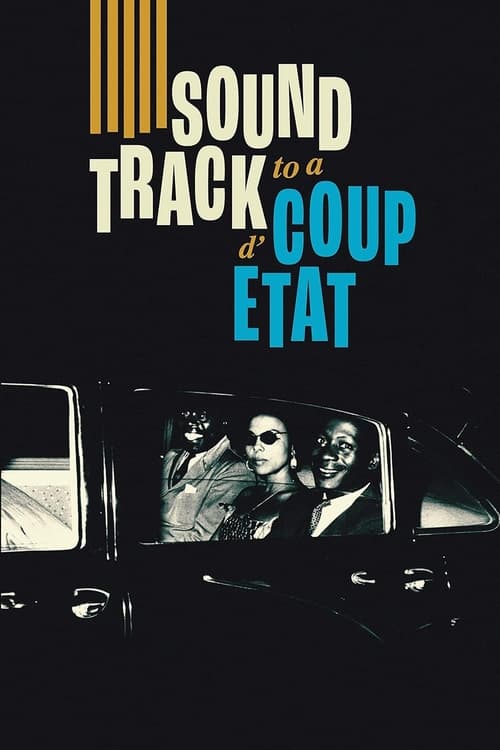
Soundtrack to a Coup d'Etat
2024 · Johan Grimonprez
For when you want a documentary that makes you think hard and feel the pulse at the same time — history as rhythm, not homework. Pick it when you're up for outrage delivered with style.
What it's about
A documentary that tells two Cold War stories as one: the U.S. State Department sending jazz giants abroad as ambassadors of American freedom, and the 1960–61 destabilization of the newly independent Congo that ended in the assassination of its first prime minister, Patrice Lumumba. Built entirely from archival footage, music, and testimony, it follows how Louis Armstrong, Nina Simone, and their peers were drafted into a propaganda campaign that ran alongside — and covered for — covert intervention in Africa, and how some of the musicians caught on and fought back.
The experience
It moves like the music it's about — fast, syncopated, dense with cross-cutting connections, an archival montage that plays more like a thriller than a history lecture. You leave buzzing and furious, with a playlist and a reading list.
The craft
Grimonprez's editing is the star: thousands of archival fragments — newsreels, UN sessions, performances, interviews — cut to a jazz pulse so the argument lands musically as well as intellectually. The soundtrack is extraordinary and genuinely rewards good speakers; this is a rare political documentary you should hear loud.
Why it matters
Premiering at Sundance in 2024, it became one of the most acclaimed documentaries of its season and a benchmark for archival filmmaking — reopening the story of Lumumba's assassination and the entanglement of culture and covert power for a new audience.
Snapshot
Soundtrack to a Coup d'Etat is a feature-length documentary essay by the Belgian artist-filmmaker Johan Grimonprez that braids two Cold War histories usually told apart: the United States government's deployment of jazz musicians as cultural ambassadors abroad, and the 1960–61 destabilization of the newly independent Republic of the Congo, culminating in the assassination of its first prime minister, Patrice Lumumba. The film argues, through a dense archival montage, that the celebration of Black American music as a showcase of American freedom coincided almost exactly with covert Western intervention against African self-determination — and that some of the musicians drafted into that "soft power" program came to understand, and protest, the contradiction. The film premiered at the Sundance Film Festival in January 2024, ran a lengthy festival circuit through the year, and was nominated for the Academy Award for Best Documentary Feature at the 97th Academy Awards. Roughly two and a half hours long, it is at once a work of historical revisionism, a jazz film, and a formal continuation of Grimonprez's long practice of found-footage collage. Its most cited image — the drummer Max Roach and singer Abbey Lincoln leading a protest that disrupted the UN Security Council in February 1961 after news of Lumumba's death — functions as the film's emblem: art and politics colliding in the same historical frame.
Industry & production
The film sits within the international art-documentary and festival-funding ecosystem rather than the commercial nonfiction market. It is a European co-production associated with Grimonprez's own production milieu (his work has long been produced through Belgian art-cinema structures), and like most feature documentaries of this scale it was assembled from a patchwork of public film funds, broadcaster support, and festival development money. Precise financing figures are not part of the public record, and I will not invent them. What is clear is the project's dependence on archival licensing: a film built almost entirely from historical footage and recorded music carries substantial rights-clearance costs and a correspondingly long post-production timeline, which is consistent with Grimonprez's method of working over years rather than months.
Distribution followed a specialty-arthouse pattern. In North America the film was released by Kino Lorber, a distributor with a strong catalog in political and archival documentary, which positioned it for a limited theatrical run followed by the awards-season and repertory circuit. The Academy Award nomination materially raised its profile and extended its theatrical life. As with most films in this category, box-office returns were modest and are not reliably documented in a way I can cite; the film's "market" is properly understood as festivals, cinematheques, universities, and streaming/home-video afterlife rather than multiplex exhibition.
Technology
Technologically the film is a work of curation and digital post-production rather than original image capture. Its raw material is twentieth-century archival media — 16mm and 35mm newsreel, television broadcasts, kinescopes, home movies, and, crucially, a very large body of recorded jazz. The central technical labor is therefore the sourcing, digitizing, restoring, and conforming of heterogeneous archival elements into a single coherent digital timeline, with the attendant challenges of mismatched aspect ratios, film grain, tape artifacts, and audio fidelity. The film generally lets that heterogeneity show rather than smoothing it into invisibility, so that the seams of the archive remain legible. Non-photographic elements — animated text, on-screen quotations, and typographic interludes — are digitally composited over or between the archival images. In short, the "technology" of the film is that of the modern nonlinear editing suite applied to a century of analog media, and its expressive power comes from the density and precision with which those sources can now be juxtaposed.
Technique
Cinematography
Because the film is built overwhelmingly from found footage, it has almost no original cinematography in the conventional sense; its visual authorship lies in selection and framing-within-the-frame rather than in lighting or camera movement staged for this production. The "eye" of the film is an editorial and archival eye. That said, Grimonprez and his team are highly attentive to the graphic qualities of the material they choose — the theatrical lighting of a concert stage, the flat institutional look of UN chamber broadcasts, the propaganda gloss of official newsreels, the grain of on-the-ground reportage. The contrast between glamorous, well-lit images of American cultural triumph and rougher, more chaotic footage of political violence is itself a compositional argument. Any original photography (contemporary interviews or newly shot connective material, if present) is secondary to this archival visual field; the precise balance of new versus found imagery is best confirmed from the film's own credits, and I flag it rather than assert a figure.
Editing
Editing is the film's dominant creative dimension and the seat of its meaning — as it is across Grimonprez's whole body of work. The method is dialectical montage in the Soviet tradition, updated for the archive age: two images or an image and a sound are set against each other so that the collision produces a third idea the film never states outright. A jazz performance abroad is cut against a covert-operations timeline; a beaming diplomatic photo-op is cut against footage of repression. The rhythm is frequently keyed to the music, so that the cutting itself "swings" and the essayistic argument rides the pulse of the soundtrack. The film's considerable length is a deliberate accumulation strategy: the case is built by layering dozens of correspondences until the pattern feels structural rather than coincidental. The editing is credited to Rik Chaubet, a longtime Grimonprez collaborator; readers should confirm the credit against the film's titles, but the collaboration is consistent with the director's established working method.
Mise-en-scène / staging
Traditional mise-en-scène — the arrangement of actors and objects before a camera — does not apply here, since the film stages almost nothing itself. Its equivalent is the "staging" of the archive: the ordering of clips, the placement of text on screen, the choreography of when music enters and drops out, and the rhythm of black frames or typographic cards between passages. Grimonprez treats the screen as a page as much as a window, interpolating written quotations (drawn from memoirs, speeches, and testimony) that function like intertitles, giving the montage a literary spine. The organizing "set" of the film, conceptually, is a small number of recurring spaces — the concert stage, the UN chamber, the Congolese street — whose repetition across the runtime does the work that a fixed location would do in a fiction film.
Sound
Sound is not accompaniment here; it is co-equal with image and arguably the film's protagonist. The soundtrack is a curated body of existing jazz — the music of figures such as Louis Armstrong, Dizzy Gillespie, Duke Ellington, Nina Simone, Max Roach, and Abbey Lincoln, among others associated with the era — deployed both as historical evidence (this is the music the State Department exported) and as emotional and rhythmic engine. Roach and Lincoln's protest-jazz, particularly the We Insist! Freedom Now Suite milieu, sits at the thematic center, binding the aesthetic and political arguments together. Voice enters largely through archival speech and through spoken passages of testimony and memoir; the film generally prefers quotation and archival voice to a single authoritative narrator, which keeps its "voice-of-God" tendencies in check and foregrounds the historical actors themselves.
Performance
There are no performances in the acted sense. The film's "performers" are historical people captured in the archive — musicians on stage, diplomats at podiums, politicians in chambers, ordinary people in the street — and the human presences that carry the film are drawn from that record: Lumumba, Armstrong, Gillespie, Lincoln, Roach, Nikita Khrushchev, Dag Hammarskjöld, and the Congolese and Pan-African figures around Lumumba. A crucial textual "performance," in effect, comes from the writings of Andrée Blouin, the Pan-African political activist who served in Lumumba's circle and whose memoir supplies some of the film's most incisive first-person perspective. The film's power depends on how vividly these archival presences register; its casting is the casting of history.
Narrative & dramatic mode
Formally the film is an essay-documentary: it advances a thesis through juxtaposition rather than delivering a neutral chronicle. But it also has a genuine tragic-historical narrative running through it — the arc from the euphoria of Congolese independence in June 1960 to Lumumba's overthrow and murder by January 1961, framed within the wider Cold War contest between the United States and the Soviet Union over the newly decolonizing world. The dramatic mode is contrapuntal: two timelines (the cultural-diplomacy story and the covert-political story) are run in parallel and made to comment on each other, so that suspense derives less from "what happens" (the outcome is history) than from watching the two strands converge into a single indictment. The film's rhetoric is that of accumulation and irony — the gap between what the music promised and what the geopolitics delivered — rather than of conventional three-act storytelling.
Genre & cycle
The film belongs to several overlapping traditions at once. As nonfiction it is a compilation/archival documentary and, more specifically, an essay film in the lineage of Chris Marker, Santiago Álvarez, and the political found-footage tradition. As a music film it participates in the jazz-documentary genre, but subverts its usual celebratory register by embedding the music in a story of complicity and protest. And as a work about decolonization and the Congo it joins a distinct cycle of films reckoning with Lumumba and Belgian colonial responsibility — a cluster that includes Raoul Peck's Lumumba: Death of a Prophet (1990) and Lumumba (2000). Within Grimonprez's own filmography it extends the "history-as-montage" cycle he has pursued since the 1990s. It is best understood not as a straightforward genre picture but as a deliberate hybrid that uses the pleasures of one genre (jazz) to deliver the argument of another (political history).
Authorship & method
Johan Grimonprez is an artist-filmmaker who moves between the gallery and the cinema, and whose signature is the montage of appropriated media in the service of a critical historical argument. His breakthrough, Dial H-I-S-T-O-R-Y (1997), assembled a history of aircraft hijacking and media spectacle from archival footage; later features Double Take (2009), on Alfred Hitchcock and Cold War doubling, and Shadow World (2016), on the global arms trade, deepened his interest in the machinery of power and the complicity of images. Soundtrack to a Coup d'Etat is recognizably the work of the same author: essayistic, archive-driven, morally pointed, and structured by juxtaposition rather than exposition.
The method is collaborative in specific ways. Editing — the decisive craft in this kind of film — is credited to Rik Chaubet, a recurring Grimonprez collaborator. Rather than a conventional composer's score, the film's "music department" is really a matter of music supervision and rights: the soundtrack is drawn from historic jazz recordings, so the creative act is curatorial selection and clearance rather than original composition, and I note that distinction rather than crediting an original score that the film does not have. The "writing" is likewise unusual: the film's text derives substantially from documentary and literary sources — notably the memoir of Andrée Blouin and the historical record of the period — so that authorship is distributed between Grimonprez's structuring intelligence and the testimony of the historical figures he quotes. Where exact collaborator credits matter, they should be verified against the film's titles; the broad division of labor described here follows Grimonprez's established practice.
Movement / national cinema
The film is a product of European (specifically Belgian/Flemish) art-cinema and the international documentary festival system rather than of any national industrial cinema. Grimonprez's practice straddles contemporary visual art and film, and Soundtrack is legible within the tradition of the political essay film that runs from the 1960s European and Latin American avant-gardes to today's gallery-adjacent documentary. There is a pointed national dimension to the subject matter, however: as a Belgian filmmaker confronting the Congo, Grimonprez works in the shadow of his own country's colonial history and its documented role in the events leading to Lumumba's death, which gives the film an implicit reflexive charge about Belgian responsibility even as its formal home is transnational art cinema.
Era / period
The film was made and released in the mid-2020s, a moment of intensified public reckoning with colonial legacies, restitution debates, and reassessments of Cold War interventionism — a climate in which its subject landed with contemporary force. Its historical setting, by contrast, is concentrated on 1958–61: the crest of African decolonization, the Congo's independence, the Cold War scramble for influence in the postcolonial world, and the State Department's jazz-ambassador program of the same years. The film insists on the simultaneity of these events — that the cultural showcase and the covert operation belong to a single period and a single system — and its rhetorical energy comes from collapsing the distance between the celebratory official memory of that era and its suppressed political underside.
Themes
The governing theme is the instrumentalization of Black American culture as Cold War soft power, and the moral contradiction of exporting the image of American freedom while Western powers worked to defeat African self-determination. From this flow the film's other concerns: decolonization and its betrayal; the assassination of Lumumba as a hinge of twentieth-century history; the complicity of images and spectacle in political violence (a lifelong Grimonprez preoccupation); and the counter-tradition of artists — Roach, Lincoln, and their circle — who refused the role assigned to them and turned their art into protest. Beneath these runs a meta-theme about historiography itself: how official archives construct memory, and how montage can be used to reassemble those same archives into a counter-history. The film is finally about listening — hearing, in the "soundtrack" of a triumphalist era, the coup it was scored to accompany.
Reception, canon & influence
Critically the film was received as one of the major documentaries of its year: reviewers praised the ambition and density of its argument and the virtuosity of its montage, while some noted that its length and information overload can overwhelm. Its clearest institutional recognition was the nomination for the Academy Award for Best Documentary Feature at the 97th Academy Awards, following a Sundance premiere and a broad festival run; it also featured on numerous critics' year-end lists. I flag that specific festival prizes and critics'-group wins should be checked against the record rather than asserted here, as the fine-grained awards tally is easy to misstate.
The influences on the film are legible and deep. Formally it descends from the essayistic and compilation traditions of Chris Marker and the militant montage of Santiago Álvarez, and from Grimonprez's own earlier archival features. Thematically it draws on decolonization historiography and on the specific body of Lumumba cinema associated with Raoul Peck, as well as on primary testimony such as Andrée Blouin's memoir and the era's protest jazz. Its forward influence is still forming, as befits a recent film, but its likely legacy is twofold: it strengthens the case for the archival essay film as a serious mode of historical argument at a moment when that form is ascendant, and it contributes to an ongoing cultural re-evaluation of the "jazz ambassadors" program and of Lumumba's assassination — reframing a celebrated chapter of American cultural diplomacy as inseparable from a suppressed history of intervention. Whether it becomes a durable reference point for future decolonization documentaries will depend on its afterlife in classrooms and cinematheques, but its Oscar-nominated visibility gives it a strong platform to shape how that history is taught and re-seen.
Reception
No reappraisal arc needed — it hit as an event from Sundance 2024 onward, riding a year of festival buzz all the way to an Oscar nomination, and is already being talked about as one of the decade's essential documentaries.
How Soundtrack to a Coup d'Etat was received, from release to now →
How to watch Soundtrack to a Coup d'Etat: what to notice on a first viewing
- Notice a jazz clip cut against a political news clip. Grimonprez keeps pairing a diplomatic photo opportunity or a concert against footage of repression or covert planning, letting the collision make an argument the film never states out loud. The meaning isn't in either shot. It's built in the gap between the two.
- Notice the jazz is real archival recording, not a score. Every note in the film comes from the period itself, music the State Department actually sent abroad, used here as historical evidence as much as mood. You're listening to the actual soundtrack of the soft power campaign the film is examining.
- Follow two separate timelines running side by side. One strand follows jazz musicians touring as American cultural ambassadors, the other follows a covert political operation in the Congo, and the film keeps cutting between them as if they were one story. Watching two timelines converge does the arguing here, instead of a narrator telling you what to conclude.
- Notice the written quotations appearing on screen. Grimonprez interpolates text drawn from memoirs, speeches, and testimony directly into the images, so the film reads as much as it plays, using quotation instead of a narrator's voice. The history speaks for itself, in its own words, instead of being summarized for you.
- Notice the same few spaces returning throughout the film. The concert stage, the UN chamber, and the Congolese street keep recurring across two and a half hours, doing the work a single fixed location would do in a scripted film. These few recurring places become the film's landmarks, so you always know which story you're inside.
The whole guide to watching Soundtrack to a Coup d'Etat, with the keys for a rewatch →
Influences: the films it descends from and the films it influenced
- The Fall of the Romanov Dynasty (1927) — Founded the compilation-documentary method Grimonprez works in — constructing a polemical historical argument entirely from re-edited, repurposed archival footage rather than shot material.
- Night and Fog (1955) — Model for the contrapuntal archive essay: newsreel and photographic montage set against an off-screen literary text and a deliberately dissonant commissioned score (Hanns Eisler) that comments rather than illustrates.
- Now! (1965) — The direct precedent for music-keyed political collage — cutting found imagery to the rhythm and structure of a single protest song (Lena Horne's 'Now!') so the track drives the montage's argument.
- In the Year of the Pig (1968) — Established the narration-free compilation argument, letting the collision of found interviews and newsreel — with no voice-of-God — indict state power through juxtaposition alone.
- A Grin Without a Cat (1977) — The essayistic reassembly of the global left's archive into a dialectical history of revolution and its betrayal, the template for structuring by juxtaposition over exposition.
- Sans Soleil (1983) — Perfected the contrapuntal essay film in which a quoted, distributed narrating voice plays against wandering archival image — the authorial signature Grimonprez adapts by voicing Blouin's and others' testimony.
- Lumumba: Death of a Prophet (1990) — First-person essayistic reckoning that assembles the fragmentary Lumumba archive into an act of counter-memory — the specific craft forebear for reframing the assassination through recovered image and testimony.
- Tribulation 99: Alien Anomalies Under America (1992) — Hyper-dense found-footage collage that indicts U.S. Cold War intervention across the Americas by ironic reappropriation of official and pulp imagery — a precedent for found-footage-collage as anti-imperial argument.
- Dial H-I-S-T-O-R-Y (1997) — The director's own founding method: appropriated broadcast media montaged into a critical history of spectacle, establishing the archive-driven, morally pointed dialectic he reuses here.
- Summer of Soul (2021) — Reclaims a suppressed chapter of Black cultural-political history through curatorial editing of long-buried performance footage, treating the music itself as the primary historical document — the jazz-documentary-as-recovery mode Grimonprez politicizes.
- The Black Power Mixtape 1967–1975 (2011) — Reactivates dormant archival footage of Black liberation with a contemporary sonic and vocal layer, the same strategy of letting period image and present-day audio commentary interrogate each other.
- Concerning Violence (2014) — Archival decolonization essay that narrates Fanon's written text over African liberation-struggle footage, using screen-as-page titling and quoted text — the closest formal cousin to Grimonprez's Blouin-driven decolonial montage.
- I Am Not Your Negro (2016) — Builds an archival essay around a distributed authorial voice — an author's own words (Baldwin) montaged against image — the same displacement of narration onto a historical figure's testimony.
- HyperNormalisation (2016) — Sweeping political argument assembled from broadcast-archive collage with music-keyed cutting, where pop and atmospheric tracks pace the montage and bind disparate power-histories into one thesis.
- Shadow World (2016) — Same author extending the archive-driven indictment of the machinery of power to the global arms trade, sharing the essayistic structure and complicity-of-images theme.
- Did You Wonder Who Fired the Gun? (2017) — Militant first-person essay film that fuses agitprop montage, on-screen text and a driving musical spine to prosecute a suppressed history of American racial violence.
Similar films
- The Black Power Mixtape 1967-1975 (2011) — influence & lineage
- HyperNormalisation (2016) — influence & lineage
- The Secret Agent (2025) — same viewing thread
- I Am Cuba (1964) — same viewing thread
- The Act of Killing (2012) — same viewing thread
- Sambizanga (1973) — same viewing thread
- Z (1969) — same viewing thread
- Battleship Potemkin (1925) — same viewing thread
All the films related to Soundtrack to a Coup d'Etat →
Watch it with: curated runs of related films
- The Long Shadow of the Coup — A run of films tracing political violence from the mutiny and the massacre through martial law to the decades-long reckoning that follows — watch them near each other and the same machinery of power keeps rhyming across continents and eras.