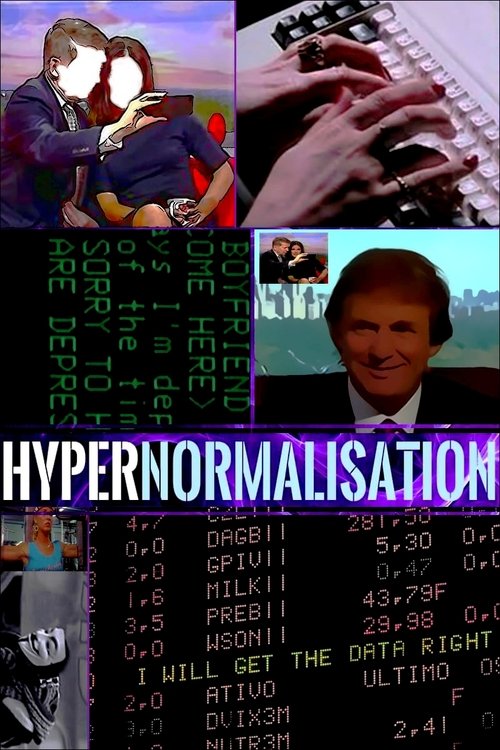
HyperNormalisation
2016 · Adam Curtis
For when you want a film to chew on for days and argue about after — a long, immersive evening for the politically curious. Challenging by design; keep your skepticism switched on and it's exhilarating.
What it's about
A 166-minute argument about how we got to the post-truth world: since the 1970s, Adam Curtis contends, politicians, bankers, and technologists gave up on managing reality's complexity and built a simpler, fake version of it instead — and we went along because we couldn't imagine an alternative. The story sweeps from 1970s New York's fiscal crisis through Syria, cyberspace, and perception management, stitched together entirely from the BBC's archive.
The experience
Hypnotic and unsettling — a collage of found footage, pop music, and Curtis's flat, doom-laden narration that plays less like a documentary than a dark bedtime story about the modern world. You come out half-convinced, half-arguing with it, and either way you can't stop thinking about it.
The craft
The craft is the editing: decades of BBC archive footage cut against unexpected music into something between essay, montage, and mood piece. Curtis's own narration is the spine, and the film's sound design — droning, dreamlike, occasionally needle-drop perfect — rewards headphones or good speakers.
Why it matters
Released straight to BBC iPlayer weeks before the 2016 U.S. election, it seemed to predict the moment it landed in, and 'hypernormalisation' entered the vocabulary of how people talk about post-truth politics.
Snapshot
HyperNormalisation is a 166-minute essay-documentary by the British filmmaker Adam Curtis, released directly to the BBC's iPlayer streaming service on 16 October 2016 — several weeks before the U.S. presidential election that its argument seemed to anticipate. Assembled almost entirely from the BBC's film and television archive and narrated by Curtis himself in his characteristic flat, portentous voice, the film advances a single sweeping thesis: that since the 1970s, politicians, financiers, and technologists have retreated from the messy complexity of the real world into a simpler, managed, and ultimately fake version of it — and that we, the audience, have colluded in the pretense because we cannot imagine an alternative. The title is borrowed from the anthropologist Alexei Yurchak's study of the late Soviet Union, where citizens knew the system was hollow but behaved as though it were permanent and normal. Curtis transposes that condition onto the contemporary West. Ranging across the New York fiscal crisis, Syria and Gaddafi's Libya, the rise of Russian "managed democracy," Silicon Valley's utopianism, and the figure of Donald Trump, the film is less a linear argument than a mood — an atlas of disillusion delivered as hypnotic montage.
Industry & production
HyperNormalisation belongs to a distinctive institutional niche: the BBC-funded, iPlayer-native long-form documentary, a form Curtis effectively invented with Bitter Lake (2015). Freed from the roughly one-hour slots and editorial conventions of broadcast television, these films run to feature length and beyond, structured for on-demand viewing rather than a scheduled transmission. HyperNormalisation was commissioned and produced within the BBC and released without a theatrical run or a traditional broadcast première, a strategy that both signaled its experimental status and insulated it somewhat from the broadcast-standards scrutiny that Curtis's earlier series (The Power of Nightmares, The Trap) attracted. Curtis works as a near-solo author inside a large public broadcaster — an unusual arrangement in which the institution supplies the archive, the funding, and the platform while ceding almost complete creative control to one editor-writer-narrator. Precise budget figures and detailed crew credits are not part of the public record in the way they would be for a theatrical feature; on the evidence of the finished work and Curtis's stated practice, the production footprint was extremely small.
Technology
The film is a product of two technologies in particular: the vast, digitised BBC archive and the streaming platform that carried it. Curtis's method depends on decades of accumulated news rushes, current-affairs footage, foreign correspondents' tapes, and unused B-roll, now searchable and retrievable in digital form; the film is essentially a database work, mining an archive rather than shooting new material. Non-linear digital editing makes possible the dense, rapid, associative cutting that defines the style. Equally important is distribution: iPlayer allowed a 166-minute film with no advertising breaks and no fixed running time, a length that would be impossible in conventional scheduling. The aesthetic also foregrounds the degradation of its source media — VHS dropout, analog video noise, faded film stock, glitches, and momentary bursts of static — so that the technology of the archive becomes part of the film's texture and one of its arguments about memory, decay, and the unreality of recorded history.
Technique
Cinematography
There is, in the conventional sense, almost no original cinematography. HyperNormalisation is a compilation film; its images are found, not photographed by the production. The "camerawork," therefore, is inherited from thousands of anonymous BBC cameramen and news crews across four decades. Curtis's compositional intelligence operates at the level of selection: he favours long, seemingly incidental takes — a bored official in a corridor, a crowd dispersing, a landscape held a beat too long, faces caught between expressions. These "empty" or off-moment shots, drained of their original journalistic purpose, acquire an uncanny, elegiac charge. The recurring visual motifs — decaying architecture, deserts, dancing crowds, surveillance imagery, blank interiors — function as a kind of authored cinematography assembled after the fact from other people's footage.
Editing
Editing is the film's true authorship and its dominant technique. Curtis constructs meaning almost entirely through juxtaposition: an image is placed against a piece of music, a line of narration, and an adjacent shot so that a claim emerges from the collision rather than from any single element. The rhythm alternates between long, floating passages of ambient reverie and sudden accelerations of hard-cut montage. Ideas rhyme visually across the film's length — a gesture or image introduced early returns transformed later — giving the sprawling, non-chronological structure an associative coherence. This is also the film's most criticized feature: the same associative logic that makes it mesmerizing allows connections to be asserted through adjacency rather than demonstrated through argument, so that correlation and causation blur by design.
Mise-en-scène / staging
Because the film stages nothing, "mise-en-scène" must be understood as curatorial. Curtis composes the frame after the fact, cropping, slowing, freezing, and repeating found images, and occasionally overlaying text — spare white captions that name a person, a date, or a stark declarative phrase. The staging is in the arrangement: the decision to hold on a face, to let a scene run past its informational usefulness into pure atmosphere. The intertitles, terse and often deliberately banal or ominous, punctuate the flow and cue the viewer's reading of the images that follow.
Sound
Sound is central and highly authored. Curtis is a connoisseur-curator of music, and the film's soundtrack draws on electronic, ambient, industrial, and pop sources to create emotional weather — dread, melancholy, euphoria, irony — that guides the interpretation of the images. Brian Eno–style ambience, propulsive electronic tracks, and pop songs are laid against archival footage to estrange it, a technique of ironic or elegiac counterpoint that is one of Curtis's signatures. (Specific track listings circulate among viewers, but I won't attribute particular songs here without certainty.) Just as important is the disembodied narration: Curtis's own voice, calm, insistent, and slightly hypnotic, delivering grand historical claims in plain declarative sentences. The interplay of that voice, the music, and the ambient sound of the archive constitutes the film's real "score."
Performance
There are no actors and no performances in the fictional sense. Instead the film repurposes the recorded behavior of real historical figures — politicians, ideologues, celebrities, ordinary people caught on camera — as if they were a cast. Figures such as Vladislav Surkov, Muammar Gaddafi, Hafez al-Assad, Henry Kissinger, Patti Smith, Jane Fonda, and Donald Trump become characters in Curtis's story, their archival gestures and utterances recontextualised to serve the argument. The one sustained "performance" is Curtis's narration, which functions as a guiding consciousness — omniscient, wry, and quietly apocalyptic.
Narrative & dramatic mode
The film is an essay-documentary — the audiovisual equivalent of a discursive, associative long-form essay. It rejects the interview-driven, balanced structure of conventional television journalism in favour of a single authorial voice building a cumulative argument. Its dramatic mode is elegiac and ironic rather than investigative: it does not so much prove a case as induce a state of recognition. Chronology is fractured; the film moves by theme and rhyme, circling back to key years (1975, the 1990s, the 2000s) and key ideas (retreat, perception management, the failure of radical alternatives). The result is closer to tragedy than to reportage — a story about the slow closing of political imagination, in which the audience is implicated as a passive participant rather than addressed as a neutral observer.
Genre & cycle
HyperNormalisation sits within the tradition of the compilation film and the film-essay — a lineage running from Soviet montage and the found-footage documentary through to the personal essay-films of Chris Marker and the détournement practices of the Situationists. Within that broad genre it belongs to a very specific cycle: the Adam Curtis film, a recognizable and much-imitated brand of archival montage cultural history. It is one node in a continuous body of work — The Century of the Self (2002), The Power of Nightmares (2004), The Trap (2007), All Watched Over by Machines of Loving Grace (2011), Bitter Lake (2015), and later Can't Get You Out of My Head (2021) — that shares themes, methods, and even recurring footage. HyperNormalisation extends the long-form, iPlayer-native cycle inaugurated by Bitter Lake.
Authorship & method
This is auteur documentary in the most literal sense: Curtis researches, writes, narrates, and edits, and the film is unmistakably the product of one sensibility. His method is archival immersion — spending long periods inside the BBC's film library, retrieving forgotten footage and building arguments from what he finds. The absence of the usual division of labor is the point: there is no credited cinematographer because nothing is shot; the "composer" is really a curator of pre-existing music; the "editor" and the "writer" are the same person as the director and the narrator. This concentration of roles is both the source of the work's coherence and the target of its critics, who argue that a single unaccountable author, wielding an institution's archive and no counter-voice, can make almost any historical connection feel inevitable. Curtis has been candid that his films are subjective, avowedly authored accounts rather than balanced journalism — a stance that defines both the method and its controversies.
Movement / national cinema
The film is deeply British and specifically a BBC product — unimaginable outside the resources of a large, long-established public-service broadcaster with a deep archive and a willingness to fund idiosyncratic authorship. Yet its lineage is international and avant-garde: the essay-film tradition of Marker and Godard, the détournement of Guy Debord and the Situationists (whose critique of the "spectacle" underlies much of Curtis's thinking), and the montage theory of Soviet cinema. Curtis constitutes something close to a one-man movement — his influence has produced a recognizable school of imitators and parodists — but he is best understood as a British public-broadcasting auteur working in the transnational grammar of the political essay-film.
Era / period
HyperNormalisation is a document of the mid-2010s moment of Western political disorientation: the aftermath of the 2008 financial crisis, the disappointments of the Arab Spring and the Syrian catastrophe, the resurgence of an assertive Russia, the failure of Occupy, and the imminence of the Brexit and Trump upheavals. Its release in October 2016, on the eve of Trump's victory, gave it an immediate sense of prophecy, and much of its early reception fixed on that timing. The film also looks backward across the whole neoliberal era, treating 1975 — the New York City fiscal crisis, when finance is shown stepping into a vacuum left by retreating politics — as a founding moment for the "fake world" it describes.
Themes
The governing theme is the retreat from complexity: the idea that those with power responded to an unmanageable real world by constructing a simplified, stable, and false one. Around this cluster several others. Perception management and "nonlinear" politics: the film's account of Vladislav Surkov's stagecraft in Putin's Russia — funding both sides, keeping the population in a state of permanent uncertainty — becomes a model for a politics that abandons truth for the management of confusion. Finance as the successor to politics: the 1970s handover of power from elected officials to markets. The failure of radical alternatives: from Patti Smith and the utopian counterculture to Occupy, the film traces how dissent turned inward, toward the self and the network, and left the machinery of power untouched. Cyber-utopianism and its disappointment: the internet, imagined as a space of liberation, becomes another managed and pacifying illusion. The scapegoat and the invented villain: Gaddafi's Libya as a fictionalized enemy that let the West avoid the real complexities of the Middle East. Above all, complicity — the "hypernormal" condition in which everyone knows the story is false and no one can act otherwise.
Reception, canon & influence
Critical reception was substantial and divided. The film was widely praised as hypnotic, ambitious, and eerily timely, and its release just before the 2016 U.S. election amplified its reach and its reputation for prescience; it circulated far beyond the BBC through clips, discussion, and academic attention. At the same time it drew serious criticism of a now-familiar kind: that its associative method manufactures connections it does not prove, that its grand unifying thesis is unfalsifiable, that it flattens complex histories into a single melancholy narrative, and that its seductive style can substitute mood for evidence. Both responses have become part of the standard critical framing of Curtis's work generally.
Its influences reach backward to the Situationist critique of the spectacle, the essay-films of Chris Marker and Jean-Luc Godard, Soviet montage, and the anthropological source of its title in Alexei Yurchak's writing on the late Soviet Union; conceptually it is continuous with Curtis's own earlier films on public relations, fear, and the psychology of power. Looking forward, HyperNormalisation helped consolidate a recognizable audiovisual idiom — archival montage plus ambient music plus authorial narration — that has been widely emulated and parodied across YouTube and the wider video-essay culture, to the point that "the Adam Curtis style" is now a genre reference in its own right. Within Curtis's filmography it stands as the fullest statement of the long-form iPlayer mode and the immediate precursor to the still more expansive Can't Get You Out of My Head. Its lasting influence lies less in any single verified claim than in the vocabulary it popularized: "hypernormalisation" itself, and the intuition it names — that we inhabit a world we know to be false and cannot yet imagine leaving — entered political and cultural discourse and has outlived the film's specific arguments.
Reception
Dropped quietly on BBC iPlayer in October 2016, it got a huge second wind three weeks later when Trump won and the whole thing suddenly read as prophecy — it's since become the default entry point for Curtis converts.
How HyperNormalisation was received, from release to now →
Influences: the films it descends from and the films it influenced
- The Fall of the Romanov Dynasty (1927) — Invented the compilation film — constructing a political history of a regime entirely by re-editing found archival footage nobody shot for the purpose, the exact procedure Curtis applies to the BBC library.
- Man with a Movie Camera (1929) — Soviet associative montage in which meaning is manufactured by the collision of unrelated shots rather than by any single image, the editing logic underlying Curtis's argument-by-juxtaposition.
- Listen to Britain (1942) — British poetic-documentary tradition of impressionistic montage and sound-image counterpoint, building mood from off-moment observational shots rather than narration — the native idiom Curtis inherits as a BBC filmmaker.
- A Movie (1958) — Found-footage collage that sets appropriated newsreel and stock footage against music for ironic effect, the deadpan image/soundtrack counterpoint Curtis systematizes.
- In the Year of the Pig (1968) — The 'radical scavenger' compilation method — assembling a persuasive political thesis wholly from pre-existing archive, letting the cut carry the argument.
- The Society of the Spectacle (1973) — Situationist détournement: hijacking appropriated media footage and overlaying a critical authorial voice to expose a falsified reality — the theoretical and formal template Curtis's facets name directly.
- Sans Soleil (1983) — First-person essay-film in which a subjective, melancholy narration threads disparate found and shot footage into a meditation on memory and images — the authored, elegiac voice-over mode Curtis descends from.
- Histoire(s) du cinéma (1988) — Archival montage as historiography — superimposition, ironic musical scoring and free association across an image bank to advance a single author's grand thesis about the century.
- Images of the World and the Inscription of War (1989) — The interrogative essay-film that reads archival images against the grain to expose what institutions did not intend to record — the analytic use of the archive Curtis shares.
- The Century of the Self (2002) — Curtis's own consolidation of the house style — BBC archive plus curated pop soundtrack plus authorial narration — on which HyperNormalisation is built.
- The Power of Nightmares (2004) — Established Curtis's parallel-narrative structure, cutting between two histories to imply a hidden symmetry driving world events — the associative architecture HyperNormalisation extends.
- Beyond Clueless (2014) — Video-essay feature fusing found clips, ambient score and a single authored narration into a mood-driven cultural thesis — the direct heir to the 'Adam Curtis style' as a genre.
- Can't Get You Out of My Head (2021) — The fullest expansion of HyperNormalisation's method — a six-hour braid of individual biographies and archival montage that scales the single-author iPlayer essay to its maximum.
- Bitter Lake (2015) — The immediate iPlayer-native precursor: first long-form work freed from broadcast running time, using raw unnarrated rushes and durational archival passages that HyperNormalisation inherits.
- Room 237 (2012) — Builds an entire feature from re-purposed footage and voice-over into an unfalsifiable interpretive web — the same seductive-but-unprovable associative method critics level at Curtis.
- Our Nixon (2013) — An archive-only compilation documentary that lets forgotten institutional footage (here Super 8 home movies) carry the historical argument without new photography.
- Love Is the Message, The Message Is Death (2016) — Associative archival montage cut to a driving music track so that juxtaposition and rhythm, not commentary, produce an emotional-political argument from appropriated footage.
- Soundtrack to a Coup d'Etat (2024) — Sweeping political argument assembled from broadcast-archive collage with music-keyed cutting, where pop and atmospheric tracks pace the montage and bind disparate power-histories into one thesis.
- The Black Power Mixtape 1967-1975 (2011) — Mines a national public-service broadcast archive (the BBC's) to build an associative, essayistic montage authored through juxtaposition, the same practice of turning a television archive into a first-person essay.
Similar films
- Brexit: The Uncivil War (2019) — shared sensibility
- Soundtrack to a Coup d'Etat (2024) — shared sensibility
- The Truman Show (1998) — shared sensibility
- The Big Short (2015) — shared sensibility
- Chronicle of a Summer (1961) — shared sensibility
- The War Game (1966) — shared sensibility
- The History of Concrete (2026) — shared sensibility
- Threads (1985) — shared sensibility