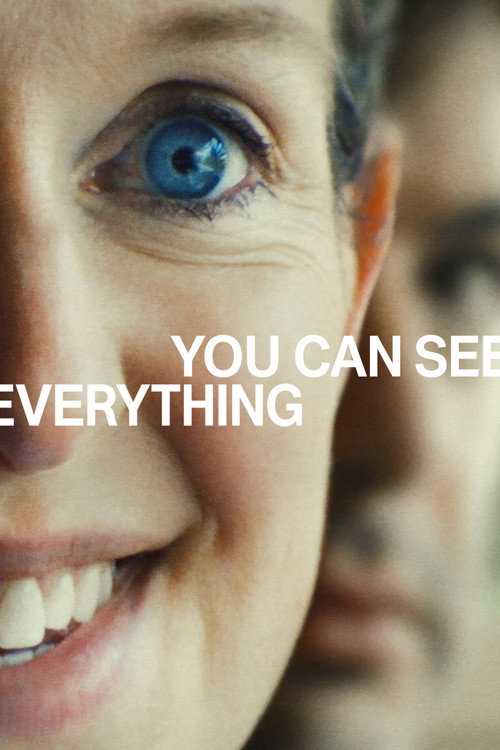
You Can See Everything
2026 · Nathan Fielder
For a night when you want to be messed with — when true crime feels too tidy and you'd rather have something that keeps you arguing about what you actually saw. A challenge, not a comfort watch, and best with someone to dissect it with afterward.
What it's about
Thirty-four days before Elizabeth Holmes reports to prison for defrauding Theranos investors, she and her partner Billy Evans invite a film crew into their rented Del Mar beach house to document her final weeks of freedom. Nathan Fielder, in his first feature as director (co-directed with Lance Oppenheim), starts with an observational portrait — then, two years into her sentence, resumes shooting with a strange new tool: Amanda Seyfried, who played Holmes in a TV dramatization, reenacting the conversations the cameras never caught. The question quietly shifts from what Holmes did to who controls her image now — and whether the filmmakers themselves can still be trusted as witnesses.
The experience
It plays like a slow-building psychological thriller wearing a documentary's clothes — funny in Fielder's deadpan way, then increasingly uneasy as suspicion creeps into every sunny domestic scene. At nearly three hours it uses its length deliberately, letting doubt accumulate until you're second-guessing footage you watched an hour earlier. You leave rattled, amused, and unsure who played whom.
Performances
Amanda Seyfried is remarkable in a genuinely layered position: she plays Holmes in reenactments, comments on the real footage, and gradually turns her suspicion on the filmmakers themselves — an actor's past performance becoming an event inside the documentary. Christopher Abbott brings unnerving precision to Evans, and Fielder's affectless on-camera persona, pushed in front of the lens against his original plan, anchors the whole uneasy enterprise.
The craft
David Bolen's cinematography splits the film into two registers — bright, coastal household footage versus firelit, shadowy rooms where the reenactments are staged and picked apart — and Adam Locke-Norton's editing keeps rereading early material in light of what comes later, so single shots change meaning on you. Ari Balouzian's score sustains the creeping unease. All three, plus the direction and the film itself, earned Critics' Choice Documentary Award nominations; the long runtime and slow-burn sound design reward a theater or a dark room with good speakers.
Why it matters
Kept secret until a surprise Telluride premiere, it landed one of the biggest documentary openings on record and near-unanimous acclaim, instantly making the case that formally daring nonfiction can work as an event release. It also marks Fielder's leap from cult television to feature filmmaking, carrying his reenactment method into a story with real legal and moral stakes.
Snapshot
You Can See Everything is a 174-minute documentary co-directed by Nathan Fielder and Lance Oppenheim, and it is Fielder's first feature as director. Its subject is Elizabeth Holmes, the founder of Theranos, who was convicted of defrauding investors. In April 2023, thirty-four days before Holmes reported to Federal Prison Camp Bryan in Texas to begin an eleven-year sentence, she and her partner Billy Evans invited the filmmakers into their rented beach house in Del Mar, California. The film starts as an observational portrait of those last weeks. When shooting resumes about two years after Holmes enters prison, it becomes something stranger: Fielder brings in Amanda Seyfried, who played Holmes in the Hulu miniseries The Dropout (2022), to reenact conversations the cameras never captured, and Christopher Abbott plays Evans. The investigation moves away from what Holmes did at Theranos and toward who controls her image now, and toward whether the filmmakers themselves can still be trusted as witnesses.
A24 produced and distributed the film on a reported budget of $7 million. Its existence was kept secret until an unannounced screening at the 53rd Telluride Film Festival on September 6, 2026. It opened in North America on October 16, 2026, and took about $15.6 million from 855 theaters, which was reported as the second-highest opening weekend ever for a documentary. Reviews were close to unanimous in its favor: 98% on Rotten Tomatoes and 97 on Metacritic at the time of writing.
Industry & production
The project came out of a connection between the two directors. According to published accounts, Oppenheim learned that Fielder had watched part of Oppenheim's Some Kind of Heaven (2020), and the two got in touch. The idea for the film reportedly came in 2023 at the Magic Castle in Los Angeles, when someone shouted Holmes's name during a magician's act. Oppenheim remembered rumors that Holmes was looking for documentary access through A24 and suggested they pursue it together. Fielder had read John Carreyrou's Bad Blood (2018) and was still curious about Holmes's own account, even after years of coverage.
The production companies were A24, To Be Formed, and Blow Out Productions. The producers were Fielder, Oppenheim, Tatiana Bears, Maggie Ambrose, and Jack Davis. Accounts of the production stress that A24 set no deadline and placed no obligation on the filmmakers to finish a film. That open-ended arrangement shaped the result: a three-year shoot, a long pause while Holmes was in prison, and a second phase built mostly from reenactment. The production was kept secret all the way to Telluride, which was a deliberate strategy in an industry where documentaries normally build awareness through long festival campaigns. The film's commercial performance, a doc opening on a near-wide release, is unusual in the recent theatrical market. The record does not yet show whether this changes how distributors handle nonfiction.
The production had conflicts of its own, and some of them ended up in the film. Fielder has said that Evans "was trying to exert a level of control over the project that made us uncomfortable." Evans's request for a share of the box office, made to the filmmakers and to A24 executives, is restaged in the film. Most of Holmes's associates declined to take part.
Technology
Little has been published about the film's cameras, formats, or post-production pipeline, and this dossier makes no claims about them. What can be said is that the film works in at least two registers. The first is the Del Mar material, shot as household vérité inside a real, inhabited space. The second is the later reenactment and interview footage, staged in controlled interiors. The film's themes also touch on technology indirectly. It shows billboards, social-media accounts, and "authorized" AI representations of Holmes that, the film suggests, Evans manages under a power of attorney. Media technology is part of the film's subject as well as its tools.
Technique
Cinematography
David Bolen is the credited cinematographer, and the film's cinematography was nominated at the Critics' Choice Documentary Awards. Reviews and summaries describe a clear visual difference between the two phases. The Del Mar footage is bright, domestic, and coastal. The reenactment frame sequences are much darker; one account describes "a dark, cozy living room with only the fireplace providing an orange, flickering light," where Fielder and Seyfried go over what happened. The title promises total visibility. The images keep showing how little that visibility settles. In one widely discussed swimming sequence, the person beside Holmes appears to be Evans and is later revealed to be Fielder. A single misread shot changes the emotional sense of a whole stretch of the film.
Editing
Adam Locke-Norton edited the film, and the editing was also nominated for a Critics' Choice Documentary Award. The structure depends on time-shifted revelation. Material shot in 2023 is reread in light of what the filmmakers learn later, and reenactments are cut against observational footage of the same events. At 174 minutes, the film uses its length to build a sense of duration and to let suspicion grow slowly. Critics singled out its twists. The Guardian's Adrian Horton called it "more shocking, twistier, thornier and revealing than billed." On-screen text appears at key points, including the closing card stating that Evans later chose not to accept box-office profits from A24.
Mise-en-scène / staging
The film stages its material in three spaces: the rented beach house, a reconstructed prison visiting room, and the firelit room where reenactments are discussed. The beach house works the way the shut-in houses of observational cinema do. It is a temporary set that the subjects are using to perform a version of their life. The reenactments follow Fielder's established method from Nathan for You and especially The Rehearsal: he rebuilds a situation with performers so that he can study it. Here, though, the method serves a documentary inquiry instead of a social experiment. The most consequential staged scene is Fielder's prison visit to Holmes. Because it can only be shown through reenactment, the film's climactic encounter is necessarily mediated by an actor.
Sound
Ari Balouzian, who has worked often with Oppenheim, composed the score. It was released as a 25-track album on the day the film opened, and Wikipedia describes it as helping to build the film's uneasy atmosphere. Beyond the score's nomination at the Critics' Choice Documentary Awards, little detailed writing exists yet on the sound design. Fielder's deadpan voice-over and on-camera questioning, familiar from his television work, set much of the film's tone.
Performance
Performance is the film's main subject as well as its method. Holmes performs a version of herself. She keeps insisting that she never intentionally misled anyone, and she continues to pitch investors on a revised device. Evans performs as protector and manager. Fielder was originally meant to stay behind the camera, but by his own account his exchanges with the couple were so odd that the filmmakers moved him in front of it. Seyfried takes on a layered role: she plays Holmes, comments on the footage, and gradually comes to suspect Evans. She also turns the suspicion back on Fielder, asking whether he has come to care about Holmes and changed the truth. Christopher Abbott plays Evans in the reenactments. The film also records that Holmes was angry about Seyfried's earlier portrayal, which she said had affected how fellow inmates treated her. So an actor's past performance becomes an event inside the documentary.
Narrative & dramatic mode
The film is a hybrid of three modes: observational portrait, investigative documentary, and reflexive essay. Its dramatic engine is suspicion. It is not much interested in proving Holmes's guilt, since the courts already settled that. It asks whether the access she granted is real or itself a performance. The arc moves away from Theranos and toward Evans's possible control of Holmes's public image, which rests on his power of attorney and his claim that her prison emails authorize what he does. The climax turns on semantic ambiguity. Asked about Evans's undisclosed approach to A24, Holmes gives answers that may mean she knew he would propose something without knowing what. Fielder then doubts his own memory of the conversation. The film refuses to settle on whether Holmes is a manipulator, a victim, or simply misunderstood. Variety's Owen Gleiberman called the result "a one-of-a-kind reality-TV-as-hangout-movie psychodrama circus." That mix of comedy, hangout looseness, and psychological thriller defines its mode.
Genre & cycle
The film belongs to the cycle of "con-artist" and fallen-founder media that grew up around Theranos and similar scandals. For Holmes specifically, that cycle includes Carreyrou's Bad Blood, Alex Gibney's HBO documentary The Inventor: Out for Blood in Silicon Valley (2019), and The Dropout. The film knows it arrives late in this sequence and openly draws on it, most obviously by casting the actor from the dramatization. It also belongs to the subject-sanctioned documentary, where a notorious figure invites the camera in on their own terms, and to the growing body of reflexive, reenactment-heavy nonfiction. Reviewers repeatedly placed it between documentary and reality television. Some call it cringe comedy; others call it philosophical inquiry. Its genre identity is unsettled on purpose.
Authorship & method
Nathan Fielder. Fielder came from Canadian sketch and television comedy. He developed his persona and method on Nathan for You (Comedy Central, 2013–2017), The Rehearsal (HBO, 2022– ), and The Curse (Showtime, 2023), which he co-created with Benny Safdie. The persona is an affectless, socially awkward questioner. The method builds elaborate real-world scenarios to probe how people perform sincerity. You Can See Everything carries that method into a subject with real legal and moral stakes. Richard Brody of The New Yorker noted that Fielder's self-questioning stance here differs from his earlier work. Here the "bit" turns back on its author: whether Fielder can be relied on becomes one of the film's questions. The Rotten Tomatoes critics' consensus puts it this way: "Fielder's ironclad commitment to the bit is pushed to its limit."
Lance Oppenheim. Oppenheim brings a different documentary background. Some Kind of Heaven (2020) studied the retirement community The Villages in Florida through stylized, carefully composed observation. His later nonfiction, including Spermworld (2024) and the HBO series Ren Faire (2024), deals with self-made worlds and the people who rule them. That concern clearly runs through the Holmes–Evans household. Published accounts do not settle how authorship was divided between the two directors, and this dossier does not speculate about it.
Key collaborators. David Bolen (cinematography), Adam Locke-Norton (editing), and Ari Balouzian (music) were all nominated in their categories at the Critics' Choice Documentary Awards. Balouzian's long collaboration with Oppenheim is documented. Seyfried joined through an introduction from Fielder's friend Emma Stone. Stone had acted in The Curse.
Movement / national cinema
The film is an American independent production made inside the A24 ecosystem. A24 has become the main US brand for auteur-driven, upscale genre and nonfiction work. It belongs to no formal movement. Its intellectual lineage does tie it to a transnational tradition of reflexive documentary that questions observational truth. The film's North American–Canadian comedy roots run through Fielder. Its form is closer to the American art-documentary tradition than to the streaming-era true-crime series it superficially resembles.
Era / period
The film is a product of the mid-2020s. Its concerns are characteristic of that period: the cultural afterlife of the 2010s Silicon Valley founder myth, the rebranding of public figures through managed social media, and anxiety about synthetic media. The AI representations of Holmes in the film embody that last concern. Its theatrical success came during a period of ongoing uncertainty about theatrical distribution. Manohla Dargis of The New York Times placed it squarely in that moment, writing that "few movies speak as uncannily to the pathos and destabilizing confusions of the present moment." She compared it, in reverse, to Orson Welles's War of the Worlds broadcast, in the sense of the legitimacy that media can confer.
Themes
- Access versus truth. The title's promise of total visibility is ironic. Unlimited access to Holmes's home produces more ambiguity, not less.
- Performance and self-authorship. Holmes, Evans, Seyfried, and Fielder all perform a version of the truth, and the film treats sincerity as something that can be staged.
- Language and deniability. Both the Theranos pitches and the climactic prison exchange depend on semantic slippage, where statements are worded to stay technically defensible.
- Control of image. Evans's power of attorney, the billboards, the impersonation on social media, and the "authorized" AI versions of Holmes raise the question of who owns a person's public self once that person can't speak freely.
- The filmmaker's complicity. Seyfried's suspicion that Fielder has come to care about Holmes turns the documentary's investigative gaze back on its makers.
- Money and testimony. Evans's request for box-office profits, and his later reported refusal of them, tie the film's own economics to the authenticity of what it records.
Reception, canon & influence
Critical reception. The reception was overwhelmingly positive: 98% on Rotten Tomatoes across 140 reviews, with an average of 9.3/10, and a Metacritic score of 97 indicating "universal acclaim." PostTrak audience polling was 98% positive. Brody called the film "strangely, poetically, poignantly beautiful." Nick Schager of The Daily Beast said it "stands shoulder-to-shoulder with the form's all-time greats." Responses from people inside the story were more mixed. Carreyrou praised the filmmakers for providing "a microscope with which to observe and dissect" Holmes's lies. Theranos whistleblower Tyler Shultz praised the film's artistry but questioned what it leaves out: the unfinished prototype it shows is not the device at the center of Holmes's crimes. Evans reportedly said that taking part "may have been the dumbest thing" he had ever done. Fielder has said Holmes called him before release to express her trust. At the time of writing, the film has nominations at the Critics' Choice Documentary Awards (November 8, 2026) for feature, direction, cinematography, editing, and score, with results pending.
Influences on the film (backward). These are scholarly placements, not influences the filmmakers have confirmed. The film draws first on Fielder's own The Rehearsal, whose reenactment-as-inquiry method it imports wholesale. Beyond that, it belongs to the tradition of documentaries that question their own claim to truth:
- Errol Morris's The Thin Blue Line (1988), for reenacting contested events.
- Abbas Kiarostami's Close-Up (1990), for real people performing their own story around an act of impersonation.
- The Maysles brothers' Grey Gardens (1975), for the house-bound portrait of a couple performing for the camera.
- Andrew Jarecki's Capturing the Friedmans (2003) and The Jinx (2015), for subjects who invite cameras in and are undone by them.
- Kitty Green's Casting JonBenet (2017), for actors used to examine a real case.
- Sarah Polley's Stories We Tell (2012), for blurring the line between restaged and archival material.
The Theranos media cycle (Bad Blood, The Inventor, The Dropout) serves both as source and as foil.
Legacy (forward). Released only days ago, the film has no measurable legacy yet, and any claims about its long-term influence would be premature. Two immediate effects can be noted. First, its commercial result, one of the largest documentary openings on record, makes a case that ambitious, formally strange nonfiction can work as an event release. Second, its secret, surprise-premiere rollout is a distribution model that other distributors may examine. Whether it lasts as a canonical work of reflexive documentary, which its early reviews suggest, will depend on critical reassessment beyond its release year.
Sources: Wikipedia · Variety review · Variety interview · Rolling Stone · /Film ending explainer · WBUR · ABC News/AP
Reception
Unveiled as a secret 174-minute screening at Telluride in September to instant masterpiece talk, it opened October 16 to a $15.6 million weekend in just 855 theaters, good for second place, carrying a 98% Rotten Tomatoes score, a 97 on Metacritic, and a 91% definite recommend from PostTrak audiences.
How You Can See Everything was received, from release to now →
Influences: the films it descends from and the films it influenced
- The Rehearsal (2022) — Its main method is building full-scale replica sets and casting actors to play real people, so a past or future event can be rehearsed until something true comes out, with Fielder himself on screen as the anxious organiser.
- Nathan for You: Finding Frances (2017) — This feature-length finale was Fielder's first long-form nonfiction work, and it set up the dynamic of a filmmaker co-producing a subject's self-mythology: he hires actors and stages scenes around Bill Heath's story of a lost love, then takes apart how much of that story was performed.
- The Thin Blue Line (1988) — It restages contested testimony as stylised reenactments, playing the same moment several ways to match each witness's version, so a reenactment shows the rival claims instead of settling the facts.
- Close-Up (1990) — Hossain Sabzian and the family he fooled by posing as Makhmalbaf reenact their own story as themselves, which makes an act of impersonation the subject and the structure of the film.
- F for Fake (1973) — Welles puts himself on screen as a conjurer-host in a film about forgers and hoaxers, and he makes the filmmaker's own trickery part of the con-artist portrait.
- Grey Gardens (1975) — This direct-cinema portrait stays inside one house while its subjects play to the camera, and it lets the filmmakers' presence show (spoken to by name, glimpsed in mirrors) instead of hiding the relationship.
- Capturing the Friedmans (2003) — It sets the family's own home-movie self-documentation against later interviews, so the subjects' wish to film themselves becomes the evidence that undoes them.
- The Jinx: The Life and Deaths of Robert Durst (2015) — A subject who sought out the cameras is caught by a hot-mic recording found and placed late in the series, a time-shifted revelation whose wording and edited order were argued over afterwards.
- Stories We Tell (2012) — Polley shot Super 8 recreations with actors that pass for home-movie archive until the film shows how they were made, which forces the viewer to re-read shots they had trusted as real.
- The Act of Killing (2012) — Willing perpetrators stage their own past in genre forms they choose, so reenactment that the subjects approve becomes the tool that cracks their self-image.
- The Imposter (2012) — The con man narrates his own deception to camera while actors lip-sync his interview audio in polished reenactments, giving the fraudster control of the dramatisation of their own story.
- Casting JonBenet (2017) — Auditions with local actors for parts in a real case turn the casting process itself into a way of examining the case and the public's projections onto it.
- The Inventor: Out for Blood in Silicon Valley (2019) — It builds its Holmes portrait from Theranos's own promotional footage and her staged corporate image, the image-control material that the seed reworks under Holmes's approval.
- Dick Johnson Is Dead (2020) — Johnson stages elaborate fictional scenes with her real subject taking part and then shows the crew and the seams, with the filmmaker on screen as the person responsible.
- Exit Through the Gift Shop (2010) — It is built to stay ambiguous: the ending will not say whether the subject's transformation was sincere or a staged con run by the filmmaker.
Similar films
- Tuner (2026) — shared sensibility
- The Housemaid (2025) — shared sensibility
- Blink Twice (2024) — shared sensibility
- Strange Darling (2024) — shared sensibility
- Primetime (2026) — shared sensibility
- Disclosure Day (2026) — shared sensibility
- The Invisible Man (2020) — shared sensibility
- Presence (2025) — shared sensibility