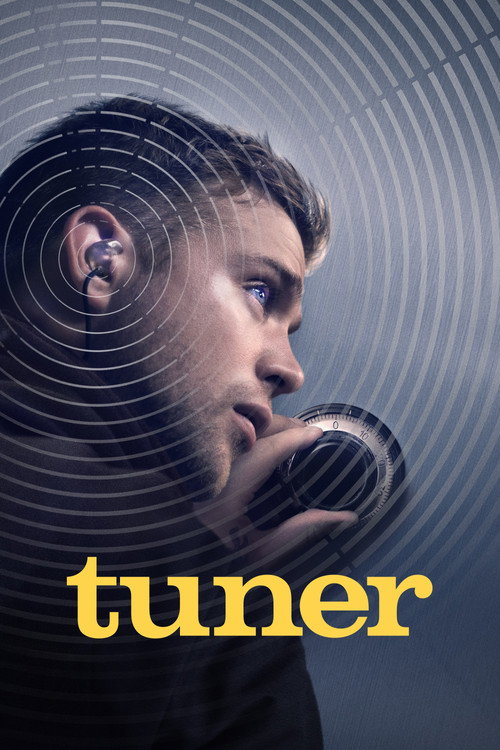
Tuner
2026 · Daniel Roher
When you want a smart, stylish heist-adjacent thriller that seduces rather than pummels — a film for savoring rather than white-knuckling.
What it's about
A gifted piano tuner discovers that the skills of his trade — the patient ear, the feel for tiny mechanical increments — are almost exactly the skills of cracking safes. That discovery pulls him out of his quiet, meticulous life and into robbery, a mentor's orbit, and a romance, with everything he was suddenly at stake. It's a crime story built on craft: hands, ears, and locked things.
The experience
Lyrical and tactile more than loud — the thrills come from listening, from close-up precision work where a single click matters. It's tense in a hushed, held-breath way, with real warmth threaded through the crime.
The craft
The premise is a sound designer's dream and the film leans into it: safecracking and piano tuning are staged as acts of listening, which makes headphones or good speakers genuinely worth it. It's the first fiction feature from Daniel Roher, who won the documentary Oscar for Navalny, and he brings a documentarian's patience for process.
Why it matters
A closely watched leap — an Oscar-winning documentarian crossing into narrative fiction with one of the most elegant genre hooks in recent memory.
Snapshot
Tuner is the first narrative fiction feature by Daniel Roher, the Canadian documentarian who won the Academy Award for Best Documentary Feature for Navalny (2022). Its premise — a piano tuner finds that the skills of his trade transfer to opening safes — is one of the more elegant genre engines in recent memory, because the two crafts are, in mechanical fact, nearly the same craft: the patient interrogation of a sealed object through hearing and touch, working by increments too small for the eye. The film therefore arrives pre-loaded with a century of cinema about hands, ears, and locked things.
A necessary caveat, stated once and honestly: this is a very recent release, and the verifiable public record on it is thin. Roher's documentary career and the film's premise are firmly documented. Its below-the-line credits, financing, festival path, reviews, and commercial performance are not things I can confirm, and I will not supply names or numbers to fill those gaps. Trade reporting around the production identified Leo Woodall in the title role, with Dustin Hoffman and Havana Rose Liu; readers should check final credits against the film itself. Where this dossier discusses craft, it distinguishes between what the material and the tradition make legible and what would require the film's actual credit roll to assert.
Industry & production
Roher's route to a fiction debut is the clearest thing about the production. A Toronto filmmaker, he made his feature documentary debut with Ghosts of Our Forest (2017), then Once Were Brothers: Robbie Robertson and The Band (2019), which opened the Toronto International Film Festival — the first documentary ever given TIFF's opening-night slot, a piece of festival history that says as much about the 2010s music-documentary boom as about the film. Navalny followed in 2022, premiering at Sundance as a late-added surprise screening and winning both the Audience Award and the Festival Favorite award there; it was a CNN Films production released theatrically and on HBO Max, and it won the Oscar in March 2023. Its subject, Alexei Navalny, died in a Russian penal colony in February 2024, which retroactively converted the film from an intervention into a record.
That Oscar is the production capital behind Tuner. In contemporary industrial terms, a documentary Academy Award is one of the few credentials that reliably converts into a first fiction feature with recognizable actors and conventional distribution — it certifies that the director can run a long, unpredictable shoot and deliver a propulsive cut. The crossing itself is well-travelled: Errol Morris to The Dark Wind (1991), Asif Kapadia, Laura Poitras, Lucy Walker, RaMell Ross. The closest structural analogue is Bart Layton, the British documentarian of The Imposter (2012) who made American Animals (2018) — a heist film that kept its nonfiction machinery visible. A documentarian's first crime picture is not a swerve; the investigative documentary and the procedural thriller share a spine.
I cannot responsibly characterize Tuner's budget, financiers, distributor, or release pattern, and no box-office figure appears in this dossier.
Technology
Two technological registers matter, and the film's premise lives in the first.
Diegetic. Aural piano tuning is a beat-counting discipline. The tuner sets a temperament octave by ear, listening not to pitches but to the interference beats between them — the slow throb where two nearly-identical frequencies fight — and adjusting until the beat rates across fifths, fourths, and thirds fall into the pattern equal temperament requires. Equal temperament is itself a negotiated compromise: every interval except the octave is detuned slightly so that all keys become usable. Real strings complicate this further through inharmonicity, the upper partials sounding sharper than theory predicts, which is why tuners "stretch" the octaves — the empirical curve of that stretch across the keyboard is documented in the Railsback measurements. Electronic tuning devices and software have automated much of this since the late twentieth century, which means the film's protagonist practices a trade already partly obsolesced by machines.
Safe manipulation rests on the same kind of perception. Mechanical combination locks of the common Group 2 class have wheel packs with tolerances loose enough that a skilled operator can detect, through the dial's resistance and sound, where each wheel's gate sits — reading contact points against the drive cam and narrowing the possibilities by feel. This is a genuine engineering literature, not folklore; the security researcher Matt Blaze's paper "Safecracking for the Computer Scientist" (2004) is the standard accessible account of how these locks fail to their tolerances. The countermeasures are equally real: serrated or nylon anti-manipulation wheels, glass relockers, thermal relockers, and the Underwriters Laboratories tool-resistance ratings (TL-15, TL-30) that specify how long a safe holds against an expert with tools. A crucial honest point for the film's historical placement: high-security and electronic locks have largely closed manipulation as a practical route, and professional openings today lean on auto-dialers and drilling to scope. A 2026 film about opening safes by ear is already, technologically, a period piece — which is precisely the elegiac condition the subgenre has always fed on.
Productional. The technology of mid-budget crime filmmaking in 2026 is permissive in ways that directly serve this material. Contemporary large-format digital sensors make genuinely dark scenes — vaults, back rooms, night streets — recordable at ambient light levels that would have required push-processing or invented sources in the era of Rififi or Thief. Immersive theatrical mixing (Dolby Atmos and its equivalents) makes a film about listening deliverable in a way The Conversation (1974) could only gesture toward on release prints. And digital audio post — sample-precise editing, spectral repair and analysis tools — makes forensic hearing both a plausible plot device and a workable mix strategy. Roher's documentary practice, meanwhile, was built in the small-crew, handheld, available-light nonfiction mode; the current fiction toolkit allows something very close to that footprint on a scripted set.
Technique
Cinematography
No cinematographer credit is verifiable to me, so what follows is the grammar the material demands and the tradition supplies, not a description of shots in this film. A film about micro-perception runs on scale contrast: macro inserts of the tuning lever on a pin, of a dial's knurling, of felt and wire, cut against wide shots that place the body alone in a room. Rack focus becomes a semantic device rather than a flourish — it is the visual equivalent of attention narrowing. The tradition's reference points are specific: the near-darkness of Jules Dassin's Rififi (1955); Léonce-Henri Burel's tight, unglamorous framing of hands in Bresson's Pickpocket (1959), where the camera refuses the faces it could have had; and Donald Thorin's sodium-vapor Chicago nights in Michael Mann's Thief (1981), which established that a heist could be photographed as industrial process and still be beautiful.
Editing
Heist cinema has a native syntax, and it is an editing syntax. Rififi's central robbery runs roughly half an hour without dialogue or score, a structural gambit that taught the genre that competence held in real time is more suspenseful than cross-cut peril; Melville's Le Cercle rouge (1970) extended the lesson. The counter-tradition is the procedural montage that teaches the audience the rules so the later violation reads. Roher's own strongest nonfiction sequence is instructive here: in Navalny, the telephone call in which Navalny, posing as a security official, induces one of the men involved in his poisoning to describe the operation, is built as sustained listening — tension generated by duration and by the reactions of people in a room, not by cutting. That is the exact editorial instinct a film about hearing requires.
Mise-en-scène / staging
The premise hands the film an unusually rich staging situation: a piano tuner is invited into houses. He is the trusted intruder, admitted to the drawing rooms of people wealthy enough to own a grand piano, left alone with their instrument and their rooms for hours. That figure has a genuine lineage — Losey's The Servant (1963), Chabrol's La Cérémonie (1995), Bong Joon-ho's Parasite (2019) — and it carries class knowledge as a structural fact rather than a theme to be announced. Two further spaces govern the film's design logic: the piano, a set-piece whose interior is a machine of felt, wire, and tension; and the safe interior, the one space in a heist film that cannot be shown while it matters.
Sound
This is the department on which the film necessarily stands or falls, and the canon is dense. Walter Murch's work on The Conversation remains the governing precedent: it dramatizes expert listening by making the audience do the labor of extraction from degraded audio, so that the surveillance man's obsession becomes the viewer's. Blow Out (1981) converted the same premise into pulp. Sound of Metal (2019), with Nicolas Becker's design, established the current grammar for subjective hearing states. Closest of all in subject is Michael Tyburski's The Sound of Silence (2019), whose protagonist tunes New York apartments as though they were instruments — a direct sibling to this premise. The craft risk is literalism: the "super-hearing" cue, a swelling whoosh that announces perception instead of rendering it. The Murch alternative is to build perception out of loss and attention rather than augmentation, and to let beat rates — which are genuinely audible and genuinely unnerving — do their own work.
Performance
Playing expertise is a specific acting problem, usually solved by some mix of hand doubles, invisible edits, and real training. Mann's practice on Thief — collaborating with people who had actually done the work, to the point of casting them — set the authenticity standard the subgenre is measured against. For an actor, the demand here is not virtuosity but stillness with occupation: a person whose principal action is listening must remain dramatically active while doing almost nothing, which is why the role belongs to the same family as Gene Hackman's Harry Caul. The reported presence of Dustin Hoffman gives the film an additional lineage rather than just a marquee name: Hoffman's own filmography contains the canonical American performances of uncanny aptitude and of expertise turned against a body (Rain Man, Marathon Man), and casting him in a story about a gift discovered is a legible authorial choice. I can speak to the shape of these demands, not to how the performances land.
Narrative & dramatic mode
Tuner runs on conversion: a legitimate craft becomes an illegitimate one without any change in skill, only in object. Dramatically this is a bildungsroman wearing a caper's clothes — not the noir "one last job" but its inverse, the first job, with the moral slope running downhill from competence into appetite. The mode question is which tradition the film chooses. Mann's Thief is the professional's film: work is identity, and the protagonist's tragedy is that he is only ever free inside the task. Bresson's Pickpocket is the fable: theft as displaced grace, process filmed as liturgy. A premise this metaphor-ready can tip either way, and the synopsis's phrase — a life "turned upside down" — suggests the more conventional appetite-and-consequence arc. Either way the film owes the audience legibility: heist tension is impossible unless we have been taught the rules well enough to know when they are broken.
Genre & cycle
The lineage is the heist film's main line: Huston's The Asphalt Jungle (1950), which fixed the template of the assembled crew and the plan's entropic collapse; Rififi; Melville's Bob le flambeur (1956) and Le Cercle rouge; Kubrick's The Killing (1956); the caper-comedy branch (Topkapi, The Italian Job); Thief; Heat (1995); the Ocean's Eleven (2001) revival that turned the form glossy. More useful for placement is the artisanal turn of the last decade — Good Time (2017), Widows (2018), The Old Man & the Gun (2018) — which returned the genre to small crews, tactile work, and regret.
Tuner belongs specifically to a narrow, interesting subgenre: the heist organized around a sensory peculiarity. Baby Driver (2017) made tinnitus and a soundtrack into the mechanism of the job. Fabián Bielinsky's El Aura (2005) gave its taxidermist protagonist epilepsy and a fantasist's genius for the perfect crime. And there is a direct, near-forgotten precursor on the subject itself: Kira Muratova's The Tuner (Nastroyshchik, 2004), in which a charming piano tuner works as a confidence trickster on two elderly women — proof that the profession's access to trust, not just its ear, is what makes it criminally useful on screen.
Authorship & method
Roher's authorial signature across three documentaries is genre appetite applied to nonfiction: Navalny is constructed as a thriller, with an investigation, a revelation scene, and a ticking return to Moscow, and it works because the construction is disciplined rather than decorative. Its investigative engine — the open-source work of Christo Grozev and Bellingcat, cross-referencing travel manifests and telephone records obtained through Russia's grey data market — is itself a procedural, and Roher filmed it as one. Once Were Brothers shows the other half of the method: an ear for music as biography, and comfort with subjects who are also performers. Both halves are directly relevant to a film about a musician's technician who becomes a criminal technician.
On collaborators I must be explicit. Reporting around the production credited Roher with the screenplay as well as direction, which would make this an auteur-shaped debut; I cannot verify the final writing credit, and I can verify none of the cinematography, editing, or music credits on Tuner. Rather than guess, I leave them unnamed — for a film whose entire interest is craft precision, inventing craftspeople would be the worst possible error. On Navalny, the producing team of record includes Odessa Rae, Diane Becker, Melanie Miller, and Shane Boris, who accepted the Academy Award; other technical credits from that film I would recommend checking directly rather than take from this account.
Movement / national cinema
Roher is a product of Toronto's documentary ecology — Hot Docs, the long National Film Board tradition of observational actuality that runs from Allan King forward, and a city whose nonfiction sector has functioned for decades as a training ground for international work. The Canadian fiction tradition he backs into is unusually hospitable to this premise: Cronenberg's lifelong attention to bodies as instruments and instruments as bodies; Atom Egoyan's cinema of recording, surveillance, and mediated intimacy (Family Viewing, Speaking Parts, The Adjuster), which is the closest national antecedent for a thriller about listening; and the now-standard career path in which a Canadian director moves from national-cinema beginnings to internationally financed genre filmmaking, of which Denis Villeneuve is the template. If, as the packaging suggests, Tuner is an American-set genre picture by a Canadian author, that too is a long-established Canadian pattern rather than a departure from one.
Era / period
The film lands in a period defined by the partial return of the mid-budget adult thriller. After a decade in which such films migrated to streaming and largely dissolved as a theatrical category, the 2020s have seen distributors treat the well-made crime picture with a recognizable cast as a viable proposition again — modest, star-legible, review-dependent. Tuner is that object. Its second period marker is the documentarian-as-auteur economy: nonfiction prestige now functions as an entry credential to fiction in a way it did not before the streaming documentary boom.
The sharpest era resonance, though, is thematic. A film about a human ear whose discriminations cannot be delegated arrives in a year when pitch detection, audio analysis, and pattern recognition are trivially automated, and when the general anxiety about machine substitution for skilled perceptual work is at a peak. Electronic tuning devices already made the aural tuner semi-optional; auto-dialers already made the manipulation artist semi-obsolete. The protagonist is a man whose two talents are both being retired by machines, which gives an ostensibly light premise a genuine period melancholy.
Themes
The film's central conceit supplies its best metaphor, and the metaphor is technically exact. Equal temperament is a compromise: to make every key playable, every interval but the octave is made slightly wrong, and the tuner's job is to distribute error evenly rather than eliminate it. A protagonist whose expertise is the management of acceptable wrongness is well positioned for a story about moral drift — the thematic argument is built into the physics.
Around that sit the genre's durable concerns: craft as identity, and the discovery that a skill has no ethics of its own, only applications. The intimacy of service labor, and the class knowledge that comes with being admitted to rooms you could not otherwise enter. Listening as care versus listening as violation — the Harry Caul problem, where attentiveness and intrusion are the same act. And the safe as the figure of another person's locked interior: a thing built to be impenetrable, opened by someone patient enough to hear it give.
Reception, canon & influence
I cannot summarize this film's critical reception. Its festival premiere, reviews, and audience response are not part of the record I can verify, and I will not manufacture a consensus or cite any figure. What can be assessed responsibly is the influence running in each direction.
Backward. The film's inheritance is unusually legible. From the heist tradition: The Asphalt Jungle for the architecture of the plan, Rififi and Le Cercle rouge for the silent procedural, Pickpocket for hands as moral subject, Thief for the dignity of tools and the researched authenticity of craft, Heat for the professional's interiority. From the cinema of listening: Blow-Up (1966) as the visual ancestor of forensic perception, The Conversation as its definitive audio form, Blow Out as its pulp mutation, Sound of Metal for the modern grammar of subjective hearing. From the sensory-anomaly crime picture: El Aura, Baby Driver. And from the narrow field of tuner films specifically: Muratova's The Tuner, the Quay Brothers' The Piano Tuner of Earthquakes (2005), and The Sound of Silence. Roher's own Navalny belongs on this list as a formal precursor — a nonfiction film that had already tested how long an audience will hold its breath while someone listens.
Forward. Prospective, and worth stating with the historical base rate attached: first fiction features by Oscar-winning documentarians have rarely entered the canon, Morris's The Dark Wind being the cautionary case, and the burden of proof sits with the film. The two places it is most likely to matter are as a case study in the documentary-to-fiction transfer — whether the investigative director's instinct for real process survives contact with a screenplay — and as a data point in the artisanal-heist revival, which has been hunting for premises that restore tactility to a genre long since given over to gadgets. If the film's sound work succeeds on its own terms, its likeliest legacy is narrower and more specific: another proof, after Sound of Metal, that hearing is a viable organizing principle for a whole picture rather than a set-piece effect.
Reception
How Tuner was received, from release to now →
Influences: the films it descends from and the films it influenced
- The Asphalt Jungle (1950) — Establishes the heist film's plan-as-blueprint architecture — the job broken into named specialist functions and rehearsed verbally before it is executed visually — which is the scaffolding Tuner inverts by making its specialist's ordinary day job the entire preparation.
- Rififi (1955) — The half-hour break-in played without a word of dialogue or a bar of score, tension carried entirely by tool noise and the crew's held breath — the direct template for Tuner's wordless real-time safe procedure.
- A Man Escaped (1956) — Builds a whole prison-break procedural on off-screen sound as the protagonist's primary sense organ — footsteps, keys, distant trains read as intelligence — the grammar Tuner extends by making a trained ear the actual instrument of the crime.
- Pickpocket (1959) — Isolates hands in macro close-up as the moral subject of the film, choreographed by a real practitioner (Kassagi) so the dexterity is documentary rather than staged — the precedent for Tuner's macro inserts of fingers on felt, pin and tumbler.
- Le Trou (1960) — Refuses to compress manual labor: concrete is chipped in real duration by a cast including the actual escapee, so the cut respects the work rather than summarizing it — the editing ethic behind Tuner's uncut procedure scenes.
- Blow-Up (1966) — Invents the forensic-perception sequence — a technician enlarging his own recording past the threshold of legibility — and the scale contrast between grain and world that Tuner restages as macro insert against large-format room.
- Le Cercle rouge (1970) — The silent jewel-store sequence turns a single arcane skill (a marksman defeating an alarm) into the whole heist's hinge, and recruits an insider whose legitimate access is the plan — the trusted-intruder staging Tuner runs through its service call.
- The Conversation (1974) — Walter Murch's mix makes the audience audit a recording alongside the technician, re-hearing the same material with shifting emphasis until meaning changes — the definitive form of the sustained listening scene Tuner is built around.
- Blow Out (1981) — Puts the sound technician's bench on screen as genre spectacle — reels, splices, sync to picture — proving obsolescent audio hardware can be photographed as thriller apparatus rather than set dressing.
- Thief (1981) — Hires the real safecracker as consultant and cast member and shoots the thermal-lance burn at working speed, treating tools with documentary dignity — the researched-authenticity standard a documentarian's first fiction feature is measured against.
- Heat (1995) — Locates suspense in the professional's interiority and discipline rather than in obstacles, and shoots night interiors on the era's fastest available stock so low light reads as workplace, not as style.
- The Tuner (2004) — The only prior film to make piano tuning itself a criminal method: the tuner's professionally sanctioned entry into private homes is the con's mechanism, exactly the access Tuner weaponizes.
- The Sound of Silence (2019) — Its house tuner diagnoses apartments by the pitch of their appliances, dramatizing an invented acoustic profession through calibrated instruments and rack-focus inserts on tuning forks and meters.
- Berberian Sound Studio (2012) — Films obsolescent analog sound craft as procedure — Foley, tape, faders, gain — with the technician's concentration held long enough that the equipment becomes character; the same fetish for a dying skill's hardware.
- The Zone of Interest (2023) — Johnnie Burn's year-built sound library and Atmos placement make off-screen audio the film's actual subject while the image stays flat and available-light, the strongest recent argument that a mix, not a camera, can organize a whole picture.
Similar films
- Thief (1981) — influence & lineage
- A Man Escaped (1956) — influence & lineage
- Rififi (1955) — influence & lineage
- The Zone of Interest (2023) — influence & lineage
- Le Trou (1960) — influence & lineage
- The Mastermind (2025) — shared sensibility
- Relay (2025) — shared sensibility
- It Was Just an Accident (2025) — shared sensibility