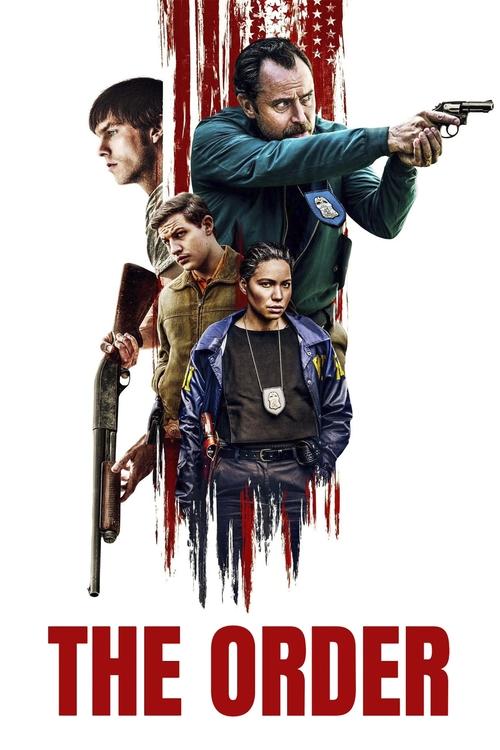
The Order
2024 · Justin Kurzel
For when you want a serious, adult crime drama — something to chew on rather than escape into, best when you're up for a film that's tense and troubling in equal measure.
What it's about
In the Pacific Northwest of the early 1980s, a string of bank robberies and armored-car heists turns out to be the funding arm of something far darker: a white supremacist cell plotting war against the federal government. A worn-down veteran FBI agent, newly posted to Idaho, starts connecting the crimes while the group's young, magnetic founder accelerates toward open violence. It's drawn from a true story.
The experience
Grim, taut, and genuinely disturbing — a slow-burn manhunt that gets its dread from how ordinary the evil looks. The heists hit hard, but it's the quiet recruitment scenes that stay with you.
Performances
Jude Law disappears into the shambling, obsessive agent, all fatigue and instinct, while Nicholas Hoult is chillingly persuasive as the true-believer leader — charisma played straight, which is what makes it frightening.
The craft
Justin Kurzel shoots the Northwest as vast, beautiful, and indifferent, and stages the robberies with brutal, procedural clarity. The film's restraint is its power — no speeches, just accumulating evidence and dread.
Why it matters
A Venice competition title that landed with unsettling timeliness, extending Kurzel's career-long examination of charismatic male violence onto American soil.
Snapshot
The Order is Justin Kurzel's dramatization of the rise and violent end of the Brüder Schweigen — "the Silent Brotherhood," better known as The Order — a white-supremacist cell that carried out armored-car heists, counterfeiting, and assassination across the Pacific Northwest in 1983–84. Drawn from Kevin Flynn and Gary Gerhardt's nonfiction book The Silent Brotherhood, the film stages a cat-and-mouse pursuit between Bob Mathews (Nicholas Hoult), the group's charismatic young founder, and Terry Husk (Jude Law), a worn, displaced FBI agent who pieces the conspiracy together from a string of seemingly disconnected crimes. Premiering in competition at the Venice Film Festival in 2024, it extends Kurzel's career-long study of charismatic male violence and the social soil that grows it, transposed for the first time from Australia to the American interior. Its grim throughline — that the group modeled its campaign on the playbook of William Luther Pierce's novel The Turner Diaries — gives the period piece an unmistakable contemporary charge.
Industry & production
The Order is a mid-budget, independently financed adult drama of a kind that has grown scarce in studio filmmaking — a genre-literate procedural pitched at grown audiences rather than franchise economics. It was produced through AGC Studios with partners including Jude Law's and Nicholas Hoult's involvement as producers, and was shot largely in Alberta, Canada, with the Calgary region and surrounding country standing in for the forests, small towns, and high plains of Idaho and Washington State. The casting of two bankable leads — Law as a fictionalized investigator, Hoult against type as a soft-spoken zealot — was central to the package's viability.
The film bowed at Venice in the autumn of 2024 and traveled the festival circuit before a limited theatrical release in the United States through Vertical Entertainment late that year. As is typical of specialty releases of this scale, its theatrical footprint was modest; the precise box-office figures are not something I can cite reliably, and I will not invent them. The production's lineage matters as much as its financing: Kurzel reassembled a trusted creative unit — cinematographer Adam Arkapaw, composer (and brother) Jed Kurzel — whose long collaboration gives the film its consistency of texture.
Technology
The film belongs to the contemporary digital-finishing era, and its imagery is built around naturalistic, low-key lighting and the muted color register Kurzel and Arkapaw have favored across their work together. I cannot confirm the precise capture format — whether photochemical film or digital — and so will not assert it; what is evident on screen is a deliberately tactile, grain-inflected, period-appropriate look that resists the over-clean sheen of much modern production. The technological choices here are conservative by design: the film's aesthetic project is to recover the visual grammar of 1970s and early-'80s American cinema, so the tools serve fidelity to an older mode rather than spectacle. Period detail — vehicles, firearms, radio and broadcast technology, the analog texture of pay phones and surveillance — is handled with restraint, never foregrounded as nostalgia.
Technique
Cinematography
Adam Arkapaw's photography is the film's signature achievement and the clearest line of continuity with Kurzel's earlier work (Snowtown, Macbeth) and with Arkapaw's celebrated television (True Detective season one, Top of the Lake). The Pacific Northwest is rendered as cold, depopulated, and overcast — wet greens, slate skies, interiors lit by weak practical sources. Arkapaw favors a watchful, slightly recessed camera, often holding on faces in available light, and stages the landscape as both refuge and trap for men who imagine themselves frontier insurgents. The robberies and the climactic siege are shot with documentary sobriety rather than action-genre flourish, the violence sudden and graceless. The palette's chilliness does double duty: it evokes the period's film stock and isolates the characters within an indifferent, beautiful terrain.
Editing
The cutting builds a dual-track structure — Mathews assembling his cell and escalating its crimes, Husk assembling his case — that gradually converges. The pacing is patient and accretive, prioritizing procedural logic and mounting dread over momentum for its own sake; setpieces are placed as punctuation within a longer investigative rhythm. The film trusts ellipsis, letting time pass between operations and allowing the audience to feel the methodical quality of both conspiracy and counter-investigation.
Mise-en-scène / staging
Kurzel stages the white-supremacist milieu with anthropological coolness rather than caricature: the Aryan Nations compound, the rural homesteads, the family kitchens where ideology is passed alongside dinner. The horror is in the ordinariness — children present, domestic routines intact, hate articulated in the reasonable cadences of grievance. Husk's world is its mirror: motel rooms, field offices, the solitary clutter of a man whose work has cost him a family. The film's compositions repeatedly frame Mathews as a magnetic center surrounded by followers and Husk as isolated, a contrast that does much of the thematic work without dialogue.
Sound
Jed Kurzel's score is spare and ominous, built from low drones and restrained motifs that withhold catharsis. Sound design leans on environmental quiet — wind, engines, the crackle of radio — punctured by the report of gunfire. The film makes pointed use of the period's broadcast culture: talk radio is both texture and plot engine, culminating in the group's assassination of the Denver host (played by Marc Maron), where the disembodied voice on the air becomes a target precisely because speech is the group's enemy.
Performance
The film is anchored by a study in contrasts. Nicholas Hoult plays Mathews not as a snarling villain but as a quiet, almost tender true believer — a husband and father whose conviction is the more chilling for its calm. Jude Law, heavily weathered, plays Husk as a depleted, physically diminished man running on instinct and grievance of his own. Tye Sheridan plays a local deputy drawn into the investigation, Jurnee Smollett a fellow agent, and Marc Maron the doomed radio broadcaster Alan Berg, whose murder is one of the case's historical anchors. The performances are tuned to a register of suppression — feeling held just beneath the surface — consistent with Kurzel's directorial temperament.
Narrative & dramatic mode
The Order operates in the mode of the converging-parallel-lives crime drama: two protagonists, antagonists to each other, pursued in alternation until they collide. It is fundamentally a procedural — the pleasure and dread come from watching a case assembled — but it resists the genre's usual reassurances. Husk is no infallible hunter; he is compromised, obsessive, and only partly redeemed by the chase. Mathews is granted interiority without sympathy. The dramatic engine is less "will he be caught" than "how much damage before the inevitable," and the film's fictionalization of the investigator (Husk is a composite rather than a single historical agent — a point the film does not disguise) frees it to make the pursuit archetypal. It is tragedy in the procedural's clothing.
Genre & cycle
The film sits at the intersection of the American crime thriller and the based-on-true-events extremism drama. Its most legible lineage is the 1970s New Hollywood crime film and the cop-and-criminal mirror-study perfected by Michael Mann — the Husk/Mathews dynamic openly recalls the antagonist-doubles structure of Heat, while the cold procedural texture evokes Thief and David Fincher's Zodiac. It also belongs to a contemporary cycle of films and series reckoning with American white nationalism and homegrown terror, and to the durable subgenre of FBI-versus-domestic-conspiracy narratives. Kurzel inflects these traditions with the true-crime sobriety of his own filmography rather than the genre's adrenaline.
Authorship & method
Justin Kurzel has built a body of work around real or historically grounded violence and the charismatic men at its center: Snowtown (the Bunting murders), his stark Macbeth, True History of the Kelly Gang, and Nitram (the Port Arthur massacre). The Order is his first feature set and shot in North America, but its preoccupations are continuous — masculinity, ideology, the seduction of belonging, and the rural margins where violence incubates. His method is observational and restrained, withholding judgment at the level of style so that the moral weight falls on the viewer.
The authorship is collaborative in a tightly recurring way. Adam Arkapaw (cinematographer) and Jed Kurzel (composer, the director's brother) have shaped nearly all of Kurzel's films; their participation makes The Order recognizably of a piece with Snowtown and Macbeth. The screenplay is by Zach Baylin, whose credits include King Richard, Creed III, and Gran Turismo — a writer here working in a darker, more austere register than his sports-drama work, adapting Flynn and Gerhardt's reportage into a two-hander. The editing is credited to Nick Fenton. Together they prioritize fidelity of mood over biographical completeness, compressing and fictionalizing the historical record (most visibly in the Husk composite) while keeping the documented crimes — the heists, the counterfeiting, Berg's murder, Mathews's death in the Whidbey Island siege — as fixed points.
Movement / national cinema
The Order is the work of an Australian auteur turning his gaze on American material, and that vantage is part of its method: the cool, slightly estranged observation of the American interior reads as the perspective of an outsider attentive to the country's mythologies of frontier, self-reliance, and violence. It can be placed within the recent migration of Australian directors (Kurzel among them) into American genre filmmaking, and within an international art-cinema sensibility applied to a U.S. crime story. The film is not a product of a national "movement" so much as of a single director's transplanted authorial project.
Era / period
The film is set in 1983–84, in the early Reagan years, amid farm-belt economic distress, the organizing of the Aryan Nations in Idaho, and the circulation of The Turner Diaries as an underground blueprint for race war. Its production and release in 2024 give that history a deliberate double exposure. The Order's tactics and texts have a long downstream shadow — The Turner Diaries is widely understood to have influenced Timothy McVeigh and the 1995 Oklahoma City bombing — and the film's arrival in a period of resurgent organized extremism in the United States is plainly intentional. Without editorializing on screen, The Order invites the viewer to read 1983 as prologue to the present.
Themes
The film's central theme is the manufacture of the true believer: how grievance, masculinity, and a sense of dispossession are organized into ideology and then into violence. Mathews is portrayed as a man who experiences hate as community and purpose, which makes the film's account of radicalization more disturbing than any monstrous portrait could. Against this, Husk embodies the cost of the hunt — obsession that hollows out a private life, justice pursued at the edge of burnout. Recurrent Kurzel concerns surface throughout: fathers and sons, the family as a vector for ideology, the frontier landscape as both freedom and entrapment, and the thin membrane between ordinary domestic life and atrocity. Speech and silence form a structuring motif — a "Silent Brotherhood" that kills a broadcaster for talking.
Reception, canon & influence
Critical reception was broadly favorable, with particular praise directed at Nicholas Hoult's against-type restraint and at Arkapaw's photography, and recurring admiration for the film's throwback craftsmanship and Mann-inflected gravity; Marc Maron's turn as Alan Berg was also singled out. Some critics noted the familiar shape of the procedural and the inevitable compression of history, while crediting the film for refusing sensationalism. I am summarizing the consensus of its festival-and-release reception rather than quoting specific reviews, and I will not attribute lines I cannot verify.
The influences on the film run backward to a clear set of sources: Flynn and Gerhardt's book as documentary spine; Michael Mann's Heat and Thief and Fincher's Zodiac as genre models; and Kurzel's own Snowtown and Nitram as the authorial template for treating real violence with cool sobriety. As for its legacy — what the film itself shapes going forward — the record is necessarily thin: released in 2024, The Order is too recent for its downstream influence to be assessed honestly, and any claim of lasting impact would be premature. What can be said is that it stands, for now, as a notable entry in the contemporary cinema of American extremism and as confirmation that Kurzel's true-crime method travels intact across national borders.
A Deleuzian reading
A kitchen, early evening.
The full Deleuzian reading of The Order →
Reception
Premiered in competition at Venice 2024 to strong reviews, then got a quiet limited release from Vertical Entertainment — and almost immediately became the 'why did nobody see this?' thriller, steadily finding its audience through streaming and word of mouth.
How The Order was received, from release to now →
Influences: the films it descends from and the films it influenced
- Thief (1981) — Establishes the patient, process-fixated rendering of criminal labor — the mechanics of the score shown as skilled work under nocturnal low-key light — that The Order borrows for its heist and counterfeiting procedural texture.
- Heat (1995) — The structure of cop and criminal as mirrored professionals; The Order's antagonist-doubles two-hander between Husk and Mathews descends directly from the Hanna/McCauley symmetry of mutual respect across the line.
- Manhunter (1986) — The investigator who must inhabit his quarry's logic, rendered in cool desaturated blues and procedural restraint rather than action — the template for Husk's empathic profiling.
- Zodiac (2007) — Period-precise procedural built on obsessive documentation, elliptical jumps across years, and a muted late-'70s/'80s palette that The Order explicitly emulates in its 1983 setting.
- Snowtown (2011) — Kurzel's own authorial template — Adam Arkapaw's low-key naturalistic camera and an anthropological refusal to editorialize, letting documented real violence sit without commentary.
- Nitram (2021) — The cool, suppressed-register treatment of a real mass killer, withholding sensational catharsis so the moral weight falls on the viewer — the method The Order carries to North America.
- Macbeth (2015) — The recurring Arkapaw–Jed Kurzel collaboration: desaturated landscape photography married to a low-frequency drone score charting a charismatic man's descent into ideological violence.
- Talk Radio (1988) — Dramatizes the same Alan Berg assassination, foregrounding the diegetic talk-radio provocateur as both medium and target — the exact sound-motif The Order threads through its procedural.
- All the President's Men (1976) — The 1970s investigative procedural of patient evidence-gathering and institutional doggedness shot in naturalistic muted interiors, prioritizing process over spectacle.
- The Silence of the Lambs (1991) — The FBI procedural in which the agent psychologically shadows the antagonist, building tension through interview and pursuit rather than violence — a structural ancestor to Husk's hunt.
- Mississippi Burning (1988) — The FBI procedural investigating organized American white-supremacist violence specifically, mapping the bureaucratic hunt against an ideologically motivated rural killing.
- The Assassination of Jesse James by the Coward Robert Ford (2007) — Shares the elliptical pacing, against-type performance restraint, and Deakins' desaturated frontier light, observing a mythologized outlaw with the same anthropological cool.
- No Country for Old Men (2007) — The lawman-pursues-killer procedural rendered with near-scoreless sparse sound design and rural-margin restraint, refusing genre release.
- Sicario (2015) — The desaturated procedural carried by Jóhann Jóhannsson's ominous low-frequency drone score — the same throb of dread Jed Kurzel deploys to underscore institutional pursuit.
- Hell or High Water (2016) — A bank-robbers-versus-lawmen procedural set in economically hollowed rural America, using parallel-converging editing to draw pursuer and pursued toward collision.
- Wind River (2017) — Anthropological restraint toward violence in the rural American margins, with a suppressed-register lawman and a refusal of sensationalism that mirrors Kurzel's sobriety.
Similar films
- No Country for Old Men (2007) — influence & lineage
- Sicario (2015) — influence & lineage
- Two Prosecutors (2025) — same viewing thread
- Rebel Ridge (2024) — same viewing thread
- Number 24 (2024) — same viewing thread
- Longlegs (2024) — shared sensibility
- Citizen Vigilante (2026) — shared sensibility
- The Resistance Banker (2018) — shared sensibility
All the films related to The Order →
Watch it with: curated runs of related films
- One Man Against the Machine — A run of thrillers about a single conscience squaring off against entrenched, corrupt or outright murderous power — watch these when you want the slow-burn tension of someone who won't back down.