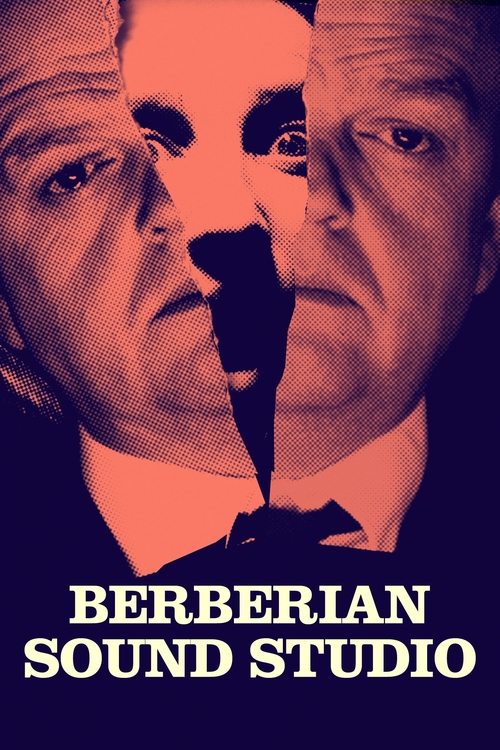
Berberian Sound Studio
2012 · Peter Strickland
For a late night when you want atmosphere and strangeness over plot — a puzzle-box mood piece to chew on for days. Best for patient viewers who love craft and don't need resolution.
What it's about
In the 1970s, a timid British sound engineer — a man whose credits are gentle nature documentaries — is hired to create the sound effects for a lurid Italian horror picture about witches. The film never shows us that movie: we only hear it, as screams in the recording booth and vegetables stabbed and smashed to mimic violence. Stranded in a cramped studio among contemptuous producers, far from his mother's letters and his garden shed, he starts to come apart along with the film he's mixing.
The experience
Hypnotic and insidious rather than scary — a slow slide from workplace comedy of discomfort into full-blown disorientation, where you stop being sure which film you're inside. It gets under your skin through your ears.
Performances
Toby Jones is quietly magnificent — a whole portrait of English timidity and suppressed panic built from flinches, polite protests and the way he listens. The film rests entirely on his face and he holds it.
The craft
This is one of the great films about sound, and its own sound design is the main event: analogue tape machines, squelching produce, screams looped until they lose meaning. Peter Strickland recreates the look and texture of 1970s Italian genre cinema with loving precision. Headphones or good speakers are essential — it's an ear film before it's an eye film.
Why it matters
It established Peter Strickland as British cinema's foremost fetishist of analogue texture and became the touchstone for films about post-production as psychological horror, while sending a new generation to explore Italian genre cinema.
Snapshot
Berberian Sound Studio is Peter Strickland's second feature. It is a horror film about making a horror film, and it never shows the horror film itself. Toby Jones plays Gilderoy, a mild sound engineer from Dorking whose past work is on gentle English nature documentaries. In the 1970s he is hired to do the sound for an Italian giallo-inflected witch picture called The Equestrian Vortex. Almost all of the film takes place inside a cramped post-production studio. We watch the film-within-the-film only as light on Gilderoy's face, and hear it as screams recorded in the booth and vegetables stabbed, smashed and left to rot to make the sound of violence. As the work wears him down, the film's own form starts to come apart: languages, reels and identities leak into one another. It is a homage to Italian genre cinema of the 1970s, a study of what sound does in cinema, and a portrait of a gentle man made complicit in images he never has to look at. It made Strickland's name as one of the most distinctive British filmmakers of his generation, and it remains a key title in the 2010s revival of "weird" British cinema.
Industry & production
The film was a British independent production. It came out of the circuit around Warp X and Illuminations Films, with producer Keith Griffiths, and had support from public and broadcaster money, notably Film4 and the UK's lottery-funded film bodies. Strickland's first feature, Katalin Varga (2009), was a revenge drama made in Romania on a famously small budget, partly self-funded. Its festival success, including a Silver Bear for outstanding artistic contribution (sound design) at Berlin, gave him the standing to make a more ambitious second film.
The production was modest, and the script turns that into a strength. Setting nearly everything in one studio space let the film rebuild a period Italian post-production house on a soundstage instead of on location. It also let the budget go into sound, art direction and period equipment. The film premiered at the Edinburgh International Film Festival in 2012, played the international festival circuit, and opened in UK cinemas that summer through Artificial Eye. Detailed figures on budget and gross are not reliably on record and are not given here.
Technology
The film is about obsolete technology, and its look and sound are built from period hardware. The studio holds reel-to-reel tape machines, mixing consoles, oscillators, spring reverbs, tape loops and splicing blocks. The camera treats them with near-fetishistic attention, in tight close-ups of VU needles, spinning spools and magnetic tape being cut and joined by hand. Cue lights and the red "silenzio" lamp work as recurring visual punctuation.
The film's argument is that the sound of cinema violence is made by hand. In this world, a stabbing is a knife going into a cabbage, hair being torn out is radish stalks being pulled, and a body hitting water is a melon dropped into a tank. Strickland's own background is in experimental sound. He was part of The Sonic Catering Band, an experimental group that made music from the sounds of cooking. That background shows in the film's ear for the gap between a sound's source and its meaning. Late in the film the analogue medium itself appears to fail: celluloid seems to burn and break, and the film's own soundtrack skips and switches language. This makes the physical fragility of film and tape part of the story.
Technique
Cinematography
Nicholas D. Knowland shot the film. He frames the studio as a claustrophobic set of dark wood panelling, padded booths and coloured cue lights. The palette leans to warm browns, ambers and deep reds, alluding to the saturated colours of 1970s Italian horror without copying them. The compositions are often static and tight, isolating Gilderoy against machinery or catching him through the booth glass. The insert shots of equipment are shot almost like product photography, which gives the knobs and spools a tactile, uncanny presence. Above all, the photography is built around what it holds back. The screen Gilderoy watches mostly stays out of shot, so the camera's main subject is the act of watching and listening.
Editing
Chris Dickens edited the film. Its structure moves from near-documentary process to growing disorientation. The first half is built from sessions: a scene is projected, Foley is performed, actresses scream into microphones, and Gilderoy's letters from his mother arrive. These repeated loops set up a rhythm the second half then breaks. Scenes start to repeat with slight changes, and Gilderoy's speech gets dubbed into Italian. Near the end a cut seems to tear the film open, and the narrative restarts with Gilderoy taking part in scenes he had only observed before. The editing makes the film work like the tape it is about, with splices, loops and dropouts.
Mise-en-scène / staging
The production design builds a closed, airless world. The studio is staffed by brusque Italian men, Francesco the producer and Santini the director, along with technicians and a rotating group of actresses. Gilderoy's small rented room holds his letters and notes. Strickland stages power through space: Gilderoy stays behind the mixing desk while the producer and director stand over him. The actresses are herded into the vocal booth, where they perform the agony of characters being tortured on screen. The produce is the film's most memorable prop. Rotting marrows and pulped tomatoes pile up in bins, so the violence on the unseen screen leaves a growing physical residue in the room.
Sound
Sound is the film's subject, method and main pleasure. The sound design is credited to Joakim Sundström, working closely with Strickland. The soundtrack keeps three layers in play: the diegetic audio of The Equestrian Vortex as it gets assembled, the room tone and ambience of the studio, and an expressive score. The score is by the English group Broadcast, whose work drew heavily on library music, early electronics and the experimental scene around the BBC Radiophonic Workshop. Trish Keenan, Broadcast's vocalist, died in January 2011, and the score is among the band's last released work. Several cues contain hidden pieces of Equestrian Vortex material, such as chanting, an invented "witch" vocabulary and treated voices. These blur the line between the fictional film's sound and Strickland's own.
The film's best-known move is that we hear horror without seeing it. The screams, the wet impacts and the producer's spoken descriptions of what is happening on screen ("a hot poker") make viewers build the images themselves. Strickland makes the audience complicit, in the same way Gilderoy is complicit when he serves images he says he finds repugnant.
Performance
Toby Jones gives the film its moral and emotional centre. His Gilderoy is polite, repressed, unable to complain, and attached to letters from his mother about birds nesting in the garden at home. Jones plays him through small physical retreats: shoulders drawn in, eyes lowered, a stammered request for a travel reimbursement that is endlessly put off. The supporting cast plays against him in Italian and accented English, which keeps him an outsider. Cosimo Fusco plays the impatient, flattering and bullying producer Francesco. Antonio Mancino plays Santini, a vain director who insists his film is not a horror film. Among the actresses, Fatma Mohamed, who became a regular in Strickland's company, and Tonia Sotiropoulou play the women whose screams the film harvests. The vocal performances in the booth are among the film's most unsettling moments, because they show real performers producing real distress on cue.
Narrative & dramatic mode
The story is simple and close to procedural. A stranger arrives, takes on a job he does not understand, is gradually corrupted, and then dissolves. The dramatic mode is slow-building psychological unease, not shock, and the film pointedly turns down the release that horror normally offers. There is no monster and no murder on screen. There is also no clear explanation for what happens in the final act.
That last act moves the film from realism into something closer to Lynch or Bergman. Gilderoy's mother's letters take on a sinister new meaning. His own voice is dubbed. The story seems to fold into the film being made, so that Gilderoy becomes a character in it, or in a version of it. The film leaves these events unexplained, and critics have read the ending in different ways: as breakdown, as possession by the medium, or as moral collapse. Strickland lets the form of the film carry the meaning, so how the story is told becomes the drama.
Genre & cycle
Berberian Sound Studio is explicitly genre-conscious. The Equestrian Vortex is pitched as a sensational Italian witch film, set somewhere between the giallo and the occult horror of the 1970s. It evokes Dario Argento's Suspiria (1977) in particular, along with the Gothic and witchcraft films of Mario Bava and the wider exploitation economy of Italian studios. The opening titles of The Equestrian Vortex, the only part of it we see directly, deliberately recall the graphic style of those films.
Strickland's film belongs to a smaller tradition of paranoid sound-and-image thrillers about media workers who become entangled in what they record. Francis Ford Coppola's The Conversation (1974) and Brian De Palma's Blow Out (1981) are the obvious precedents. It also sits within a 2010s cycle of British genre-art crossovers that mined pulp and occult traditions for formal experiment. Comparable films include Ben Wheatley's Kill List (2011) and A Field in England (2013), and the period's wider folk-horror and "hauntological" revival. It is a horror film as much as it is an essay about horror films, and it has been programmed and argued about as both.
Authorship & method
Peter Strickland (born 1973, Reading, of Greek and English parentage) came to features from experimental music and short films. He developed Katalin Varga largely outside the British film establishment. Berberian Sound Studio set out the concerns he would keep returning to:
- an intense interest in the materiality of sound and the sensory, tactile sides of cinema;
- love of European genre traditions (giallo, Eurohorror, softcore and art-erotica), treated without irony;
- closed, ritualised worlds governed by strange etiquette and power relations;
- deadpan humour that coexists with real unease.
His collaborators were central to the film. Nicholas D. Knowland's cinematography gives it its amber, enclosed visual character. Chris Dickens's editing, especially the loops and ruptures of the final act, carries much of its formal argument. Broadcast's score links the film to a British tradition of library music and radiophonic experiment and tied Strickland to the band's milieu. Joakim Sundström's sound design, which the work treated as equal in importance to the image, is arguably the film's real co-authorship. Strickland wrote the screenplay himself. He has spoken of his long immersion in Italian genre soundtracks and in the collecting culture of soundtrack and library-music records. The title is widely read as a nod to Cathy Berberian, the singer closely associated with Luciano Berio and postwar electroacoustic music.
Movement / national cinema
Strickland is a British filmmaker who makes films that look outward to Europe. Katalin Varga was a Romanian-language film. Berberian Sound Studio is a British-funded film about an Englishman lost in Italy and in the Italian language. The Duke of Burgundy (2014) was shot in Hungary with a cast speaking English but no English characters. In that sense the film is a key example of a European-minded strand of 21st-century British art cinema that resists the social realism traditionally associated with the national cinema.
Within Britain it is usually grouped with the post-2010 revival of eerie, genre-inflected art filmmaking, with Wheatley, with the folk-horror rediscovery, and with the "hauntology" discourse around Broadcast, the Ghost Box label and the Radiophonic Workshop. That discourse was concerned with memories of analogue media and half-forgotten 1970s culture. The film's portrait of a meek Englishman abroad also continues a long national comic and dramatic type, which Strickland turns into horror.
Era / period
The film works on two periods. Its setting is the mid-1970s, the height of Italian genre production. This was the era of gialli, occult and exploitation horror, and of soundtracks by composers and groups such as Ennio Morricone, Bruno Nicolai and Goblin. Post-production then meant analogue tape, hand-made Foley and dubbing. Many Italian films were shot without synchronised sound and voiced entirely afterwards, a fact the film quietly uses as its premise. Its period detail of equipment, clothing and cues is generally praised as exact and affectionate.
Its moment of production, 2012, is equally relevant. It arrived at the end of photochemical cinema and the transition to digital production and projection. The film's elegy for tape, splices and burning celluloid reads in part as a meditation on that transition. It also came at the high point of a culture of reissues and cult rediscovery, in which labels, festivals and online communities were reviving Italian horror and its soundtracks.
Themes
- The ethics of complicity. Gilderoy objects to the cruelty of the images he works on, yet he keeps producing their sounds, efficiently and well. The film asks how much distance the craftsman can claim from what he helps to make. Because it withholds the images, it puts the same question to the audience.
- Sound as violence, violence as artifice. The gap between source and effect, a cabbage becoming a skull, is both comic and disturbing. Making horror is shown to be a kind of violence in its own right, practised on vegetables and above all on the women who have to scream.
- The exploitation of women. The actresses' treatment in the booth mirrors the torture of the witches on screen. The film links the misogyny of the genre to the misogyny of the industry that produces it, without simply condemning the genre it plainly loves.
- Language, foreignness and power. Gilderoy cannot follow the Italian around him, is excluded from decisions and cannot get paid. Isolation in language becomes isolation of the mind, and ends with him losing his own voice when he is dubbed.
- Englishness and repression. The letters from home about birds and the English countryside hold up an idyll of innocence against the Italian studio's appetites. The film suggests that idyll may be a self-deception.
- The materiality of media. Tape, film, the voice and the body are all treated as physical substances that can be cut, spliced, burned and decayed.
Reception, canon & influence
Critical reception. The film was widely acclaimed on release in Britain and internationally. Critics praised Toby Jones's performance, the sound design, the period reconstruction and Strickland's formal daring. The most common reservation was about the elliptical final act, which some reviewers found either evasive or truly destabilising, depending on their taste. It won strongly at the 2012 British Independent Film Awards. Prizes there included Best Actor for Jones and craft recognition for the film's production and technical work, especially its sound. Strickland was also honoured for directing. The film appeared on many British critics' year-end lists and has since been regularly cited in surveys of significant British films of the 2010s.
Influences on the film (backward). The clearest sources are Italian genre cinema of the 1970s: Argento, Bava, Fulci and the giallo and occult cycles more broadly, along with their soundtrack culture. Coppola's The Conversation and De Palma's Blow Out provide the template of a sound professional undone by his recordings. Polanski's paranoid apartment films, especially The Tenant (1976), share its view of a foreigner collapsing in an alien space. Bergman's Persona (1966) and Lynch's later work, particularly Inland Empire (2006), are often cited as precedents for the self-consuming final act and the film that seems to burn itself. Beyond cinema, the film draws on the BBC Radiophonic Workshop, musique concrète and the electroacoustic avant-garde.
Legacy (forward). Berberian Sound Studio established Strickland as an auteur and set the terms for his later work. The Duke of Burgundy (2014) took on Eurotica as he had taken on the giallo. In Fabric (2018) brought the giallo's colours and fetishes into a British department store. Flux Gourmet (2022) went back almost literally to sonic catering, with a collective that performs the sounds of food. Fatma Mohamed's continued presence in these films marks a recurring Strickland company. More broadly, the film helped legitimise a mode of "meta-genre" art horror that studies the craft and history of its own form. It has become a reference point in writing about cinema sound and Foley, and is often used to introduce audiences to the hidden labour of post-production. It also fed the critical and curatorial revival of Italian horror and its music in the 2010s. Its direct influence on particular later films is harder to document than its general standing, and specific lines of descent beyond Strickland's own work are better treated as affinities than as established lineage.
Influences: the films it descends from and the films it influenced
- The Conversation (1974) — Walter Murch's design, where one recording is replayed and re-filtered until the listener's guilt and paranoia live inside the playback, is the template for Gilderoy, a technician undone by the tapes he handles.
- Blow Out (1981) — De Palma's sound-effects man splicing a real scream into an exploitation film's soundtrack sets up the device Strickland reworks: a horror film's dubbing session where recorded screams become a site of real harm.
- Suspiria (1977) — Goblin's score, mixed with whispered voices and played at full volume over the images, offers the model of an occult-horror soundtrack built from breaths, chants and percussion, which 'The Equestrian Vortex' imitates.
- Deep Red (1975) — A remembered sound (the children's lullaby on tape) drives the plot, and the black-gloved giallo grammar shown in insert close-ups gives Strickland the genre vocabulary he keeps offscreen and pastiches through the sound alone.
- Kill, Baby, Kill (1966) — Bava's Gothic witchcraft cycle, with its post-synchronised Italian production culture and voices recorded in the studio separately from the image, is the industrial practice that Berberian's dubbing stage dramatises.
- The Tenant (1976) — Polanski's foreigner coming apart in a hostile, enclosed space, with sounds from neighbours who are never seen eating away at his identity until he becomes someone else, is the structural model for Gilderoy's final-act dissolution.
- Persona (1966) — Bergman's film that seems to burn itself, with the projector breaking down and the celluloid tearing, anticipates Berberian's self-consuming final act, where the projector light cuts out and the film's own apparatus takes over the story.
- Inland Empire (2006) — Lynch's dissolving film-within-a-film, in which a performer's identity merges into the production she is working on, is the precedent for Gilderoy being written into 'The Equestrian Vortex' and redubbed in Italian.
- Eraserhead (1977) — Lynch and Alan Splet's continuous industrial room tone, used as psychological atmosphere, prefigures Strickland and Joakim Sundström's handling of the studio hum as the protagonist's mental state.
- Deadly Sweet (1967) — Its pop-art Italian thriller style and library-music sensibility belong to the soundtrack-collector culture behind Broadcast's pastiche score and Strickland's catalogue-like treatment of genre sound.
- The Stone Tape (1972) — Nigel Kneale's BBC play about engineers recording a haunting into the fabric of a building, using BBC Radiophonic Workshop sound, is the British hauntological source for the idea that recording technology stores trauma.
- The Shout (1978) — Literalises the shout's premise — a sound engineer is dismantled by the material passing through his own equipment — and stages Foley (vegetables, tape, oscillators) as the visible source of horror while withholding the images being scored.
- The Duke of Burgundy (2014) — Strickland applies to Eurotica (the Jess Franco and Radley Metzger mode) the same non-ironic method he applied to the giallo, keeps the closed ritualised world and the bureaucratic deadpan, and brings Cat's Eyes in to repeat the band-as-composer arrangement he had with Broadcast.
- In Fabric (2018) — Berberian's offscreen giallo becomes an onscreen giallo, with Argento-style coloured gels, catalogue-style insert close-ups and ritualised staff jargon (Fatma Mohamed carrying over), all moved into a British department store.
- Flux Gourmet (2022) — It returns to sonic catering almost literally: a collective that amplifies and performs the sounds of food expands Berberian's Foley of cabbages and melons into a whole premise about the ethics of performance.
- Censor (2021) — Its repressed British technician in an amber-lit post-production booth, whose identity dissolves into the violent footage she processes, carries Berberian's premise into the video-nasty censorship era.
- Saint Maud (2019) — In the British art-horror wave that followed Berberian, Paul Davies's close-miked, interior sound design renders a lonely protagonist's breakdown as a heightened acoustic subjectivity.
- Teenage Sex and Death at Camp Miasma (2026) — The film-within is never shown, only heard — its leader, countdown and Foley table make post-production the site of complicity, and the credit sequence for the unseen film the only image of it we get.
- Katalin Varga (2009) — Strickland's debut already treats location sound and natural acoustics as a narrative force, an early version of the foregrounded sound design that Berberian makes into its subject.
- Amer (2009) — A contemporary of Berberian in meta-giallo art horror, it breaks Italian genre grammar down into fetish close-ups and repurposed 1970s soundtrack cues, studying the form's sensory materials rather than retelling its plots.
- Last Night in Soho (2021) — A contemporary British cinephile homage that rebuilds giallo craft from the inside — the same mode of reverent formal reconstruction of Italian horror technique that Wright pursues.
- MaXXXine (2024) — Meta-giallo built around the recording apparatus itself — the Foley and post-sync machinery of Italian horror — sharing MaXXXine's fixation on the technology that records screaming.
- Tuner (2026) — Films obsolescent analog sound craft as procedure — Foley, tape, faders, gain — with the technician's concentration held long enough that the equipment becomes character; the same fetish for a dying skill's hardware.
Similar films
- Suspiria (1977) — influence & lineage
- Censor (2021) — influence & lineage
- Eraserhead (1977) — influence & lineage
- Skinamarink (2023) — shared sensibility
- Repulsion (1965) — shared sensibility
- Hour of the Wolf (1968) — shared sensibility
- The Cabinet of Dr. Caligari (1920) — shared sensibility
- The Shout (1978) — shared sensibility