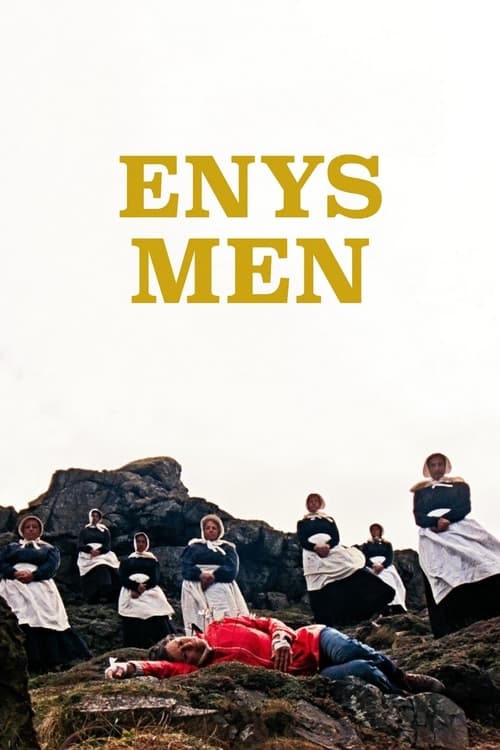
Enys Men
2023 · Mark Jenkin
A wildlife volunteer on an uninhabited island off the British coast descends into a terrifying madness that challenges her grip on reality and pushes her into a living nightmare.
Snapshot
Enys Men (Cornish for "Stone Island") is Mark Jenkin's second feature. It is a folk-horror reverie set in 1973 on an uninhabited island off the Cornish coast, where a lone woman credited only as "the Volunteer" (Mary Woodvine) keeps watch over a rare flower. Each day she checks the plant, takes the soil temperature, drops a stone down a disused mine shaft and writes "No change" in her logbook. That routine slowly comes apart. Lichen spreads from the flower onto her body. The island's past keeps showing through: drowned lifeboatmen, nineteenth-century bal maidens (women who worked at the surface of the tin mines), a preacher, a girl who may be a younger version of the Volunteer herself, and a standing stone that seems to move. The film premiered at the Directors' Fortnight in Cannes in 2022. It opened in the UK in January 2023 and was released in the United States by Neon later that year. It confirmed Jenkin as one of the most distinctive formalists in contemporary British cinema. Enys Men has almost no dialogue and no conventional plot. It was shot on hand-wound 16mm film and all of its sound was recorded afterwards. In atmosphere it is closer to 1970s British television's eerie strand than to modern genre horror, and it is less a story than a loop of time that slowly fills with ghosts.
Industry & production
The film was made through Bosena, Jenkin's Cornwall-based production company, with backing from Film4 and the BFI. That money followed the critical success of his debut feature Bait (2019), which won the BAFTA for Outstanding Debut by a British Writer, Director or Producer. Bait had been a near-artisanal project, and Enys Men kept that scale: a small cast, a small crew and a shoot in West Penwith, the far western tip of Cornwall, which Jenkin has worked in for most of his career. The island in the film is fictional, put together from mainland Cornish locations rather than shot on a real offshore island. Denzil Monk, a long-time collaborator, was among the producers.
Distribution followed the familiar route for British art cinema. The Cannes Directors' Fortnight launch led to festival screenings, a UK theatrical release through the BFI's distribution arm, and the US release by Neon, then the leading American distributor for elevated and auteur-led horror. Detailed budget and box-office figures are not reliably documented in public sources, so none are given here. By any measure, though, this was a low-budget film released in specialist cinemas.
Technology
Celluloid is central to the film's identity. Jenkin has long championed analogue film and shoots with clockwork Bolex 16mm cameras. These hold only short loads of film and must be wound by hand, so takes are brief and cannot synchronise with live sound. Bait was shot in black and white and famously hand-processed. Enys Men is in colour, and its saturated, grainy 16mm image deliberately recalls the look of 1970s British film and television: the reds of the Volunteer's anorak, the yellow-green of lichen and gorse, the grey of granite. The grain, the shifts in exposure and the occasional flicker of the material are part of the film's texture, not flaws to be removed. These physical limits shape everything else about the film's method, as the following sections describe.
Technique
Cinematography
Jenkin photographed the film himself. The images are short, fixed or simply framed shots built around textures: close-ups of lichen, stone, rope, the turning of logbook pages and the gauge of the thermometer, set against wide shots of headland and sea. Tight zooms and abrupt reframings recall 1970s television drama and documentary. Repeated set-ups (the Volunteer at the flower, at the shaft, at the generator, at her desk) make up the film's grammar. When those framings come back with small changes, such as a figure where there was none or lichen where there was skin, the change registers as a disturbance. The handheld, hand-cranked camera gives a slight instability to images that are otherwise composed with great formality.
Editing
Jenkin also edited the film, and the editing carries its sense of time. Ordinary daily actions are cut into rhythmic, almost musical sequences, and as the film goes on the edit begins to splice different times together. Shots of the 1970s present are cut against images of miners, bal maidens and the lifeboat crew, with no optical transition to mark that the period has changed. Cause and effect weaken. An event shown once comes back later, apparently not yet having happened, and quick inserts (a hand, a stone, a flash of red) break into scenes like intrusive memories. The result works less like flashback than like layers of time on top of one another, which matches the film's idea of landscape as a stack of the past.
Mise-en-scène / staging
The world of the film is reduced to a few emblems. There is the stone cottage with its radio, generator and logbook. There is the cliff-top flower, the mine shaft and the standing stone. Each becomes a kind of station in the Volunteer's daily round. Costume and props are carefully period: knitwear, a red anorak, a transistor radio, a paperback copy of E. F. Schumacher's A Blueprint for Survival-era environmental writing (the book is often identified by critics as A Blueprint for Survival, the 1972 Ecologist manifesto). The ghostly figures are staged with plain stillness. They stand in the landscape and look at the camera or at the Volunteer, and the film uses no special effects or monster make-up for them. The horror comes from where things are placed and when they reappear, never from spectacle.
Sound
Because the Bolex cannot record synchronised sound, every sound in the film was built in post-production. This is one of Jenkin's stated principles and was already central to Bait. The result is heightened and slightly unreal: footsteps, wind, the drone of the generator, the scratch of pencil on paper, all clear and detached from the images. Voices are rare, and when they come they often sound displaced, as radio fragments or murmurs from another time. Jenkin's own score is built from drones and textures and mixes with the sound effects so that it is hard to separate music from the sound of the island. A recurring sung or hummed folk motif and electronic tones in the manner of the BBC Radiophonic Workshop locate the film's sound in the 1970s eerie tradition.
Performance
Mary Woodvine, a Cornish actor and Jenkin's partner, carries the film almost alone and almost without words. Her performance consists of repeated physical tasks, closely watched looks and an increasing stillness. The role asks her to be a precise instrument of routine rather than a psychologically readable character. Edward Rowe, the star of Bait, plays the Boatman who brings supplies. Flo Crowe plays the Girl, a figure whom many viewers take to be the Volunteer's younger self. John Woodvine, Mary Woodvine's father, appears as the Preacher. The non-naturalistic, post-synced performances belong to the film's overall design: these figures are less characters than presences.
Narrative & dramatic mode
Enys Men deliberately puts structure in place of story. Its basic form is a daily loop, with logbook entries dated in April 1973 marking the days. The drama lies in how that loop wears away. "No change" is written again and again while everything changes. The film never says whether what we see is the Volunteer's breakdown in isolation, a haunting, a time slip, or a woman who is herself already a ghost repeating her last days. Several readings stay open, and Jenkin has generally declined to settle them. The mode is lyrical and elliptical, more like a tone poem than a thriller. Suspense comes from repetition, and dread builds from small departures from the established pattern.
Genre & cycle
The film belongs to the twenty-first-century revival of British folk horror, a term made popular by Mark Gatiss's BBC documentary A History of Horror (2010) and taken up widely in later criticism and festival programming. That classic canon includes Witchfinder General (1968), The Blood on Satan's Claw (1971) and The Wicker Man (1973). Enys Men is also close to the 1970s British television "eerie": Children of the Stones (1977), the BBC's Ghost Story for Christmas strand, Penda's Fen (1974) and the public-information films of the period. These works linked landscape, ancient stones and buried history with dread. The film's 1973 setting places it inside the decade that is its main point of reference.
Within contemporary horror, it was received alongside the so-called "elevated" or arthouse horror of the 2010s and 2020s, the A24 and Neon cycle. But its rejection of narrative explanation and jump scares sets it apart from most of those films. It has also been grouped with a strand of British experimental landscape cinema concerned with place, labour and memory, including Ben Wheatley's A Field in England (2013) and In the Earth (2021).
Authorship & method
Jenkin is credited as writer, director, cinematographer, editor and composer. That unusual concentration of roles reflects a method he has set out publicly, most fully in his "Silent Landscape" rules of engagement, a manifesto-style list of principles for his filmmaking. These include shooting on celluloid with clockwork cameras, recording all sound in post-production, and accepting the limits of the material as creative principles. The manifesto belongs to the line of filmmakers' rule sets that runs from Dogme 95, though its aims are quite different: artisanal and analogue rather than stripped-down realism.
His collaborators come from a close Cornish circle. Producer Denzil Monk worked with him on Bait, Mary Woodvine is a long-standing creative partner, and Edward Rowe links the two features. The sound team built the film's entire soundscape after the shoot. Public sources say little about how specific creative contributions within the small crew were divided, beyond what the credits show.
Jenkin came from shorts and experimental work made in Cornwall over many years before Bait. That background explains both his formal confidence and his commitment to his region as both subject and production base.
Movement / national cinema
Enys Men sits where British art cinema meets a specifically Cornish cinema. Jenkin's work is committed to Cornwall as a place with its own language, history and economic grievances, and that commitment runs through both features. Bait dealt with tourism and gentrification in a fishing village. Enys Men turns to deeper history: the collapse of tin mining, the Cornish language (in the title) and the long maritime record of lost lifeboats. More broadly, it belongs to a strand of British regional, landscape-centred filmmaking, and to a renewed interest in analogue production among British and international filmmakers in the 2010s and 2020s. Film4 and BFI funding place it within the institutional structure of British art cinema, even though its aesthetic sits at that cinema's most experimental edge.
Era / period
The film was made at the start of the 2020s, after the pandemic, and set in 1973. It looks back to a precise moment: the early environmental movement, the oil crisis and the energy anxieties of the 1970s (the Volunteer's generator and her fuel supply carry that weight), and the last stages of Cornwall's industrial decline. Its retro-analogue style is part of a wider hauntological mood in British culture. Critics borrowed the term from Mark Fisher's writing, which drew on Derrida, to describe art preoccupied with "lost futures" and the ghostly media of the postwar decades. Enys Men was often discussed in those terms, as a film haunted by the look and sound of 1970s Britain as much as by its own ghosts.
Themes
- Time as sediment. The island holds its pasts all at once: miners, bal maidens, drowned sailors and the preacher coexist with the 1970s present. The standing stone, the mine shaft and the lichen all suggest slow, geological, cumulative time against which a human life is brief.
- Routine, isolation and the self. The Volunteer's rituals of observation give the film its structure and its unease. Repetition offers both meaning and entrapment, and the line between observer and observed (the flower, the lichen, the island) dissolves.
- Ecology and contamination. The flower she guards and the lichen that spreads onto her body suggest the human absorbed into the natural world. The 1970s environmental reading matter ties this to the period's early ecological consciousness.
- Labour and loss in Cornish history. The mine and its women workers, and the lifeboat disaster, bring the region's history of dangerous labour and communal grief to the surface. The film presents that history as something the landscape remembers.
- Women's presence in the landscape. The Volunteer, the Girl and the bal maidens form a chain of female figures across time, which many critics read as the film's emotional core.
Reception, canon & influence
Critical reception. Enys Men was widely admired by critics, especially in Britain, where it was praised as a bold and singular follow-up to Bait. Reviewers singled out its textures, its sound design and Woodvine's performance, and many placed it in the lineage of 1970s British folk horror and eerie television. The film's lack of narrative explanation divided some reviewers and many general audiences. Some critics described it as hypnotic and others as opaque, and it was more clearly a critics' and festival film than a crowd-pleasing genre release. It appeared on several year-end lists of notable British films, but this account does not cite specific rankings or awards, because the precise record is not verified here.
Influences on the film. Critics and Jenkin's own remarks point to a set of sources: classic British folk horror (The Wicker Man, The Blood on Satan's Claw), 1970s British television including Children of the Stones and the Ghost Story for Christmas films, and Nicolas Roeg's Don't Look Now (1973), whose fractured editing and flashes of red are often cited in reviews. Behind those lie the traditions of artisanal and experimental filmmaking with hand-wound cameras and post-synchronised sound, and the place-based writing and art of Cornwall, including its archaeology and the landscape of standing stones and quoits in West Penwith.
Legacy and what it shaped. It is too early to state firmly what Enys Men has influenced. Its clearest contributions so far are three. It is a visible instance of folk horror as art cinema, extending the revival away from narrative genre films towards something closer to experimental film. It is a proof that analogue, artisanal production methods can be sustained at feature length with national-funder support, which has made it a reference point in conversations about celluloid and regional filmmaking in the UK. And it secured Jenkin's standing as an auteur whose later work is expected to continue the Cornish project begun with Bait. Its place in the canon is still being settled, but it is already treated as one of the defining British genre-art films of its decade.
Influences: the films it descends from and the films it influenced
- Ivy (2015) — An isolated single-location slow-burn where temporal disorientation and dense atmospheric texture dissolve genre categories, extending Ivy's editing-driven unreliability.
- Kill List (2011) — Carries the British folk-horror revival into handmade, elliptical form, using abrupt non-linear cuts and a discordant soundscape to keep the occult logic of a landscape unexplained.
- Rose of Nevada (2026) — The immediate template for Rose: color 16mm folk-horror built on a time-slip structure where past and present bleed via associative cutting, scored and Foley'd entirely in post to a heightened, artificial sound field.
- Censor (2021) — British folk-horror shot on hand-processed 16mm. Like Censor, it builds dread through analogue material texture, a solitary woman's ritual routine and an electronic drone, and it dissolves linear time into ambiguous delirium.
- Men (2022) — A woman alone in remote Cornwall is besieged by men, ghosts and the land itself. It is built through escalation by repetition, with the same actions, intrusions and looped images recurring, a contemporaneous rural-uncanny sibling to Men's repeating visitors.