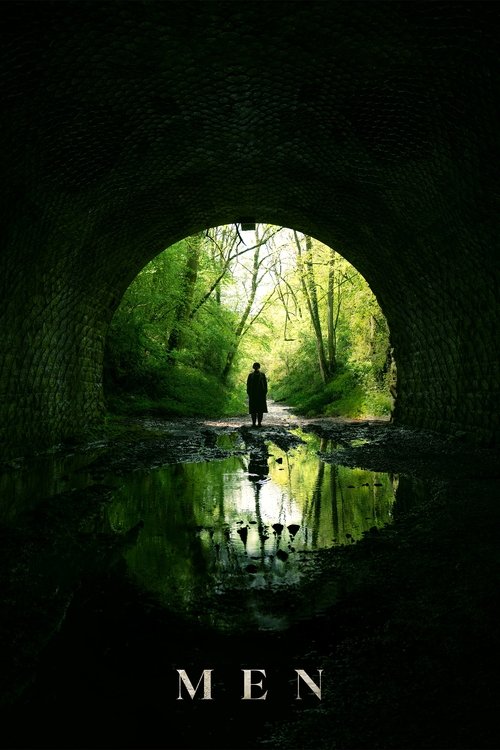
Men
2022 · Alex Garland
Civil War's refusal to name its politics made it 2024's most argued-about film, and his "war is bad, both sides" interviews poured fuel on it; Warfare continued the provocation. The name attached to "is apolitical centrism a stance" discourse.
When you want a film to chew on for days and you have the stomach for it — this is challenge-viewing, not comfort. Reach for it when you want horror that works like a riddle and aren't afraid of images you can't unsee.
What it's about
Reeling from her husband's death, Harper rents a grand country manor in a postcard English village to be alone and heal. But the men she meets there — the chummy landlord, the vicar, a policeman, a stranger from the woods — begin to feel unsettlingly alike, and something in the surrounding countryside seems to be closing in on her, dragging her worst memories with it.
The experience
A slow, suffocating build from unease to full-blown nightmare, beautiful and sickening in roughly equal measure. It trades jump scares for a creeping wrongness that curdles into some of the most confrontational body horror in recent memory, and it leaves you rattled and arguing about what you just saw.
Performances
Jessie Buckley carries the film almost alone, making Harper's grief and defiance completely believable, while Rory Kinnear pulls off the eerie feat of playing every man in the village — each one distinct, all of them subtly the same.
The craft
Alex Garland shoots the English countryside as something lush to the point of menace — dripping greens, an echoing tunnel, imagery drawn from old folk carvings — and the sound design turns birdsong and silence into threat. The final stretch is a showcase of grotesque practical and visual effects. It demands a big screen and good speakers, and darkness.
Why it matters
One of the most divisive horror releases of its moment and a flashpoint in the conversation around so-called elevated horror, it confirmed Garland as a filmmaker willing to follow an allegory all the way over the edge.
Snapshot
Men is Alex Garland's third feature as director. It is a folk-horror chamber piece in which grief, guilt and male aggression take literal, monstrous form. Harper (Jessie Buckley) rents a country manor in an English village to recover from the death of her husband James (Paapa Essiedu). He fell from their London flat moments after she told him she wanted a divorce, and moments after he hit her. In the village she meets a series of men: the landlord Geoffrey, a naked stranger from the woods, a vicar, a police officer, a sullen boy and the drinkers at the pub. Rory Kinnear plays all of them. The mounting menace ends in a night-time siege and a grotesque chain of births, in which each man delivers the next until James himself appears.
The film is short, tightly bounded and openly allegorical. Garland uses Green Man and sheela-na-gig iconography, Edenic apples and the reproductive grotesque of body horror to stage a single question: what do men want from women, and why do they keep reproducing the same demand? Men divided critics more than anything else Garland had directed. Its performances and craft were widely admired. Its symbolism was called either richly ambiguous or bluntly overstated.
Industry & production
Men was produced by DNA Films, the British company run by Andrew Macdonald and Allon Reich, which had backed Garland since his screenwriting work with Danny Boyle (28 Days Later, Sunshine) and produced his directorial debut Ex Machina (2014). A24 co-financed and distributed the film in North America. This continued a partnership that began with Ex Machina's US release and placed Men inside A24's horror slate.
The film was shot in Gloucestershire in the spring of 2021, under COVID-19 production protocols. The pandemic shaped it, if only indirectly: a small cast, one principal location (the manor house and its grounds), a nearby village, woodland and a disused railway tunnel. All of this suited a production that had to stay contained. Men had its European premiere in the Directors' Fortnight at Cannes in May 2022 and opened in US cinemas on 20 May 2022, with a UK release following shortly after. It was a modest commercial performer by any measure. This dossier does not give box-office figures.
Technology
Men was shot digitally. Its technical interest lies less in the capture format than in how it combines practical prosthetic effects with digital compositing. Two problems needed that combination.
The first was Kinnear's multiple roles. Most of his characters are played with makeup, wigs, teeth and costume. The boy Samuel is a different case: a child performer's body carries a digitally composited version of Kinnear's face. The effect is deliberately uncanny, and it signals early that the film's realism is unstable.
The second was the climactic birth sequence. Prosthetic bodies, practical fluids and digital extension build a continuous, long-held transformation in which bodies split, swell and deliver adult men. Garland chose to keep the sequence legible and sustained rather than fragmented by cutting. That choice was demanding technically, and it became the most discussed element of the production. Published accounts give only partial detail on how the work was divided between departments and vendors, so this dossier does not attribute it.
Technique
Cinematography
Rob Hardy, Garland's cinematographer since Ex Machina, divides the film into strongly coded visual registers. The flashbacks to James's death are drenched in saturated orange-red light, as though the London flat is lit permanently by sunset. The slowed fall past the window becomes a recurring, almost still image. The countryside, by contrast, is shot in deep, wet greens: lush and photogenic, and gradually oppressive.
Hardy makes extensive use of symmetrical compositions and fixed, observing frames. These are set against handheld or tracking movement when Harper explores. The railway-tunnel sequence is a set piece of light and darkness. Harper walks toward a bright arch of daylight while a figure appears at the far end, and the tunnel's geometry becomes a frame within the frame.
Night photography in the house's final act moves into cold blues and murky, low-key interiors. This lets the prosthetic horrors emerge gradually from the dark rather than being displayed under full light, until the birth sequence deliberately reverses that restraint.
Editing
Jake Roberts, who had cut Brooklyn and Hell or High Water among others, edits Men with patience. In the first hour, long stretches play almost in real time: Harper arriving, touring the house with Geoffrey, walking the woods, speaking on video calls with her friend Riley (Gayle Rankin). Flashbacks are cut in as sudden intrusions, often triggered by a sound or image in the present. They imitate the involuntary return of traumatic memory rather than offering a tidy backstory.
In the last act the editing escalates by repetition rather than speed. The birth sequence works through accumulation: the same action recurs again and again in a structure that critics described as both hypnotic and exhausting, depending on their verdict on the film.
Mise-en-scène / staging
Production designer Mark Digby, another long-standing Garland collaborator, builds the film around an old manor house that is too large for one guest, and a village church. The church font carries carvings of the Green Man, the foliate head of English and European church ornament, on one side and a sheela-na-gig, the exhibitionist female figure, on the other. This pairing is the film's iconographic key. The naked man from the woods gradually takes on the Green Man's foliage, and the final births literalise the sheela-na-gig's display of female generative power, appropriated by men.
Eden imagery is established early. Harper eats an apple from a tree in the garden, and Geoffrey jokes about forbidden fruit. Most staging isolates Harper against wide spaces: fields, empty lanes, the cavernous house. The men tend to appear in doorways, windows and the margins of the frame. The letterbox in the front door, through which a hand and later an arm push in, becomes a recurring point of violation.
Sound
The score is by Geoff Barrow (of Portishead) and Ben Salisbury, Garland's composers since Ex Machina. It relies heavily on layered choral and vocal textures rather than conventional orchestral horror cues. The tunnel sequence is the film's sonic signature. Harper sings into the tunnel's echo and her voice loops back to her, building into a polyphonic chord that slides from joyful play into dread. The score then takes up the same vocal material. Natural sound such as wind, birds, dripping water and footsteps on gravel is mixed close and present, so the countryside's supposed peace stays audibly alive and watchful.
Performance
The casting concept is the film's central formal gamble. Kinnear plays Geoffrey the affable, faintly patronising landlord; the naked wanderer; the vicar who suggests Harper bears responsibility for her husband's death; the dismissive police officer; the pub regulars; and, by composite, the boy. Kinnear differentiates them through voice, posture and class register, yet keeps the resemblance visible. Harper never remarks on it, which leaves open whether she perceives it or whether it is the film's comment to the audience.
Buckley's performance carries the film. She is often alone on screen, and she plays Harper's fear, irritation, guilt and eventual exhausted defiance with great tonal control. In the climax she meets escalating horror with weary refusal rather than screaming. Critics frequently singled this out as the film's most striking acting choice. Essiedu's James, seen only in flashback, moves between pleading vulnerability and coercive threat, and he anchors the domestic abuse at the story's root.
Narrative & dramatic mode
The story is linear in the present, with traumatic flashbacks breaking in. It is built in three movements. The first is arrival and fragile calm. The second is a widening pattern of encounters with men, each of whom dismisses, blames, sexualises or threatens Harper. The third is a siege and a phantasmagoric climax.
The dramatic mode moves steadily from realism to allegory. The early scenes play as naturalistic drama about grief. By the end the film has openly abandoned plausibility for nightmare logic. Garland deliberately leaves unresolved whether events are supernatural, psychological, or a mix the film refuses to separate.
The final exchange makes the thesis explicit. Harper asks James what he wants, and he says he wants her love. A demand presented as need is the same emotional coercion she escaped. The coda, in which a pregnant Riley arrives at dawn, offers a guarded image of female solidarity and continuity without explaining what has happened.
Genre & cycle
Men belongs to the twenty-first-century British folk-horror revival. Its main points of comparison are Ben Wheatley's Kill List (2011) and A Field in England (2013), and the wider rediscovery of the "unholy trinity" of Witchfinder General (1968), The Blood on Satan's Claw (1971) and The Wicker Man (1973). Like those films, it treats the English rural landscape as a place where old, pre-Christian forces survive beneath a polite surface.
It also belongs to the cycle often labelled "elevated horror", a term much contested by critics, and associated especially with A24. That cycle includes The Witch (2015), Hereditary (2018), Midsommar (2019) and Lamb (2021): director-driven, allegorical horror centred on grief and trauma.
A third context is the cluster of post-#MeToo horror films about male violence and gaslighting. Leigh Whannell's The Invisible Man (2020) is one; the same 2022 season brought Fresh and Barbarian, which also turn male entitlement into the genre's monster. Men is the most abstract and least narratively conventional of these films.
Authorship & method
Garland wrote Men alone, as he wrote Ex Machina, Annihilation (2018) and the series Devs (2020). Before directing he was a novelist (The Beach) and a screenwriter (28 Days Later, Sunshine, Never Let Me Go, Dredd). His directing work favours confined settings, small casts and ideas staged as confrontations. In Ex Machina it is a glass-walled research house; in Annihilation the Shimmer; in Men a manor and a village.
Men shares with Annihilation a preoccupation with mutation, doubling and bodies dissolving into one another. With Ex Machina it shares a sustained examination of male projection onto women. Garland described the film in interviews as more open to interpretation than his earlier work and was reluctant to fix its meaning.
Garland is known for a stable creative company, and most of his key collaborators returned for Men:
- Rob Hardy – cinematography (Ex Machina, Annihilation, Devs; later Civil War)
- Geoff Barrow and Ben Salisbury – music (Ex Machina, Annihilation, Devs, Civil War)
- Mark Digby – production design (a regular collaborator from Ex Machina onwards)
- Jake Roberts – editing (also Civil War)
- Andrew Macdonald and Allon Reich (DNA Films) – producers
Movement / national cinema
Men is a British film financed partly with US money. It fits a long British tradition of rural uncanny: the M.R. James ghost-story adaptations made for BBC television in the 1970s, folk horror proper, and the more recent revival of interest in "hauntology" and the occult English landscape. Its village is a recognisably English social world of pubs, churches, local police and class-coded politeness. Much of its menace comes from that world's capacity to shut out an outsider while appearing hospitable.
The film also reflects the growing role of US distributors, especially A24, in financing and branding British auteur genre cinema in the 2010s and 2020s.
Era / period
The film was made during the COVID-19 pandemic and released in 2022. It belongs to a period in which horror became a main vehicle for discussing gender, consent and abuse after the #MeToo movement. Language such as "gaslighting" and "coercive control" had entered general use, and Men engages with these ideas directly. The vicar's suggestion that Harper drove James to his death and the police officer's indifference stage institutional complicity.
The film also coincides with the streaming era's pressure on mid-budget theatrical releases. Men is the kind of director-driven, idiosyncratic genre work that A24's model kept in cinemas during those years.
Themes
- Male violence as a single, multiplying figure. Casting one actor as every man makes masculinity, or a particular kind of masculine demand, a repeated pattern rather than a set of individuals. The birth chain makes that reproduction literal.
- Grief, guilt and blame. Harper's mourning is bound up with the guilt James tried to impose on her, which threatened suicide is meant to produce. The vicar's accusation takes that guilt outside her.
- Myth and the uses of nature. The Green Man, a figure of renewal and fertility, becomes a predatory pursuer. The sheela-na-gig's power is claimed by men. The garden apple turns the Fall, a story long used to blame women, back on itself.
- Echo and repetition. The tunnel's looping voice, the recurring fall, the repeated faces and the cascading births all suggest that trauma and patriarchal behaviour reproduce themselves through repetition.
- Female resistance through refusal. Harper's final response is fatigue and withdrawal of sympathy rather than triumph. The film's last image of female friendship and pregnancy is open to readings of hope or of the cycle continuing.
Reception, canon & influence
Critical reception. Men polarised critics, and reviewers mostly agreed about where the divide lay. Buckley's and Kinnear's performances, Hardy's photography, the Barrow–Salisbury score and the tunnel sequence were widely praised. Many reviewers also found the central metaphor too explicit, with the title and casting announcing the thesis in advance. Others defended the film's opacity and nightmare logic and read it as a deliberately ambiguous horror poem rather than a lecture.
The birth sequence became the main point of contention. It was celebrated as among the most audacious body-horror images of the decade and dismissed as gratuitous or self-defeating. Audience response was generally cooler than critical response. The film is usually counted the least admired of Garland's directed features, though it has a committed group of defenders.
Influences on the film.
- Folk horror: The Wicker Man, The Blood on Satan's Claw and Witchfinder General for the hostile village and pagan survivals.
- Isolation and paranoia: Roman Polanski's Repulsion (1965) and Rosemary's Baby (1968), frequently cited for a woman alone whose perceptions are doubted and whose space is invaded.
- Body horror: David Cronenberg, especially the monstrous reproduction of The Brood (1979), and Andrzej Żuławski's Possession (1981), which reviewers often invoked for the climax.
- Garland's own work: the mutating, doubling bodies of Annihilation.
- The British ghost story: the M.R. James tradition, for the uncanny ecclesiastical detail and the watching figure in the landscape.
Legacy. Men's forward influence is still hard to measure. Its most lasting place may be as a reference point in discussions of the post-#MeToo gender-horror cycle and the folk-horror revival, often as the example of how far a film can push allegory. The film confirmed Kinnear's range, and the casting concept is regularly cited as a model of multi-role performance used as meaning.
Within Garland's career, Men marked the end of his run of speculative chamber pieces. He moved next to the larger-scale political action of Civil War (2024) and the combat docudrama Warfare (2025), co-directed with Ray Mendoza. In both, Hardy, Barrow, Salisbury and Roberts carried the team forward.
The film's reputation does not yet settle into a clear canonical position. Some later critical reassessments treat it more generously than its first reviews did, but the record is too recent to say it has been firmly re-evaluated.
Influences: the films it descends from and the films it influenced
- Repulsion (1965) — A woman's unease in a lone dwelling becomes hallucinatory violation through the building itself: hands burst from walls and intruders breach the door. Men stages the same breach, with the naked man's arm thrust through the letterbox and the house's thresholds turned into points of attack.
- Rosemary's Baby (1968) — A courteous circle of older men and neighbours turns out to be a single conspiracy, and the heroine's perceptions are politely overruled. Men's affable landlord and patronising vicar perform the same doubting of a woman's account.
- Don't Look Now (1973) — Grief is cut into the present as associative flash-intrusions keyed to one colour (the red coat). Garland adopts this for the husband's fall, which interrupts Harper's present in a saturated red-orange register set against Cotson's greens.
- The Wicker Man (1973) — An outsider arrives in a picturesque British community whose men share one pagan logic. Folk iconography is staged as architecture and ritual rather than as monsters, the template for Men's church font, with its carved Green Man and Sheela-na-gig, and its unified village.
- The Blood on Satan's Claw (1971) — The rural English landscape is shot as an active, predatory presence that produces bodily corruption: hair, flesh and skin erupt from the soil's influence. Men develops this in the leaf-covered naked man who appears as a Green Man risen from the woods.
- Whistle and I'll Come to You (1968) — The BBC's M.R. James adaptation fixes the British ghost-story grammar of a distant, motionless figure watching across open countryside in long static frames. Men's first sighting of the naked man in the meadow uses the same staging.
- The Brood (1979) — Trauma is literalised as external parturition, with rage made flesh through monstrous births staged in prosthetic detail. This is the direct body-horror model for Men's chain of men birthing one another.
- Possession (1981) — A marital breakdown is externalised as a slimy creature that the wife's own body produces, with prosthetic grotesquerie pushed to hysterical length. Men's climax echoes this in its escalating, near-unwatchable sequence of births.
- Kind Hearts and Coronets (1949) — Alec Guinness plays an entire lineage of D'Ascoyne men, each a variant of one type. This set the British precedent for one actor across many roles as a structural statement about a class, which Kinnear's village of men turns toward gender.
- Anomalisa (2015) — Every other person shares Tom Noonan's voice and face, so the protagonist's alienation is made perceptible through casting. Men does the same with Kinnear's faces and prosthetic and digital composites, making every man the same man.
- Annihilation (2018) — Bodies mutate into doubles and copies, cued by Barrow–Salisbury's voice-based score. Its mirroring 'humanoid' climax is the formal template for Men's birth chain, where each body copies the last.
- Midsommar (2019) — An A24 folk-horror holiday shot in bright natural light uses a grieving woman's trauma flashbacks as the structuring device. Men shares this daylight and pastoral treatment of dread and the A24 'elevated horror' framing.
- Starve Acre (2023) — The post-Men British folk-horror strain continues here: a grieving couple's rural isolation is pushed into pagan-landscape allegory through austere, fixed compositions and earth-born bodily uncanniness.
- The Substance (2024) — Gendered horror is literalised as a body birthing a successor body, with practical prosthetics escalating into a deliberately excessive grotesque finale. This extends Men's birth-chain climax and its staging of gender allegory as body horror.
- Civil War (2024) — Hardy, Barrow–Salisbury and editor Jake Roberts move into a political road film. The sudden tonal ruptures Men used for its trauma intrusions carry over, with pastoral calm cut abruptly against violence and contrasting colour registers.
- Ex Machina (2014) — Garland, Rob Hardy, Barrow–Salisbury and Mark Digby share a chamber method here: an isolated house, a small cast and symmetrical fixed frames used to stage male projection onto a woman as interrogation.
- Kill List (2011) — A domestic realist drama tips into a pagan-cult nightmare in its last act. This launched the British folk-horror revival's realism-to-allegory structure, which Men follows from grief drama to symbolic delirium.
- Enys Men (2022) — A woman alone in remote Cornwall is besieged by men, ghosts and the land itself. It is built through escalation by repetition, with the same actions, intrusions and looped images recurring, a contemporaneous rural-uncanny sibling to Men's repeating visitors.
- 28 Years Later (2025) — Garland directing English-landscape folk horror with overt pagan iconography (Green Man, Sheela-na-gig) — the same folk-horror turn he scripts here.
- 28 Years Later: The Bone Temple (2026) — Garland's explicit pagan-English-countryside folk-horror, with foliate/Green Man iconography and ritual repetition, the closest authorial cousin to the Bone Temple's cult material.
- Heretic (2024) — Extends the Garland lineage of an isolated protagonist besieged inside a single dwelling by an antagonist embodying an ideology, staging argument-as-threat in confined space — a contemporary A24 cousin to Heretic's method.
Similar films
- Midsommar (2019) — influence & lineage
- The Wicker Man (1973) — influence & lineage
- Kill List (2011) — influence & lineage
- The Ritual (2017) — shared sensibility
- Relic (2020) — shared sensibility
- Bring Her Back (2025) — shared sensibility
- Oddity (2024) — shared sensibility
- Morvern Callar (2002) — shared sensibility