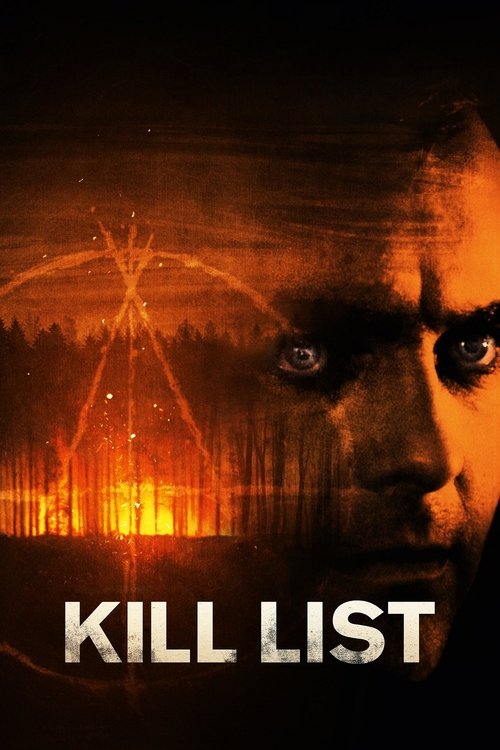
Kill List
2011 · Ben Wheatley
When you want horror that ambushes you — a film that keeps changing what kind of film it is and refuses to reassure you. Absolutely a challenge pick, not comfort viewing; best with someone to talk it over with after.
What it's about
Jay is a former soldier turned contract killer who hasn't worked in eight months, since a job in Kiev went wrong, and his marriage is cracking under the money pressure. His old army mate Gal brings him a new contract — three targets, big payoff — and the jobs start simply enough. But the people on the list behave strangely, the client's terms are unsettling, and the work pulls Jay somewhere much darker than a hit list.
The experience
It starts as an abrasive kitchen-sink drama, tightens into a brutal crime thriller, and then drops the floor out from under you. The violence is blunt and upsetting, the dread is constant, and the ending leaves a bruise you'll want to argue about.
Performances
Neil Maskell makes Jay terrifying and pitiable at once — a man whose rage keeps surging past his control — while Michael Smiley gives Gal a warmth that makes the darkness around him worse. MyAnna Buring is fierce as Shel, turning the domestic scenes into their own kind of combat.
The craft
Ben Wheatley shoots domestic argument and ritual violence with the same naturalistic, eavesdropping camera, so the genre shifts land as shocks rather than gear changes. The sound design and droning score keep a wrongness humming under even the ordinary scenes. Much of the dialogue was improvised around the script, and it shows in the lived-in abrasion between the leads.
Why it matters
The film made Wheatley's name internationally and became a cornerstone of the modern British folk-horror revival, its divisive ending a fixture of genre conversation ever since.
Snapshot
Kill List is Ben Wheatley's second feature. It starts as a domestic drama about a former soldier turned contract killer whose marriage is falling apart in a house in the English suburbs. It then becomes a hitman thriller, and in its final act it turns into occult folk horror. The protagonist, Jay (Neil Maskell), has not worked for eight months since a job in Kiev went wrong. His wife Shel (MyAnna Buring) quarrels with him over money, and his old army friend and partner Gal (Michael Smiley) brings him a new contract: three killings for a large fee. The targets are a priest, a librarian and a Member of Parliament. They thank Jay before he kills them. The client seals the contract with blood, and the job ends in a torchlit ritual in the countryside, which forces Jay into an act of violence that the film has been quietly preparing from its first scenes.
The film made on a small budget, much of its dialogue was improvised, and its shifts in genre are abrupt and deliberately left unresolved. It became one of the most discussed British genre films of its decade. It established Wheatley and his co-writer Amy Jump as major voices, and it is regularly cited as a starting point of the twenty-first-century British folk-horror revival.
Industry & production
Kill List was produced by Rook Films, the company of producers Claire Jones and Andy Starke, which had worked with Wheatley on Down Terrace (2009). It was developed under Warp X, the low-budget feature arm of Sheffield's Warp Films, and its backers included Film4. Warp X's slate was set up to make lean, director-driven features in the North of England. Kill List fitted that model: a small cast, a short shoot, real locations in and around Sheffield and South Yorkshire, and a story that could change register without needing costly set pieces. The budget is widely reported to have been modest, in the hundreds of thousands of pounds rather than millions. Exact figures differ between sources and are not authoritatively documented, so no single number is given here.
The film had its premiere in the Midnighters section of South by Southwest in March 2011, where it gained a strong genre-festival following. It then played the festival circuit, including Fantastic Fest. Optimum Releasing distributed it in the UK from September 2011, and IFC Midnight released it in the US in early 2012. Its commercial life was modest, as you would expect for a film of its size. Its reputation grew mainly through critics, festivals and later home viewing.
Technology
The film was shot digitally, which suited its schedule and budget. Contemporary production accounts give few specifics about the camera package, and they are not stated here as fact. In practice, the digital capture let the production shoot handheld and for long takes in cramped domestic interiors and in low light: the night-time woodland sequences of the final act rely on available torchlight and firelight more than on large lighting rigs. The film's technical method was economy. The violence depends on practical make-up effects, most notoriously in the hammer killing of the Librarian, and on what the editing withholds, rather than on digital effects.
Technique
Cinematography
Laurie Rose, who became Wheatley's regular cinematographer, gives the first half a loose, observational, handheld look close to British social realism. Dinner-party scenes are shot as if the camera were another guest, catching overlapping glances and half-heard remarks. As the job goes on, the framing hardens. Hotel corridors, institutional interiors and anonymous roads are shot with growing coldness, and the final act moves into darkness lit only by torches. In the tunnel chase, the image shrinks to what Jay can see. Rose's work makes the film's change of mode feel like a gradual tightening of the screws rather than a jump to a different film.
Editing
The editing is the film's most distinctive formal feature. Robin Hill, Wheatley's long-time collaborator, is credited as editor, and Wheatley and Jump are known to be closely involved in cutting their films. Scenes are often cut off abruptly, sometimes in mid-gesture or mid-line, which produces a jagged, elliptical rhythm. Time jumps without explanation. The film is divided by intertitles naming each target ("The Priest," "The Librarian," "The MP") and finally "The Hunchback," which gives it the feel of a ledger being worked through. This fragmentation leaves the audience unsure of causes and connections, and that uncertainty is the source of much of the film's dread. Viewers notice details (a symbol scratched behind a bathroom mirror, a blood-sealed handshake, victims who seem to know Jay) without the film ever arranging them into an explanation.
Mise-en-scène / staging
The design is deliberately ordinary. There is a new-build suburban house with unpaid bills, a children's bedroom, chain hotels, a dinner table cluttered with wine bottles and takeaway. The horror grows out of these ordinary spaces instead of replacing them. Wheatley stages the domestic quarrels so that they spill into adjoining rooms and are overheard, and he blocks the violence with clinical, flat directness. The final sequence goes into a countryside of woods, a manor house and a tunnel, where masked figures in straw-like costumes recall the iconography of The Wicker Man. The last image places a crown on Jay's head while the cult applauds. It is staged as a ceremony and offers no explanation.
Sound
Jim Williams's score is sparse and mostly discordant: low drones, dissonant strings and percussive pulses that often begin before anything on screen has given cause for alarm. The music announces horror long before the plot does, so even the early domestic scenes feel slightly wrong. The sound design follows the same principle. Ambient hums, muffled voices through walls and sudden drops into silence keep the audience off balance. Williams went on to work with Wheatley again, notably on A Field in England and Possessor-era British genre projects, and his collaboration with Wheatley started in this film.
Performance
The performances combine scripted structure with improvisation, a method Wheatley had already used in Down Terrace. Neil Maskell plays Jay as a man whose charm and wounded pride can turn into brutality in an instant, and the actor never asks for sympathy. MyAnna Buring makes Shel more than a nagging spouse: she is sharp, practical and in some ways as tough as Jay, which matters a great deal for the ending. Michael Smiley's Gal is the film's emotional anchor. He is funny, loyal and increasingly frightened, and his performance won Best Supporting Actor at the 2011 British Independent Film Awards. Struan Rodger's soft-spoken Client and Emma Fryer's Fiona, Gal's girlfriend, a quietly uncanny presence, are both understated and chilling. The naturalistic, overlapping ensemble work in the first act makes the later strangeness hit harder.
Narrative & dramatic mode
The narrative is built as a slow tonal slide: kitchen-sink domestic drama, then crime procedural, then occult horror. Each mode is held long enough to feel stable before it gives way. The film withholds information on principle. It never explains what happened in Kiev, what the cult is, why the victims are grateful, or how long Jay has been a target. It also cuts out scenes that a conventional thriller would include. Interpretations range from a literal conspiracy that has groomed Jay from the start, to a psychological allegory of a traumatised veteran's breakdown, to a political parable about violence passed down through the state and the family. The film supports all of these readings and confirms none of them. The final reveal, in which the "Hunchback" Jay kills is his wife with his son strapped to her, completes a tragic structure: the household he was killing to protect turns out to be the final sacrifice.
Genre & cycle
Kill List belongs to several cycles at the same time. As a hitman film it relates to the post-Tarantino British crime cycle and to older models such as Get Carter (1971). As a portrait of a veteran damaged by service, it sits alongside the post-Iraq and Afghanistan "returning soldier" narratives. Its most lasting genre affiliation is folk horror, the British tradition of pagan ritual, rural cults and the rural landscape as a threat, defined by Witchfinder General (1968), The Blood on Satan's Claw (1971) and The Wicker Man (1973). Wheatley's film brought that tradition back through realism, not period reconstruction, and it was one of the films that helped make "folk horror" a widely used critical label again in the 2010s.
Authorship & method
Ben Wheatley came to features from comedy shorts, viral internet work and television directing. Down Terrace (2009), a low-budget crime comedy set in a Brighton family home, established his method: small crews, improvised dialogue around a firm structure, family dysfunction as the setting for violence, and sudden changes of tone. Kill List pushed the method into horror and won him international recognition.
Amy Jump, Wheatley's wife and co-writer, wrote the screenplay with him. Their partnership continued through Sightseers (2012), A Field in England (2013), High-Rise (2015) and Free Fire (2016). Critics often credit Jump with the structural rigour and the literary layering beneath the films' apparent looseness, though the exact division of labour within the partnership is not publicly documented in detail.
Laurie Rose (cinematography), Robin Hill (editing; Hill also co-wrote and acted in Down Terrace) and Jim Williams (music) formed the core of a repertory team that gave Wheatley's early films a consistent texture. Producers Claire Jones and Andy Starke of Rook Films were also key to the low-cost, creatively autonomous model of production.
Movement / national cinema
The film belongs to British cinema of the late 2000s and early 2010s, when low-budget schemes and regional production (Warp X in Sheffield, Film4's support for first and second features, regional screen agencies) supported a group of distinctive genre directors. Its realist grammar comes from the British social-realist tradition associated with Ken Loach, Mike Leigh and Alan Clarke, especially Leigh's improvisational method and Clarke's blunt staging of violence. What was new in Kill List was putting that grammar in service of horror. It suggested that a British genre cinema could be both specific to its place and formally ambitious, neither imitating Hollywood nor retreating into heritage drama. Wheatley is often grouped with other British directors who worked across genres in the same period, but he did not belong to any formal movement.
Era / period
Kill List was made in the shadow of the 2008 financial crisis and the wars in Iraq and Afghanistan. Both are present in the film. Jay's unemployment, the household's money troubles and the arguments about debt place the film in the economy of austerity Britain. Jay and Gal's military past, the references to service, and Jay's unexplained trauma connect the violence to British foreign wars. Critics have also noted that the targets (a priest, a librarian with a collection of abusive material, an MP) correspond to the institutions at the centre of British public scandal at the time: clerical abuse, establishment complicity, political corruption. The film does not develop these as explicit commentary, but they place it firmly in its moment.
Themes
- Violence as inheritance and economy. Killing is Jay's trade, his trauma and his family's income. The film asks what kind of man that work produces and what it costs the people who depend on him.
- Masculinity and the family. Jay's rage, his pride and his inability to talk about what he has done shape the house well before the cult appears. The final act turns the protective role of father and husband into its horrific opposite.
- Faith and its counterfeits. Gal is a Christian, the first target is a priest, and the cult's rites offer a pagan, transactional alternative. The film sets belief, contract and sacrifice side by side.
- The establishment as occult. The suggestion that respectable figures (the Client, the MP, the well-dressed cult members) belong to a hidden order turns British class anxiety into a literal conspiracy.
- Predestination and agency. Hints that Jay has been chosen, watched and prepared for a long time raise the question of whether anything he does is his own choice.
- Righteous violence. Jay's escalating brutality toward the Librarian's associates, which he justifies by their crimes, makes the audience complicit in a violence presented as moral, until the film reveals what that violence is for.
Reception, canon & influence
Critical reception. Kill List was widely and strongly praised on its release, especially in Britain, where critics including Mark Kermode championed it, and it appeared on many year-end lists for 2011. Reviewers praised its performances, its control of dread and its formal daring. A minority found the final act opaque or arbitrary, or considered the withholding of explanation a weakness rather than a strategy. That split has persisted and is part of the film's reputation. At the British Independent Film Awards it received several nominations, and Michael Smiley won Best Supporting Actor. It has since become a cult object, frequently discussed in online analysis devoted to decoding its ending.
Influences on the film (backward). The Wicker Man is the most obvious model, in its pagan cult, its sacrificial structure and its outsider lured to a ritual end. Critics have also cited Don't Look Now (1973) for its grief, premonition and fragmented editing, and the wider tradition of 1960s–70s British folk horror. The crime side draws on Get Carter and the hitman film generally. The domestic first act recalls the improvised realism of Mike Leigh and the rawness of Alan Clarke. A sense of conspiracy and grooming that Jay cannot escape has also been compared to Rosemary's Baby (1968). Wheatley has spoken in general terms about British horror and 1970s cinema as touchstones, but the specific attributions above are critical readings, not a documented list of sources.
Legacy (forward). Kill List is widely seen as an early landmark of the 2010s folk-horror revival and of the cycle later (and contentiously) called "elevated" or "post-horror": slow-building, formally ambitious horror films rooted in family trauma and ending in ritual. Its pattern of a family crisis that leads into a cult's long-planned ceremony, with a final crowning, anticipates films such as Hereditary (2018) and Midsommar (2019). Critics have often pointed to that affinity, though direct influence has not been documented here. Within British cinema it opened the way for Wheatley and Jump's A Field in England, a full venture into English occult history, and it encouraged a broader regional, realist strand of British horror. In the folk-horror revival of the 2010s, including the documentary and critical work that reconstructed the tradition, Kill List is regularly named as a key modern example. Its reputation now depends less on any single scene than on the model it offered: domestic realism and ritual horror combined in one film, with the change between them left for the audience to work out.
Influences: the films it descends from and the films it influenced
- The Wicker Man (1973) — Supplies the template of an outsider steered through a plot that turns out to be a long-planned pagan ritual, which ends in a sacrificial climax staged as a community ceremony with masked, straw-clad participants.
- Don't Look Now (1973) — Roeg's fractured, associative editing, which cuts across time to lay premonition into everyday scenes, anticipates Kill List's elliptical jump cuts that break up continuity inside domestic and violent scenes alike.
- Get Carter (1971) — Gives the British hitman film its terse, unglamorous violence carried out by a cold professional in drab regional settings, the register Kill List uses for Jay and Gal's jobs before the genre turns.
- Rosemary's Baby (1968) — Shows how to build a grooming conspiracy through ordinary social encounters and kind strangers, so the cult's final claim on the protagonist reads in hindsight as planned from the first scene.
- Witchfinder General (1968) — A founding text of the English folk-horror 'unholy trinity': it uses real rural English locations and sudden, unromantic violence to tie the English landscape to cruelty carried out by people in authority.
- Made in Britain (1982) — Clarke's handheld camera that follows its subject and his raw, confrontational performances give the model for Kill List's documentary-style first act, where aggression erupts at close range with no stylised distance.
- Abigail's Party (1977) — Leigh's method of building characters through improvisation and staging excruciating social friction around a suburban dinner party lies directly behind Kill List's dinner-party scene of marital sniping and hosts' awkwardness.
- Dead Man's Shoes (2004) — Combines improvised Midlands social realism with a revenge story by a returned soldier that tips into near-supernatural dread, which is the same genre slide from kitchen-sink naturalism to horror that Kill List performs.
- Down Terrace (2009) — Wheatley's debut sets up the method Kill List extends: improvised dialogue over a firm Jump/Wheatley structure, family dysfunction as the setting for crime, sudden lurches in tone, and Robin Hill's abrupt editing.
- Onibaba (1964) — Carries forward the masked-cult demon and the slow dread built from landscape and abrupt percussive sound cuts, an heir to Onibaba's interior-exterior alternation and mask iconography.
- The Shout (1978) — Reproduces the escalation from banal domestic naturalism into rural ritual with no explanatory scene between the two registers, and uses Jim Williams's scraped, drone-based score as an intrusion into the sound field rather than accompaniment.
- Eden Lake (2008) — It continues Eden Lake's move from social-realist naturalism into rural horror, ending on a nihilistic twist in which the protagonist's own violence condemns them. This is the reversal of the final girl as folk horror.
- A Field in England (2013) — Takes Kill List's buried English occultism fully into the past, with chapter-like tableaux, strobing psychedelic montage and a discordant Jim Williams score, and keeps the same withholding of explanation.
- Hereditary (2018) — Repeats the structure of a family crisis that is revealed as the slow staging of a cult's long-planned ceremony, ending in a crowning in which the trapped protagonist is enthroned.
- Midsommar (2019) — Extends the Wicker Man–Kill List pattern of a relationship in crisis led into a community's ritual, ending in a sacrificial climax that is also the protagonist's crowning.
- In the Earth (2021) — Wheatley goes back to woodland occultism on a micro-budget, with stroboscopic, sound-saturated sequences and a narrative that drifts from realist survival into ritual horror that is never explained.
- Enys Men (2022) — Carries the British folk-horror revival into handmade, elliptical form, using abrupt non-linear cuts and a discordant soundscape to keep the occult logic of a landscape unexplained.
- Apostle (2018) — A Welsh director restages the Wicker Man–Kill List structure of an outsider infiltrating an insular pagan community, with sudden, intensely physical practical-effects violence breaking into a slow build.
- Saint Maud (2019) — Follows Kill List's model of British horror rooted in drab, austerity-era coastal realism, where a working-class protagonist's trauma slides by degrees into religious ecstasy and violence, ending on an abrupt, devastating final image.
- 28 Years Later: The Bone Temple (2026) — The named Wheatley debt: fractured, elliptical editing that withholds the hooded cult reveal until a gut-punch, fusing kitchen-sink realism with folk-ritual dread.
- When Evil Lurks (2023) — Folk-horror belief systems delivered through naturalistic performance and a brutal late tonal collapse into an annihilating gut-punch ending, a rhythm Rugna mirrors.
- Raw (2017) — Jim Williams' scoring method — dissonant orchestral dread laid under flatly naturalistic domestic scenes so the music, not the image, announces the genre — is transposed intact onto Raw's dorm-room banality.
- Sightseers (2012) — The same Wheatley–Jump–Laurie Rose–Jim Williams team brings Kill List's swing between mundane British domestic comedy and sudden brutal violence to a caravan holiday across heritage sites.
- The Borderlands (2013) — A low-budget British horror film that combines laddish naturalistic banter with an ancient pagan presence under rural English church ground, ending in a sudden descent into an underground sacrificial horror.
- The Ritual (2017) — Male-dread British horror that detonates into a folk-horror cult reveal, masked figures and ritual sacrifice deployed as the final structural turn.
- Men (2022) — A domestic realist drama tips into a pagan-cult nightmare in its last act. This launched the British folk-horror revival's realism-to-allegory structure, which Men follows from grief drama to symbolic delirium.
Similar films
- Kill (2024) — shared sensibility
- Men (2022) — shared sensibility
- Bone Tomahawk (2015) — shared sensibility
- You're Next (2013) — shared sensibility
- Ivy (2015) — shared sensibility
- I Saw the Devil (2010) — shared sensibility
- The Ritual (2017) — shared sensibility
- Enemy (2013) — shared sensibility