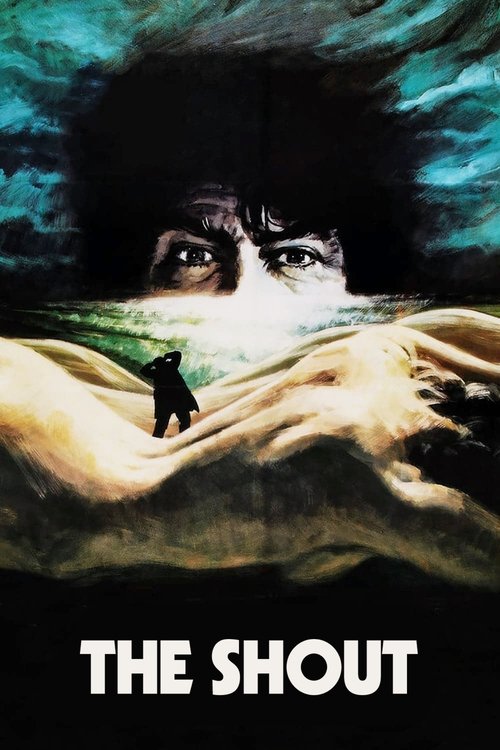
The Shout
1978 · Jerzy Skolimowski
For when you're craving strangeness — an unsettling puzzle-box for a late night, best with good speakers and no distractions. A challenge for viewers who like their horror ambiguous and their endings arguable.
What it's about
A drifter named Crossley attaches himself to an experimental composer and his wife in a lonely stretch of Devon, claiming he spent years in the Australian outback learning magic — including a shout that can kill anyone who hears it. Whether he's a madman or exactly what he says he is becomes the question the whole household starts living inside. The tale is told, unreliably, from the sidelines of a cricket match at an asylum.
The experience
Genuinely eerie in a way jump-scare horror never touches — hushed, off-kilter, and hallucinatory, with sound itself as the source of dread. It's short, dense, and leaves you unsure what you can trust, which is the point.
Performances
Alan Bates is magnetically menacing as Crossley — all coiled certainty and animal confidence — while John Hurt and Susannah York register his invasion of their marriage with escalating, believable unease.
The craft
Skolimowski builds the film around its soundtrack: the composer hero manipulates recorded and electronic sound, and the film does the same to you, making the audio design the true special effect. It rewards a proper sound system more than almost any film of its era — the title isn't a metaphor.
Why it matters
It took a major prize at Cannes and became one of British cinema's great cult objects — a touchstone for filmmakers interested in horror driven by sound and ambiguity rather than gore.
Snapshot
Eighty-six minutes long, set almost entirely in a corner of North Devon, and structured as a story told by a lunatic during a cricket match, The Shout is the strangest thing to come out of British production in the late 1970s and one of the few films of that decade to make sound itself the instrument of terror. Jerzy Skolimowski — a Polish émigré working in England, adapting a 1929 short story by Robert Graves — took a premise that could have been a Hammer curio (a man returns from the Australian outback with a lethal cry) and built from it a compact, hallucinatory essay on possession, artistic potency, and the unreliability of the person telling you the story.
Alan Bates plays Charles Crossley, who insinuates himself into the household of an experimental composer, Anthony Fielding (John Hurt), and his wife Rachel (Susannah York), and proceeds to take the house, the wife, and the husband's sense of himself. The film won the Grand Prix (Special Jury Prize) at Cannes in 1978, shared with Marco Ferreri's Bye Bye Monkey, and then spent decades as a half-remembered cult object before disc reissues restored it to circulation. It is now routinely and correctly claimed as an ancestor by the folk-horror revival and by a strain of contemporary cinema that treats sound as the primary medium of dread.
Industry & production
The Shout was made at a low point for British film. American studio money, which had underwritten the British boom of the 1960s, had largely withdrawn by the early 1970s; what remained was the Eady Levy, the National Film Finance Corporation, and a patchwork of independent producers assembling budgets film by film. Under those conditions, an eighty-six-minute art film with no stars in the international sense, no action, and a metaphysical premise was a fragile proposition.
It was produced by Jeremy Thomas, for whom it stands as a first feature as producer and as the founding statement of a career built almost entirely on backing difficult auteurs with foreign passports — Nagisa Ōshima, Bernardo Bertolucci, Nicolas Roeg, David Cronenberg, and Skolimowski again on Moonlighting (1982). The pairing matters: Thomas's model was to find a director with an uncompromised vision and a modest budget and let the vision be the selling point, which is precisely how The Shout was positioned — festival first, art houses after.
Skolimowski himself was in the middle of a long working exile. He had left Poland after Hands Up! (1967) was banned, and had since made films in Belgium, Britain, and West Germany. He was, by 1978, a director with a formidable reputation among cinephiles and an unstable commercial record, working in a country whose industry he understood as an observer rather than a native. That outsider position is legible in every frame of the film's England.
Production was concentrated in Devon, with the dunes at Braunton Burrows serving for the film's central set piece and local church and farmhouse locations providing the rest. The compression is total: a handful of interiors, a stretch of sand, a churchyard, an asylum cricket ground.
Technology
Two technological registers run through the film, and their collision is the film's argument.
The first is the apparatus of production: 35mm color negative, location shooting with relatively light equipment, natural and available-light interiors pushed toward a chalky, overexposed pallor. The film's look owes something to the mid-70s move away from studio-controlled lighting toward on-location naturalism, which in British hands often produced a damp, unglamorous realism — and which Skolimowski and his cinematographer weaponize by pushing it a half-step past plausibility.
The second register is diegetic and central. Anthony Fielding is a composer of electronic and concrete music, and the film is unusually well-informed about what that practice actually looked like in 1977: reel-to-reel tape machines, splicing and looping, contact microphones, oscillators, a synthesizer, and a working method of recording ordinary objects — marbles rattled in a tin, gravel, breath, metal — and then processing them past recognition. This is the world of musique concrète after Schaeffer and Henry, of Stockhausen's tape works, of the BBC Radiophonic Workshop and the British experimental scene of the period, transplanted into a country church. Fielding's studio is a machine for making sound unnatural by mediation.
Against this the film sets Crossley's shout: a sound with no apparatus at all, produced by a body, requiring no electricity, and lethal. The composer's technology can only simulate power; the traveler's voice has it. That opposition — mediated modernity versus unmediated, pre-technological force — is the film's engine, and it is why The Shout reads as a film about art and appropriation rather than merely a supernatural anecdote.
The film also arrives at the exact moment theatrical sound reproduction was being transformed by Dolby's noise reduction and stereo optical formats, which by 1977–78 had begun to make dynamic range and spatial placement expressive resources for narrative cinema rather than technical afterthoughts. The detailed record of The Shout's own mixing and release format is thin in the accessible literature, and I will not guess at it; what is audible on the film is a soundtrack conceived with unusual attention to dynamics — long stretches of near-silence and ambient wind against sudden, distorted, low-frequency assault.
Technique
Cinematography
Mike Molloy shot the film. His formation matters: he had worked as a camera operator for Stanley Kubrick, and something of that training survives in The Shout's discipline — the willingness to hold a wide, symmetrical composition and let unease accumulate inside it rather than chasing the actors.
The Devon exteriors are shot in a bleached, sunstruck register that inverts the usual English pastoral. The dunes sequence — Crossley leading Fielding out to a shifting, featureless landscape of sand and marram grass to demonstrate what he can do — is composed for emptiness: enormous sky, low horizon, two figures reduced to marks. The horror is not staged in shadow but in glare and open space, which is one of the film's most durable innovations and the thing later folk horror borrowed most directly.
Interiors are handled differently: shallow, cluttered, overlit through windows so that faces sit against burnt-out frames. The camera drifts, sometimes hand-held, sometimes on slow tracking moves that arrive at a detail — a shoe buckle, a stone, a sleeping face — before the narration acknowledges it. Molloy and Skolimowski repeatedly place the camera where no character is standing, a small formal signal that the story we are being told has slipped its narrator's authority.
Editing
Cut by Barrie Vince, the film's editing is its most radical department. The Shout is constructed as a nested narration — Crossley telling his tale to a young man named Robert Graves during a cricket match — and the cutting refuses to keep the two levels separate. Images from the tale intrude on the frame; figures at the cricket ground appear to correspond to people in the story; the film cuts on sound and on association rather than on continuity.
The result belongs to the same moment as Nicolas Roeg's work — Performance (1970), Don't Look Now (1973) — in which fragmentation is not stylistic decoration but epistemology. The difference is that Roeg's associative editing usually gestures toward a hidden order, while Skolimowski's insists there may be none. Crossley tells Graves early on that his story is always true but that he tells it differently each time; the editing takes him at his word and then denies the viewer any stable ground from which to check.
Mise-en-scène / staging
The staging works by displacement. Crossley arrives at a church, at a lunch table, in a house, and each time the blocking quietly reassigns the space: he takes a chair, a doorway, a position at the head of a table. Fielding is progressively pushed to edges of frames and thresholds of rooms until he is effectively a guest in his own marriage.
Objects carry the plot with almost no dialogue: a buckle removed from Rachel's shoe, a scatter of stones on the dunes among which a soul is supposedly hidden, a pair of wax earplugs, a cricket scoreboard. The film's magic system is never explained and never needs to be, because it is enacted entirely through the handling of small things.
The Devon settings are staged as ordinary to the point of banality — a village fête atmosphere, a shoemaker's shop, a country churchyard — which is exactly the folk-horror method: the uncanny is not imported into the English countryside, it is discovered to have been living there.
Sound
This is the department the film exists for. Fielding's compositions are heard in progress, unfinished, as loops and tests; the ambient track is dominated by wind, sea, insects, and the enormous acoustic dead air of the dunes. Silence is used structurally, so that the shout, when it comes, lands as a physical event rather than a sound effect — a distorted, saturated, low-frequency roar that overwhelms the mix.
The score is credited to Tony Banks and Michael Rutherford of Genesis, working outside the progressive-rock idiom they were known for. What they supply is not song-form music but texture: synthesizer drones, unresolved harmonic beds, pulses that sit under scenes without commenting on them. It is one of the more successful rock-musician-to-film-score crossings of the period precisely because it declines melody.
Detailed documentation of how the shout itself was constructed is not well preserved in accessible sources; accounts generally describe layered and heavily processed material, and I will not manufacture specifics. What can be said with confidence is that the film treats the sound mix as the site of its horror in a way almost no other British film of the decade attempted.
Performance
Alan Bates plays Crossley without a single supernatural mannerism — no glare, no incantatory delivery. He is affable, physically imposing, and entirely certain, and the certainty is the threat. It is a performance built on the assumption that a man who believes he can kill with his voice would not need to perform belief.
John Hurt, two years before The Elephant Man, gives Fielding a nervy, thin-skinned intelligence: a man whose authority is entirely intellectual and therefore evaporates on contact with somebody who does not recognize intellectual authority. Susannah York's Rachel is the film's most difficult role — a woman whose interiority the narration systematically withholds — and York plays her as increasingly, disquietingly serene, which reads simultaneously as enchantment and as a woman who has simply chosen.
Robert Stephens, as the asylum's chief medical officer, supplies the film's dry institutional comedy, and Tim Curry plays the young Robert Graves — a reflexive stroke, since Graves wrote the source story, that folds the author into his own tale as a listener. Jim Broadbent appears in a minor early screen role among the cricketers.
Narrative & dramatic mode
The Shout is a frame narrative in which the frame is contaminated. The outer level is realist and mildly comic: an annual cricket match between a mental hospital and a village side, scorers in a hut, a storm building. The inner level is the account Crossley gives of what he did to the Fieldings.
The mode is closest to the literary fantastic as Todorov described it: a text that sustains hesitation between supernatural and psychological explanation and refuses to resolve it. Every element of Crossley's story admits a mundane reading — he is a charismatic sociopath who talked his way into a vulnerable marriage — and a magical one, and the film gives no privileged vantage. Skolimowski goes further than the source by letting the frame and the tale bleed together, so the hesitation extends to the act of narration itself. When the storm finally breaks over the cricket ground and lightning takes the scoring hut, the film supplies an ending without supplying an answer.
Dramatically, it is a chamber piece: three principals, one house, a triangle. Its shape is the intruder plot — a stranger enters a couple's closed system and exposes its rot — and its particular cruelty is that Fielding's marriage is already compromised by his own affair, so Crossley is less an invader than a bailiff.
Genre & cycle
The film sits at an intersection. It is British folk horror by geography and instinct, arriving after Witchfinder General (1968), Blood on Satan's Claw (1971), and The Wicker Man (1973) had established that the English landscape harbors older law than the one on the statute books — but it arrives at the tail of that cycle, after the audience had stopped, and so it has the quality of a coda rather than a contribution.
It belongs equally to the European intruder film: Polański's Knife in the Water (1962), which Skolimowski co-wrote, is the direct ancestor, along with Losey and Pinter's The Servant (1963), Polański's Cul-de-sac (1966), and Pasolini's Teorema (1968). In all of these a stranger enters a bounded space and the space's occupants discover what they actually are.
And it is an art-house psychological horror in the lineage that runs through Repulsion (1965) and Don't Look Now (1973) — films where genre machinery is retained but the pleasures of resolution are withheld. It is not, in any useful sense, a horror film as the 1978 marketplace understood the term, which is part of why it was not commercially placeable.
Authorship & method
Skolimowski came to cinema from poetry, boxing, and painting, and his films retain a poet's indifference to explanation and a boxer's interest in what bodies do to each other. Trained at Łódź, he wrote for Wajda (Innocent Sorcerers) and Polański (Knife in the Water) before directing his own run of Polish features — Identification Marks: None (1964), Walkover (1965), Barrier (1966) — and then leaving the country after Hands Up! was suppressed. His method is elliptical: scenes begin late and end early, motivation is withheld, and physical detail carries meaning that dialogue refuses.
The screenplay is credited to Skolimowski and Michael Austin, who would go on to co-write Greystoke: The Legend of Tarzan, Lord of the Apes (1984) — another story about a European encounter with a supposedly primal world. Their adaptation compresses Graves's 1929 story and adds the reflexive doubling between frame and tale that gives the film its instability.
The key collaborators are the ones already named and worth restating as a unit: Mike Molloy's hard, bright photography; Barrie Vince's associative cutting; Tony Banks and Michael Rutherford's textural score; Jeremy Thomas's production, which protected the film's shape. It is a small crew making a small film with unusual coherence of intent.
Movement / national cinema
The Shout is a Polish film made in England, and both halves of that sentence are load-bearing. Skolimowski belongs to the generation of the Polish School's aftermath — the cohort around Polański and Wajda that inherited the postwar cinema's moral seriousness and replaced its historical subject matter with existential and formal games. Exiled, that generation exported a particular sensibility: the closed system, the psychological duel, the refusal of catharsis.
Placed in the English countryside, that sensibility produces something no English director would have produced. The Devon of The Shout is observed anthropologically — its cricket, its church, its shoemakers and vicars rendered as the exotic rituals of a tribe. This makes the film a peculiar mirror of its own plot: a film about a European who returns from among Aboriginal people claiming their power, made by an outsider studying the English as though they were the material.
Within British cinema it belongs to the small, precious category of late-70s films made possible by domestic public finance and international festival ambition rather than by any market — a category that also includes Derek Jarman's Jubilee (1978) and the early Channel 4-era work that would follow.
Era / period
1978 is a hinge. Punk had just detonated in Britain; the Callaghan government was months from the Winter of Discontent; the national self-image was in visible disrepair. The Shout is not a topical film, but its England — provincial, stagnant, faintly rotten, its institutions represented by a lunatic asylum and a cricket match — is legible as a portrait of that moment.
It is also the last year before the horror landscape changed permanently. Halloween opened in 1978; Alien was in production. Within two years the commercial genre would be reorganized around body threat, stalking, and effects, and a film whose central weapon is an idea about sound would have nowhere to sit. The Shout is a late work of the 1970s' patient, ambiguous, adult horror, released just as that mode lost its audience.
Themes
Sound as power. The film's governing idea is that sound is not representation but force — that a vibration can kill, and that the composer who spends his days processing tape has mistaken the copy for the thing. Fielding's art is a technology of imitation; Crossley's shout is presence.
Appropriation and the colonial return. Crossley's power is explicitly stolen: acquired during eighteen years among Aboriginal people, along with a law he claims obliged him to kill his own children. The film never travels to Australia, never shows the source, and never verifies any of it — the "Aboriginal magic" exists only as a white man's assertion. Read generously, this is a critique of the Frazerian imperial imagination that Graves's 1929 story emerged from, in which Indigenous knowledge is a resource to be brought home. Read plainly, the film still trades on the exotic frisson it half-criticises, and modern viewers will find that tension unresolved rather than transcended.
Displacement and marital fragility. The triangle works because the marriage is already hollow. Fielding's affair gives Crossley his opening, and Rachel's turn is staged so that it can be read as bewitchment or as choice — an ambiguity the film pointedly does not settle in the husband's favour.
Madness and narrative authority. Everything reaches us through a man certified insane, in a film that repeatedly shows us more than he could know. The theme is not "is he mad" but "what is the status of any story," and the framing device makes the audience complicit in a credulity it never quite earns.
The soul as object. The stones on the dunes, in which souls are supposedly kept, give the film a materialist mysticism: the self is a small hard thing that can be picked up, hidden, or broken. It is a genuinely disturbing image because it is so undramatic.
Reception, canon & influence
The Cannes Grand Prix in 1978, shared with Ferreri's Bye Bye Monkey, gave the film immediate critical standing, and reviews in the serious press treated it as a major and difficult work by a director of established importance. It did not translate into commercial life. The film was too austere for horror audiences and too generic for art-house programmers, and after its festival year it drifted into the condition of a title more cited than seen — a reputation sustained by repertory screenings, television broadcasts, and word of mouth among cinephiles rather than by availability. Restoration and disc reissue in the digital era changed that, and the film's standing has risen steadily since; it is now discussed as one of the essential British films of the 1970s.
Backward. The primary source is Robert Graves's short story "The Shout" (1929), and behind it the mythographic obsessions Graves would systematize in The White Goddess (1948) — the belief in a pre-Christian, pre-rational poetic magic that modernity has forgotten. Cinematically, the debts run to Knife in the Water (1962), whose closed triangle and psychological warfare Skolimowski had helped write; to The Servant (1963) and Teorema (1968) for the intruder structure; to Repulsion (1965) and Don't Look Now (1973) for the fractured subjective mode; and to the British folk-horror cycle for the conviction that the countryside is not safe.
Forward. The Shout's influence is disproportionate to its visibility, and it runs along one clear line: cinema that treats sound as a haunted medium. Peter Strickland's Berberian Sound Studio (2012) — a film in which a sound engineer is destroyed by the material he is processing — is unimaginable without it, and Strickland's subsequent work continues the inquiry. Ben Wheatley's A Field in England (2013) and Kill List (2011) inherit the combination of sunlit English landscape, ritual violence, and refused explanation. The broader folk-horror revival of the 2010s, which retrieved The Wicker Man and Blood on Satan's Claw as canonical, retrieved The Shout alongside them and arguably found it the most formally advanced of the three.
Its second legacy is inside Skolimowski's own career. The film's confidence that a body in a landscape can carry a whole film without exposition leads directly to Essential Killing (2010), nearly wordless, and to EO (2022), which asks an audience to inhabit the sensorium of a donkey. The through-line from Crossley's shout to those late films is the same proposition: that the most powerful things in cinema are the ones that cannot be paraphrased.
A Deleuzian reading
Two men walk out into the dunes at Braunton Burrows.
The full Deleuzian reading of The Shout →
Reception
It shared the Grand Prix at Cannes in 1978, then quietly slipped out of circulation for decades — only to be rediscovered by the folk-horror revival crowd, who now treat it as one of British weird cinema's great buried treasures.
How The Shout was received, from release to now →
How to watch The Shout: what to notice on a first viewing
- Watch Crossley take the chair at the head of the table. Everywhere he goes he quietly claims a doorway, a seat, or the head of a table, and Fielding keeps drifting to the edges of his own rooms. Whoever controls the space controls the household, and nobody has to say it out loud.
- Notice the horror scenes are lit in bright glare. The dunes sequence is shot in an overexposed, empty daylight rather than shadow, with two tiny figures set against enormous sky and low horizon. The dread lives in open space and glare, not in darkness.
- Listen for the long stretches of near silence. Wind, sea, and insects dominate for long passages before anything else happens, training your ear to notice sound the way the plot eventually needs you to. By the time anything loud happens, your ears have already been put to work.
- Notice how much the plot moves through small objects. A buckle removed from a shoe, a scatter of stones, a pair of earplugs carry entire turns of the story with almost no dialogue attached. Small things end up carrying a weight the dialogue never explains.
- Notice when the camera sits where nobody is standing. Several shots are framed from a position no character in the scene occupies, a small, quiet break in whose point of view you're supposed to be sharing. The story's own telling starts to feel less trustworthy than it first seemed.
The whole guide to watching The Shout, with the keys for a rewatch →
Influences: the films it descends from and the films it influenced
- Forbidden Planet (1956) — Louis and Bebe Barron's all-electronic 'tonalities' erased the boundary between score and sound effect, the exact operating principle of Banks and Rutherford's Genesis-era synth textures, which cue emotion and simultaneously function as diegetic acoustic phenomena in the dunes.
- Knife in the Water (1962) — Skolimowski co-wrote its closed three-hander in which an uninvited stranger converts a couple's private space into a duel of physical dares and withheld motive — the same dramaturgy of two men competing over a woman through demonstrations of power rather than argument.
- The Servant (1963) — Losey and Pinter established the British intruder film's method of registering a hierarchy inverting through blocking and props — who sits, who stands, who handles the object — rather than through any scene in which the takeover is stated.
- Repulsion (1965) — Its treatment of amplified, unmotivated sound (ticking, wall cracks, distant bells) as the primary evidence of a mind coming apart is the technique Skolimowski inverts by making the sound objectively lethal instead of merely symptomatic.
- Teorema (1968) — The visitor arrives with no biography, no stated motive and no explanation of his power, and the film refuses to supply one — the structural withholding that lets Crossley's claim about Aboriginal magic stay permanently unadjudicated.
- Blood on Satan's Claw (1971) — Established the folk-horror grammar of shooting pre-Christian survival in flat English daylight across plowed fields and church ground, refusing gothic shadow — the visual premise of Molloy's bleached Devon exteriors.
- The Wicker Man (1973) — Made sound itself the carrier of the pagan threat — song, chant and Giovanni's folk arrangements are how belief is transmitted and how the outsider is undone — the same logic Skolimowski compresses into a single killing vocalization.
- Don't Look Now (1973) — Roeg and Graeme Clifford's associative cutting — matching on color, gesture and sound across gaps in time so that images seem to remember or predict each other — is the model for Barrie Vince's shuffling of cricket pavilion and dune footage.
- The Conversation (1974) — Walter Murch built the film around a man whose professional relationship to recorded sound destroys him, treating tape manipulation as both plot mechanism and score — the direct precedent for Anthony Fielding's studio of tape loops, gravel trays and oscillators.
- Blow Out (1981) — Extends the sound-technician protagonist into thriller mechanics: a recorded audio artifact is isolated, layered and replayed until it becomes lethal knowledge, with the mix design privileging the engineer's headphone perspective over the camera's.
- Essential Killing (2010) — Carries the dunes sequence's proposition to its limit — a near-wordless feature in which a body's motion through landscape and its breathing on the soundtrack replace all exposition, motive and dialogue.
- Kill List (2011) — Reproduces the escalation from banal domestic naturalism into rural ritual with no explanatory scene between the two registers, and uses Jim Williams's scraped, drone-based score as an intrusion into the sound field rather than accompaniment.
- Berberian Sound Studio (2012) — Literalises the shout's premise — a sound engineer is dismantled by the material passing through his own equipment — and stages Foley (vegetables, tape, oscillators) as the visible source of horror while withholding the images being scored.
- A Field in England (2013) — Inherits the sunlit English field as a site of ritual violence and refused explanation, adding tableau freezes and a stroboscopic montage that, like the shout, assaults the audience's sensorium directly rather than depicting an assault.
- Under the Skin (2013) — Mica Levi's detuned, sliding string writing functions as a physical instrument acting on the viewer rather than as commentary, paired with an unanchored, drifting camera that observes a predatory outsider without granting access to her intent.
- EO (2022) — Completes the trajectory by constructing an entire film around a non-human sensorium, where Paweł Mykietyn's score and the sound mix carry the interiority that dialogue and psychology are explicitly denied.
- Picnic at Hanging Rock (1975) — Russell Boyd's bridal-veil-gauzed, sun-flared exteriors paired with a narrative that sustains Todorov's fantastic to the final frame — an event that admits neither natural nor supernatural resolution — is the identical formal wager made three years later in Devon.
Similar films
- Don't Look Now (1973) — influence & lineage
- The Wicker Man (1973) — influence & lineage
- The Zone of Interest (2023) — shared sensibility
- The Brood (1979) — shared sensibility
- A Quiet Place (2018) — shared sensibility
- Funny Games (1997) — shared sensibility
- mother! (2017) — shared sensibility
- Sound of Falling (2025) — shared sensibility