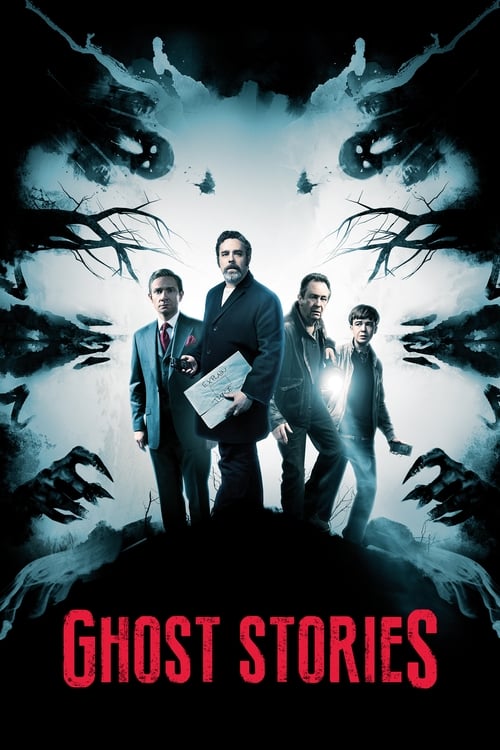
Ghost Stories
2018 · Andy Nyman
For a lights-off night when you want proper old-fashioned ghost-story chills with a brain — the kind of film you'd watch with a friend so you can argue about it after. Scary but playful, and it rewards paying attention.
What it's about
Professor Philip Goodman has built a career debunking psychics and exposing supernatural fraud on television. Then his vanished childhood hero — a legendary sceptic — resurfaces and challenges him to explain three cases he could never crack: a night watchman tormented in a derelict asylum, a teenager whose car breaks down on a dark forest road, and a wealthy man visited by something while his wife is in labour. As Goodman investigates, the three stories begin to feel connected — and aimed at him.
The experience
Classic campfire scares delivered with real craft — creaking corridors, things glimpsed at the edge of the frame, jolts that land — wrapped around a puzzle that gets stranger and sadder as it goes. It's funny in a dry British way, then quietly devastating.
Performances
Martin Freeman is a standout as the smug City financier whose composure keeps slipping, Paul Whitehouse brings unexpected pathos to the haunted night watchman, and Alex Lawther is nerve-shreddingly good as the terrified teenager.
The craft
Adapted by Andy Nyman and Jeremy Dyson from their own hit stage play, it translates theatrical sleight-of-hand into cinema — the film is built like a magic trick, planting details everywhere that pay off on a rewatch. The locations drip with damp English gloom, and the sound design does a lot of the scaring.
Why it matters
It brought the great British portmanteau horror tradition roaring back and became a cult favourite among horror fans who love a film that plays fair with its mysteries.
Snapshot
Ghost Stories is a British portmanteau horror film written and directed by Andy Nyman and Jeremy Dyson. The single-director credit in the header is incomplete: Nyman and Dyson share the directing credit. They adapted the film from their own stage play, which premiered at the Liverpool Playhouse in 2010 before transferring to London. Nyman also stars as Professor Philip Goodman, a television debunker of psychic fraud. His childhood hero, Charles Cameron, a long-vanished pioneer of paranormal scepticism, summons him and asks him to explain three cases Cameron could never solve: a night watchman (Paul Whitehouse) tormented in a derelict asylum; a nervous teenager (Alex Lawther) whose car breaks down on a forest road; and a wealthy City man (Martin Freeman) visited by a poltergeist while his wife is in labour. The film has the familiar shape of the Amicus anthology, with a frame story holding several tales. Its last act takes that shape apart: the tales and the man investigating them turn out to be one psychological structure, built from Goodman's own guilt.
The film premiered on the festival circuit in autumn 2017 (Toronto's Midnight Madness and the BFI London Film Festival among its early showings) and opened in UK cinemas in April 2018. It stands as one of the more self-aware revivals of the British anthology tradition, and as a rare case of a theatrical horror success carried over to the screen by its own authors.
Industry & production
The film was produced in the UK. Warp Films, the Sheffield-founded company known for Shane Meadows's and Ben Wheatley's work, was among the producing entities, with Altitude Film Entertainment also involved. Lionsgate handled UK distribution and IFC Midnight the US release. The budget was modest by genre standards. The production record available to me does not support a reliable figure, so none is given here.
The film's main industrial point of interest is where it came from. Ghost Stories the play was a theatrical rarity: a commercially successful stage horror show. It was marketed on secrecy (audiences were asked not to reveal its twists) and built on jump-scares that relied on live darkness, sound cues and stagecraft. The play went from Liverpool to the West End and later had revivals in London and runs abroad. When Nyman and Dyson moved it to film, they kept authorial control rather than selling the property. That gave them a ready-made structure and a known reputation among British horror audiences. It also left them with the challenge of turning effects designed for a live auditorium into cinematic ones.
Technology
The film uses ordinary contemporary digital production methods. Its approach to the uncanny favours practical, in-camera means over spectacle. The creature and apparition effects are mostly kept in shadow, out of focus, or at the edge of the frame. The record does not document any production technology specific to this film, and its interest lies in how it uses standard tools rather than in technical innovation. Where digital compositing appears, it supports moments of spatial impossibility, especially in the final act, where the sets and identities of the earlier tales start to bleed into each other.
Technique
Cinematography
Ole Bratt Birkeland's cinematography gives each tale its own textural world while keeping a consistent drab, institutional palette. The asylum segment depends on the limited reach of a torch beam and the depth of long, dark corridors. The forest road segment uses the darkness beyond headlights, an image with a long line in British and American horror. The poltergeist segment takes place in an expensive but cold modern house and nursery, where the cleanliness feels menacing in itself. The camera often holds on empty space and invites the viewer to search the frame, so the scares are built on anticipation as much as on the shock itself. The frame story, set in seaside caravans, small flats and municipal interiors, has a grey, washed-out quality. That look grounds Goodman's world in a recognisably unglamorous provincial England.
Editing
Billy Sneddon's editing has to manage two rhythms: the stop-start pacing of the individual tales, built around set-piece frights, and the forward motion of Goodman's investigation. The jump-scares inherited from the stage version rely on precise timing between a held, quiet shot and a sudden intrusion of image and sound. The film is open about its debt to fairground and ghost-train mechanics in these moments. Editing matters most in the final act. Cross-cutting and match-cuts between characters, locations and details from earlier segments reveal that the film's whole architecture has been a closed loop.
Mise-en-scène / staging
The production design is full of planted details: objects, phrases, names and numbers that come back across the tales and the frame. A second viewing turns these into a deliberate puzzle structure, which links the film to the "fair-play" tradition of mystery writing as much as to horror. The spaces are mostly British public and semi-public places in decline: a closed asylum, a forest road, a seaside caravan park, a hospital. The staging keeps theatrical habits from the play. Characters often deliver their stories as monologues to Goodman, so the tales are framed as testimony before being dramatised. The decaying spaces also carry thematic weight, as damaged, half-abandoned containers for memory.
Sound
Sound is central to the film's method, as it was to the play's. Frank Ilfman's score works alongside a sound design that relies on silence, low ambient drones, and sudden spikes in volume and frequency. Off-screen sounds (knocking, breathing, voices on radios and phones) carry much of the dread before anything is shown. The jump-scare is used openly as a tool. The film does not claim to be above the cheap fright; it stages the fright with craftsmanship and then, in the final act, gives it a psychological meaning.
Performance
The casting carries part of the film's structural argument. Paul Whitehouse, best known for sketch comedy (The Fast Show), plays the night watchman Tony Matthews as bitter and morose, a sharp turn away from his comic persona. Alex Lawther, already known for jittery, vulnerable young men in The Imitation Game and the Black Mirror episode "Shut Up and Dance", plays the terrified Simon Rifkind as tightly wound and close to hysteria. Martin Freeman's Mike Priddle is outwardly composed, wealthy and faintly smug, with a contempt that later sours into something darker. Nyman plays Goodman as both host and victim: a man whose fluent, professional scepticism is a defence. Without spoiling more than the dossier needs, the final act reframes these performances. The actors' faces belong to a deeper logic of the protagonist's mind, so watching the film again means watching every performance differently.
Narrative & dramatic mode
The film uses a portmanteau or anthology structure: a frame narrative with three self-contained tales. Its distinguishing move is to treat that structure as a trap. Classic anthologies such as Dead of Night (1945) and the Amicus cycle often ended with a frame-story twist, typically revealing that the narrators were dead, damned, or caught in a loop. Ghost Stories follows that convention and pushes it into psychological territory. The final act reveals that the tales are the products of a single, damaged consciousness and are built from fragments of Goodman's life. The investigator becomes the subject of the investigation.
Dramatically, the film moves from procedural (the debunker gathering testimony) to set-piece horror (the tales) to a kind of psychological allegory (the reveal). It is a puzzle film and rewards re-viewing. Its main dramatic question shifts as it goes. It begins as "are these cases real?" and ends as "what has this man refused to know about himself?"
Genre & cycle
Ghost Stories belongs to the British horror anthology tradition. Its key ancestors are Ealing's Dead of Night and the Amicus productions of the 1960s and 70s: Dr. Terror's House of Horrors (1965), The House That Dripped Blood (1971), Tales from the Crypt (1972), Asylum (1972) and others. It also draws on the British television ghost-story tradition, including the BBC's A Ghost Story for Christmas strand and Nigel Kneale's work, and on the pseudo-documentary hoax mode of Ghostwatch (1992), which shares the film's interest in televised paranormal investigation and its debunking.
In its moment it belongs to a broad revival of horror anthologies and to a wider British folk and psychological horror resurgence of the 2010s. Its emphasis on debunking also links it to the "sceptic investigator" subgenre, in which a rationalist's certainty is tested. Precedents run from Night of the Demon (1957) to The Awakening (2011) and Red Lights (2012).
Authorship & method
Andy Nyman came to the project with a background as an actor and as a long-time creative collaborator of the illusionist Derren Brown. He co-wrote and co-devised many of Brown's stage and television shows, whose central concern is how belief, suggestion and misdirection work. That background shapes Ghost Stories directly. Goodman's profession, the film's interest in how people come to believe the impossible, and its use of planted details and misdirection all mirror a stage magician's craft. Nyman also lead-performed in the play.
Jeremy Dyson, co-writer and co-director, is a member of The League of Gentlemen (with Mark Gatiss, Steve Pemberton and Reece Shearsmith). That group's work mixed grotesque comedy with a deep affection for British horror traditions. Dyson's own short fiction and his documentary interest in Robert Aickman, the writer of "strange stories", inform the film's taste for the unexplained and the uncanny over straightforward shock. The film's homage to the Amicus anthology form draws on a cinephilia the two shared.
Key collaborators: cinematographer Ole Bratt Birkeland; composer Frank Ilfman; editor Billy Sneddon. The writing credit belongs to Nyman and Dyson, adapting their own play.
Movement / national cinema
The film is part of contemporary British genre cinema. During the 2010s, independent producers such as Warp Films, together with public funders and festival programmers, backed a run of distinctively British horror and dark genre work by directors like Ben Wheatley and Peter Strickland. Ghost Stories has a distinctly English sense of place: run-down seaside towns, institutions, caravans, wet roads, municipal hospitals. Its attention to class runs through all three tales: the embittered working-class watchman, the anxious suburban teenager and the comfortable City professional. The film also uses Goodman's Jewish background as a thread through the frame narrative, including a domineering, strictly observant father seen in the opening. That gives an unusual inflection to the very English ghost-story mode, which is usually Anglican or secular.
Era / period
The film was made in the late 2010s, when horror was enjoying sustained commercial and critical attention, with talk of "elevated horror" in critical circles. Nyman and Dyson's film does not fit that label neatly. It is happy to deploy jump-scares, but it shares the period's interest in grief, guilt and trauma as the real sources of haunting. It also fits a period fascination with misinformation, belief and the performance of expertise. Goodman, as a television sceptic, is a figure with obvious contemporary resonance, and the film questions whether debunking is itself a kind of performance.
Themes
- Belief and scepticism: Goodman's rationalism is a professional identity and a psychological armour. The film tests it from outside, through the cases, and from inside, through his own suppressed memory.
- Guilt and complicity: A childhood moment of cowardice is presented as the buried wound behind the whole film. Its exact contours are revealed only at the end. The theme is not the guilt of the active wrongdoer but the guilt of the bystander who did nothing.
- Fathers and inheritance: All three tales and the frame involve fathers, sons and failed parental relationships, from Goodman's own father to Priddle's impending fatherhood.
- The mind as haunted house: Its spaces (the asylum, the woods, the nursery) work as externalised mental states. The final act makes that metaphor literal.
- Storytelling itself: The title is literal. The film is about how stories are told, by whom and for what purpose, and about the comfort and danger of narrative as a way to manage pain.
Reception, canon & influence
Critical reception: On UK release the film was generally well received, particularly by British critics with an affection for the genre's history. Reviewers praised its craftsmanship, its performances (Whitehouse and Lawther were often singled out) and its affectionate rework of the Amicus anthology. The final act drew more mixed responses. Some critics found the reveal clever and moving. Others found it over-explained or felt it dissipated the tension of the tales. I cannot supply reliable box-office figures or aggregate scores, so none are given here.
Influences on the film (backward): Dead of Night (1945); the Amicus anthology cycle; British television ghost stories, especially A Ghost Story for Christmas and Nigel Kneale; Ghostwatch (1992); the "strange stories" of Robert Aickman, which Dyson has championed; the tradition of stage magic and mentalism behind Nyman's work with Derren Brown; and the twist-ending psychological films of the late 1990s and 2000s, whose puzzle structures it shares.
Legacy (forward): The film is too recent for a settled legacy. It is commonly counted among the most accomplished recent British horror anthologies and among the best screen adaptations of a stage horror work. Together with the stage play, it showed that an old genre structure could still attract audiences when reshaped by authors who understood its mechanics deeply. The play has continued to be revived and toured, and the film has become a common reference in discussions of the modern portmanteau horror revival. A firm line of influence on specific later films is not documented in the record, so it is not asserted here.
Influences: the films it descends from and the films it influenced
- Dead of Night (1945) — Builds the portmanteau as a trap rather than a container: the tales gradually invade the frame, which then folds back on its own opening scene in a closed loop. Ghost Stories borrows that structure directly for its circular ending.
- Dr. Terror's House of Horrors (1965) — Set Amicus's template of strangers hearing their fates told one by one inside a confined frame, with a final reveal that they are already dead. Ghost Stories updates this by turning the listener into an investigator collecting testimonies.
- Tales from the Crypt (1972) — Its frame narrator turns out to be a judge over the listeners, and the tales become retroactive evidence of their guilt. Goodman's three cases are recast the same way in the end, as an indictment of his own buried sin.
- Asylum (1972) — A doctor interviewing inmates frames the tales, and the last twist recasts the interviewer's identity and the institution itself. This is the clinical-investigator frame that Ghost Stories turns into its hospital-bed reveal.
- The House That Dripped Blood (1971) — A Scotland Yard inspector probing a property's history links the Amicus tales, which makes the frame a detective's case file. Goodman's sceptic case-load follows that procedural shape.
- Night of the Demon (1957) — A rationalist debunker has his disbelief worn down by a chain of uncanny incidents, staged mostly through offscreen suggestion and darkness. This is the arc and the restraint Ghost Stories gives Goodman.
- Whistle and I'll Come to You (1968) — The BBC M.R. James adaptation set the British TV ghost-story grammar of a dry, sceptical academic, long silent takes over empty landscapes, and dread built through absence. Dyson's taste for the uncanny comes from this source.
- The Stone Tape (1972) — Nigel Kneale's scientific investigators set out to rationalise a haunting with recording technology, and the attempt itself releases it. Ghost Stories draws on this Kneale strain of empirical investigation turning into horror.
- Ghostwatch (1992) — Uses the trusted forms of the paranormal-investigation broadcast (sceptic guests, testimonies, half-glimpsed figures at the edge of the frame) to manipulate belief. Ghost Stories quotes this directly in Goodman's TV-debunker persona and in its peripheral-glimpse scares.
- Don't Look Now (1973) — Plants recurring visual motifs and fragmentary flashes that only resolve at the end through associative match-cuts. Ghost Stories reworks this in its seeded details (the numbers, the faces, the boys) that snap together at the reveal.
- Jacob's Ladder (1990) — Its supernatural episodes turn out to be the mind of a man in a liminal medical state working through guilt. Ghost Stories reveals its own tales as the same kind of comatose psychodrama.
- The Sixth Sense (1999) — Hides a protagonist's true state in plain sight through planted clues that reward a second viewing. Nyman and Dyson apply this magician-style misdirection to the anthology frame.
- The Mortuary Collection (2019) — Revives the Amicus portmanteau through a storyteller frame whose final turn recasts the tales and their listener. This modern anthology follows the same revival Ghost Stories helped legitimise.
- Host (2020) — Moves the Ghostwatch strategy of investigation inside a trusted broadcast format onto a Zoom séance, with sceptical participants and scares built from empty corners of the frame. This British strand of form-as-misdirection horror is shared with Ghost Stories.
- Shutter Island (2010) — Its investigative frame is revealed as an institutional role-play built around a patient's repressed guilt, with the supporting cast doubling as hospital staff. Ghost Stories pulls the same move when the tale-tellers reappear as Goodman's doctors and orderlies.
- The Awakening (2011) — A professional ghost-debunker in post-war Britain uses period investigative gadgetry against a haunting, and finds it tied to her own repressed childhood. This sibling shares the sceptic-to-subject structure.
- The Woman in Black (2012) — Another Hammer-era British ghost story rooted in a long-running stage play. It builds its scares from empty-frame anticipation, held silence and a sudden sound spike, the theatrical scare grammar Ghost Stories carries from stage to screen.
Similar films
- Dead of Night (1945) — influence & lineage
- Night of the Demon (1957) — influence & lineage
- Cobweb (2023) — shared sensibility
- Hokum (2026) — shared sensibility
- Sinister (2012) — shared sensibility
- Phantasm (1979) — shared sensibility
- Insidious (2011) — shared sensibility
- Oddity (2024) — shared sensibility