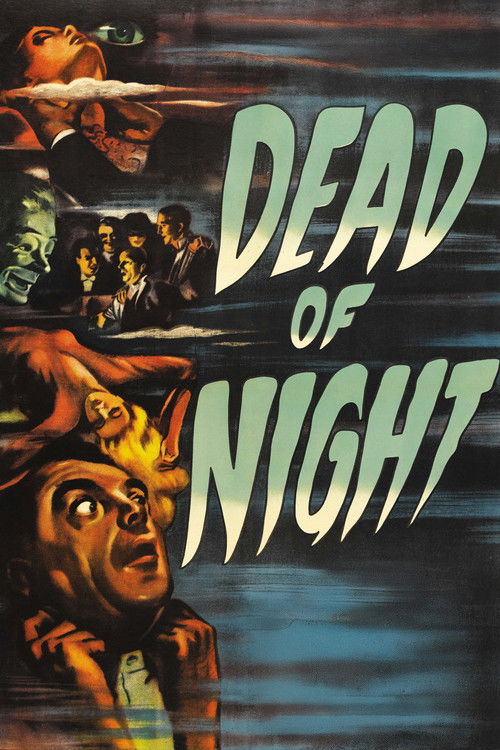
Dead of Night
1945 · Charles Crichton
When you're craving a proper old-fashioned scare — fireside ghost stories with real teeth. Cozy in its trappings, unsettling in its effect; ideal for a dark night with the phone off.
What it's about
An architect drives out to an English country house on a routine job and realizes, with growing dread, that he has seen this house, these guests, and this afternoon before — in a recurring nightmare he can never finish. As a skeptical psychiatrist tries to explain it all away, the assembled guests pass the time by telling their own brushes with the supernatural: a premonition, a haunted mirror, a ghost story, a round of golf with an afterlife complication, and a ventriloquist whose dummy seems to have a will of its own. The stories keep tightening the knot of the frame around him.
The experience
A slow, creeping unease that builds tale by tale, punctuated by one genuinely comic interlude, and then turns the screws hard in the final stretch. The ventriloquist episode remains truly disturbing eighty years on, and the whole thing has a bad-dream logic that lingers after the lights come up.
Performances
Michael Redgrave, as the ventriloquist coming apart at the seams, gives one of the great horror performances — a portrait of a man losing the border between himself and his dummy that is painful to watch in the best way.
The craft
An anthology made at Ealing Studios by four directors, its episodes shift register from droll to nightmarish while the linking story keeps its grip, and the black-and-white photography turns a sunny farmhouse into something quietly wrong. The construction of the frame — the way the stories feed the architect's dread — is the real feat of writing and editing.
Why it matters
It set the template for the horror anthology film and made the malevolent ventriloquist's dummy a permanent genre fixture; decades of portmanteau horror and killer-doll stories descend from it.
Snapshot
An architect named Walter Craig drives down to a farmhouse in Kent to discuss some alterations, and finds that he has been there before — not in life, but in a dream he has had many times and can never quite finish. The other guests are strangers he already knows. He knows what they will say. He knows, with rising nausea, that the dream ends badly. To pass the afternoon they tell ghost stories; a skeptical psychiatrist, Dr. van Straaten, offers rationalizations; and the frame closes on Craig exactly as he feared it would, then opens again on the same drive down to the same house.
A note on attribution is necessary at the outset. Dead of Night is a portmanteau, and Charles Crichton directed only one of its five tales — the comic "Golfing Story." The linking narrative and the "Hearse Driver" episode are Basil Dearden's; "The Christmas Party" and "The Ventriloquist's Dummy" are Alberto Cavalcanti's; "The Haunted Mirror" is Robert Hamer's. The film is properly a collective work of the Ealing Studios ensemble under Michael Balcon, and its coherence — which is remarkable, given four directors and at least three principal writers — comes from the studio system that produced it rather than from a single hand.
It is the most influential British horror film made before Hammer, and one of the few films of the 1940s whose formal design has outlived its scares.
Industry & production
Ealing in 1945 was not a horror studio. Under Balcon it had spent the war making pictures of national purpose — Went the Day Well?, San Demetrio London, The Foreman Went to France — in a house style shaped by documentary personnel and a rhetoric of collective effort. The comedies that would define the studio's reputation had not yet arrived; Hue and Cry, directed by Crichton, was still two years off. Dead of Night sits in the gap, and its production reflects a studio with a repertory company of directors, writers and technicians who could be assigned to a compound project and trusted to converge.
The immediate industrial context is the collapse of the British horror film during the war. The BBFC had introduced the restrictive "H" certificate in the 1930s, and wartime conditions — a mixture of official discouragement, import restriction and the sense that atrocity did not need dramatizing — effectively suspended domestic production in the genre. Dead of Night, which carried the "H", was among the first British films to reopen it, arriving in British cinemas in September 1945, within weeks of the war's end.
Balcon produced, with Sidney Cole and John Croydon as associate producers. The screenplay is credited to John Baines and Angus MacPhail, with additional dialogue by T. E. B. Clarke, later the studio's great comic screenwriter. Baines supplied the two strongest original conceits — the mirror and the dummy. Two of the remaining tales are literary adaptations: the "Hearse Driver" derives from E. F. Benson's short story "The Bus-Conductor," and the "Golfing Story" from H. G. Wells's "The Story of the Inexperienced Ghost." "The Christmas Party" draws on the Road Hill House murder of 1860, the killing of the child Francis Saville Kent, a case that had already passed into English true-crime folklore.
Universal handled the American release in 1946 and cut the film substantially, dropping the golfing episode and the Christmas party and reducing the running time by roughly a quarter. American audiences for a generation therefore saw a tighter, humorless, and arguably lesser film — a distribution decision that has shaped its critical reputation on both sides of the Atlantic in different ways.
Technology
The film is a conventional black-and-white 35mm Academy-ratio production shot on nitrate stock at Ealing, and its technical interest lies almost entirely in effects achieved in camera and in performance rather than in laboratory work. There is no process innovation to claim here, and it would be false to invent one.
"The Haunted Mirror" is the exception worth dwelling on: a mirror that reflects not the modern bedroom in front of it but a candlelit Jacobean chamber, and eventually a husband who exists only in the reflection. The classic studio solution to this problem — an empty frame with a reversed duplicate set built behind it, staged so that doubles and blocking supply what a real reflection cannot — is what the sequence appears to use, though the precise on-set method is not thoroughly documented in the standard production accounts, and I will not pretend otherwise. What matters is that the illusion is spatial and photographic rather than optical: the audience is looking through a hole in the wall and being asked to believe it is a mirror, and the trick holds because the staging never cheats the geometry.
The dummy Hugo is likewise a practical achievement — a puppet, a performer's voice, and editing. No mechanism does the work.
Technique
Cinematography
Two credited lighting cameramen, Stan Pavey and Douglas Slocombe, divided the film. Slocombe was near the beginning of a career that would run through Kind Hearts and Coronets and The Servant to Raiders of the Lost Ark, and the film's most striking lighting — the low-key nightclub interiors and hard-edged close-ups of the ventriloquist episode — belongs to the modern, continental end of the studio's visual range.
The governing strategy is a gradient. The frame story begins in flat, even, almost documentary daylight: a farmhouse sitting room, teacups, weather. As Craig's dread accumulates the lighting tightens and lowers, shadows lengthen across the group, and the final movement abandons naturalism outright for a delirium of canted angles, glaring keys and impossible spaces. The film teaches the viewer that ordinary English light is safe and then removes it.
Editing
Charles Hasse cut the picture, and the editing carries the film's central formal argument. Transitions into each tale are soft — dissolves, a face held while a voice takes over — so that the anthology never feels like a series of blackouts. The last ten minutes reverse this entirely: Craig's nightmare is assembled as an accelerating montage that raids every preceding story, dropping him into the mirror's Victorian bedroom, into a prison cell with Hugo, into the hands of figures he has just heard described. The cut becomes the mechanism of the horror. It is a set piece of associative montage more characteristic of the European avant-garde than of Ealing, and it is Cavalcanti's temperament showing through.
Mise-en-scène / staging
Michael Relph's art direction gives Pilgrim's Farm a specific, unglamorous solidity — beams, chintz, a fireplace — and the film's method is to make that solidity claustrophobic by repetition. The group is repeatedly staged in a closed circle of chairs; Craig is repeatedly the odd point outside it. The tales themselves are staged with deliberate variety of register: the mirror episode in deep, furnished domestic space; the golfing story in bright, open comic exteriors; the ventriloquist story in cramped dressing rooms and hotel bedrooms where the dummy is almost always in the frame, often in the foreground, often nearer the camera than the man who operates him.
Sound
The score is by Georges Auric, a member of Les Six and shortly to write for Cocteau's La Belle et la Bête — an unexpectedly modernist appointment for a British studio, and a signal of Ealing's willingness to import continental sensibility. Auric's contribution is discriminating rather than continuous: several passages are unscored, and the film's most frightening moments are quiet ones.
Two sound effects do disproportionate work. The first is a line of dialogue — the hearse driver's "Just room for one inside, sir," repeated later by a bus conductor in a completely different register, so that a phrase becomes a death sentence by recurrence. The second is Hugo's voice, which Michael Redgrave produces and which the film's sound perspective refuses to help us locate: it comes from the right place in the room whether or not Frere's lips are moving.
Performance
Mervyn Johns plays Craig as a mild, tired, deeply embarrassed man — the horror registers as social awkwardness before it registers as terror, which is very English and very effective. Frederick Valk, a Central European émigré actor, gives van Straaten a heavy, patient authority that makes the rationalist position genuinely formidable rather than a straw man. Googie Withers anchors the mirror episode as a woman watching her husband become someone else. Basil Radford and Naunton Wayne, transplanted from the Charters-and-Caldicott persona they had built with Hitchcock's The Lady Vanishes, supply the comic relief.
The performance everyone remembers is Redgrave's. His Maxwell Frere disintegrates in stages — charm, then evasion, then jealousy, then collapse — and the choice that makes it great is that Redgrave never plays possession as external. Hugo is not an entity; Hugo is the part of Frere that gets to speak. It remains among the most admired portrayals of dissociation in English-language cinema.
Narrative & dramatic mode
The film's structure is its argument. The five tales are graded — a premonition, a haunting, a marital possession, a farce, a psychological catastrophe — and interleaved with a frame that is itself a sixth story, slowly revealed to be the one that contains and consumes the others. Craig's dread is the audience's: he knows the shape of what is coming and cannot alter it.
Two moves distinguish this from ordinary anthology practice. The first is the frame's escalation. Most portmanteau films use a frame as a clothesline; here the frame is the dramatic engine, tightening between episodes, and the comic golfing story is placed precisely to relieve tension before the last, worst tale. The second is the coda: the nightmare montage dissolves the boundary between frame and inset entirely, and then the film resets to its opening shot, the telephone ringing with the same invitation. The loop is not a twist but a cosmology. Nothing is escaped; everything recurs.
That circularity has an afterlife outside cinema. The cosmologists Fred Hoyle, Hermann Bondi and Thomas Gold are frequently reported — Hoyle himself told the story — to have taken the film's closed structure as the prompt for their steady-state model of the universe, conceived in the late 1940s. It is an anecdote rather than a documented derivation, but it indicates how legible the film's form was to its first audiences.
Genre & cycle
Dead of Night is the founding modern instance of the horror anthology as a commercial form. It did not invent the portmanteau — Weimar cinema had Unheimliche Geschichten and Paul Leni's Waxworks — but it established the template that the English-language genre would use for forty years: a frame, an assortment of tones, a sting.
Generically it belongs to the quiet English ghost story rather than to the Gothic. Its monsters are furniture, a face in a mirror, a child on a staircase, a wooden head. The mode is M. R. James and Benson: irruption into the domestic and the mundane, with the supernatural licensed but never quite confirmed. Van Straaten's presence keeps the psychiatric reading permanently available; the film's tension between diagnosis and haunting is unresolved by design.
Authorship & method
The film is a useful test case for auteurist reading, because its four directors are visibly themselves. Cavalcanti — Brazilian-born, formed in the French avant-garde of the 1920s with Rien que les heures, then in Grierson's GPO Film Unit — contributes the two episodes with the strongest formal signature and the darkest psychology. Hamer, who would make Kind Hearts and Coronets four years later, brings a cool interest in respectable people harboring something appalling. Dearden, the studio's most reliable craftsman and later the director of The Blue Lamp and Victim, handles the connective tissue and its steady escalation. Crichton, the future director of The Lavender Hill Mob and, forty years on, A Fish Called Wanda, takes the comedy.
Around them the collaborators matter as much: Baines and MacPhail's scripts, Clarke's dialogue, Auric's score, Hasse's cutting, Relph's sets, Slocombe and Pavey's light. The method is studio method — a pool of specialists, a producer imposing coherence, individual temperament expressed within a shared idiom rather than against it.
Movement / national cinema
British cinema in 1945 was pulled between the realist-documentary tradition that dominated wartime prestige production and the fantastical strand emerging around Powell and Pressburger, whose A Matter of Life and Death would arrive the following year with its own architecture of dream and adjudication. Dead of Night is the point where those tendencies meet: documentary-trained personnel, naturalistic playing and unglamorous interiors deployed to make the irrational feel procedural.
It also belongs to Ealing's brief, largely forgotten dark period, alongside Cavalcanti's They Made Me a Fugitive (made after he left the studio) and Hamer's It Always Rains on Sunday — a strain of postwar unease that the studio's comedies would soon overwrite in the national memory.
Era / period
The film was released into an England that had just stopped being at war and had not yet begun to feel relieved. Mass bereavement had produced, as after 1918, a measurable revival of spiritualism; the anxiety about premonition, about the dead who arrive to warn or to collect, is not decorative. Craig's condition — a man trapped in a recurring nightmare of violence he cannot prevent himself committing — reads plainly as a portrait of the traumatized, and the film's refusal to let him wake into safety is its most contemporary gesture.
The country house setting carries the period's other question. Pilgrim's Farm is a leisured world of weekend guests and professional men that the 1945 election had just placed under notice. The film does not editorialise, but it does dissolve that world into hysteria.
Themes
Repetition and the closed circuit. The film's deepest subject is compulsion — the dream that restarts, the phrase that returns, the story that has always already happened.
The rationalist's failure. Van Straaten explains everything and prevents nothing. His spectacles break at the decisive moment: the instrument of clear sight fails, and the dark arrives.
The divided self. Frere and Hugo are the film's clearest figure, but the mirror episode is the same idea in domestic form — a husband displaced by a version of himself that belongs to another century.
Domestic contamination. Every horror enters through an ordinary object or occasion: a wedding present, a party game, a lift home, a stage act.
Fatalism. Foreknowledge confers no power. The film's ethics are those of the ghost story rather than the thriller.
Reception, canon & influence
Contemporary British notices were broadly favourable, with the usual anthology complaint that the parts were uneven — the golfing episode has always been the most criticized, and the ventriloquist and mirror stories the most praised. The film's reputation grew steadily rather than instantly, helped by the fact that Ealing's subsequent identity made it an anomaly worth discussing. It is now routinely treated as the outstanding British horror film of its decade and appears regularly on canonical lists, including Martin Scorsese's frequently reproduced roster of the scariest films ever made.
Backward. The film inherits from the Weimar portmanteau tradition and from expressionist lighting via Cavalcanti's continental formation; from the English literary ghost story of James, Benson and Wells; from the documentary movement's insistence on ordinary surfaces; and, for the dummy, from a small existing screen tradition — The Great Gabbo (1929), with Erich von Stroheim, had already put a ventriloquist's madness on film.
Forward. Its influence runs along three lines. The first is structural: Milton Subotsky repeatedly named Dead of Night as the model for the Amicus anthologies that dominated British horror in the 1960s and 70s — Dr. Terror's House of Horrors, Torture Garden, Asylum, Tales from the Crypt — and through them for the television and film anthology tradition that followed, from Night Gallery to Creepshow. The second is iconographic: Hugo established the evil-dummy image as a durable genre property, visible in The Twilight Zone's "The Dummy," in Devil Doll, in Richard Attenborough's Magic, and onward. The third is formal: the ouroboros ending, in which the narrative reveals itself as a closed loop with no exterior, became one of the standard architectures of modern uncanny cinema, and remains the reason the film still unsettles audiences who find its individual ghosts quaint.
Eighty years on, the tales have aged at different rates. The structure has not aged at all.
A Deleuzian reading
A car comes down a lane in Kent.
The full Deleuzian reading of Dead of Night →
Reception
Released just as Britain lifted its wartime ban on horror films, it landed as a startling one-off from cozy Ealing — and it's only grown since, now routinely cited as the granddaddy of anthology horror and one of the greatest British films of any genre.
How Dead of Night was received, from release to now →
How to watch Dead of Night: what to notice on a first viewing
- Watch how the guests circle the room, with Craig outside it. The group is repeatedly staged in a closed circle of chairs, and Craig is consistently the odd point standing apart from it. The staging keeps marking him as someone already outside the group's ordinary time.
- Notice how flat and ordinary the daylight looks at the very start. The frame story opens in even documentary daylight, then the lighting tightens and lowers as Craig's dread accumulates through the afternoon. The film teaches you that ordinary English light is safe, then slowly takes it away.
- Listen for a line of dialogue that returns in a different voice. A hearse driver's warning gets repeated later by a bus conductor in a completely different, cheerful register. The same four words become a death sentence just by showing up in the wrong place.
- Watch where the dummy sits relative to the man working it. Hugo is almost always in the frame, often in the foreground, nearer the camera than the performer who supposedly controls him. The framing quietly gives the object more authority in the shot than the man holding it.
- Watch the haunted mirror for what it shows instead of a reflection. The mirror displays a candlelit Jacobean room with its own history rather than the modern bedroom actually in front of it. A reflection is supposed to show you the present. This one shows you someone else's past instead.
The whole guide to watching Dead of Night, with the keys for a rewatch →
Influences: the films it descends from and the films it influenced
- The Cabinet of Dr. Caligari (1920) — Establishes the retroactive frame reveal — a closing return to the asylum that re-reads every preceding image as the narrator's delusion — the structural move Dead of Night radicalizes by removing the frame's exterior entirely.
- Waxworks (1924) — The Weimar portmanteau blueprint: a hired writer's commission generates episodes of ascending stylization until the frame itself collapses into the nightmare of the final tale, exactly the escalation Dearden's linking material reproduces.
- The Student of Prague (1926) — In-camera mirror doubling with a reflection that acquires autonomous will and blocking — the direct staging ancestor of Hamer's reversed-set episode, where the mirror shows a room built as its own left-right inversion.
- Rien que les heures (1926) — Cavalcanti's own avant-garde grammar of associative dissolve-montage over ordinary city surfaces, imported wholesale into the soft transitions that carry the film from Pilgrim's Farm naturalism into delirium.
- Night Mail (1936) — Cavalcanti's GPO sound supervision — verse cadence and score cut against documentary image as rhythmic motif — is the technique behind the recurring spoken refrain ('room for one more, sir') that detonates across two separate levels of the narrative.
- The Great Gabbo (1929) — Von Stroheim's ventriloquist gives the screen its first split-voice performance grammar, the dummy speaking what the man has disowned; Redgrave inherits the device and plays the switch as involuntary rather than theatrical.
- Flesh and Fantasy (1943) — The immediate supernatural-portmanteau model: a club-room frame of skeptical gentlemen, tales elicited to answer the skeptic, and a prophecy-fulfilment logic in which the telling causes the event.
- The Halfway House (1944) — Ealing's dry run with the same production pool and the same Mervyn Johns: strangers assembled at a country house who are gradually revealed to be inside a ghost story rather than merely hearing one.
- The Queen of Spades (1949) — Georges Auric again scores an English-language ghost film, and the same low-key gradient operates: meticulously naturalistic period surfaces degraded shot by shot into subjective hallucination and a card-table death.
- Black Sabbath (1963) — Bava treats the host-wraparound as the film's real subject, ending with a pull-back that exposes Karloff on a prop horse amid wind machines — the frame-as-trap converted into frame-as-exposed-apparatus.
- Devil Doll (1964) — A near-transcription of the Hugo episode down to the dummy's name: stage ventriloquist, autonomous wooden partner, and the act built so the audience cannot locate which mouth is speaking.
- Dr. Terror's House of Horrors (1965) — Subotsky's declared template — strangers sealed in a train compartment, tales elicited by a stranger who reads them, and a closing reveal that the frame's occupants were dead before the first story began.
- Repulsion (1965) — Extends the naturalism-to-delirium gradient into a single apartment: documentary-flat domestic space progressively warped through mirrors, reversed geography and a recurring aural motif that punctures the realist surface.
- Asylum (1972) — Perfects the escalating-frame device by making the interviewer's own frame the final story — the doctor auditioning the inmates' tales becomes the last case, so the container is consumed by its contents.
- Magic (1978) — Hopkins builds the part directly on Redgrave's dissociation method — the dummy's voice produced as an intrusive second personality rather than a trick — and Attenborough shoots the two-shot to deny us a cut that would separate them.
- The Shining (1980) — The ouroboros ending as a photograph: a final image proving the protagonist was always already inside the loop, the same closed-circle revelation Dead of Night delivers with a ringing telephone.
- Ghost Stories (2017) — Openly rebuilds the architecture — a professional skeptic collects three tales, each interrogation escalating the frame, until the wraparound is revealed as his own self-generated loop with no waking exterior.
- Oddity (2024) — Its ventriloquist-dummy episode is the foundational template for the uncanny effigy as the film's single indelible horror image — a man-shaped object whose stillness and ambiguous agency carry the fear, exactly the role Oddity gives its wooden man.
- Identity (2003) — Frames fractured identity through a psychiatric encounter and dramatizes the ventriloquist's-dummy split self, prefiguring Identity's framing device of a doctor litigating one mind's personalities.
- The Saragossa Manuscript (1966) — A portmanteau of nested tales sealed by a looping frame that folds the ending back into its opening — the same closed-circuit, eternally-restarting structure Potocki's manuscript enacts.
- Kind Hearts and Coronets (1949) — Hamer repeats the closed-circle architecture in comic register — a memoir composed in the condemned cell whose final shot returns to the dropped manuscript, snapping the frame shut on its own narrator.
Similar films
- The Cabinet of Dr. Caligari (1920) — influence & lineage
- The Shining (1980) — influence & lineage
- Night of the Demon (1957) — shared sensibility
- Late Night with the Devil (2024) — shared sensibility
- Hour of the Wolf (1968) — shared sensibility
- Hokum (2026) — shared sensibility
- Night of the Living Dead (1968) — shared sensibility
- Oddity (2024) — shared sensibility