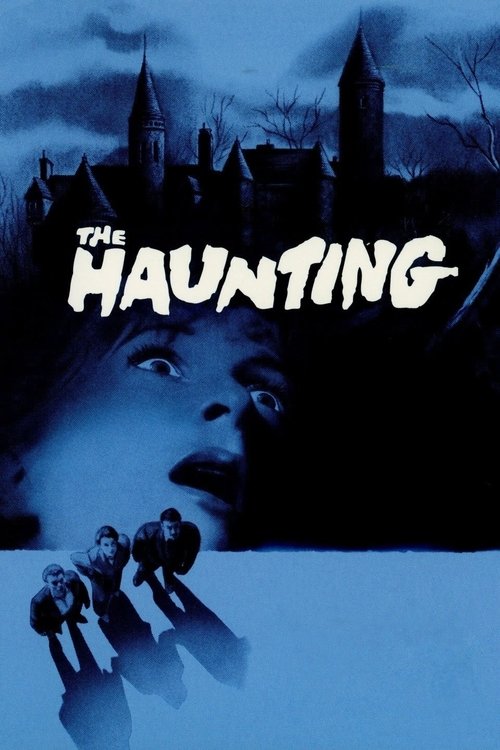
The Haunting
1963 · Robert Wise
For when you're craving a real scare built from atmosphere and suggestion rather than gore — lights off, sound up. It demands a little patience and pays it back with dread that follows you to bed.
What it's about
A researcher into psychic phenomena invites a small group to stay in Hill House, a New England mansion with a sinister history, under cover of a scientific study. Among them is Eleanor, a lonely woman who has spent her life caring for her invalid mother and has nowhere else to go. Over a few nights the house makes itself known — through sound, cold, and its own wrong-angled architecture — and it seems to take a particular interest in her.
The experience
One of the most purely frightening films ever made without showing a single ghost: the terror is all pounding doors, breathing walls, and what the camera suggests. It's slow-burning and psychologically intimate, and the scariest scenes are also the saddest.
Performances
Julie Harris is devastating as Eleanor, playing loneliness so raw that the house's attention feels almost like a seduction. Claire Bloom gives Theodora a sly, worldly edge that keeps the human tension as alive as the supernatural kind.
The craft
Robert Wise shoots the house in black-and-white anamorphic widescreen with distorting lenses and off-kilter angles that make the architecture itself feel hostile, and the sound design — knocks, whispers, silence — does the work most films leave to monsters. Adapted from Shirley Jackson's novel, it keeps her masterstroke: the haunting may be in the house, or in Eleanor's head.
Why it matters
Widely held up as the gold standard of the haunted-house film and the proof that suggestion can out-scare any effect; generations of horror filmmakers cite it as the scariest film they know. It fixed Jackson's novel in the culture and remains the template its many successors are measured against.
Snapshot
The Haunting is Robert Wise's adaptation of Shirley Jackson's novel The Haunting of Hill House (1959). An anthropologist with an interest in psychic phenomena, Dr. John Markway, brings a small group to stay in a notorious New England mansion. Two of them are women chosen because they have a history of paranormal experience: Eleanor "Nell" Lance, a lonely woman who spent her adult life nursing her invalid mother, and Theodora, a worldly and sharp-tongued psychic. They are joined by Luke Sanderson, the flippant heir to the house. Over a few nights the house shows its hostility through sound, cold, and the uncanny shape of its architecture, and it seems to choose Eleanor as its own.
The film was made by MGM in England in black-and-white anamorphic widescreen. It is known for showing almost no ghost at all. The fear comes from pounding on walls, a door that seems to bulge inward, patterns in wallpaper and carving that look like faces, and Eleanor's anxious inner voice heard in voiceover. Its first reviews were mixed. Its reputation has risen steadily since, and it is now widely treated as a central text of the "haunted house" film. It is also a key example of the argument that suggestion is more frightening than showing.
Industry & production
The film was produced through Argyle Enterprises, Wise's production company, and released by Metro-Goldwyn-Mayer. Wise made it between West Side Story (1961) and The Sound of Music (1965), the two big musicals that defined his commercial standing in the decade. It was a much smaller project, and the record suggests Wise pursued it out of personal attachment to Jackson's novel and to the genre where he had started as a director.
Shooting took place in England at MGM's British studios in Borehamwood. British production at the time offered financial advantages to American studios, and the location also allowed a largely British cast and crew. Ettington Park, a Gothic Revival house in Warwickshire, served as the exterior of Hill House. The interiors were built as studio sets. So the film's "New England" is assembled from an English country house and soundstage construction, a mismatch the film never needs to hide because its geography is psychological rather than regional.
Nelson Gidding, who had written I Want to Live! (1958) for Wise, wrote the screenplay. Gidding later said that his early interpretation read Eleanor's experience as a mental breakdown, and that Jackson, when consulted, made clear that she had intended a supernatural story. The finished film keeps both readings open, much as the novel does. Budget and box-office figures are not reliably documented in sources I can verify, and are left out here.
Technology
The film's most discussed technical choice concerns the lens. Wise and cinematographer Davis Boulton shot in Panavision's anamorphic widescreen format. Wise later recounted that he asked for an unusually wide-angle anamorphic lens, around 30mm, which Panavision considered not ready for use because of its barrel distortion at the edges of the frame. According to Wise's account, he accepted the distortion in writing and used it on purpose. The bowed verticals and the stretching of rooms near the edges of the frame make Hill House look subtly "wrong", which fits Jackson's description of a house built without true angles.
The film is in black and white. By 1963 that was becoming a deliberate stylistic choice for prestige features rather than a default. Some accounts say infrared film stock was used for certain exterior shots of the house, which helps explain the strange, high-contrast look of the façade against the sky. The extent of its use is not fully documented. The sets were reportedly built with ceilings so that low camera angles could take in whole rooms, which was uncommon in studio construction of the period.
Technique
Cinematography
Davis Boulton's photography is built on deep shadow, steep angles, and a camera that moves as if it were a presence in the house. Low angles combine with the wide lens to make doorways, statues, and the library's spiral iron staircase loom and lean. Exteriors of the house are often framed from below so that its windows look like eyes, an effect Eleanor's narration invites. The camera often prowls or tilts across walls and ornament, encouraging the viewer to read faces into carved wood and patterned paper. That habit of seeing is the film's main source of fear.
Editing
Ernest Walter edited the film. Wise had been an editor himself, on Orson Welles's Citizen Kane (1941) and The Magnificent Ambersons (1942), and his films are usually precise in their cutting. The Haunting builds tension through duration rather than shock. The pounding sequences hold on the women's faces and on the door as the noise grows, cutting only to the source of the threat, which is never revealed. The prologue's account of Hill House's history is compressed into a brisk montage with narration. It sets up the deaths tied to the house, including the carriage crash at the tree in the drive and the hanging in the library tower, as patterns the ending will repeat.
Mise-en-scène / staging
Elliot Scott's production design gives Hill House a crowded Victorian interior. The rooms are full of statuary, mirrors, heavy drapery, and dense ornament, and the eye keeps finding apparent faces and figures in them. The rooms feel off-balance, and their spaces seem to shift. The set pieces are spatial: the corridor where something presses against the door; the nursery with its cold spot; the library's rickety spiral staircase, which Eleanor climbs in the climax; and the dining room and parlour, where the four characters perform a strained sociability. Claire Bloom's wardrobe is credited to Mary Quant. It gives Theodora a modern, chic look that sets her apart from Eleanor's dowdy clothes, and so from the past the house stands for.
Sound
Sound may be the film's most important tool. The haunting is mostly heard rather than seen: booming, rhythmic knocking that moves along the corridors; muffled voices and laughter; a sound that might be a child crying. In the best-known sequence, Eleanor lies in the dark gripping what she believes is Theodora's hand while a voice murmurs on the other side of the wall. When the lights come up she sees Theodora across the room and realises that someone else was holding her hand. The scene depends on sound and offscreen space. Humphrey Searle, a British composer known for serial and twelve-tone concert music, wrote a sparse, dissonant score that is used sparingly, leaving room for the effects and for silence. Eleanor's whispered interior monologue adds a further layer, so that much of the film is heard from inside her head.
Performance
Julie Harris plays Eleanor with nervous, hungry intensity. The character is eager to belong, quick to take offence, and increasingly convinced that the house wants her. The voiceover lets Harris play two registers at once: the timid outward manner and the strained, sometimes grandiose inner voice. Claire Bloom's Theodora is cool, perceptive, and teasing. Under the constraints of the Production Code, the film codes her as lesbian through her attention to Eleanor and her mockery of Eleanor's feelings for Markway. Richard Johnson's Markway is a rational, well-meaning investigator whose authority proves useless. Russ Tamblyn's Luke is a cynic whose jokes give way to fear. Rosalie Crutchley's brief turn as the housekeeper Mrs. Dudley, with her flat recital of the house rules about what happens "in the night, in the dark," is among the film's most quoted moments. Fay Compton and Lois Maxwell, as Markway's sceptical wife Grace, have supporting roles.
Narrative & dramatic mode
The film follows the novel's structure closely. A prologue gives the house's history. Eleanor escapes from a dependent life. The group arrives and settles in. A series of nightly disturbances gets worse. The house appears to possess Eleanor, and she dies in a car crash at the same tree that killed the first Mrs. Crain. Markway's narration frames the opening and Eleanor's voice frames the end. Her closing words echo the house's long history and the novel's last line, putting her inside the house's story for good.
The mode is ambiguous psychological horror. The film never settles whether the house is truly haunted, whether Eleanor's fragile mind is projecting onto it, or whether the two reinforce each other. That ambiguity comes from Jackson, but the film's form strengthens it. Because it shows no apparitions, every event can be read as either psychic or supernatural. Its drama is as much social as spectral: a lonely woman tries to find a place among strangers, is accepted and rejected in turn, and finally finds a "home" that consumes her.
Genre & cycle
The Haunting belongs to the haunted-house tradition, which runs from literary Gothic through films such as The Uninvited (1944) and William Castle's House on Haunted Hill (1959). It rejects the gimmicks and visible ghosts of the latter. Its closest contemporary relative is Jack Clayton's The Innocents (1961), also a British-made black-and-white widescreen adaptation of a prestigious ghost story (Henry James's The Turn of the Screw), also built on ambiguity and a woman's unreliable view. Together the two films are often treated as the high point of the restrained, literary ghost film in the early 1960s. That is the same moment when Hammer's colour Gothic and Roger Corman's Poe cycle were pushing horror toward lurid spectacle, and when Psycho (1960) was turning it toward contemporary psychological terror.
Authorship & method
Robert Wise began directing at RKO under producer Val Lewton, co-directing The Curse of the Cat People (1944) with Gunther von Fritsch and directing The Body Snatcher (1945). Lewton's unit was known for suggestion: horror through shadow, offscreen sound, and the unseen. The Haunting is widely read as Wise's return to that approach with far greater resources. Wise is often described as a versatile craftsman rather than a stylist with a personal signature, since his career spans noir, science fiction, the war film, the social-problem drama, and the musical. The Haunting is one of the films most often cited against that view, because its approach is so consistent and so carefully worked out.
Nelson Gidding (screenplay) kept much of Jackson's structure and a great deal of her dialogue and interior voice. He changed Eleanor's surname from Vance to Lance, gave Markway a more conventional dramatic role, and made the Grace Markway subplot more prominent. Davis Boulton (cinematography) was a British cameraman whose work here is his best known. Humphrey Searle (music) brought a modernist concert composer's vocabulary to a studio picture. Ernest Walter (editing) and Elliot Scott (production design) were MGM-British regulars. Shirley Jackson, as author of the source, is in many ways the film's second creator. Its ambiguity, its focus on Eleanor, and its picture of the house as a living organism all come from the novel.
Movement / national cinema
The film is an American studio production with an American director, an American lead, and an American setting. It was made entirely in Britain with largely British personnel, as one of the "runaway" productions Hollywood studios were basing in British facilities in the 1950s and 1960s. It belongs to no national movement as such. Its look and pacing sit between the classical Hollywood tradition Wise was trained in and the British literary-Gothic manner of The Innocents. Its supporting cast, especially Crutchley, Compton, and Valentine Dyall as Mr. Dudley, gives the "New England" house an unmistakably British strangeness.
Era / period
The film appeared at the end of the classical studio era. The Production Code was still in force but weakening, and widescreen had become standard for major features. Black and white was fast becoming a deliberate stylistic choice. Theodora's sexuality could only be implied, and the film implies it fairly clearly for its time. It is a key early example of 1960s horror centred on women's psychology, alongside Psycho, The Innocents, and later Repulsion (1965). In these films, women's isolation, repression, and instability become the place where horror happens. Eleanor's escape from years of caregiving, and her yearning for independence and connection, place the film in a period that was beginning to examine women's domestic confinement.
Themes
- The house as psyche and organism. Hill House is treated as a living, malevolent body. Its architecture is "diseased," and it reflects back Eleanor's own longing and fear.
- Belonging and loneliness. Eleanor's desire to be wanted drives the tragedy. The house offers the acceptance that people withheld from her, and the cost is her life.
- Guilt and the mother. Eleanor's guilt over her mother's death, including whether she ignored her mother's knocking on the wall, recurs in the pounding in the house. This ties the haunting to her past.
- Reason versus the unknown. Markway's scientific framework gives no protection, and Grace's flat scepticism is answered by her own terror.
- Repressed and coded desire. Theodora's attraction to Eleanor and Eleanor's crush on Markway create a tense triangle. Desire is spoken through implication, which suits a film about what lies beneath surfaces.
- The unseen. The film's central argument is about form: what is not shown is more frightening than what is.
Reception, canon & influence
Critical reception. Contemporary reviews were mixed. Some reviewers admired its atmosphere and craft, while others found it slow, overwrought, or too indirect. The precise wording and sources of individual reviews are not reliably available to me, so I do not quote them. Its standing grew over the following decades through television showings, home video, and critical reappraisal. It became a standard reference in discussions of psychological horror and of the ghost story on film. Martin Scorsese has named it among the scariest films ever made, putting it at the top of a widely circulated list of his favourite horror films. Writers on the genre routinely pair it with The Innocents as a model of restraint.
Influences on the film (backward). The most direct influence is Jackson's novel, often called one of the great American ghost stories of the twentieth century. Next is the Val Lewton tradition of suggestion that formed Wise as a director. The wider literary Gothic and the Henry James tradition of the ambiguous ghost story stand behind both, and earlier haunted-house films such as The Uninvited are part of its background.
Legacy (forward). The Haunting helped set the conventions of the investigative haunted-house film: a scientist and a team of sensitives spend set nights in a notorious house, and the house is a malign entity rather than the home of a single ghost. Later films in that form, such as The Legend of Hell House (1973, from Richard Matheson's novel) and The Changeling (1980), are often discussed in its line. Its approach of withheld spectacle and its central sequences, the pounding at the door and the hand in the dark, are frequently cited as models by later directors of quiet horror. Specific claims of direct influence on individual later films are, however, usually critics' inferences rather than documented testimony. The novel was adapted again by Jan de Bont as The Haunting (1999), a big-budget effects film widely judged a failure. The comparison is often used to illustrate the original's restraint. Mike Flanagan's Netflix series The Haunting of Hill House (2018) reimagined the material at length, which shows the continuing cultural reach of both Jackson's novel and Wise's film. Wise's version remains the main screen interpretation of the novel and a lasting example of horror built from sound, space, and suggestion.
Influences: the films it descends from and the films it influenced
- Cat People (1942) — Lewton's unit invented the offscreen-sound scare (the 'bus' cut, the unseen presence in the swimming-pool sequence), the grammar Wise scales up into the unseen pounding along Hill House's corridor.
- The Curse of the Cat People (1944) — Wise's first directing credit, under Lewton, treats a lonely female protagonist's inner life as the source of the supernatural, so you can't tell whether the ghost is real or a fantasy, the same ambiguity he gives Eleanor.
- The Uninvited (1944) — Hollywood's first serious haunted-house film builds dread from cold spots, sobbing heard offscreen and a coded-lesbian figure tied to the dead woman, a template for Theodora's charged watchfulness and the house's audible presence.
- Rebecca (1940) — A timid, unnamed heroine's interior voiceover, a house that dominates her through looming architecture, and a coded-lesbian antagonist (Mrs Danvers): together the model for Eleanor's monologue and Hill House's possessive pull.
- The Innocents (1961) — A British-shot black-and-white scope ghost story: Freddie Francis's deep-focus CinemaScope frames and an experimental electronic sound design keep the ghosts ambiguous, possibly the projections of a repressed woman. It is the film The Haunting is always paired with as a model of restraint.
- The Magnificent Ambersons (1942) — Wise, having edited Ambersons under Welles, transposed its ceilinged-set wide-angle deep-focus system directly into horror — Hill House's architecture functions exactly as the Amberson mansion does, a domestic space that actively diminishes and distorts its inhabitants through oppressive perspective rather than supernatural event.
- Night of the Demon (1957) — Wise, a Lewton-unit alumnus, builds an entire feature on the un-shown entity — the bulging door, wide-angle spatial distortion, sound as the sole evidence — demonstrating at feature length the withholding Tourneur was denied in the final cut.
- The Queen of Spades (1949) — The purest later application of showing least at the moment of greatest pressure — a bulging door and an isolated pounding on the track, with the house's architecture warped by wide lenses into the same animate antagonist Dickinson made of the Countess's mansion.
- Repulsion (1965) — Gil Taylor's distorting wide lenses and an apartment whose walls physically crack and sprout hands extend Wise's bulging door and warping architecture into a horror of the female psyche told purely through set and lens.
- The Legend of Hell House (1973) — Repeats the investigative formula Wise set down: a scientist and a team of mediums spend fixed nights in a notorious house, and the house itself is the malign agent.
- Burnt Offerings (1976) — Makes the 'devouring home' literal: the house restores itself by consuming its occupants, and a mother is drawn into it the way Eleanor is absorbed into Hill House.
- The Changeling (1980) — Builds its haunting from sound and duration instead of apparitions (rhythmic pounding at dawn, a child's ball bouncing down the staircase), with a lone grieving protagonist in a huge, looming house, in direct line with Wise's offscreen-pounding set pieces.
- The Shining (1980) — Extreme wide-angle lenses that make corridors and ballrooms seem to swallow the figures within them, and a hotel that 'wants' a fragile occupant to stay forever, echo Wise's distorting lens on looming architecture and Hill House's claim on Eleanor.
- The Others (2001) — Restraint in the Lewton–Wise line: thumps and voices from behind closed doors, a heroine whose perceptions can't be trusted, and almost no visible ghosts, with dread sustained through sound and the shut door.
- The Haunting (1999) — A remake of the same novel that makes the house's ornamental faces and moving doors literal CGI animation, the standard counter-example critics use to show why Wise's ambiguous, suggested ornament worked.
- Paranormal Activity (2007) — Swaps shock for duration: long static night takes in which offscreen thuds and a slowly moving door carry the horror, the logic of Wise's long scene of pounding heard behind a closed bedroom door.
- The Night House (2021) — Turns Wise's pareidolic ornament into a method: figures appear in the negative space of doorframes, shelves and room geometry, so the architecture itself seems to have a face.
- A Tale of Two Sisters (2003) — Generates terror almost entirely from sound, off-screen suggestion and a breathing, sentient architecture rather than visible ghosts — the house-as-character method central to the film's design.
- The Sixth Sense (1999) — Wise extends Lewton's suggest-don't-show technique to the architectural ghost film, treating the house's empty rooms and off-screen sound as the scare — the elegant atmospheric reticence Fujimoto and Mondshein reproduce.
- Ring (1998) — Builds terror entirely through withholding, off-screen sound and architectural framing while never showing the supernatural — the scare-via-the-unseen, duration-control method central to Ring's dread.
- Carnival of Souls (1962) — Early-60s horror about a woman's mind in which an isolated protagonist's dissociation drives the haunting, scored with a sinister organ that, like Searle's modernist music, marks her estrangement from the ordinary world.
- The Fall of the House of Usher (1960) — Wide-screen staging of a mansion as a living, decaying organism that feeds on its family's minds anticipates Hill House as a malign entity rather than a home for any single ghost.
- Manichitrathazhu (1993) — Sustains deliberate ambiguity over whether the haunting is supernatural or the projection of a psychologically fragile woman — the interpretive tension that powers Manichitrathazhu's entire mystery.
Similar films
- The Shining (1980) — influence & lineage
- The Innocents (1961) — influence & lineage
- Repulsion (1965) — influence & lineage
- Rebecca (1940) — influence & lineage
- The Conjuring (2013) — shared sensibility
- A Tale of Two Sisters (2003) — shared sensibility
- Insidious (2011) — shared sensibility
- The Birds (1963) — shared sensibility