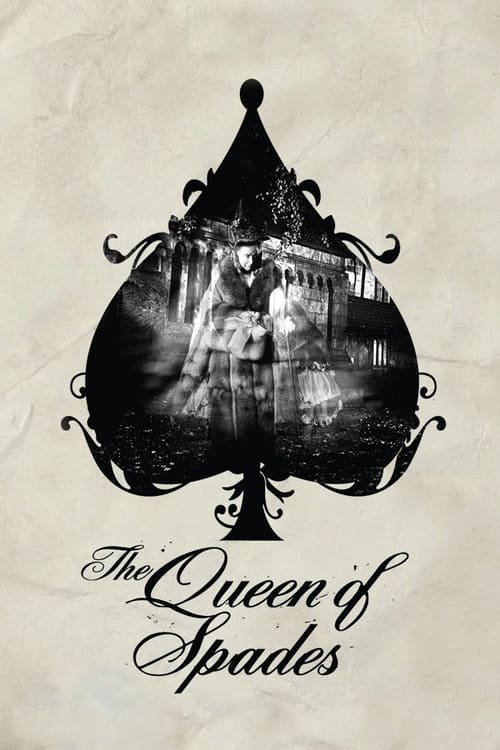
The Queen of Spades
1949 · Thorold Dickinson
For a night of classic gothic chill — when you want atmosphere and creeping dread rather than shocks. Perfect for viewers who love black-and-white horror that works by suggestion.
What it's about
In czarist St. Petersburg, Herman, a poor captain of engineers, watches wealthy officers gamble away fortunes he'll never touch. He becomes convinced that an aged countess holds the secret of three unbeatable cards — bought, rumor says, from the devil in her youth — and he will use anyone, including her lonely young ward, to get it. Obsession shades into something that may or may not be supernatural.
The experience
A slow-building fever — candlelit, whispering, thick with shadow and dread. It plays like a ghost story told in a locked room: elegant on the surface, increasingly suffocating, with an ambiguity that keeps you off balance to the end.
Performances
Anton Walbrook is mesmerizing as Herman, his courtliness curdling into mania by degrees, and Edith Evans — in her return to the screen — makes the ancient countess imperious, pitiable, and genuinely frightening at once.
The craft
Made at emergency notice on modest stages, it conjures Pushkin's Russia through candlelight, mirrors, swooping camera moves, and one of the most expressive soundscapes of 1940s British cinema — rustling silk and wind doing the work of any monster. The result is studio artifice at its most transporting.
Why it matters
A high point of the British cinema's late-1940s boom that fell into neglect and was later rediscovered as one of the finest supernatural films ever made in Britain, championed by directors as a model of suggestion-over-shock horror.
Snapshot
A British studio picture that behaves like a fever dream in a locked room. Adapted from Pushkin's 1834 novella, The Queen of Spades follows Herman Suvorin (Anton Walbrook), an impecunious captain of engineers who watches the Horse Guards gamble away sums he will never earn, and who convinces himself that an aged Countess (Edith Evans) holds a secret sequence of three winning cards, bought from the devil in her Parisian youth. What begins as social envy hardens into monomania, and monomania opens a door onto something that may or may not be supernatural.
The film's reputation rests on a paradox: it is one of the most sumptuously atmospheric films the British industry produced in its late-1940s boom, and it was made by a director who came to it at emergency notice, on modest stages, with sets already built for someone else. It stands with Dead of Night (1945) as the strongest evidence that British cinema in the 1940s had a Gothic imagination fully the equal of its celebrated realist one — a claim that took critics roughly four decades to make out loud.
Industry & production
The film was produced by Anatole de Grunwald for Associated British Picture Corporation and shot at ABPC's smaller Welwyn studios in Hertfordshire. De Grunwald, born in St Petersburg into a Russian diplomatic family and a fixture of wartime British production (French Without Tears, The Way to the Stars), was an apt sponsor for a Pushkin adaptation, and the project carried the prestige-literary ambition characteristic of British production in 1948–49.
Its most-repeated production fact concerns the change of director. Rodney Ackland — the playwright who had co-written 49th Parallel with Emeric Pressburger and had directed Thursday's Child (1943) — co-wrote the screenplay with Arthur Boys and was set to direct. He was removed shortly before shooting, and Thorold Dickinson was brought in at extremely short notice, inheriting Oliver Messel's completed designs and an assembled cast. Accounts vary on the exact interval; the figure usually given is somewhere between a few days and a fortnight. The specifics of the removal — who decided, and on what grounds — are among the genuinely thin parts of the record, and the surviving versions come largely from the participants' own later recollections, which do not entirely agree.
The circumstance matters critically rather than as anecdote. Dickinson had no time to redesign, so he reconceived the film through what he could still control: camera, cutting, sound, and performance. The result is a film whose visual density comes from decor it did not commission, animated by a directorial intelligence working almost entirely in movement and rhythm.
Commercially it was not a significant success, and precise returns are not well documented. It reached the United States only in limited fashion and remained hard to see for decades. A restoration undertaken around 2009 with BFI involvement returned it to circulation and to festival and repertory screens, which is when its modern reputation consolidated.
Technology
The film is a 35mm black-and-white production in the Academy ratio (1.37:1), with an optical soundtrack — the standard, and by 1949 the mature, configuration of studio cinema on the eve of widescreen and magnetic sound. Everything in it is a function of that toolkit's late perfection.
Welwyn's stages were small. The palatial St Petersburg of the film is therefore substantially an achievement of forced perspective, painted backings, glass and matte work for exteriors, and studio-manufactured snow — the standard illusionist apparatus of the period, deployed with unusual conviction. There is almost no daylight and no real location air in the picture, and the film converts that limitation into an aesthetic: a world that feels sealed, over-furnished, and short of oxygen.
The chiaroscuro depends on the increasingly fast panchromatic emulsions available after the war, which made it practical to expose for candle- and lamp-motivated key light and let large portions of frame fall to genuine black rather than filled gray. Camera mobility came from dollies and cranes rather than zooms, which did not yet exist as a production tool; every reframing is therefore a physical movement through space, with the parallax and shifting occlusion that entails. Optical printing supplies the dissolves and the apparitional effects. The optical track's constrained dynamic range shaped both Georges Auric's orchestration and the mix, favouring clarity of individual effects — a rustle, a wind, a bell — over dense layering.
Technique
Cinematography
Otto Heller, the Czech-born émigré who would later shoot Peeping Tom (1960), Victim (1961), and The Ipcress File (1965), gives the film a lighting scheme built from isolated sources in enormous darkness: candelabra, a fire, a lamp, the pale rectangle of a window. Faces emerge and are reabsorbed. The Countess's rooms are photographed so that the decor — mirrors, screens, drapery, the accumulated bric-a-brac of a long and idle life — reads as obstruction, an environment that hides as much as it displays.
The camera is restlessly mobile in a way that anticipates the reputation Ophüls would soon consolidate: long lateral tracks through gaming rooms, glides down corridors, movements that begin as elegant description and end as stalking. Dickinson and Heller frequently move the camera when the drama does not require it, so that when a movement does coincide with Herman's advance on the Countess, the technique has already been established as ambient rather than pointed — and the effect is that the house itself seems to be doing the approaching.
Editing
Hazel Wilkinson cut the film, but the editorial sensibility is inseparable from Dickinson's: he had come up through the cutting room in the early 1930s and thought natively in terms of duration and juxtaposition. The film's most conspicuous strategy is a deliberate asymmetry of tempo. Long stretches are held at a nearly static, ceremonial pace — the Countess being undressed by her servants, the lying-in-state, Herman waiting in the dark — and are then broken by short, hard cutting at moments of shock. The pattern trains the viewer into the film's slowness so that the interruptions land as violence.
The other notable choice is withholding. Several of the film's key events are elided or shown only in reaction, which allows the picture to remain formally ambiguous about whether the supernatural is occurring or being hallucinated.
Mise-en-scène / staging
Oliver Messel, one of the pre-eminent British stage designers of his generation (he had costumed Cukor's Romeo and Juliet in 1936 and would later design Suddenly, Last Summer), supplied sets and costumes of a theatrical opulence that Dickinson stages against rather than with. The rooms are crowded to the point of morbidity; the Countess is less a person in a house than an object among objects, a mummified survivor of the eighteenth century sitting inside her own reliquary. Her elaborate toilette — wig, paint, layers of dress — is staged as a nightly reconstruction of a self that no longer exists.
Recurring motifs organize the imagery: caged and beating birds, mirrors that return the wrong information, doors that open on nothing, snow and wind entering interiors that should be sealed. Herman is repeatedly staged at thresholds — outside windows, at the foot of stairs, at the edge of rooms he cannot afford to enter — which literalises the class geometry of the story before a word of it is spoken.
Sound
The sound work is the film's quietest achievement and arguably its most modern. Dickinson builds long passages in which the only sound is a specific, isolated noise given uncanny prominence: the drag of silk, a stick tapping, wind at a casement, the scrape of a chair, the mechanical wheeze of a music box. Silence is used as a positive value rather than an absence, and the apparitional scenes lean on off-screen sound to do work that a visible effect would have coarsened.
Georges Auric — a founding member of Les Six, Cocteau's composer of choice for La Belle et la Bête and Orphée, and the man who had scored Dead of Night — writes a score that alternates between period pastiche in the ballroom and dance material and a spare, astringent modernism elsewhere. The diegetic dance music is used ironically: the world of the salon keeps playing while Herman's obsession consumes him inside it.
Performance
Anton Walbrook gives one of his most extreme performances, and it is deliberately unmodulated. Herman is played from the first scene as a man already in the grip of something, with Walbrook's Viennese-inflected English adding a layer of estrangement — he does not sound like the Britons playing Russians around him, and the difference isolates him. The performance escalates by intensification rather than change, which is precisely right for a study of monomania, and which some viewers find airless.
Edith Evans, in her first screen role in more than three decades — she had appeared in a handful of British silents around 1915–16 — plays the Countess almost entirely without dialogue for long stretches, working in stillness, refusal, and the small physical tyrannies of the very old. It is a performance of extraordinary economy inside an extraordinarily decorated frame. Yvonne Mitchell, making her film debut as the companion Lizaveta Ivanovna, supplies the film's only warmth and its only ordinary human scale; Ronald Howard and Anthony Dawson head a supporting cast drawn from the British stage.
Narrative & dramatic mode
Pushkin's novella is short, cool, and ironic — a story told at a slight amused distance, in which the supernatural is offered and simultaneously undercut, and whose famous ending consigns Hermann to an asylum repeating "three, seven, ace." The film's fundamental adaptive move is to trade that irony for immersion: to take the fever seriously and stay inside it.
Ackland and Boys' screenplay expands in three directions. It dramatizes the Countess's youthful bargain — a Parisian flashback that gives the legend visual existence rather than leaving it as rumor. It gives Lizaveta an interior life, a suitor, and something like an escape route, converting Pushkin's cipher into a second protagonist and sharpening Herman's cruelty by giving its object a consciousness. And it supplies Herman with material means of pursuing the secret, including an occult volume that makes his obsession a research project as well as a delusion — a nicely modern touch, the rationalist engineer applying method to damnation.
The dramatic mode is Gothic melodrama structured as a tightening spiral: each scene reduces Herman's options and increases his certainty. The film keeps the supernatural question formally open — everything can be read as the projection of a mind that has ceased to function — while stacking the atmosphere in favour of belief. It is a story about a man who wants a system, and who is destroyed by receiving one.
Genre & cycle
The film sits at the junction of three cycles. It belongs to the prestige literary adaptation, then at its British apex (Great Expectations, Oliver Twist, Hamlet). It belongs to the late-1940s international vogue for period melodramas of obsession and doomed romanticism, of which The Red Shoes (1948) is the era's most famous British example and shares its leading man. And it belongs — more importantly for its afterlife — to a thin but real British supernatural cycle running from Dead of Night (1945) through The Queen of Spades to the isolated Night of the Demon (1957), before Hammer's color Gothic changed the terms of the genre in Britain entirely.
It is also, at a structural level, a gambling film: it takes its place in a lineage of narratives in which the card table is a machine for exposing character, from Dostoevsky through to the postwar noir cycle's compulsive losers.
Authorship & method
Thorold Dickinson (1903–1980) had one of the more unusual careers in British cinema. He entered the industry as an editor, was an activist in the Association of Cine-Technicians, worked within the Film Society's continentally-minded milieu, and made documentary work on the Spanish Civil War in 1938 with Sidney Cole. His Gaslight (1940) — also starring Walbrook — is the other film on which his reputation rests, and it was famously suppressed after MGM acquired the property for its 1944 remake. He later made Secret People (1952), directed Hill 24 Doesn't Answer (1955), worked in film for the United Nations, and became the first professor of film in a British university, at the Slade School within University College London, later writing A Discovery of Cinema (1971).
His method on The Queen of Spades was necessarily improvisational at the level of preparation and rigorous at the level of execution: a director's film assembled from other people's materials by force of staging. The collaborators are unusually distinguished for a mid-budget ABPC production — Heller's camera, Messel's design, Auric's score, Wilkinson's cutting, Ackland and Boys' script — and the film's texture is genuinely collective. What Dickinson supplied was the temporal architecture: the decision about how long to hold, when to move, and when to cut.
Movement / national cinema
The film is a monument of what one might call the émigré strain in British cinema. Its star was Austrian, its cinematographer Czech, its composer French, its producer Russian-born. That configuration was typical of British production from the mid-1930s onward, and it is the primary channel by which German expressionist lighting practice and continental Romanticism entered a national cinema whose dominant critical value was documentary realism.
For decades British film culture wrote its own history around that realist tradition, and films like this one fell outside it. Julian Petley's essay "The Lost Continent," in Charles Barr's 1986 anthology All Our Yesterdays, named the problem — an entire submerged British cinema of the fantastic, the Gothic, and the excessive that the critical establishment had declined to see. The Queen of Spades is one of the exhibits that argument was built to recover, and its rehabilitation has followed the fortunes of that revisionist case.
Era / period
The production sits precisely on a hinge in British industrial history. The 1947 ad valorem duty on imported American films and the American boycott that followed produced a scramble to fill British screens with British product; the duty's repeal in 1948 released a flood of held-back Hollywood films into a market suddenly oversupplied, and the resulting slump made 1949 a year of contraction, with the National Film Finance Corporation established to shore up production. The Queen of Spades was conceived in the boom and released into the bust, which helps explain both its ambition and its shallow commercial footprint.
Culturally, 1949 Britain was still a place of rationing and austerity, and the appetite for lavish period spectacle — for rooms full of things — had an obvious compensatory logic. The film's Russia is also arriving at a moment when "Russia" was becoming a Cold War sign rather than a literary one; the picture answers by retreating firmly into the pre-revolutionary, Pushkinian past, where the aristocracy is doomed for metaphysical rather than political reasons.
Themes
The film's engine is class ressentiment. Herman's obsession is not with cards but with the wall between himself and the Horse Guards who lose fortunes casually because they were born to them. The secret of the three cards is attractive because it promises to convert an accident of birth into a solvable problem — a shortcut through a social order that has no other exit.
From that follows the film's central identification of money with the supernatural. The Countess's bargain makes explicit what the story implies throughout: that capital, in a society where it cannot be earned across the class line, functions exactly like magic — inexplicable, inherited, and morally uncontracted. The Faustian pact is the correct genre form for a story about unearned wealth.
Around this cluster: the instrumentalisation of Lizaveta, courted purely as a means of access, which is the film's clearest moral indictment and the point where its expansion of Pushkin pays off dramatically. Age, decay, and the grotesque, concentrated in the Countess's nightly reassembly of a self a half-century out of date. And knowledge as ruin — the film's coldest idea being that Herman's disaster is not that the secret is false but that it might be true.
Reception, canon & influence
Contemporary reception. British notices in 1949 responded most warmly to the film's visual atmosphere and to the Walbrook–Evans pairing, with Evans's return to the screen a natural focus of interest. It was not, however, a substantial commercial performer, and it did not become an awards property; documentation of its first release is patchier than for the era's larger pictures, and any confident account of its box office would be invention. Its visibility outside Britain was limited for a long period, which is the main reason its critical standing lagged its quality by decades.
Influences on the film. Pushkin's novella is the direct source, and the film consciously works against the more familiar shadow of Tchaikovsky's 1890 opera by commissioning an original Auric score rather than borrowing the operatic material. Formally the debts are to German expressionist lighting and to the studio Gothic of the 1930s and 40s: the isolated key light in vast darkness, the animate architecture, the doubling of interior state and interior space. There is a clear kinship with the moving-camera Romanticism that Max Ophüls was developing in the same years — Walbrook would work for Ophüls immediately afterwards in La Ronde (1950) and later Lola Montès (1955). Domestically, Dead of Night had demonstrated four years earlier that British studios could make the supernatural work, and Auric's presence links the two directly. Dickinson's own Gaslight supplies the template of a claustrophobic period interior in which one person systematically destroys another.
Legacy. The honest account is that the film's influence has been more a matter of admiration than of genealogy. Its long unavailability meant it could not function as a widely-copied model, and Hammer's color Gothic from 1957 onward drew on quite different sources. What The Queen of Spades has instead is a durable position as a director's-cinema cult object, championed by filmmakers and critics — Martin Scorsese has been among its most prominent advocates — and repeatedly cited in the revisionist project of taking British fantasy cinema seriously. Its restoration and return to circulation around 2009 moved it from a title known by reputation to one that can actually be seen and taught.
Where its influence is most legible is atmospheric rather than structural: it is a reference point for filmmakers pursuing period horror as a study of psychology and class rather than as a monster narrative, and its handling of the ghostly through sound and elision — showing least at the moment of greatest pressure — remains a model of restraint that later, louder cinema has periodically rediscovered. Alongside Gaslight, it is also the principal reason Thorold Dickinson is discussed at all today, which is its own kind of legacy for a director who spent the second half of his career teaching other people how to look at films.
A Deleuzian reading
Servants take the Countess apart for the night.
The full Deleuzian reading of The Queen of Spades →
Reception
Well reviewed in 1949 but overshadowed and then half-forgotten for decades — until a restoration and Martin Scorsese's vocal championing pushed it back into the conversation as one of the great British supernatural films.
How The Queen of Spades was received, from release to now →
How to watch The Queen of Spades: what to notice on a first viewing
- Watch candlelight surrounded by total darkness in every room. Heller lights scenes from single sources, a candelabrum, a fire, a lamp, while everything beyond that pool of light disappears into black, so faces keep emerging and vanishing. The darkness around each face feels like part of the room, not just an absence of light.
- Notice the camera drift through rooms with no one in them. Dickinson moves the camera along corridors and through gaming rooms even when nothing in the scene requires it, establishing wandering movement as an ambient habit of the film. By the time the camera tracks toward something specific, it already feels like the house is doing the approaching.
- Watch Herman stand at doorways he does not enter. He is repeatedly staged outside windows, at the foot of stairs, at the edge of rooms, always at the boundary of spaces he cannot afford to be inside. His position in the frame tells you his social standing before any dialogue does.
- Notice how crowded and cluttered the Countess's rooms are. Mirrors, screens, drapery, and the accumulated belongings of a long idle life fill her rooms so densely that the decor reads as obstruction rather than decoration. The clutter hides as much as it displays, the way the Countess herself does.
- Listen for one small sound held in total silence. Long passages carry only a single noise, the drag of silk, a tapping stick, wind at a window, given unusual prominence against near total quiet. Silence is doing active work here, not just marking the absence of music.
The whole guide to watching The Queen of Spades, with the keys for a rewatch →
Influences: the films it descends from and the films it influenced
- The Queen of Spades (1916) — The prior Pushkin adaptation establishes the film's two governing set-pieces — the long unbroken traverse of the Countess's staircase and corridor toward the bedchamber, and the apparition rendered as an in-frame optical event rather than a reaction shot — which Dickinson restages with a mobile camera instead of superimposition.
- Faust (1926) — Supplies the pact-bargain lighting grammar Otto Heller reworks: a single isolated key on the supplicant's face with the surrounding studio volume left in unmodelled black, so the bargain appears to be struck with the darkness itself rather than with a visible figure.
- La Chute de la maison Usher (1928) — Model for animate architecture as an index of monomania — billowing curtains, guttering candles and drifting camera treat the house as a nervous system extending the protagonist's fixation, the device Dickinson applies to Herman's staircases, doorways and shutters.
- Vampyr (1932) — Precedent for threshold blocking and for a soundtrack built from a handful of isolated diegetic effects over near-silence, the camera drifting through doorways ahead of the character so that architecture, not editing, delivers the dread.
- Gaslight (1940) — Dickinson's own template: a claustrophobic period interior packed with bric-a-brac through which the camera prowls while Anton Walbrook performs a clipped, controlled predation — one person methodically dismantling another inside a set that closes in as the reels advance.
- Cat People (1942) — Establishes the withholding principle the film adopts at its climax — the terror carried by off-screen sound and a cut away from the source, so that the audience's own inference does the work the effects budget cannot.
- Dead of Night (1945) — Direct collaborator link through Georges Auric, and the immediate proof that a British studio could stage the supernatural through mirrors, doubling and framing rather than makeup — the mirror as a portal onto another room's history recurs in Dickinson's mirror-and-bird motif scheme.
- La Belle et la Bête (1946) — Auric again, scoring an enchanted interior where the décor is the performer: candelabra, drapery and doorways treated as living apparatus, with the score entering to signal a threshold crossing rather than to underline emotion.
- La Ronde (1950) — Walbrook carries the Dickinson figure directly into Ophüls: the master-of-ceremonies who lives on thresholds, addressing the camera from the seam between one space and the next, with the crane doing the narrating.
- Peeping Tom (1960) — Otto Heller's own continuation — the same restless subjective camera and hard-edged pools of practical light, now attached to a compulsion the film refuses to cut away from, inverting Queen of Spades' elision into unblinking implication.
- The Innocents (1961) — Period horror as class-and-psychology study rather than monster narrative: candle-flame key light isolated in deep-focus black, apparitions held at the far edge of the frame, and sound (a music box, a rook, a held silence) doing the frightening.
- The Haunting (1963) — The purest later application of showing least at the moment of greatest pressure — a bulging door and an isolated pounding on the track, with the house's architecture warped by wide lenses into the same animate antagonist Dickinson made of the Countess's mansion.
- Repulsion (1965) — Extends the monomania spiral as a tempo problem: long stretches of near-silence broken by amplified isolated diegetic sound (a dripping tap, a ticking clock, footsteps in the hall) while the interior itself deforms in step with the mind occupying it.
- Barry Lyndon (1975) — The gambling-film craft carried forward at its most rigorous — card salons lit by practical candle sources with faces modeled out of surrounding dark, and a rise-and-ruin structured by elision, the decisive turns of fortune skipped over rather than dramatized.
- The Age of Innocence (1993) — From the film's most prominent advocate: a period interior filmed as a pressure system, the camera gliding across objects and thresholds while abrupt elisions and isolated sounds register the social violence that the staging deliberately declines to show directly.
- The Picture of Dorian Gray (1945) — Parallel solution to literary Gothic in the studio era — a portrait/mirror doubling scheme, lacquered high-contrast interiors, and a supernatural bargain shown only through its effect on a face, with the fatal object kept mostly out of frame.
- The Red Shoes (1948) — Walbrook's other 1948 monomaniac: the same performance grammar of glacial courtesy cracking into fanatic appetite, staged in doorways and on staircases where Hein Heckroth's décor externalizes obsession exactly as Oliver Messel's does for Dickinson.
- Letter from an Unknown Woman (1948) — Contemporaneous moving-camera Romanticism — the camera gliding along corridors and past pillars in step with a character's desire, treating period décor as a set of veils to be passed through rather than a backdrop to be photographed.
Similar films
- The Innocents (1961) — influence & lineage
- Vampyr (1932) — influence & lineage
- Dead of Night (1945) — influence & lineage
- Nosferatu (2024) — shared sensibility
- Rebecca (1940) — shared sensibility
- The Third Man (1949) — shared sensibility
- Chess of the Wind (1976) — shared sensibility
- Nosferatu (1922) — shared sensibility