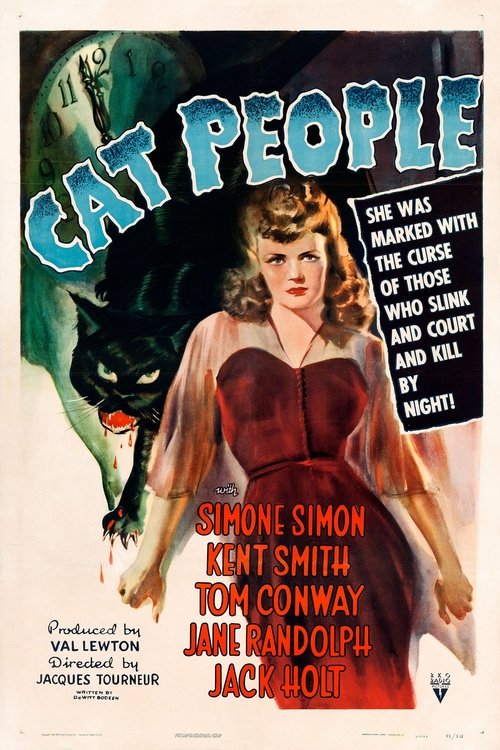
Cat People
1942 · Jacques Tourneur
When you're craving an old-school shiver — atmosphere and dread rather than gore — or a perfect late-night black-and-white mood piece. Watch it with the lights off.
What it's about
Irena, a Serbian-born fashion illustrator in Manhattan, meets an easygoing engineer at the Central Park Zoo and marries him — but she believes an ancient curse from her homeland means that if she ever gives in to passion or jealousy, she'll transform into a predatory cat. Her marriage stalls, a psychiatrist gets involved, another woman gets close to her husband, and the shadows around Irena start to move.
The experience
Quiet, elegant, and genuinely eerie — the fear comes from darkness, footsteps, and things you almost see, never from what's shown. At 73 minutes it's a swift, dreamlike watch that leaves a chill out of all proportion to its restraint.
Performances
Simone Simon is the reason it works: sad-eyed, feline, and sympathetic, she plays Irena as a lonely woman terrified of her own desire rather than a monster, and the film aches because of her.
The craft
Made for around $134,000 as the first film of producer Val Lewton's B-unit at RKO, it conjures terror almost entirely through shadow, sound, and suggestion — pools of darkness, an echoing swimming pool, a bus door hissing like a snarl. The inky, low-key cinematography is a masterclass in doing more with less, and it rewards a dark room and good speakers.
Why it matters
Its surprise success launched the whole cycle of literate, suggestive Lewton horror films and proved that what you don't show can scare audiences more than any monster — a lesson horror filmmakers have been relearning ever since. One of its jump scares was so influential the technique got named after the film's bus.
Snapshot
Cat People is the film that proved horror could be built out of absence. Made at RKO Radio Pictures for a budget in the neighborhood of $130,000–$150,000 — the figure most often cited is roughly $134,000, though sources vary and the studio's internal accounting has never been fully settled in the popular literature — it was the first production of a new low-budget unit headed by the Russian-born producer Val Lewton, and it returned many times its cost. Its commercial success is the reason a certain kind of suggestive, literate, atmospheric horror existed at all in 1940s Hollywood.
The film follows Irena Dubrovna (Simone Simon), a Serbian-born fashion illustrator in Manhattan who meets a pleasant, uncomplicated marine engineer, Oliver Reed (Kent Smith), at the Central Park Zoo. She marries him and then cannot consummate the marriage, because she believes she descends from a village of people who transform into panthers when roused by passion or jealousy. Oliver, baffled, drifts toward his colleague Alice Moore (Jane Randolph); a psychiatrist, Dr. Louis Judd (Tom Conway), is engaged to cure Irena and instead attempts to seduce her. Whether Irena is cursed or merely ill is a question the film refuses to close, and that refusal is its formal signature.
What makes Cat People historically pivotal is not its monster but its method: the monster is barely shown. Jacques Tourneur, directing his first feature for the unit, and cinematographer Nicholas Musuraca constructed terror out of pooled shadow, off-screen sound, and the audience's own supplied images. The result is one of the most consequential horror films ever made in the American studio system, and a foundational text for the idea that suggestion frightens more reliably than display.
Industry & production
The immediate context is RKO in crisis. The studio had absorbed the financial and political damage of Citizen Kane (1941) and the debacle of The Magnificent Ambersons (1942), and had turned decisively toward cheap, dependable product. Charles Koerner, who took over production in 1942 with the famous watchword of "showmanship instead of genius," wanted low-cost films with commercially legible hooks. Meanwhile Universal's The Wolf Man (1941) had demonstrated that horror, dormant in the late 1930s, was profitable again.
Into this Koerner installed Val Lewton, who had worked for years as a story editor and assistant to David O. Selznick, to run a horror unit under tight constraints: budgets of roughly $150,000 or under, running times around 70 minutes, and — the crucial detail — titles handed down by the studio's marketing apparatus, to which Lewton then had to write a film. Cat People was such a title. Lewton's decisive act was to treat the assignment as an invitation to psychological drama rather than creature spectacle, partly by conviction and partly because the money would not stretch to a convincing panther transformation. Aesthetics and arithmetic pointed the same direction.
Economy shaped nearly every frame. The unit made heavy use of standing sets and recycled material from the studio's prestige productions; the grand staircase associated with the Amberson mansion is the most frequently cited instance of that reuse, and the film's use of existing RKO architecture is well documented in the literature on the unit. Shooting was fast — a matter of a few weeks in mid-1942 — and post-production was similarly compressed.
The reception at the studio was reportedly cool and the release modest, but the box-office return was decisive: Cat People became one of RKO's most profitable pictures of its year in proportional terms, and it stabilized both Lewton's unit and the studio's balance sheet. Between 1942 and 1946 the unit produced I Walked with a Zombie, The Leopard Man, The Seventh Victim, The Ghost Ship, The Curse of the Cat People, Isle of the Dead, The Body Snatcher, and Bedlam. There was also friction: RKO ordered a sequel, and the resulting The Curse of the Cat People (1944) is not a horror film at all but a study of a lonely child, which says a great deal about how Lewton read his own brief.
Technology
Cat People is a black-and-white 35mm production shot with the standard Academy ratio (1.37:1) and recorded with RKO's optical sound system, in an era when the technical apparatus of the studio was mature and standardized. Its interest lies not in novel equipment but in the exploitation of existing tools past their intended use.
The critical technological fact is film stock sensitivity and lighting practice. By the early 1940s, faster panchromatic negative allowed cinematographers to expose usable images at very low light levels, which made it possible to light for near-darkness rather than for legibility — to keep large areas of the frame genuinely black instead of filling them. Musuraca exploited this aggressively: pools of hard light from a single visible source, deep unmodeled shadow, no fill. This is the same technical basis that enabled the noir look developing in parallel at RKO and elsewhere, and Cat People belongs to that technical moment as much as to the horror tradition.
Sound technology matters equally. The optical soundtrack and the practices of the studio sound department permitted precise, deliberate manipulation of off-screen audio — footsteps that stop, a hiss, the abrupt pneumatic exhalation of a bus that arrives exactly where a scream should be. The film treats the soundtrack as a load-bearing element rather than accompaniment, which was less common in low-budget production of the period than the film's fluency suggests.
Optical printing and rear projection appear sparingly, and the film's few overt effects — a shadow that resolves into an animal shape, a brief and heavily obscured glimpse of the panther — are conspicuously modest. The refusal of makeup transformation effects, which Universal had made the genre's central technological attraction with The Wolf Man's lap-dissolve work, is a deliberate rejection of the state of the art in favor of what the camera could do with darkness.
Technique
Cinematography
Nicholas Musuraca's photography is the film's principal argument. A veteran RKO cameraman whose work on Stranger on the Third Floor (1940) is often treated as an early instance of the noir style, Musuraca lights Cat People with pointed, motivated sources and lets everything else fall away. Faces are frequently half-lit; Simon is repeatedly photographed so that one eye sits in shadow, giving her an unstable, unreadable quality that no dialogue has to explain.
Three sequences carry the technique. The first is the walk through Central Park, where Alice is followed by something that may be Irena and may be nothing: the shot construction alternates high-contrast lamplight and blackness, with the pursuer's presence conveyed by sound and by the rhythm of the cutting rather than by anything visible. The second is the swimming pool, where the water's reflected caustics ripple across the walls and ceiling of the darkened room — light behaving like a predator's coat, an effect that is both beautiful and functional, since it produces a threatening image without producing a threat. The third is the drafting-office sequence, where a shadow crosses a wall in a shape the eye reads as animal.
Frames are often built as cages. Banisters, doorframes, and the bars of the zoo enclosure are used to segment the image and to place Irena inside geometries she cannot leave. Camera movement is restrained; when the camera does move, it tends to move with a character's dread rather than to survey a space.
Editing
Mark Robson, then a young editor who had worked on Citizen Kane and The Magnificent Ambersons and who would go on to direct for Lewton (The Seventh Victim, Isle of the Dead, Bedlam) and then a substantial mainstream career, cuts the film for withholding. The dominant strategy is the interrupted expectation: a sequence accumulates tension through a series of shots that promise a revelation, and the revelation is replaced by something ordinary and loud.
The bus shot in the park is the canonical example — the mounting cutting pattern is broken by the hiss and sudden bulk of a bus entering frame, a jolt that discharges the tension without answering the question. The device became known in the trade as the "Lewton bus," and its descendants are everywhere in modern horror, usually in cruder form. What is often missed is that the original is not a cheap trick: the false alarm is immediately followed by a genuine confirmation, in the form of torn sheep and animal tracks that become a woman's footprints, so the audience is punished for its relief rather than merely startled.
Elsewhere the editing is unusually patient for a 73-minute film. Scenes are allowed to run in sustained two-shots; the horror sequences are the only places where the cutting rate rises sharply, which makes those accelerations register as events.
Mise-en-scène / staging
The film's spaces are ordinary in a way that was, for horror in 1942, close to radical. No castle, no fog-bound village, no laboratory. Instead: the Central Park Zoo, a fashionable Manhattan apartment, a ship-model office, a Serbian restaurant, a taxidermist's shop, a psychiatrist's consulting room. Terror is domesticated. Irena's apartment is dressed with her sketches of a panther impaled by a sword — the Prince of Serbia motif, which does the film's exposition visually — and with the caged bird that dies from her proximity.
Art direction is credited to Albert D'Agostino and Walter Keller, and the film's reuse of studio architecture is part of its texture rather than a flaw: the borrowed grandeur of a staircase or a corridor lends the Manhattan settings a slightly excessive scale that reads as psychological pressure. Staging repeatedly places Irena at the edges of rooms, or on the far side of thresholds, while Oliver and Alice occupy the lit center. The zoo panther's cage is the film's governing image and its recurring destination.
The much-discussed pool sequence works largely through set design: a small, tiled, echoing space with a single stairway out, in which a woman in a bathing suit is maximally exposed and the camera never needs to show her an antagonist.
Sound
The soundtrack is the film's most original department. Roy Webb's score is thematically economical — it leans on a lullaby-like figure associated with Irena that is tender rather than menacing, so that the music sides with her even as the images grow ominous, and it declines the brass-and-tremolo idiom that Universal horror had made standard. Webb, who scored most of the Lewton pictures, treats silence as a scoring choice: several of the film's tensest passages carry no music at all.
Just as important is the film's use of sonic substitution, in which a threatening sound proves to have a mundane source: a growl that becomes a bus, footsteps whose heels change to something padded and then to nothing. The Serbian restaurant scene, the Belgrade lullaby, and the recurring pattern of animal noise heard but never located all establish that the film's monster exists primarily as audio. The single most famous line — Dr. Judd's clinical dismissiveness, or Irena's confession of what she fears — lands because it is spoken into rooms that are otherwise quiet.
Performance
Simone Simon, a French actress whose earlier Hollywood period at Fox had not made her a star, gives a performance built on withheld affect. She plays Irena as gentle, precise, slightly foreign in her rhythms, and fundamentally opaque — never signaling monstrousness, so that the audience's suspicion is its own construction. The performance is central to the film's ambiguity: a broader reading would settle the question the script keeps open.
Kent Smith's Oliver is deliberately bland, a decent man with no equipment for what he has married, and the flatness is functional rather than a failure of casting; Jane Randolph's Alice is brisk, competent, and sympathetic, which denies the film an easy romantic-rival villain. Tom Conway's Dr. Judd is the most modern-seeming performance — smooth, insinuating, and finally predatory — and the film's willingness to make the rationalist psychiatrist the story's actual sexual aggressor is one of its sharpest moves. Elizabeth Russell's brief, unnerving appearance as the cat-like woman in the restaurant, addressing Irena as "my sister," accomplishes more in one exchange than any transformation effect could.
Narrative & dramatic mode
DeWitt Bodeen's screenplay operates as a sustained hesitation. The film can be read entirely supernaturally (the curse is real; Irena kills) or entirely psychologically (Irena is a woman whose terror of sex has produced a delusion, and whose violence is either imagined or ordinary). Crucially, the film supplies evidence for both and never adjudicates. That structure places Cat People squarely in the tradition Tzvetan Todorov later theorized as the fantastic — the mode defined precisely by unresolved uncertainty between natural and supernatural explanation.
Dramatically the film is a marriage story before it is a horror story. Its engine is not pursuit but frustration: a woman cannot touch her husband, a husband cannot understand his wife, and a third party arrives less as a temptress than as a reminder of ordinariness. The Production Code made explicit discussion of the sexual problem impossible, and the film converts that constraint into method — everything about the unconsummated marriage is conveyed through closed doors, separate rooms, and a wedding night that ends with Irena asking for time.
Structurally the film is compact and linear, roughly 73 minutes, with exposition delivered through a fairy-tale legend of King John and the Mamelukes that functions as myth rather than fact. The ending is bleak and quick: Irena, wounded, opens the panther's cage and dies with the animal, an image that resolves the plot without resolving the interpretation.
Genre & cycle
Cat People sits at the intersection of three cycles. It belongs to the 1940s horror revival kicked off by The Wolf Man, but it opposes that cycle's reliance on makeup and monster display. It belongs to the emergent film noir by way of Musuraca's lighting, its urban setting, its atmosphere of sexual dread and unreliable knowledge — several critics have argued that the Lewton films and early noir are the same photographic culture applied to different anxieties. And it inaugurates a cycle of its own: the Lewton unit's nine RKO features, which collectively established "psychological horror" as a category and demonstrated that a B-unit could have a house style.
Within the horror genre its lasting contribution is a mode rather than a monster: the suggestion film, in which the threat's non-appearance is the aesthetic principle. That mode runs through Robert Wise's The Body Snatcher (1945) and The Haunting (1963), through the British restraint of Jack Clayton's The Innocents (1961), through Night of the Demon / Curse of the Demon (1957) — Tourneur's own return to the strategy, where studio-imposed monster footage famously compromised the design — and into virtually every subsequent argument about whether horror should show its creature.
Authorship & method
Cat People is the standard case study for collaborative authorship in the studio system, because no single figure fully accounts for it.
Val Lewton (producer) supplied the governing philosophy: that the unseen is more frightening than the seen, that literacy and restraint are cheaper and better than spectacle, and that horror should be about psychology and social unease. He was deeply involved in the writing, insisted on the quotation-and-legend texture of the films, and imposed the unit's discipline of ordinary settings. His authorship is programmatic rather than visual.
Jacques Tourneur (director) — French-born son of the director Maurice Tourneur, raised partly in the American industry, seasoned on shorts and B-pictures — supplied the temperament: patience, softness of attack, an interest in the pause before the event. His later work (I Walked with a Zombie, Out of the Past, Night of the Demon) confirms that the calm, deliberate handling of dread was his, not merely the unit's. Tourneur and Lewton had worked together previously, including on second-unit material for A Tale of Two Cities (1935) at MGM, and the Cat People collaboration is best understood as a genuine convergence of sensibilities.
Nicholas Musuraca (cinematography) supplied the images, and his contribution is arguably the most decisive single technical element in the film's reputation. His signature — hard single-source light, black backgrounds, faces divided by shadow — defines the look that later filmmakers cite when they cite Lewton.
DeWitt Bodeen (screenplay) shaped the fantastic ambiguity, the fairy-tale exposition, and the film's unusual sympathy for its supposed monster; the script's decision to make Irena's condition legible as sexual fear is his and Lewton's jointly.
Roy Webb (music) supplied the plaintive, un-monstrous score and the strategic silences. Mark Robson (editing) supplied the withholding rhythm and the false-alarm architecture.
The method itself is worth stating plainly: write to an imposed title, refuse the expected spectacle, spend the money on light and sound rather than on effects, keep the running time short, and trust the audience to supply the monster.
Movement / national cinema
The film is an American studio product, but its sensibility is emphatically transnational. Lewton was born in Yalta and carried a Russian literary formation into his production practice; Tourneur was French and trained in a European visual tradition through his father; Simon was French; the story's mythology is Serbian; and the film's lighting descends recognizably from German Expressionism as it was transmitted into Hollywood through the 1930s by émigré cinematographers and by the Universal horror cycle.
Cat People is thus one of the clearer instances of European aesthetic capital operating inside the B-picture economy. It also stands slightly apart from Expressionism proper: where the German tradition distorted sets and space, Cat People keeps its spaces realistically proportioned and distorts only the light. That is closer to what would soon be called noir, and it is a genuinely American synthesis — Expressionist shadow applied to a recognizable Manhattan.
The film's wartime moment inflects its treatment of foreignness. Irena is an immigrant whose difference is unassimilable, and whose ancestral inheritance destroys her attempt at an American marriage. Whether the film endorses or mourns that reading is contested in the criticism, but the anxiety about the foreign body inside the domestic sphere is legible in a 1942 American film in ways that no one had to write into the script.
Era / period
1942 is the pivot year: American entry into the war, studios reorganizing around austerity, and audiences seeking short, cheap, frequent entertainment. The B-picture and the double bill were structurally central to the industry, which is why a 73-minute horror film could be both marginal and enormously profitable.
The Production Code was at the height of its authority, and Cat People's subject — a marriage that cannot be consummated because of the wife's terror of her own sexuality — could only reach the screen displaced into metaphor. The film is a demonstration of how censorship produced sophistication: the sexual content is unmistakable and entirely unstated.
The period also explains the film's psychiatric frame. Popular Freudianism was ascendant in American culture and would saturate Hollywood in the following few years (Spellbound, 1945, and much else). Cat People arrives early in that wave and is notably skeptical of it: the psychiatrist is neither wrong nor trustworthy, and his rationalism is what gets him killed.
Reception, canon & influence
Contemporary reception was mixed-to-dismissive in the prestige press and warm at the box office. The trade papers recognized a well-made cheap horror picture; the New York Times review, by Bosley Crowther, was notably unimpressed, treating the film as a modest programmer — a judgment that reads today as a period marker rather than a critical position. There is no serious contemporary body of writing that identified the film as a landmark; its critical elevation happened later.
That elevation came in stages. James Agee's admiration for Lewton in the mid-1940s is the earliest significant defense by a major critic. The French critics of the 1950s and after, particularly around Cahiers du cinéma and Positif, took Tourneur seriously as an auteur well before Anglophone criticism did. In Britain, Movie and later Monthly Film Bulletin writers rehabilitated the Lewton unit; in the United States, Manny Farber's writing on the pleasures of the low-budget and, later, sustained scholarship — most substantially Joel Siegel's Val Lewton: The Reality of Terror (1972) and Edmund G. Bansak's Fearing the Dark (1995) — established the unit's canonical position. The film's induction into the National Film Registry in 1993 formalized what criticism had already concluded.
Feminist and psychoanalytic criticism from the 1970s onward found Cat People unusually rich, reading Irena as a figure of female sexuality construed as monstrous, and noting that the film's sympathies lie with the woman rather than with the husband who fails her or the doctor who assaults her. Later queer and immigrant-studies readings have pressed on the ambiguity of Irena's "difference" and on the Elizabeth Russell restaurant scene in particular.
Influences on the film (backward): the Universal horror tradition and its werewolf template, which Cat People inverts; German Expressionist lighting as mediated by Hollywood; the ghost-story tradition of ambiguity running through Henry James's The Turn of the Screw and the fantastic tales of the nineteenth century; Russian and European literary sources in Lewton's formation; folkloric shapeshifter material, freely invented for the film rather than reproduced from any single documented Serbian tradition — the King John legend is the screenplay's construction; and, technically, the low-key photographic practice already emerging at RKO in Stranger on the Third Floor and Citizen Kane.
Legacy (forward): the immediate legacy is the Lewton unit itself and the careers it launched — Robson and Wise both moved from editing to directing within it. The broader legacy is the suggestion principle, which became one of horror's two permanent poles. Direct lines run to The Innocents, to The Haunting, to the restraint of much 1960s–70s art horror, and to filmmakers who cite Lewton explicitly. Martin Scorsese has repeatedly championed the Lewton films and narrated a documentary on Lewton (Val Lewton: The Man in the Shadows, 2007). The "Lewton bus" survives as a named technique, and the false-scare-then-real-scare structure is now genre grammar.
The film also generated an unusual afterlife in remakes and responses: The Curse of the Cat People (1944), which converts the material into a study of childhood imagination; and Paul Schrader's Cat People (1982), which reverses the original's method entirely by showing everything — transformation, gore, sex — and which is most interesting as a negative demonstration of what the 1942 film achieved by refusal. The 1982 film's David Bowie–Giorgio Moroder theme song has arguably had a wider circulation than the remake itself, and its later use in Quentin Tarantino's Inglourious Basterds (2009) is a small measure of how far the title has traveled from its origin.
Eighty years on, Cat People remains the standard citation for a proposition that horror keeps rediscovering: that the most frightening thing a camera can do is fail to show you something.
A Deleuzian reading
A woman is alone in a small tiled pool room with the lights off.
The full Deleuzian reading of Cat People →
Reception
Critics in 1942 largely shrugged it off as a cheap B-picture, but audiences made it a sleeper smash that helped keep RKO afloat — and it's since been canonized as the founding text of suggestion-over-shock horror, complete with a Criterion edition and a National Film Registry slot.
How Cat People was received, from release to now →
How to watch Cat People: what to notice on a first viewing
- Notice how often doorframes and banisters box Irena into the shot. Bars, thresholds, and stair rails keep cutting the frame into segments that place her inside a geometry she cannot walk out of. The staging traps her visually long before anything supernatural has to happen.
- Watch for one of Irena's eyes always sitting in shadow. Musuraca lights Simone Simon with a single hard source and lets the rest of the frame fall to real black, never filling in the dark side of her face. Her expression stays permanently half-unreadable, which is exactly what the story needs from her.
- Listen for footsteps behind a character that change or vanish. A pursuing sound turns from heels to something padded and then to nothing at all, while the frame keeps showing you an empty street. The threat exists almost entirely as something you hear, never as something you can point at.
- Listen for a lullaby melody instead of any typical horror stinger. Roy Webb's score leans on a tender theme tied to Irena and often drops out entirely during the tensest scenes. The music takes her side even while the images are making you suspicious of her.
- Notice how often the story returns to the panther's cage. The zoo, the restaurant, the apartment sketch of a speared panther: the same caged animal keeps reappearing across otherwise ordinary Manhattan settings. An ordinary city keeps circling back to one wild, captive thing at its center.
The whole guide to watching Cat People, with the keys for a rewatch →
Influences: the films it descends from and the films it influenced
- M (1931) — Stages its killing entirely offscreen — the ball rolling to a stop, the balloon snagged in wires, the mother's unanswered stairwell call — over long unscored stretches broken by a single whistled motif, the exact substitution of sound-plus-absence for the act that Tourneur runs in the pool and Central Park sequences.
- Vampyr (1932) — Rudolph Maté's gauzed, diffused light and shadows that detach from their owners keep the supernatural permanently unverified, establishing the Todorovian hesitation-as-form that Cat People builds an entire plot around rather than a mood.
- Dracula's Daughter (1936) — Supplies the structural template of a coded-queer monstrous woman who submits herself to a male psychiatrist for a 'cure' and is destroyed in the consultation room — Dr. Garth is Dr. Judd's direct precursor, seduction and all.
- Stranger on the Third Floor (1940) — Nicholas Musuraca's laboratory for the single-source key, vast unfilled black, and barred shadows raked across faces and walls; he carried the same lighting plot intact into Irena's apartment two years later.
- Citizen Kane (1941) — Legitimized underexposed, deep-focus, ceilinged interiors as acceptable RKO house style — and left behind the standing sets, lighting units and crew that Lewton's B-unit recycled directly, making darkness a budget solution as well as an aesthetic one.
- The Wolf Man (1941) — Provides the precise template Cat People inverts: folk-verse curse, sympathetic afflicted monster, and Jack Pierce's lap-dissolve transformation — Tourneur retains the curse and the sympathy and deletes the dissolve.
- Nosferatu (1922) — Lewton-unit horror that keeps the monster offscreen and conjures terror through shadow and suggestion, extending Nosferatu's economy of dread.
- The Curse of the Cat People (1944) — Keeps the cast and Roy Webb's lullaby motif but relocates the fantastic hesitation into a child's imaginary friend whom the camera treats as literally present, preserving the ambiguity device after stripping out the horror machinery.
- Night of the Demon (1957) — Tourneur's own restatement — the runic curse and the wind-and-darkness Stonehenge sequence built from sound alone — where the studio-imposed shot of the demon serves as proof by counterexample that the refusal was the technique.
- The Innocents (1961) — Freddie Francis's deep-focus CinemaScope with candle-lit blacks places figures at the extreme edge of frame that may or may not be there, applying Cat People's Todorovian structure to James with the governess's repression as engine.
- The Haunting (1963) — Wise, trained inside the Lewton unit, builds a whole feature from offscreen suggestion — the bulging door, the pounding advancing down the corridor, wide-angle wall distortion — without ever cutting to an apparition.
- Halloween (1978) — Formalizes the Lewton bus into a rhythm — false scare (Annie's car, the branch, the closet) buying the real one — and holds the Shape in soft focus at the frame's edge inside Tourneur-style doorway and window cage framing.
- Alien (1979) — Withholds the creature through cutting, steam and shadow for most of its runtime, and uses Jones the cat as a literal Lewton bus — the false animal scare that discharges tension so the real attack can land.
- Cat People (1982) — A negative demonstration: by showing the transformation, the viscera and the sex, and by literalizing the incest subtext the 1942 film coded, it measures exactly how much of the original's terror was produced by the camera's refusal to look.
- Laura (1944) — LaShelle's apartment chiaroscuro in Laura — ominous quality produced through ordinary domestic light sources rather than expressionist shadow — directly inherits Tourneur's Lewton-school grammar of lamp-lit interiors made uncanny by selective sourcing, not theatrical darkness.
- Tropical Malady (2004) — The Lewton-Tourneur grammar of conveying human-to-predator transformation through underexposed darkness, off-screen sound, and unseen stalking — never the beast itself — directly models the night-jungle tiger hunt of the second half.
- Shutter Island (2010) — Val Lewton producer-driven suggestion-horror: low-key top-light and withheld shadow make psychic dread rather than the monster the subject, a direct lighting debt.
- Cure (1997) — The Lewton/Tourneur method of generating horror from suggestion, sound, and the unseen off-frame presence — never showing the monster — is Cure's foundational principle of dread sourced from what stays outside the held wide shot.
- Invasion of the Body Snatchers (1956) — Val Lewton's method of horror by suggestion — threat kept off-screen, dread carried by silence and aural wrongness rather than spectacle — feeds Fredericks's low-key restraint.
- I Walked with a Zombie (1943) — Extends the Central Park stalk into a long, near-wordless tracking walk through cane fields where wind, distant drums and the frame's edge carry the threat, with the same refusal to confirm whether anything supernatural is operating at all.
- The Leopard Man (1943) — The purest statement of the suggestion principle: the girl locked outside her own door, the killing held wholly offscreen, the event confirmed only by blood seeping under the threshold into the lit room.
- The Seventh Victim (1943) — Robson cut Cat People, then reworked its shock grammar — the shower-curtain intrusion and the silent unlit walk home convert the bus jolt into sustained urban dread, and Tom Conway's Dr. Judd returns as the same predatory clinician.
- The Spiral Staircase (1946) — Musuraca again: the killer's eye isolated in extreme close-up, storm-lit staircases, a mute heroine — withheld identity plus the half-lit face migrating from horror into the woman's-gothic thriller.
- Out of the Past (1947) — The Tourneur–Musuraca pairing transposed whole into noir — ambient blackness with faces lit on one plane only, and a fatal woman staged in doorways, mirrors and reflected light rather than psychologically explained.
- It Follows (2015) — The Lewton-Tourneur principle of dread built from suggestion, withheld backstory, and an unseen pursuer in negative space rather than a shown monster — atmosphere-as-horror that Mitchell's slow-burn revives.
Similar films
- Halloween (1978) — influence & lineage
- Night of the Demon (1957) — influence & lineage
- Psycho (1960) — shared sensibility
- Nosferatu (1922) — shared sensibility
- Repulsion (1965) — shared sensibility
- Carrie (1976) — shared sensibility
- Possession (1981) — shared sensibility
- The Shining (1980) — shared sensibility