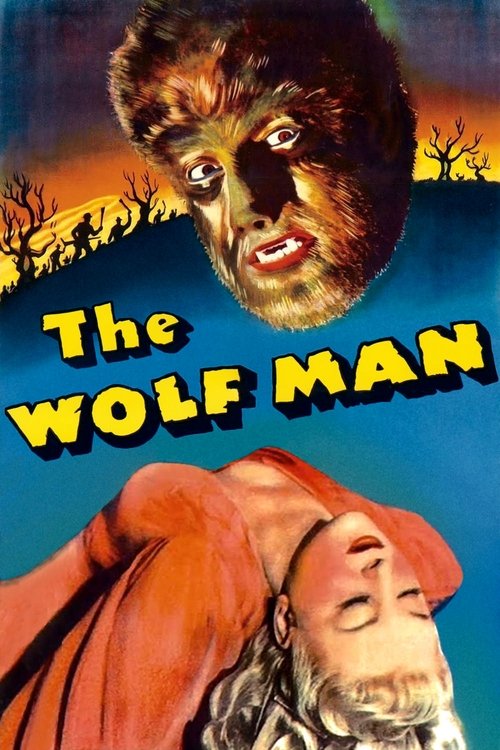
The Wolf Man
1941 · George Waggner
For a classic-horror night when you want fog, moonlight, and a monster you feel sorry for — comfort-food gothic with a genuinely mournful undertow. An ideal Halloween-season starter that won't keep anyone up.
What it's about
Larry Talbot comes home to his father's estate in Wales after his brother's death, hoping to patch up the family. Then he's bitten while trying to save a woman from a wolf attack, and a fortune teller's warnings about pentagrams and the full moon start to sound less like folklore and more like his future. The film follows a decent man slowly realizing what he's becoming — and that nobody will believe him.
The experience
Foggy, melancholy, and surprisingly sad for a monster movie: the horror comes less from the wolf than from Larry's dread of himself. It's brisk and atmospheric, closer to a tragedy with claws than a creature rampage.
Performances
Lon Chaney Jr. gives the role its lasting power — big, affable, and increasingly desperate, he makes Larry's doom feel personal. Claude Rains lends gravity as his skeptical father, and Maria Ouspenskaya is unforgettable as the fortune teller who delivers the legend's rules.
The craft
The fog-drenched studio forests and Jack Pierce's painstaking yak-hair makeup set the visual standard for werewolf cinema, with the transformation achieved through patient dissolves. The screenplay essentially invented the modern werewolf rulebook — the full moon, the pentagram, the silver — out of whole cloth.
Why it matters
This is the film that codified werewolf lore for all cinema that followed; most of what audiences 'know' about werewolves starts here. It made the Wolf Man the last great addition to Universal's classic monster pantheon and defined Lon Chaney Jr.'s career.
Influences: the films it descends from and the films it influenced
- Wolf Children (2012) — The werewolf-as-affliction-and-otherness that Hosoda directly inherits but strips of horror, converting lycanthropy from monstrous curse into a matter of inheritance, difference, and tenderness.
- Cat People (1942) — Provides the precise template Cat People inverts: folk-verse curse, sympathetic afflicted monster, and Jack Pierce's lap-dissolve transformation — Tourneur retains the curse and the sympathy and deletes the dissolve.
- Wallace & Gromit: The Curse of the Were-Rabbit (2005) — Supplies the plot machinery wholesale: the full-moon involuntary transformation, the folk-rule weapon, and the monster who is also the sympathetic protagonist — Wallace's changes are staged as clay-modelled lap dissolves in direct quotation of Universal's cross-dissolve method.
- An American Werewolf in London (1981) — Supplies the invented folklore Landis rewrites verbatim — the pentangle, the rhyming couplet, the victim-becomes-monster contract — while Jack Pierce's locked-off lap-dissolve transformation is the exact technique Baker's articulated appliance work was built to render obsolete.
Similar films
- Frankenstein (1931) — shared sensibility
- The Invisible Man (1933) — shared sensibility
- Hour of the Wolf (1968) — shared sensibility
- Nosferatu (1922) — shared sensibility
- Night of the Demon (1957) — shared sensibility
- Vampyr (1932) — shared sensibility
- Bride of Frankenstein (1935) — shared sensibility
- Nosferatu the Vampyre (1979) — shared sensibility