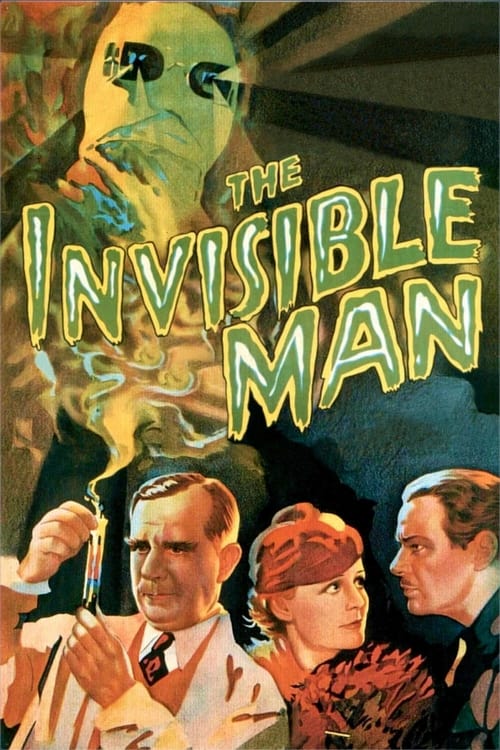
The Invisible Man
1933 · James Whale
For a classic-horror night when you want atmosphere and mischief more than gore — great in the dark, in winter, ideally with someone who's never seen what 1933 could do. Comfort-food horror with a genuinely nasty streak.
What it's about
A stranger swathed in bandages and dark goggles takes a room at a snowbound English inn, demanding to be left alone with his chemicals. He is Jack Griffin, a scientist who has made himself invisible — and the drug that did it is eroding his sanity. As he hunts for a way back, his experiments in terror escalate, and the police find themselves chasing a man they cannot see.
The experience
Brisk, wicked, and startlingly funny — the menace comes laced with black comedy, and the invisible mischief escalates from pranks to genuine chills. Nearly a century on, it still moves like a shot.
Performances
Claude Rains, in his American screen debut, gives one of cinema's great voice performances — face hidden for nearly the entire film, he builds a whole character out of silken menace, wounded pride, and cackling megalomania.
The craft
The effects were revolutionary and remain delightful: clothes that walk by themselves, bandages unwrapped from empty air, footprints appearing in snow — optical trickery executed with a magician's showmanship. James Whale directs with his signature blend of horror and sly wit, keeping the village comedy and the terror in perfect balance.
Why it matters
A cornerstone of Universal's foundational horror cycle and a landmark in special effects whose invisible-man tricks were studied and imitated for decades. It set the template for every unseen-menace story since.
Snapshot
The Invisible Man is the fourth of Universal Pictures' foundational sound-era horror films — following Dracula and Frankenstein (both 1931) and The Mummy (1932) — and the one in which the cycle's technical ambition most nakedly announces itself. Adapted from H.G. Wells's 1897 scientific romance, it stages the story of Jack Griffin, a chemist who renders himself invisible with a drug called monocane and is driven, by the compound and by his own hubris, toward megalomania and murder. Directed by James Whale at the height of his authority on the Universal lot, the film fused a genuinely novel special-effects program with a caustic, blackly comic sensibility and a performance — Claude Rains's American screen debut — conducted almost entirely through a disembodied voice. It remains a touchstone for optical trickery, for the horror-comedy hybrid, and for the figure of the scientist whose invisibility is at once a marvel and a moral catastrophe.
Industry & production
The film was produced by Universal under Carl Laemmle Jr., the studio head's son, who had shepherded the horror cycle as a prestige-and-profit strategy for a middle-tier studio. Universal held screen rights to Wells's novel, and the project passed through an unusually long development period with multiple writers attached. Robert Florey, John L. Balderston, Gouverneur Morris, Preston Sturges, and Philip Wylie are among those variously associated with early treatments; the record here is genuinely tangled, and the specifics of who contributed what have been debated by historians rather than settled. The final screenplay is credited to R.C. Sherriff, the English playwright of Journey's End — a play Whale had directed on stage and adapted for film — whose script is generally credited with returning the adaptation to the spine of Wells's novel after various more elaborate science-fiction elaborations had been considered. Wells himself is reported to have approved of the finished film while objecting to the way the drug turns Griffin into a madman, a shift from the novel's colder characterization; this account is well established in the literature though it rests on secondhand testimony.
Casting was consequential. Boris Karloff, Universal's reigning horror star, was at one point associated with the lead but did not play it — the reasons usually cited involve salary disputes and the fact that the role hides the actor's face for nearly the entire runtime. The part instead went to Claude Rains, a London stage actor with almost no prior film experience, in what became a career-launching role precisely because it privileged his distinctive, resonant voice. Production drew on Universal's now-practiced horror infrastructure, but its schedule and budget were shaped above all by the effects work, which was slow and technically exacting.
Technology
The film's importance rests substantially on its special-effects program, supervised by John P. Fulton, who ran Universal's effects department, working with cinematographer John J. Mescall and the traveling-matte specialist Frank D. Williams. The central illusion — a man present, clothed, and acting, yet with no visible body beneath the clothes — was achieved chiefly through matte photography. For shots in which Griffin was invisible but partially clothed, Rains (or a double) performed in a black velvet suit and hood against a black velvet background; this footage was then combined, through a matte process, with a separately photographed set, so that only the ordinary garments registered while the velvet-covered body dropped out entirely. Wires, concealed rigs, and mechanical effects handled objects that moved "on their own." The result was a composite image of remarkable stability for its date, with far less of the jitter and matte-line fringing that plagued contemporaneous optical work.
This was pioneering applied optical engineering as much as artistry, and it set a benchmark: the techniques Fulton refined here fed directly into Universal's later invisibility sequels and, more broadly, into the vocabulary of Hollywood optical effects for decades. The precise proprietary details of the mattes were closely held studio knowledge at the time, and some accounts of exactly how individual shots were built remain reconstructions rather than documented procedure.
Technique
Cinematography
Photography is credited to Arthur Edeson, an accomplished cinematographer whose résumé already included Frankenstein and who would later shoot The Maltese Falcon and Casablanca. Edeson's work here has a clean, high-key clarity in many scenes that is partly a technical necessity: the matte compositing demanded controlled, even lighting and stable camera setups so that the invisible-man elements could be married convincingly to the live-action plates. Where the film reaches for atmosphere — the snowbound village, the nocturnal escapes, the laboratory — it deploys the expressionist-inflected shadow and depth characteristic of the Universal horrors, but much of the picture is lit with a brightness that keeps the trick shots legible. The camera is frequently locked down or moved with restraint precisely because the effects work could not tolerate the compositional freedom of a fully live scene.
Editing
Editing is credited to Ted Kent. The cutting serves two competing demands: the comic-horror set pieces, which depend on timing and reaction, and the effects shots, which had to be intercut with ordinary coverage so that the illusion never lingered long enough to expose its seams. The film's rhythm alternates crisply between farce (the terrorized villagers, Una O'Connor's shrieking landlady) and menace (Griffin's escalating violence), and the editing manages the tonal whiplash that is central to the film's identity.
Mise-en-scène / staging
Whale stages the invisibility for maximum theatrical payoff. The celebrated early sequence at the Lion's Head inn, in which Griffin unwinds the bandages from his face to reveal nothing beneath, is built as a slow reveal, its horror wrung from absence. Elsewhere Whale choreographs empty clothing in motion, doors opening, objects flying, and a bicycle rolling riderless down a lane — comic and uncanny at once. The English-village setting, with its cramped pub interiors and snowy exteriors, grounds the fantastical in a mundane social world, which sharpens both the comedy and the sense of a community overrun. Griffin's habit of stripping naked to become wholly undetectable — and the corresponding vulnerability of exposure to cold, rain, and snow — is used as a recurring staging device, tying the effect to the character's physical predicament.
Sound
Sound is fundamental to the film in a way rare for the period. Because the protagonist is unseen, Rains's voice must carry characterization, menace, and pathos alone, and the film treats the voice as its principal instrument. The sound design also exploits the comedy and terror of noises without visible sources — footsteps, breathing, laughter emanating from empty air. Like many early-1930s Universal productions, the film uses relatively sparse underscoring rather than a continuous symphonic score; the exact attribution of its music is not as cleanly documented as its other craft credits, and I'd flag that as an area where the record is thinner than for the effects or the screenplay.
Performance
Claude Rains gives one of the sound era's most celebrated "invisible" performances, since he is glimpsed clearly only at the very end, his face restored in death. He builds Griffin from vocal register alone — cultivated, sardonic, then swelling into grandiose mania, with the drug-induced megalomania voiced through lines of chilling relish about a "reign of terror." The supporting cast anchors the film's human and comic dimensions: Gloria Stuart as Flora Cranley, the fiancée who supplies the story's pathos; William Harrigan as the treacherous colleague Kemp; Henry Travers as Dr. Cranley; Forrester Harvey and, above all, Una O'Connor, whose piercing hysterics as the innkeeper's wife became the film's most imitated comic register. E.E. Clive plays the flustered village constable.
Narrative & dramatic mode
The film's dramatic mode is a deliberate braid of horror, science fiction, and broad comedy — a tonal combination that Whale pursued more aggressively here than in Frankenstein and would push further in Bride of Frankenstein (1935). The narrative is a descent: Griffin arrives already transformed and already unraveling, and the arc traces his moral disintegration and the widening circle of his violence rather than a mystery of origins, which is delivered in expository flashback and dialogue. Structurally it moves from confinement (the inn) to flight and open predation (the countryside, the derailed train, the manhunt) to a final entrapment in the snow. The comedy is not decoration but a governing strategy: the villagers' panic and the constable's incompetence render the invisible menace absurd even as the body count rises, producing a queasy oscillation that is the film's signature.
Genre & cycle
The Invisible Man belongs squarely to the Universal horror cycle of 1931–1936, sharing its studio, its personnel, its literary-adaptation pedigree, and its marketing as a "monster" attraction — though its monster is defined by absence rather than a Karloff or Lugosi silhouette. It is also, more than its siblings, a work of science fiction: its premise is explicitly a scientific experiment gone wrong, its horror technological rather than supernatural, aligning it with Wells's tradition of the scientific romance. It sits at the head of its own sub-franchise; Universal returned to the property repeatedly with The Invisible Man Returns (1940), The Invisible Woman (1940), Invisible Agent (1942), and The Invisible Man's Revenge (1944), before folding the character into the comedy crossover Abbott and Costello Meet the Invisible Man (1951). Fulton's effects continuity across several of these entries is one of the through-lines of the series.
Authorship & method
The film is centrally a James Whale work, bearing his distinctive fusion of macabre spectacle, arch wit, and theatrical control. Whale, an Englishman with a background in stage direction, brought to Universal a sensibility both more sophisticated and more mischievous than the studio's house style, and The Invisible Man is among the clearest expressions of his taste for comedy braided into terror. His collaboration with R.C. Sherriff — a fellow Englishman and a prior partner from Journey's End — grounded the script in Wells while accommodating Whale's tonal ambitions. The other decisive authorial hand is John P. Fulton's: the film is unimaginable without its effects, and Fulton's contribution rises to the level of co-creation rather than mere technical support. Arthur Edeson's cinematography and Ted Kent's editing complete the core craft team. The uncredited or disputed contributions of earlier writers, noted above, mean that the screenplay's genesis is less cleanly authored than the finished direction.
Movement / national cinema
This is a Hollywood studio film, but one with a strongly transatlantic character. Its source is a canonical English novel; its director, lead actor, and screenwriter were all English; and its setting is an English village. The Universal horror cycle as a whole drew heavily on European talent and on the visual grammar of German Expressionism — filtered through emigre and emigre-influenced craftspeople — and The Invisible Man participates in that lineage while remaining a product of the American studio system's industrial method. It is best understood not as belonging to a self-conscious film movement but as a high point of a studio-defined cycle inflected by British literary sensibility and European visual style.
Era / period
The film is a creature of the pre-Code early sound era, released in 1933 before the Production Code Administration's enforcement tightened in 1934. Its casual body count, its glee in Griffin's cruelty, and its flashes of nudity-adjacent staging (a man who must be naked to be truly unseen) reflect the greater latitude of the moment. It also arrives at a specific technological juncture: the sound film was only a few years old, and The Invisible Man is in part a demonstration of what the new medium's marriage of image and voice — and of matte photography with recorded dialogue — could accomplish. It belongs, too, to the Depression years, and its portrait of a brilliant man ruined by his own ambition resonated in a period preoccupied with collapse and overreach, though one should be cautious about reading too neat a social allegory into a film so committed to entertainment.
Themes
The film's governing theme is the corruption of knowledge: scientific power pursued without restraint becomes indistinguishable from madness, and invisibility functions as a literalization of unaccountable power — the freedom to act without being seen, and therefore without consequence. Griffin's monocane-fueled megalomania dramatizes the idea that removing visibility removes moral limit; his fantasies of world domination make explicit the tyranny latent in the wish to be unseen. Running beneath this is a theme of isolation and dehumanization: to be invisible is to be cut off from human recognition, exiled from the community even while moving through it, and vulnerable in the body (to cold, to snow, to the tracks his feet leave) precisely because he has escaped the eye. The film also stages a tension between the tragic and the comic — Griffin is at once a monster and a pitiable, ruined man — and this refusal to resolve into either pure horror or pure farce is itself a thematic stance.
Reception, canon & influence
The Invisible Man was well received on release and is generally regarded as one of the strongest entries in the Universal horror cycle, praised in particular for its effects and for Rains's voice performance — a debut that, remarkably, made a star of an actor whose face is withheld until the final moments. (I'll flag that period box-office and precise contemporary review figures are the kind of detail I won't reconstruct from memory; the film's strong critical standing is secure, the granular commercial record less so in my recall.) Over time it has entered the canon of classic horror and of pioneering special-effects cinema, and it has been recognized institutionally as a work of enduring cultural significance.
Its influences reaching backward are clear: H.G. Wells's novel above all, together with the broader tradition of the scientific romance and of the mad-scientist figure that Universal had already codified in Frankenstein; Whale's own theatrical background and prior horror work; and the Expressionist-inflected craft traditions of the studio's horror unit.
Its influence reaching forward is substantial. Fulton's matte techniques advanced the state of optical effects and shaped the many sequels and imitations that followed, establishing invisibility as a durable genre premise carried through subsequent decades of film and television. The horror-comedy tonal blend that Whale perfected here fed directly into Bride of Frankenstein and, more diffusely, into a long lineage of films that mix terror with wit. Rains's career, launched entirely by voice, became a case study in performance without a visible face. And the figure of the invisible man himself — the scientist whose gift is also his damnation, the unseen presence as an image of power without accountability — has recurred throughout science fiction and horror ever since, including in later reinventions of the property that reframe invisibility around surveillance and control rather than chemistry. The 1933 film remains the template against which those reinventions are measured.
Reception
A genuine hit in 1933 — critics and audiences loved it, and even H.G. Wells largely approved of the adaptation. Today it's regarded as one of the crown jewels of the Universal horror cycle, with Whale's dark wit aging better than almost anything else from the era.
How The Invisible Man was received, from release to now →
Influences: the films it descends from and the films it influenced
- The Man with the Rubber Head (1901) — Pioneered the in-camera substitution splice and black-background trick photography that is the direct forerunner of Fulton's black-velvet compositing for the invisibility gags.
- The Thief of Bagdad (1924) — Its large-scale traveling-matte and optical trick effects established the compositing craft that Fulton extended and refined into the invisible-figure mattes.
- The Lost World (1925) — Willis O'Brien's optical printing combined separately photographed elements into a single frame — the multi-element compositing discipline underlying Fulton's empty-clothing shots.
- Metropolis (1927) — Supplied both the Rotwang mad-scientist archetype and the Schüfftan in-camera compositing of the German Expressionist tradition that Universal's horror unit absorbed.
- Journey's End (1930) — Introduced the Whale–R.C. Sherriff writing partnership and the theatrical, locked-down chamber staging that Whale reprises here.
- Frankenstein (1931) — Codified Universal's mad-scientist figure and Whale's directorial control over macabre spectacle, the studio-craft template on which the invisible scientist's descent-arc is built.
- Topper (1937) — Builds comedy from unseen hands animating objects and clothing — Roy Seawright's wire-and-matte gags directly extend Whale's animated-empty-clothing device.
- The Invisible Man Returns (1940) — Continues John P. Fulton's own traveling-matte invisibility work as a franchise craft, carrying the black-velvet compositing method forward intact.
- 2001: A Space Odyssey (1968) — Renders HAL 9000 as a full character through Douglas Rain's controlled, disembodied voice alone — the vocal-only, face-withheld performance Rains originated.
- Predator (1987) — Its optical-distortion 'camouflage' creature is a direct successor to Fulton's empty-space compositing problem — making a present body read as absent in-frame.
- Memoirs of an Invisible Man (1992) — Evolves the traveling-matte invisibility effect through ILM motion-control and early digital compositing, updating Fulton's technique with the same on-screen goal.
- Hollow Man (2000) — Reworks the invisible-scientist descent-arc as body horror, layering CGI compositing over the same moral premise of power without accountability.
- Her (2013) — Scarlett Johansson's entirely bodiless, vocal-only performance descends from Rains proving a star could be built from voice as an instrument with no visible face.
- The Invisible Man (2020) — Reframes invisibility as surveillance and coercive control, using the locked-down camera lingering on empty negative space to stage the slow reveal of an unseen presence.
- The Incredible Shrinking Man (1957) — Fulton's foundational traveling-matte process became Universal's in-house optical lineage that effects cinematographer Clifford Stine drew on directly for Shrinking Man's scale composites.
- The Rocky Horror Picture Show (1975) — Explicitly conjured by the 'Claude Rains was the Invisible Man' line in 'Science Fiction/Double Feature,' whose whole lyric is a curated catalog of the Universal/RKO iconography the film reanimates.
- Bride of Frankenstein (1935) — Perfects the same horror-comedy tonal braid and deploys Fulton's optical effects, made by the identical Whale authorial team one film later.
Similar films
- Frankenstein (1931) — influence & lineage
- Bride of Frankenstein (1935) — influence & lineage
- The Invisible Man (2020) — influence & lineage
- Metropolis (1927) — influence & lineage
- King Kong (1933) — shared sensibility
- The Cabinet of Dr. Caligari (1920) — shared sensibility
- An American Werewolf in London (1981) — shared sensibility
- The Incredible Shrinking Man (1957) — shared sensibility