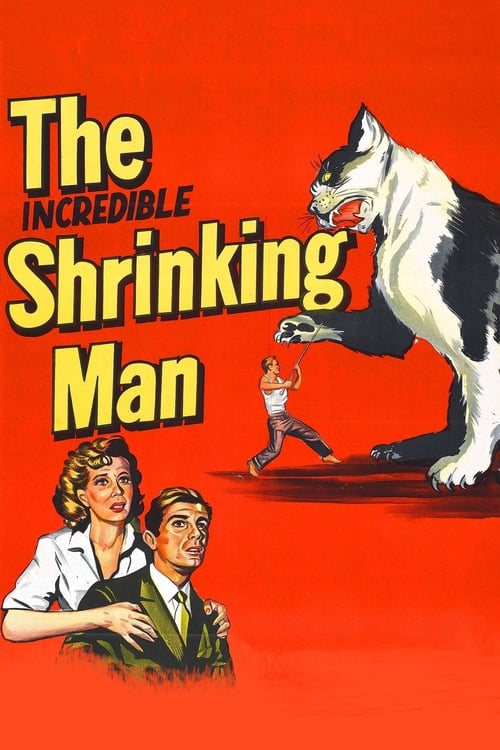
The Incredible Shrinking Man
1957 · Jack Arnold
For when you're in the mood for classic sci-fi that actually earns the label — a Saturday-matinee thrill that sneaks up on you with big ideas. Comfort viewing with an existential aftertaste.
What it's about
An ordinary suburban husband passes through a strange radioactive mist, and after a later brush with insecticide he begins, slowly and irreversibly, to shrink. First he diminishes out of his marriage, then out of human scale altogether — until his own cellar becomes a hostile wilderness where the house cat and a spider are mortal threats.
The experience
It starts as domestic drama, becomes a white-knuckle survival picture, and ends somewhere genuinely philosophical — the closing minutes still catch first-time viewers completely off guard. Tense, strange, and far more moving than a 1950s creature feature has any right to be.
The craft
Jack Arnold's trick work remains startling: giant props, split screens, and traveling mattes that turn a house spider into a genuine monster and a sewing pin into a sword. Richard Matheson adapted his own novel and refused every easy rescue, pushing atomic-age anxiety somewhere no other B-picture dared. The black-and-white effects still play beautifully on a big screen.
Why it matters
The high-water mark of 1950s atomic-anxiety science fiction, it proved a B-movie premise could carry real philosophical weight and influenced generations of shrinking and survival-at-scale stories.
Richard Matheson adapted his own novel for Universal's house of creature features, and Jack Arnold — the studio's dependable craftsman behind Tarantula and Creature from the Black Lagoon — turned a pulp premise into the 1950s' most unexpectedly metaphysical picture. A cloud of radioactive mist, a dose of insecticide, and an ordinary suburban husband begins to diminish: first out of his marriage, then out of human scale altogether, until his own cellar becomes a hostile continent. The trick work remains startling — giant props, split screens, and traveling mattes that make a house spider a genuine monster and a sewing pin a sword. But what lifts the film above its B-picture cohort is its refusal of easy rescue, atomic-age anxiety pushed to a genuinely philosophical conclusion in a closing monologue that still catches first-time viewers off guard. Arnold fought the studio to keep that ending. Every shrinking-human film since — Fantastic Voyage, Innerspace, Ant-Man — plays in the cellar this one built.
A Deleuzian reading
A sewing pin, carried like a lance.
The full Deleuzian reading of The Incredible Shrinking Man →
Reception
Released as a Universal B-picture for the drive-in crowd, it was a hit in 1957 — but its bleak, philosophical ending has since lifted it from creature-feature company into 'best sci-fi film of the 1950s' conversations, sealed by a National Film Registry induction in 2009.
How The Incredible Shrinking Man was received, from release to now →
Influences: the films it descends from and the films it influenced
- Dr. Cyclops (1940) — Pioneered the shrunken-human subgenre's core illusion — full-scale oversized props and rear-projection to place miniaturized actors inside a normal-sized world — the exact scale grammar Arnold's crew refined in the basement act.
- The Devil-Doll (1936) — Staged doll-sized humans among giant household objects (outsize furniture, a looming dog) via oversized props and matte composites, prefiguring Shrinking Man's giant-scissors and mousetrap-versus-spider staging.
- The Bride of Frankenstein (1935) — John P. Fulton's traveling-matte homunculi-in-jars established the Universal optical-printing method for compositing full-size actors at miniature scale within a single frame.
- The Invisible Man (1933) — Fulton's foundational traveling-matte process became Universal's in-house optical lineage that effects cinematographer Clifford Stine drew on directly for Shrinking Man's scale composites.
- Creature from the Black Lagoon (1954) — Arnold's craft of the sympathetic hunted 'monster' framed in expressive deep-focus wide angles, redeployed with the ordinary man himself recast as the vulnerable, cornered creature.
- It Came from Outer Space (1953) — Arnold's desolate-landscape atmospherics and first-person cosmic dread, plus the ordinary-man-confronts-the-infinite narration voice Matheson would sharpen into the closing monologue.
- Fantastic Voyage (1966) — Extends the miniaturized-human premise into elaborate oversized-set construction, treating the human-scaled body's interior as an alien landscape the way Shrinking Man treated the cellar.
- The Incredible Shrinking Woman (1981) — Direct remake-parody reusing the oversized-prop staging (giant sink, sofa, household hazards) while updating atomic anxiety into consumer-chemical anxiety.
- Innerspace (1987) — Dante, an avowed Arnold/Matheson devotee, revives the miniaturization premise through oversized-set and matte craft, explicitly honoring the shrinking-human subgenre's optical playbook.
- Honey, I Shrunk the Kids (1989) — Builds enormous backyard sets and props — towering blades of grass, a Lego brick as architecture — the purest and most literal inheritance of the scale-distortion staging.
- Downsizing (2017) — Revives the literal shrinking-human subgenre for existential and social allegory, echoing the philosophical-monologue register in which smallness becomes a meditation on human significance.
- Ant-Man (2015) — Carries the shrinking-protagonist subgenre into digital scale-distortion set pieces that stage the macro world — a bathtub, a briefcase, a toy train — as vast and lethal terrain.
- The Secret World of Arrietty (2010) — Canonical forced-perspective scale cinema built on oversized props and sets to render a human tiny—the production-design problem Arrietty resolves in 2D layout plus amplified small sounds.
- Army of Darkness (1992) — Oversized prop builds combined with traveling mattes to let a shrunken figure physically fight objects at wrong scale — the identical toolkit Raimi uses so mini-Ash can wield a fork and be swatted with a spoon in the same shot.
- Gremlins (1984) — Arnold's oversized-prop and forced-perspective grammar — building a scaled-up set so a small performer reads as tiny against real furniture, with low camera placement selling the size differential — is the same technique Gremlins uses to put Gizmo and the mogwai into human rooms.
- Tarantula (1955) — Same director and effects cinematographer (Clifford Stine) using traveling mattes to composite a radically scale-distorted body into live desert plates — the giant spider is the shrunken man's climactic antagonist rehearsed a year early.
- Them! (1954) — Atomic-age scale distortion realized through oversized mechanical props and matte-composited giants, the era's parallel technical solution to putting the wrong-sized body on screen.
- The Amazing Colossal Man (1957) — The inverse experiment released the same year — radiation-driven scale change staged with oversized props and split-screen/matte composites, running the identical technique in the opposite direction.
- Attack of the 50 Foot Woman (1958) — Scale-distortion via traveling mattes and giant props married to a gender-inflected 'body out of control' anxiety, the mirror of Shrinking Man's masculinity-in-crisis premise.
- The Fly (1958) — Atomic-science-gone-wrong body horror resolved with a bleak, philosophically resigned downbeat ending and macro-scale optical trickery, sharing Matheson-era dread of transformation.
- The Last Man on Earth (1964) — Richard Matheson's authorial method — an ordinary man reduced to existential solitude, sustained by mundane domestic detail and interior monologue — carried from his page to another adaptation of his own work.
- Forbidden Planet (1956) — The parallel optical toolkit: oversized props, forced perspective and travelling-matte composites deployed to make scale itself the subject, exactly as Forbidden Planet's Krell power-plant shafts are built from foreground miniatures married to painted extensions and tiny walking figures.
Similar films
- The Invisible Man (1933) — influence & lineage
- Invasion of the Body Snatchers (1956) — same viewing thread · often watched together
- The War of the Worlds (1953) — same viewing thread
- War of the Worlds (2005) — same viewing thread
- Annihilation (2018) — often watched together
- Invasion of the Body Snatchers (1978) — shared sensibility
- The Thing (1982) — shared sensibility
- Forbidden Planet (1956) — shared sensibility
All the films related to The Incredible Shrinking Man →
Watch it with: curated runs of related films
- The Shadow of the Bomb — Watch these when you want the Cold War's dread the way it actually landed — not in war rooms but at kitchen tables — the same annihilation refracted from pulp sci-fi to a submarine standoff to a retired couple brewing tea as the fallout arrives.