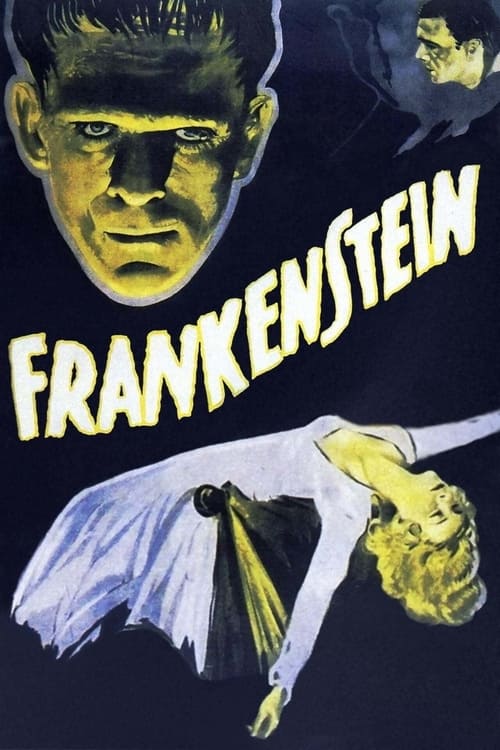
Frankenstein
1931 · James Whale
Perfect for a Halloween night or a rainy-evening dive into where horror began — a short, potent classic you can watch with almost anyone.
What it's about
Henry Frankenstein, a brilliant and obsessive young scientist, stitches together a body from stolen parts and jolts it to life in a mountaintop laboratory. His creation wakes into a world that greets it with torches and terror, and what follows is less a monster rampage than a tragedy: a confused, childlike being hated for existing, and a maker who cannot control what he's done.
The experience
Still eerie after nearly a century — brisk, strange, and unexpectedly sad. The famous creation scene crackles, but what stays with you is the monster's bewildered tenderness; you come for a Halloween chiller and leave with a lump in your throat.
Performances
Boris Karloff, billed in the credits only as '?', became a star through an almost wordless performance — the monster's whole tragic soul conveyed in lumbering movement, groping hands, and heavy-lidded eyes under pounds of makeup. Colin Clive's feverish, cracking intensity as Frankenstein gave the movies one of their most quoted moments of mania.
The craft
Whale shoots it like a gothic sculpture garden — slanted sets, towering shadows, a laboratory of sparking machinery that defined what 'mad science' looks like forever after. Jack Pierce's makeup design fixed the monster's image in the world's imagination: flat skull, bolted neck. Made before the censorship code tightened, it still carries a genuine charge.
Why it matters
It established the visual grammar of sound-era horror and built Universal's monster dynasty; virtually every screen monster since — sympathetic or not — lives in its shadow.
Snapshot
James Whale's Frankenstein is the film that fixed the modern image of the monster in the popular imagination — flat-topped skull, bolted neck, heavy-lidded incomprehension — and, with it, the visual grammar of sound-era horror. Adapted at one remove from Mary Shelley's 1818 novel (and more directly from a stage version by Peggy Webling), it was Universal's second monster picture of 1931, following Dracula by ten months and decisively outpacing it in artistic ambition. Where Dracula was stagey and largely static, Frankenstein is restless, sculptural, and emotionally serious: a tragedy disguised as a chiller. Boris Karloff, billed in the opening credits only as "?", became a star through a near-silent performance built almost entirely from movement, gesture, and a face buried under Jack Pierce's makeup. The film established Whale as Universal's premier horror stylist and seeded a franchise — and a whole studio identity — that would run for decades. It remains the foundational text of American horror cinema.
Industry & production
Frankenstein was a Universal Pictures production, made under the studio reorganized by Carl Laemmle and increasingly run by his son, Carl Laemmle Jr., who had championed the prestige-horror direction after Dracula proved commercially potent during the Depression's deepest year. The property had been in development with Robert Florey attached to direct and Bela Lugosi, fresh from Dracula, considered for the monster. Accounts long held that Lugosi balked at a non-speaking, heavily made-up part, though the precise reasons are murkier than legend allows; what is documented is that the project passed to James Whale, an English director Universal had recently signed, who chose Frankenstein from a slate of available material and brought Karloff to the role after seeing him in the studio commissary — a frequently repeated anecdote that should be treated as studio lore rather than verified fact.
The film was produced quickly and economically by the standards of the era, in the months following Dracula's release, and reached theaters in late 1931. It was a substantial commercial success and confirmed horror as a reliable Universal genre, but specific budget and box-office figures from this period are unreliable and frequently inflated in secondary sources, so I won't assign numbers to them. Whale, as a relative newcomer with stage credentials and a recent hit in the war drama Journey's End, was given notable creative latitude, which shows in the film's confidence. The production also operated before the Production Code was rigorously enforced; later reissues trimmed material, including the notorious moment by the lake and Frankenstein's "Now I know what it feels like to be God!" line, which were censored and only restored to circulating prints decades later.
Technology
Frankenstein is an early-sound film, made when the technology was barely four years old, and it shows both the constraints and the rapidly maturing ambitions of the period. It was shot on orthochromatic-era black-and-white stock in the 1.37:1 Academy frame (the soundtrack having claimed part of the silent frame). The most celebrated technological dimension is not in the camera but in the creation sequence: the laboratory's electrical apparatus — arcing Tesla coils, rising platforms, crackling switches — was built by Kenneth Strickfaden, whose "electrical properties" became iconic enough to be reused and homaged for decades. These were practical effects, real high-voltage discharges photographed in-camera, lending the sequence a genuine danger and theatricality that no painted effect could match.
The film is notable for its mobile camera at a moment when sound recording often chained cameras to soundproof booths; Universal's willingness to track, crane, and move marks a technical advance over the more locked-down Dracula. There is no synthesized or recorded musical score to speak of beyond the opening and closing — a convention of the very early sound era, when continuous underscoring was not yet standard — so the film relies heavily on diegetic sound, silence, and effects rather than orchestral cushioning.
Technique
Cinematography
Arthur Edeson, the cinematographer (who had also shot Journey's End for Whale and would later shoot Casablanca and The Maltese Falcon), gives the film a hard, high-contrast, Germanic look — deep shadows, raked light, and compositions organized around diagonals and architectural mass. The expressionist debt is explicit in the laboratory, the watchtower, and the graveyard, where light is used sculpturally to model Karloff's makeup and to carve space out of darkness. Edeson's camera moves with unusual freedom for 1931, craning up the laboratory tower during the creation and tracking through the village, and he stages several of the film's most famous shots — the monster's first entrance, backing into the room and then turning to face the camera in a series of quickening cuts toward his face — with a precision that fuses camera placement and editing into a single shock effect.
Editing
The cutting (edited by Clarence Kolster, with Maurice Pivar as supervising editor) is most striking in two places: the creature's reveal and the creation sequence. The reveal famously uses three increasingly tight shots cut hard together as the monster turns, a jump-in toward the face that produces a jolt and remains a textbook example of editing as a generator of shock. The creation sequence intercuts the storm, the machinery, the watching observers, and the twitching hand on the slab, building rhythmically to the "It's alive!" climax. Elsewhere the film's editing is restrained and classical, letting performance and staging carry scenes, which makes the bursts of montage-driven intensity land harder.
Mise-en-scène / staging
Charles D. Hall's production design is central to the film's identity. The laboratory in the ruined watchtower — all stone, beams, and improvised scientific clutter — is one of the most influential sets in horror history, and the graveyard, gallows, and Gothic interiors extend a coherent expressionist world of leaning verticals and oppressive shadow. Whale, a former stage director and cartoonist with a strong eye for the frame, composes in depth and uses architecture to dwarf and trap his characters. The staging of the monster — often framed against bare walls or in doorways, his bulk made monumental — converts a man in makeup into a thing of weight and pathos.
Sound
Sound in Frankenstein is used sparingly and pointedly. The absence of continuous music throws emphasis onto effects — the electrical crackle of the creation, the creak of the mill, the monster's inarticulate moans and growls, which Karloff and the sound team shaped into a vocabulary of pre-verbal feeling. Silence itself is dramatized; the monster's wordlessness is a sonic as much as a performative choice, and scenes play out in a quiet that modern horror, saturated with score, rarely risks. This restraint is partly a convention of the early sound era and partly a deliberate aesthetic that suits the film's solemnity.
Performance
Karloff's monster is the film's center and one of the great performances of early sound cinema, achieved without dialogue. He builds the creature from the body up — the stiff, halting gait, the groping hands, the slow dawning and clouding of awareness — and his face, even under Pierce's makeup, registers wonder, confusion, fear, and grief. The lakeside scene with the little girl, Maria, depends entirely on Karloff's capacity to convey innocence curdling into tragedy. Colin Clive plays Henry Frankenstein at a pitch of feverish obsession, his cry of "It's alive!" delivered with a hysteria that defines the mad-scientist archetype; Dwight Frye, as the hunchbacked assistant Fritz, supplies grotesque comedy and cruelty; Edward Van Sloan and Mae Clarke fill out the conventional human drama that frames the monster's story.
Narrative & dramatic mode
The film is structured as a tragedy in the guise of a horror melodrama. Its dramatic engine is hubris: a man who usurps the divine prerogative of creation and is destroyed by what he makes. But Whale's decisive move is to split sympathy. The screenplay (credited to Garrett Fort and Francis Edward Faragoh, from John L. Balderston's adaptation of Webling's play) compresses Shelley severely and abandons her articulate, eloquent creature for a mute one — a change that paradoxically deepens the pathos, because the monster cannot argue his case and can only suffer. The narrative alternates between the human plot (Henry, his fiancée Elizabeth, the worried father and mentor) and the monster's plot, and the film's lasting power comes from how the monster's strand overwhelms the conventional one. The famous business of the "abnormal brain" supplies a pseudo-scientific alibi for the creature's violence, but the film keeps undercutting that determinism: the monster reaches for light, recoils from fire and cruelty, and kills mostly out of terror. The mode is finally elegiac, the horror inseparable from compassion.
Genre & cycle
Frankenstein is, with Dracula, the founding film of the Universal horror cycle of the 1930s — the run that includes The Mummy, The Invisible Man, Bride of Frankenstein, and many sequels and spin-offs, and that effectively created the American horror film as a studio genre. It also sits at the hinge of horror and science fiction: where Dracula is supernatural Gothic, Frankenstein locates its terror in laboratory science, electricity, and transgressive experiment, making it a foundational science-fiction horror as much as a Gothic one. The film codified durable conventions — the obsessed scientist, the loyal/deformed assistant, the torch-bearing mob, the misunderstood monster — that the genre has drawn on, parodied, and revised ever since.
Authorship & method
James Whale is the film's decisive author, and Frankenstein is best understood within his small, distinctive horror output — The Old Dark House, The Invisible Man, and above all Bride of Frankenstein — which together display a sensibility blending Gothic dread, visual sophistication, theatrical staging, and a streak of dark, sometimes camp wit. Whale's stage background and graphic eye account for the film's strong composition and confident handling of actors; his sympathy for the outsider, often read in light of his own position as an openly gay man in Hollywood (a biographical reading popularized later and dramatized in Gods and Monsters), is frequently cited as informing the monster's pathos, though this is interpretation rather than documented authorial statement.
The collaboration that made the film possible was unusually deep. Jack Pierce, Universal's makeup chief, designed the monster's look — the squared cranium, the neck electrodes, the heavy brow and scarred lids — and that design, a copyrightable Universal property, is as responsible for the film's immortality as anything Whale shot. Arthur Edeson's photography and Charles D. Hall's sets supplied the expressionist envelope. Karloff's performance gave the design a soul. There is no symphonic composer to credit — early sound convention left the film essentially unscored beyond its bookends, with Bernhard Kaun supplying the brief title music — and so authorship here is genuinely distributed across director, makeup artist, cinematographer, designer, and star.
Movement / national cinema
Though an American studio film, Frankenstein is steeped in German Expressionism. Its lighting, its skewed and shadowed architecture, its monster-as-tragic-double all descend from The Cabinet of Dr. Caligari, The Golem, Nosferatu, and Metropolis. This influence reached Hollywood partly through the migration of German and European film artists in the 1920s and partly through Universal's own roots in Laemmle's German-American heritage and its hiring of European-trained craftsmen. Whale, an Englishman, and Edeson, an American, were synthesizing a continental visual tradition for a Hollywood sound feature, and the result is a distinctly Universal hybrid: Gothic-Germanic expressionism domesticated into American genre storytelling. The film thus belongs to the broader transatlantic current that carried Expressionist style into both Hollywood horror and, later, film noir.
Era / period
Frankenstein is a product of the early sound era and the early Depression, two contexts that mark it deeply. Technologically it sits in the brief window after talkies arrived but before scoring, camera mobility, and editing rhythms had fully reintegrated the fluency of late silent cinema — which is why it mixes near-silent expressive passages with the new sound apparatus. Industrially it belongs to the pre-Code period, freer with violence and blasphemy than films a few years later would be allowed to be, which is why its harshest moments were subsequently censored. Culturally, the monster cycle's Depression-era popularity is often read as resonating with anxieties about science, social dislocation, and the destruction of innocents by forces beyond their control — a reading that is plausible and widely held, though one should be cautious about treating audience psychology as documented fact.
Themes
The film's governing theme is creation without responsibility — the scientist who can make life but cannot care for it, and who abandons his creature to a world that meets it with cruelty. From this flows a cluster of concerns: the limits and arrogance of science (the explicit "playing God" motif, made literal in the censored line); the manufacture of monstrousness by society rather than by nature (the creature is gentle until terrorized, and the "criminal brain" excuse is repeatedly belied by what we see); the fear and persecution of the outsider, embodied in the torch-bearing mob; and the corruption of innocence, devastatingly concentrated in the lakeside scene with Maria. Underlying all of it is a meditation on what it means to be human — whether a soul can be assembled, whether comprehension and suffering confer humanity — that gives the film a weight unusual for its genre and era.
Reception, canon & influence
Frankenstein was both a popular success and, for many contemporaries, a genuine sensation — frightening, novel, and impressively mounted — and it quickly entered the culture in a way few films do, though period reviews ranged from enthusiastic to wary of its grimness, and I'd caution against citing specific contemporary quotations without the originals in hand. Over time its critical standing has only risen; it is now firmly canonical, selected for the U.S. National Film Registry by the Library of Congress as a culturally and historically significant work, and routinely placed among the most important horror films ever made.
Its influences flowing backward are clear: Mary Shelley's novel as ultimate source, Peggy Webling's stage play and John Balderston's adaptation as proximate ones, German Expressionist cinema as visual model, and Universal's own Dracula as the commercial template that made it possible.
Its influence flowing forward is enormous and ongoing. Most immediately it generated Bride of Frankenstein (1935), widely regarded as surpassing the original, and a long line of Universal sequels and crossovers that built the studio's "monster" brand. Jack Pierce's makeup design became the default image of "Frankenstein" worldwide — so dominant that the public routinely calls the monster by the doctor's name. The film's conventions — the laboratory and its crackling apparatus, "It's alive!", the deformed assistant, the angry mob, the sympathetic monster — became the shared furniture of horror and were endlessly reused, from Hammer's color remakes in the 1950s and 1960s through Mel Brooks's affectionate parody Young Frankenstein (which reused Strickfaden's actual electrical props) to countless later films, comics, cartoons, and Halloween iconography. Beyond horror, Frankenstein helped legitimize science fiction's central anxiety — that human creation may exceed human control — a theme that runs straight through later cinema about artificial life. Few films of any era have so thoroughly colonized the popular imagination; the silhouette Whale, Pierce, and Karloff made in 1931 is now simply what a monster looks like.
A Deleuzian reading
He enters backwards.
The full Deleuzian reading of Frankenstein →
Reception
A sensation in 1931 — so shocking that censor boards trimmed it and some regions banned it outright — it's long since traveled from scandalous crowd-pleaser to unassailable classic, entering the National Film Registry in its very first year, 1989... and holding a spot in virtually every horror canon since.
How Frankenstein was received, from release to now →
Influences: the films it descends from and the films it influenced
- The Cabinet of Dr. Caligari (1920) — Supplied the German Expressionist vocabulary of warped, non-naturalistic painted sets and jagged angularity that Charles D. Hall translated into Frankenstein's tower laboratory and the asymmetrical village.
- The Golem: How He Came into the World (1920) — The template for the mute, lumbering man-made creature whose heavy-footed pantomime and turn toward a child for tenderness Karloff directly extends into the Monster.
- Metropolis (1927) — Its robot-Maria animation scene — arcing electrodes, rising rings, crackling high-voltage apparatus — is the visual blueprint for Strickfaden's creation sequence and the 'It's alive!' montage.
- Nosferatu (1922) — Established the expressionist horror grammar of shadow-as-menace and the uncanny, sympathetically framed monster silhouette that Whale and Edeson light the Monster within.
- The Phantom of the Opera (1925) — Lon Chaney's makeup-built, pantomime-driven sympathetic grotesque set the craft precedent that Jack Pierce inherits in designing a face the actor must act through wordlessly.
- The Cat and the Canary (1927) — Imported expressionist chiaroscuro and a prowling mobile camera into the Universal 'old dark house' picture, the studio house-style Whale's gliding camerawork builds on.
- Faust (1926) — Universal horror's chiaroscuro modeling and the creation-by-light spectacle descend from the Expressionist lighting grammar German émigrés carried west from films like Faust.
- The Man Who Laughs (1928) — Jack Pierce's sculpted-prosthetic monster and the creature's mute, eyes-first pathos continue the sympathetic-grotesque makeup lineage from Gwynplaine's fixed rictus.
- Hell's Angels (1930) — Direct career transmission — Whale's uncredited dialogue direction here (static long masters, proscenium-scale two-shots in decorated interiors) is his studio entry credit, and the same chamber-staging instinct organizes the Frankenstein laboratory and tower scenes.
- Bride of Frankenstein (1935) — Whale's own sequel that doubles down on the original's dark-camp wit, expressionist staging, and wordless creature pathos while adding a second Pierce-designed creation.
- The Mummy (1932) — Extends the cycle's slow, hieratic monster built on a Jack Pierce makeup edifice and a near-silent Karloff performance carried by stillness and pantomime.
- The Invisible Man (1933) — Carries Whale's signature blend of Gothic dread and mordant comedy into effects-driven horror, pairing practical optical trickery with the same theatrical staging.
- Island of Lost Souls (1932) — Transplants the 'playing-God' science-horror premise into a vivisection nightmare, extending Frankenstein's anxiety that human creation exceeds human control.
- The Curse of Frankenstein (1957) — Hammer's color reboot that inherits the laboratory-apparatus iconography and the creation-as-spectacle structure while pivoting the makeup design to evade Universal's copyrighted look.
- The Spirit of the Beehive (1973) — Builds its entire emotional architecture on Whale's film — a child watching the Monster meet the little girl — preserving and meditating on the 1931 creature's sympathetic innocence.
- Young Frankenstein (1974) — An affectionate craft homage shot in period black-and-white that literally reused Kenneth Strickfaden's surviving electrical lab props to recreate the creation sequence.
- Edward Scissorhands (1990) — Reworks the Monster as a near-mute, expressionistically-designed artificial outsider whose pathos is conveyed through wordless pantomime within stylized, Caligari-descended sets.
- Casablanca (1943) — Arthur Edeson, who photographed Casablanca, developed his shadow-pool lighting technique here — high-contrast key illumination with minimal fill creating psychologically weighted darkness in enclosed studio interiors — and carried the identical technical approach into Rick's Café's expressionist chiaroscuro a decade later.
- The Maltese Falcon (1941) — Arthur Edeson, Falcon's director of photography, developed his signature high-contrast shadow technique on this film—carving human figures from near-total darkness with hard arc lamps—and carried the identical lighting vocabulary into the Warner Bros. soundstage interiors of Falcon nine years later.
- The Elephant Man (1980) — Jack Pierce's multi-piece prosthetic design for Karloff first posed the craft problem The Elephant Man inherits: how to build audience sympathy for a figure whose face is structurally blocked from conventional emotional legibility, forcing the actor to reroute feeling entirely through posture, eyes, and vocal grain.
- Eyes Without a Face (1960) — Whale establishes the Gothic laboratory as the architectural site of transgressive surgery where the doctor's guilt operates as the narrative motor: Génessier's enclosed stone clinic, surgical instruments, and moral collapse under the weight of his own obsession inherit this spatial and ethical grammar directly from Whale's Frankenstein.
- Dracula (1931) — Universal's commercial template released months earlier — same studio, same early-sound horror cycle and sparse unscored soundtrack — that proved the gothic-monster sound film viable.
- The Old Dark House (1932) — Whale's contemporaneous companion piece refining his theatrical ensemble staging, mobile camera, and streak of camp menace within the same expressionist Universal envelope.
- Frankenstein (2025) — Sets the flat-headed, mute-icon Creature and the lightning-lab creation set-piece that del Toro's film is explicitly built to honor and overturn, restoring the articulate Creature against Whale's silent template.
Similar films
- Bride of Frankenstein (1935) — influence & lineage
- The Invisible Man (1933) — influence & lineage
- Nosferatu (1922) — influence & lineage
- The Cabinet of Dr. Caligari (1920) — influence & lineage
- The Spirit of the Beehive (1973) — influence & lineage
- Frankenstein (2025) — shared sensibility
- King Kong (1933) — shared sensibility
- The Bride! (2026) — shared sensibility
All the films related to Frankenstein →