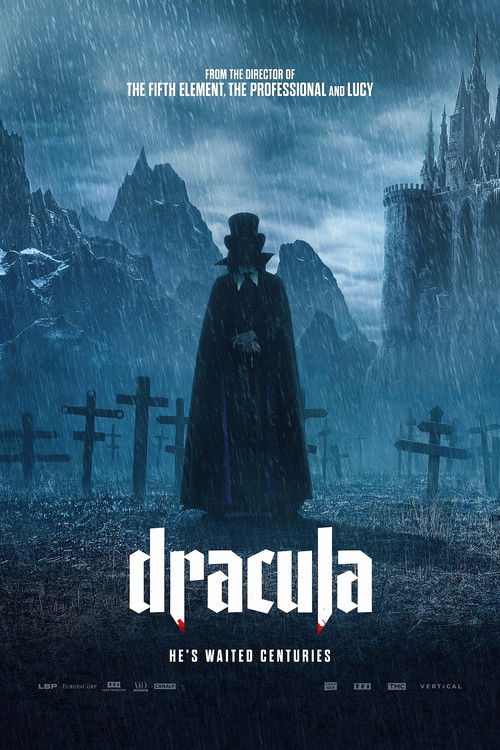
Dracula
2025 · Luc Besson
For a night when you want gothic romance with teeth — eternal love, velvet, ruin — and you'd rather be swept up than genuinely frightened. Reach for it when tragic and gorgeous sounds better than tense and terrifying.
What it's about
In fifteenth-century Eastern Europe, Prince Vlad's beloved bride is murdered — and in his grief he renounces God, is cursed with eternal life, and becomes Dracula. Centuries later the immortal warlord is still searching, following the trail of his lost love into nineteenth-century Paris, with a vampire-hunting priest closing in behind him. It's the Dracula myth rebuilt around a single idea: grief so total it outlasts death.
The experience
Lush, feverish, and unabashedly romantic — a gothic fantasy that plays its doomed-love premise completely straight, swinging between blood-soaked fury and swooning melancholy. It's more operatic than scary; the mood is candlelight and obsession rather than dread.
Performances
Caleb Landry Jones plays Dracula as a raw wound in period dress — strange, feral, and genuinely mournful — while Christoph Waltz brings his precise, dangerous charm to the priest hunting him.
The craft
Luc Besson directs at full maximalist tilt: opulent sets and costumes, centuries-spanning production design from medieval battlefields to gaslit Paris, and a visual appetite that treats every frame as spectacle. It's a film that rewards a big screen simply for the density of what's on it.
Why it matters
Besson's return to large-scale international filmmaking after years of turbulence, and his first real venture into gothic horror territory — a reminder of the French showman's appetite for reinventing familiar myths in his own extravagant image.
Horror · Vampire · Gothic. A lush, feverish gothic romance: a grieving immortal hunts his lost love across centuries, more swooning melancholy than scares.
Snapshot
Luc Besson's Dracula — released under the fuller title Dracula: A Love Tale — is the French writer-director's return to large-scale international filmmaking after a period of legal and financial turbulence, and his first outright horror-adjacent project. It is less an adaptation of Bram Stoker's 1897 novel than a re-engineering of the myth around a single organizing idea: grief weaponized into immortality. The premise foregrounded in the synopsis — a fifteenth-century prince whose bride is killed, who curses God and is remade as a deathless warlord searching across centuries for his lost love — situates the film squarely inside the "Dracula-as-tragic-lover" tradition rather than the "Dracula-as-predatory-monster" tradition. Caleb Landry Jones takes the title role, with Christoph Waltz as a hunting priest figure and Zoë Bleu as the woman whose face recurs through history. The result is a self-consciously operatic melodrama that treats vampirism primarily as a metaphor for mourning that refuses to end.
Because the film is recent and its granular production record remains comparatively thin in the English-language literature, several technical attributions below are flagged where the documentation is uncertain; I have not filled those gaps with invention.
Industry & production
Dracula was mounted as a European production driven through Besson's own production apparatus — the ecosystem descended from EuropaCorp, the studio he co-founded and which structured most of his career's mid-budget and blockbuster output (Lucy, Valerian and the City of a Thousand Planets, Anna). The project is significant less for any single deal point than for what it represents in Besson's trajectory: after Valerian (2017) became a costly commercial disappointment and EuropaCorp entered financial distress, and after Besson himself spent years contending with public allegations and litigation before being cleared in the French courts, Dracula functions as a comeback vehicle — a director returning to the kind of ambitious, star-anchored, internationally saleable genre picture that made his name.
The casting reflects a deliberately international, art-house-inflected commercial strategy rather than a Hollywood-star strategy. Caleb Landry Jones — a character actor with strong auteur associations (the Dardennes' Nitram earned him a Cannes best-actor prize) — is an unconventional choice for a romantic monster lead, signaling that Besson wanted volatility over matinee smoothness. Christoph Waltz brings an Oscar-winning gravitas and a built-in association with articulate menace. Zoë Bleu and Matilda De Angelis round out a cast pitched at European co-production and festival visibility. Precise budget figures and box-office returns are not something I can state reliably here, and I will not estimate them.
Technology
The film is a contemporary digital production and reads as one: its visual ambition lies in constructing period worlds — a fifteenth-century Eastern European battlefield and castle, later historical strata as the immortal Dracula moves through time — through a blend of built sets, costume, and digital extension. Besson's post-Valerian practice has been comfortable with heavy CGI and virtual environments, and Dracula continues that fluency, though it appears to pull back from the wall-to-wall synthetic worldbuilding of Valerian toward a more physically grounded, textured gothic. The vampire iconography — transformation, decay, the manipulation of blood and shadow — is the natural site for effects work, and the film leans on digital compositing for its supernatural set pieces. Absent a detailed published breakdown of the VFX vendors and capture pipeline, I will not specify particular tools or houses.
Technique
Cinematography
The film's visual register is gothic-operatic: deep shadow, saturated candlelit and firelit interiors, and a color logic that pushes toward blood-red against cold stone and night. Besson is a strongly pictorial director whose images tend toward the graphic and the emphatic rather than the naturalistic, and Dracula is built to be looked at — tableaux, silhouettes, and grand architectural compositions in the tradition of the lavish literary-horror film. I do not have a confident, verified credit for the film's director of photography and so will not assign one; readers should note that Besson's most storied camera collaborator across his career is Thierry Arbogast, but I cannot confirm his involvement on this title.
Editing
The cutting serves a melodrama that spans centuries, which imposes a specific structural demand: the film must move fluidly between a founding trauma (the bride's death, the renunciation) and its long aftermath, cross-cutting past and present, memory and pursuit. Besson's editorial style is generally propulsive and image-forward, favoring momentum and legibility over slow-cinema stillness, and the reincarnation-romance structure invites match-cuts and rhymes that bind the lost bride to her modern echo. The specific editor's credit is not something I can verify here.
Mise-en-scène / staging
This is the film's strongest and most characteristic dimension. Besson stages Dracula as spectacle-melodrama: costume as character (armor, ecclesiastical black, mourning and bridal white/red), architecture as emotional pressure, and the vampire's body as the film's central special effect and its central sign. The staging draws on the deep well of gothic production design — the castle as labyrinth of desire and death, the battlefield as the origin wound — and organizes bodies within the frame to read as icon rather than as documentary fact. The love-across-time conceit lets Besson repeat and vary tableaux: the same embrace, the same loss, restaged across periods.
Sound
The score is the element most central to the film's operatic intent, and here the record is clearer: Danny Elfman composed the music. Elfman's involvement is telling — his idiom (gothic-romantic orchestral writing, choral color, a lineage running from Batman through Sleepy Hollow) is precisely the register a tragic-Dracula melodrama wants, and his participation aligns the film with the lush symphonic tradition of prestige horror rather than with contemporary sound-design-driven dread. The music is doing much of the emotional argument that the dialogue and plot only sketch.
Performance
The performances are pitched to melodrama. Caleb Landry Jones plays Dracula as wounded volatility — a man hollowed by grief and rage rather than a suave seducer — which is the film's most interesting acting decision and its most divisive, since it trades erotic magnetism for damaged intensity. Christoph Waltz supplies the film's articulate opposition as the priest, a role that leverages his gift for menace delivered as reason. Zoë Bleu carries the burden of the recurring beloved — a role defined by presence and iconography as much as by dialogue. The performance mode throughout is heightened, consistent with a film that treats emotion as scale rather than as nuance.
Narrative & dramatic mode
The dominant mode is tragic romantic melodrama in gothic-horror dress. The narrative engine is not suspense (will the monster be caught?) but longing (can the dead be recovered?), and the film organizes itself around repetition and return — the beloved lost, glimpsed again, pursued across time. This is fundamentally the structure of the doomed-love ballad: a founding catastrophe that the protagonist spends eternity trying to reverse. The horror elements — damnation, blood, the undead body — function as the amplified vocabulary of a grief that has refused the ordinary human resolution of mourning. Dramatically, the film asks the audience to sympathize with a figure whose immortality is a punishment he chose, which places it in the sentimental-Faustian register: the monster is also the mourner, and the film's emotional wager is that we grieve with him.
Genre & cycle
Dracula: A Love Tale belongs to the gothic-romance horror cycle and, more specifically, to the "sympathetic Dracula" lineage that reframes Stoker's predator as a tragic lover. That reframing is not original to Besson — it is the defining move of Francis Ford Coppola's Bram Stoker's Dracula (1992), which grafted a reincarnation-romance prologue onto the novel and made loss, not appetite, the Count's motive. Besson's film participates in a long-running cultural project of humanizing and eroticizing the vampire that runs through Interview with the Vampire, the Twilight phenomenon, and prestige-TV vampirism, and it arrives amid a renewed early-2020s appetite for gothic horror at scale (Robert Eggers' Nosferatu, released the prior year, being the most conspicuous neighbor). Within that cycle, Besson's contribution is to push the material toward European art-melodrama and away from Anglo-American horror convention.
Authorship & method
Dracula is an auteur project in the strong sense: Besson is a writer-director whose films bear a consistent authorial signature — a taste for stylized, emotionally direct storytelling; strong central figures marked by loneliness or difference; a preference for the graphic image and the operatic gesture; and an outsider's relationship to Hollywood realism. His body of work (Léon: The Professional, The Fifth Element, Lucy, Valerian) repeatedly centers isolated protagonists estranged from the ordinary human world, and Dracula — the ultimate outsider, deathless and grieving — is a natural fit for that recurring preoccupation. Besson is credited as director and, consistent with his lifelong practice, is understood to have authored or co-authored the screenplay, though I flag that I cannot confirm the exact writing credits.
Among collaborators, the securely attributable creative partnership is with composer Danny Elfman, whose gothic-romantic scoring is arguably the film's defining formal choice and the clearest external authorial voice shaping its tone. The cinematography and editing credits I am not able to verify with confidence and therefore leave open rather than guess. What can be said is that Besson's method here is of a piece with his career: build a heightened, image-driven world around a mythic outsider and trust spectacle and score to carry emotion that the script renders in broad strokes.
Movement / national cinema
The film sits within French popular auteur cinema — specifically the strand Besson himself did more than anyone to build: French-financed, French-produced genre filmmaking made for a global audience in the commercial register, the so-called cinéma du look lineage grown into international blockbuster ambition. Besson emerged in the 1980s alongside Jean-Jacques Beineix and Leos Carax as part of the cinéma du look, a movement prizing surface, style, spectacle, and youthful romanticism over social realism. Dracula is a late, grand expression of that sensibility: a French director deploying a canonical British literary myth as a vehicle for pure style and heightened feeling, financed and shaped by European rather than Hollywood structures.
Era / period
Made and released in 2025, Dracula is a mid-2020s production shaped by two industrial realities: a theatrical marketplace hungry for recognizable IP and pre-sold myth, and a moment of renewed prestige interest in gothic horror. It also reads as a post-crisis, comeback-era film for its director — produced after the collapse of EuropaCorp's most ambitious phase and after Besson's protracted personal and legal difficulties resolved in his favor. That context colors the film's evident desire to be taken seriously as a grand romantic statement rather than as disposable genre product. Its release places it in direct temporal conversation with Eggers' Nosferatu (2024), making the mid-2020s a distinct micro-moment of high-budget, auteur-driven vampire cinema.
Themes
The film's governing theme is grief that will not convert into mourning — love so total that its bearer chooses damnation over acceptance of death. From that root grow its subsidiary concerns: the rebellion against God and providence (Vlad's renunciation is a theological act, not merely an emotional one); immortality as curse rather than gift, in which endless life is endless loss; and the idea of the beloved as an eternal, recurring form, love figured as fate that repeats across centuries. The vampire's blood-crusade literalizes a refusal of limits — a man who will not accept that anything, even death, is final. Against this, the priest embodies the counter-argument of submission, faith, and the acceptance of mortal law. The film is finally an argument between defiance and resignation staged over the body of a woman who keeps returning, and its sympathies lean, as melodrama's always do, toward the magnificent futility of defiance.
Reception, canon & influence
Critical reception. As a recent release whose detailed critical record I cannot survey reliably from memory, I will describe its reception only in general terms and decline to attach specific reviews, scores, or quotations. Besson's late-career films have tended to divide critics — admired for visual ambition and conviction, faulted for narrative thinness and tonal excess — and Dracula, as an unabashedly operatic melodrama with an unconventional lead performance, is the kind of film built to polarize along exactly those lines. Readers seeking a precise reception profile should consult contemporary review aggregation directly.
Influences on the film (backward). The dominant ancestor is Coppola's Bram Stoker's Dracula (1992), whose reincarnation-romance framing — the Count as a mourner crossing centuries to recover a lost love — Besson inherits wholesale as his premise. Behind that stands Stoker's novel itself (as myth-source rather than fidelity-target), the Universal and Hammer Dracula traditions as iconographic reservoirs, and the broader gothic-romantic tradition in art and music that Elfman's score channels. Besson's own filmography is a further influence on itself: the lonely, mythic outsider is his lifelong subject, and Dracula imports that figure into period-horror clothing.
Legacy / what it shaped (forward). It is too early to assess durable influence, and I will not overstate it. What can be said is that Dracula: A Love Tale is a data point in the mid-2020s revival of large-scale gothic horror and in the continuing rehabilitation of the vampire as tragic lover rather than predator. Its more consequential legacy may be industrial and biographical — as the film marking Luc Besson's return to ambitious international filmmaking after a career rupture. Whether it launches imitators or stands as a stylistic outlier will only become legible with more distance than the current record affords.
A Deleuzian reading
A man kneels in firelight holding a body.
The full Deleuzian reading of Dracula →
Reception
Critics mostly shrugged when it hit France in summer 2025 (it settled around the mid-50s on Rotten Tomatoes), and it's far too young for a real reappraisal — though it's already collecting 'so sincere it's actually fun' defenders.
How Dracula was received, from release to now →
How to watch Dracula: what to notice on a first viewing
- Watch how candlelight and firelight stain every room red and gold. Besson lights the film in deep shadow and saturated candle and firelight, pushing the palette toward blood red against cold stone and night. The color argues for tragedy before any line of dialogue does.
- Track Dracula's costume from armor to mourning black to bridal white. Besson stages Dracula as spectacle melodrama, using armor, ecclesiastical black, and mourning or bridal white and red so bodies read as icon rather than document. Costume carries the emotional argument the plot leaves unspoken.
- Watch Caleb Landry Jones hold stillness before it breaks into tremor. Jones plays Dracula as a hollowed, volatile man under visible pressure rather than a suave seducer, trading magnetism for damaged intensity. A face that seduces is at rest. This one hasn't rested since the murder.
- Listen for Danny Elfman's choral score swelling under the quiet scenes. Elfman's gothic-romantic orchestra and choral writing carry much of the film's grief, doing the emotional argument the dialogue only sketches. Mute the score and the picture goes quiet in ways the sound mix can't explain.
The whole guide to watching Dracula, with the keys for a rewatch →
Influences: the films it descends from and the films it influenced
- Bram Stoker's Dracula (1992) — Besson lifts the reincarnation-romance premise wholesale — the Count crossing centuries to recover a lost love reborn — along with Coppola's strategy of foregrounding florid in-camera optical spectacle and operatic melodrama over horror realism.
- Nosferatu (1922) — Source of the German Expressionist vampire grammar the gothic-operatic cinematography draws on — shadow deployed as an active character and architecture staged as an instrument of dread.
- Dracula (1931) — Establishes the Universal iconography and Lugosi's stylized, mannered aristocrat template that fixes the Count as a courtly, deliberately artificial outsider rather than a naturalistic figure.
- Dracula (Horror of Dracula) (1958) — Hammer's saturated-color, sensual-physical gothic recast the vampire as an erotic romantic agent — the direct precedent for treating the Count's desire as the film's engine.
- Faust (1926) — Model for the Faustian-melodrama and rebellion-against-God gesture rendered as large-scale visual spectacle, where a soul's bargain is staged through monumental effects imagery.
- La Belle et la Bête (1946) — Poetic, tactile fantasy staging and the monster-as-yearning-lover tenderness that underwrites the gothic-romance mode's sympathy for its inhuman protagonist.
- Interview with the Vampire (1994) — Codified the lush, sympathetic vampire-as-tragic-lover melodrama built on lavish period production design and interiority — the tonal register Besson inherits.
- Edward Scissorhands (1990) — Danny Elfman's tragic-outsider scoring idiom here — choral, music-box romanticism attached to a wounded, estranged protagonist — is the same authorial voice Elfman brings to Dracula's tone.
- Léon: The Professional (1994) — Besson's own template of the lonely, mythic outsider estranged from ordinary human life, transplanted here into period-horror clothing.
- The Fifth Element (1997) — Besson's method of image-driven operatic world-building — trusting maximalist spectacle and score to carry emotion the script renders in broad strokes — is the working procedure Dracula reuses.
- Twilight (2008) — Extends the rehabilitation of the vampire from predator to doomed cross-time lover for a mass audience, the commercial current Besson's tragic-lover framing rides.
- Nosferatu (2024) — Fellow node in the mid-2020s large-scale gothic revival: obsessive cross-time vampire-romance built through digital extension of candlelit historical worlds.
- Crimson Peak (2015) — Shares the gothic-operatic staging that privileges spectacle production design and romantic tragedy over jump-scare horror, treating the haunted-romance as costume melodrama.
- Only Lovers Left Alive (2013) — Recasts the vampire as a melancholic, deathless romantic, dramatizing immortality-as-grief — the same theme of eternal life experienced as endless mourning.
- Sleepy Hollow (1999) — Elfman-scored, artificially heightened period gothic where digital/optical atmosphere manufactures a stylized historical world — the same fusion of Elfman tone and constructed period image.
- Valerian and the City of a Thousand Planets (2017) — Besson's late-career digital-extension maximalism — worlds built primarily as effects spectacle around a mythic protagonist — is the production ethos Dracula applies to period gothic.
Similar films
- Bram Stoker's Dracula (1992) — influence & lineage · same viewing thread
- Nosferatu (2024) — influence & lineage · same viewing thread
- Interview with the Vampire (1994) — influence & lineage · same viewing thread
- Beauty and the Beast (1946) — influence & lineage · same viewing thread
- Crimson Peak (2015) — influence & lineage · same viewing thread
- Nosferatu (1922) — influence & lineage
- Faust (1926) — influence & lineage
- Frankenstein (2025) — same viewing thread
All the films related to Dracula →
Watch it with: curated runs of related films
- Haunted Castles and Restless Ghosts — A run of enchanted ruins, restless dead, and grief that won't stay buried — watch these when you want dread and reverie sharing the same frame.
- Drunk on Design — Watch these together for the rush of maximalist, color-drenched cinema where a woman is made, remade, or consumed by an art form — ballet, fashion, gothic desire — and the production design does half the storytelling.