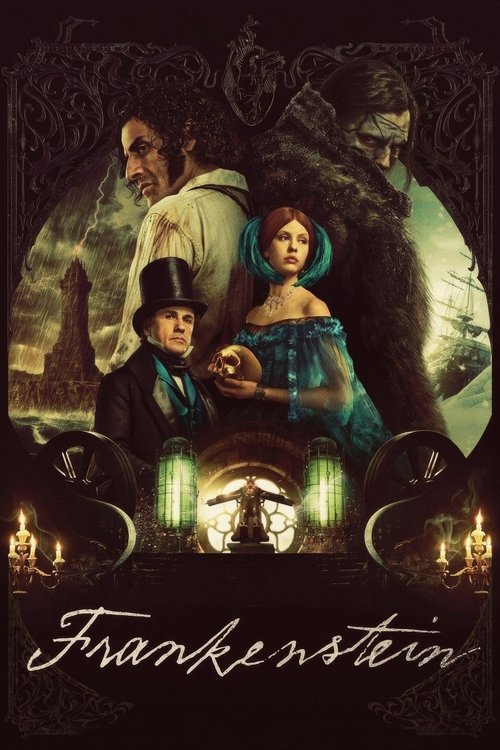
Frankenstein
2025 · Guillermo del Toro
Pinocchio's stop-motion Oscar and his Frankenstein made him the loudest voice for handmade craft against AI ("I'd rather die than use it") — his interviews are reliably viral anti-algorithm sermons. Cinephile Twitter's beloved uncle.
For when you want a big, beautiful, old-fashioned monster movie that actually means it — something to sink into on a dark evening when you're ready to feel for the creature. Comfort and heartbreak at once.
What it's about
Victor Frankenstein, a brilliant and monstrously egotistical scientist, succeeds in bringing a stitched-together creature to life — and then fails him utterly. What unfolds is a gothic tragedy of creator and creation, of fathers and sons who wound each other, set in a lavish Romantic world of laboratories, ice, and old money bankrolling forbidden science. Both man and monster are undone by the experiment, and the film insists on grieving for both.
The experience
Grand, operatic, and openly emotional — this is horror played as tragedy, more likely to break your heart than make you jump. It's sumptuous and sincere, with real anguish under all the velvet and lightning.
Performances
Oscar Isaac plays Victor as a magnetic, feverish egotist you can't look away from, and Jacob Elordi finds startling tenderness inside the Creature — a performance of wounded innocence under heavy prosthetics. Mia Goth and Christoph Waltz round out a cast that treats the material as high tragedy, not camp.
The craft
Del Toro mounts the story with everything he has: cathedral-scale sets, ornate costuming, tactile creature design, and a painter's eye for candlelight and snow. Every frame is built by hand and it shows — this one begs for the biggest screen you can find before it settles onto streaming.
Why it matters
The film del Toro spent thirty years trying to make, and the culmination of his career-long devotion to sympathetic monsters — it premiered at Venice to a prolonged ovation and instantly became the definitive statement of his gothic Romanticism.
Snapshot
Guillermo del Toro's Frankenstein is the culmination of a project the director had openly pursued for roughly three decades — by his own account the film he had wanted to make since childhood, and the one against which he measured his entire career as a creator of sympathetic monsters. A lavishly mounted, openly Romantic adaptation of Mary Shelley's 1818 novel, it stars Oscar Isaac as Victor Frankenstein and Jacob Elordi as the Creature, with Mia Goth as Elizabeth and Christoph Waltz as the arms-magnate patron Heinrich Harlander. Produced for and distributed by Netflix, the film premiered in competition at the 82nd Venice International Film Festival on 30 August 2025, where it drew a prolonged standing ovation, then received a limited theatrical run beginning 17 October before streaming globally on 7 November 2025. It became one of the season's most decorated releases, gathering nine Academy Award nominations including Best Picture and a Supporting Actor nod for Elordi. The dossier that follows treats it as del Toro's summa: a film that gathers his lifelong preoccupations — the misunderstood creature, the failure of fathers, the beauty of imperfect flesh — into a single, deliberately operatic statement.
Industry & production
Frankenstein belongs to the late-2010s/2020s pattern of auteur prestige cinema financed by a streaming platform but granted a theatrical window for awards legitimacy. Del Toro reunited here with Netflix, which had backed his stop-motion Pinocchio (2022), and with his producing partner J. Miles Dale, with whom he had won Best Picture for The Shape of Water (2017). The long development history is central to the film's identity: del Toro discussed mounting a Frankenstein picture across multiple prior phases of his career, and the eventual production carried the weight of a passion project finally realized. The Netflix model afforded a substantial budget for large-scale practical sets, prosthetics, and a sizable European-flavored ensemble, while the platform's "theatrical gamble" — a limited cinema release ahead of streaming — reflected del Toro's well-documented advocacy for the big-screen experience and his vocal skepticism of generative AI in filmmaking, positions he reiterated in press around the launch. Where precise budget and viewership figures are concerned, the public record is not fully transparent, as is typical for Netflix originals, so this dossier makes no claim to exact numbers.
Technology
The production is notable for its insistence on the photochemical and the practical over the digital, even while using a state-of-the-art capture pipeline. Cinematographer Dan Laustsen shot on the large-format ARRI Alexa 65, exploiting the oversized sensor for shallow, organic depth of field and gentle focus fall-off. To counter that sensor's clinical sharpness, Laustsen placed diffusion behind the lens rather than in front, softening highlights while preserving rich blacks and the lens flares del Toro favors. The Creature itself is a triumph of analog craft: makeup designer Mike Hill built a full prosthetic conception of Elordi as a sutured, surgically assembled body rather than the flat-headed, bolted icon of the Universal tradition — a design intended to be lit and seen in full, not hidden in shadow. Production designer Tamara Deverell grounded the laboratory and anatomical apparatus in period research, reportedly photographing thousands of specimens and instruments at London's Hunterian Museum to recreate mid-19th-century medical science. The technological argument of the film, in other words, runs counter to the synthetic: del Toro deploys cutting-edge cameras in service of tangible, hand-built artifacts.
Technique
Cinematography
Laustsen, a collaborator since Crimson Peak (2015) and the Oscar-winning The Shape of Water and Nightmare Alley (2021), gives the film a saturated, chiaroscuro palette built on contrasting color pairs — steel blue against amber, candlelit warmth set against cold backgrounds. He has cited Barry Lyndon as a reference for single-source, naturalistic lighting, while deliberately inverting Kubrick's unified tonality toward split, opposing schemes; Victor's laboratory is washed in heavy green and shrouded in smoke and steam. The widest lens used was a 24mm, chosen because the 65mm sensor renders even wide focal lengths without distortion in close-up, sustaining intimacy with faces. Crucially, the Creature is photographed in full warm light — including a sunrise-lit "father and son" key scene — staking the film's thesis that the monster is beautiful and meant to be looked at directly.
Editing
Evan Schiff — known chiefly for the John Wick films and thus a fresh collaborator for del Toro rather than a returning one — cut the picture in unusually tight tandem with the director, editing daily during the shoot rather than waiting for post. By the wrap, the director's cut was far more advanced than is customary, with temporary score and visual effects already integrated, allowing a near-complete assembly to be screened within weeks. The cutting honors the novel's nested structure, organizing the film into discrete accounts — Victor's, then the Creature's — so that the same events are revisited from the maker's and the made's points of view, a doubling that the editing must manage without redundancy.
Mise-en-scène / staging
Del Toro stages the film as a frame tale bookended in the Arctic, where a ship trapped in ice becomes the confessional space for Victor's narration. Deverell drew the polar sequences from the sublime landscapes of Caspar David Friedrich, reportedly modeling icebergs on his paintings, binding the production design to German Romantic painting as surely as the script binds itself to Romantic literature. Interiors favor density and verticality — the gothic-industrial laboratory, ornate domestic spaces — composed so that the human figures are dwarfed by their settings and their ambitions.
Sound
The film earned an Academy Award nomination for Sound, reflecting a designed soundscape that ranges from the mechanical clamor of the creation apparatus to the hush of the ice. Specific technical credits for the sound team are not detailed here to avoid misattribution, but the recognition itself signals a track built to del Toro's characteristically immersive, texture-forward standard.
Performance
Oscar Isaac plays Victor as a brilliant egotist whose tenderness curdles into abandonment — a portrayal that drew a Golden Globe nomination for lead actor. Jacob Elordi's Creature, performed beneath Hill's prosthetics, became the film's critical centerpiece, praised for finding eloquence, grief, and yearning beneath the body's stitched surface; the role earned him both Golden Globe and Academy Award nominations in the supporting category. Mia Goth's Elizabeth and Christoph Waltz's Harlander anchor the surrounding world, with a deep bench — Felix Kammerer, Lars Mikkelsen, David Bradley, Christian Convery, Charles Dance — filling out the period ensemble.
Narrative & dramatic mode
The film's dramatic mode is tragic and confessional. Following Shelley, del Toro adopts the novel's nested first-person testimonies, splitting the picture between Victor's account of his hubris and the Creature's account of his abandonment and education in cruelty and tenderness. This dual narration is the structural engine: it withholds full sympathy from the maker until we have heard the made, and it converts a horror premise into a moral and emotional reckoning between father and son. The mode is Romantic tragedy rather than fright-driven horror — the dread is existential and familial, the inevitability classical. The Arctic frame lends the whole an elegiac, retrospective cast, the story told as testimony by men already near death.
Genre & cycle
Frankenstein sits at the confluence of Gothic horror, period literary adaptation, and fantasy melodrama — the precise tri-generic label (Drama, Fantasy, Horror) under which it was released. It belongs to a long cycle of Frankenstein films stretching from James Whale's Frankenstein (1931) and Bride of Frankenstein (1935) through Hammer's Terence Fisher/Peter Cushing series and Kenneth Branagh's Mary Shelley's Frankenstein (1994). Del Toro's entry pointedly returns to Shelley over Whale, foregrounding the Creature's interiority and articulacy rather than the inarticulate grunting monster of the Universal lineage. Within the contemporary cycle of auteur-driven, streamer-financed gothic prestige cinema, it is a flagship example — a director using a canonical horror property as a vehicle for personal, art-cinema ambitions.
Authorship & method
The film is unmistakably del Toro's, both as writer (he adapted the screenplay) and director, and it functions as a personal credo: he has long described identifying with the Creature, reading Shelley's novel as scripture about the wound of being abandoned by one's maker. His method here is the assembly of a trusted, recurring atelier. Dan Laustsen returns as cinematographer for their fourth-plus feature collaboration; Alexandre Desplat, who scored The Shape of Water and Pinocchio, composes again; Tamara Deverell, his Nightmare Alley production designer, builds the world; costume designer Kate Hawley (a Crimson Peak collaborator) and creature-maker Mike Hill round out the longtime circle. The notable new hand is editor Evan Schiff. Desplat's scoring choice exemplifies del Toro's method of emotional figuration over period fidelity: rather than a strictly 19th-century pastiche, he wrote a modern score for classical instruments and assigned the violin — "the smallest, most fragile" instrument — as the Creature's voice. Hawley's costume logic is equally authored: a controlled palette of black, white, and "pigeon blood" red for Victor's world, ethereal layered greens for Elizabeth, and a Creature whose clothing ennobles as his soul articulates, beginning in a dead soldier's battlefield coat. This is filmmaking as total, coordinated design, every department keyed to a single thematic argument.
Movement / national cinema
Del Toro is a Mexican director working transnationally, and Frankenstein extends the border-crossing authorship that links him to compatriots Alfonso Cuarón and Alejandro González Iñárritu within a broader Mexican art-cinema diaspora that operates inside Anglo-American and European industrial structures. The film is not a national-cinema product in any narrow sense — it is an English-language, internationally crewed, American-platform production shot with a European Romantic sensibility — but it carries del Toro's signature Catholic-inflected fascination with flesh, suffering, and the sacredness of monsters. Its deepest affiliations are to the German and English Romanticism of its sources (Shelley, Friedrich) rather than to any contemporary national school.
Era / period
Made in the mid-2020s, the film is a product of the streaming era's prestige economy and of an industry moment defined by anxiety over generative AI — a context del Toro engaged directly in interviews, positioning his handcrafted, practical-effects Frankenstein as an implicit rebuke to synthetic image-making. The film is set in the 19th century, its design grounded in 1850s anatomical science and the Crimean War as a backdrop for the Creature's origins among the dead. The collision of those two timeframes — a period story of man-made life, produced at a moment of acute cultural unease about artificially made minds — gives the film an unforced contemporary resonance it largely declines to underline.
Themes
The governing theme is paternity and abandonment: creation as an act of love that becomes an act of cruelty when the maker refuses responsibility for what he has made. Around it cluster del Toro's perennial concerns — the beauty and dignity of the monstrous; the body as a site of wonder rather than disgust; the failure and tyranny of fathers; the human need to be seen and loved. The film also interrogates hubris and the scientific will to mastery, and, through the Creature's education, the social manufacture of monstrousness: he becomes violent because he is treated as a monster, not because he is born one. Shelley's Promethean warning is preserved, but del Toro tilts it toward compassion, asking the audience to grant the Creature the recognition his maker withholds.
Reception, canon & influence
Critical reception was strongly favorable. Aggregated reviews ran broadly positive — Rotten Tomatoes recorded an 85% critics' rating across several hundred reviews — with consensus praise centering on the film's lavish craft and, above all, Elordi's performance as the most "invigorating" element. The Venice premiere's lengthy standing ovation set the tone, and the awards record followed: five Golden Globe nominations (including Best Drama, Director, Score, and acting nods for Isaac and Elordi) and nine Academy Award nominations, among them Best Picture, Supporting Actor, Adapted Screenplay, Cinematography, Production Design, Costume Design, Original Score, and Sound. The influences on the film are openly avowed and span media: Mary Shelley's novel as primary text; the Whale, Hammer, and Branagh adaptations as the tradition to honor and revise; Barry Lyndon for lighting; Caspar David Friedrich for the sublime Arctic; and del Toro's own back catalog, from Cronos through The Devil's Backbone, Pan's Labyrinth, and The Shape of Water, all of which rehearse his sympathy for the monster. Its forward influence is, in mid-2026, still emerging and cannot yet be responsibly assessed; what can be said is that the film consolidates a model — the practical-effects, auteur-controlled, streamer-funded literary gothic — and reasserts the Creature, after nearly a century of Whale's mute icon, as Shelley wrote him: articulate, grieving, and tragically human. On the strength of its reception and awards standing, it enters the canon of Frankenstein adaptations as the definitive del Toro statement and a likely reference point for future treatments of the material.
A Deleuzian reading
Start with the light.
The full Deleuzian reading of Frankenstein →
Reception
Premiered at Venice 2025 to a rapturous ovation as the dream project del Toro had chased for over 25 years, then hit Netflix that November — where the ecstatic 'his masterpiece' first wave quickly met a 'gorgeous but toothless' backlash it's still arguing with.
How Frankenstein was received, from release to now →
How to watch Frankenstein: what to notice on a first viewing
- Watch how much warm light Laustsen puts on the Creature's face. Every other version of this story hides the monster in flicker and shadow. Here the sutures are lit plainly, sometimes by sunrise, and the camera holds the face long enough for you to read it. The film's whole case is made by lighting. You are asked to look directly at a body the genre has always kept half-seen.
- Notice the green smoke and steam filling Victor's laboratory. Del Toro washes the lab in cold green and fills it with vapor, chains, and vertical machinery. The people inside look like parts of the apparatus rather than its operators. Victor's world is lit as though the equipment has a will of its own, which is exactly the thing he refuses to believe about it.
- Notice the black, white, and deep red in Victor's house. Kate Hawley keeps Victor's world to that tight palette, dresses Elizabeth in layered greens, and starts the Creature in a dead soldier's coat that gets finer as he learns to speak. You can tell who belongs to whom, and how far the Creature has come, by fabric alone before anyone explains it.
- Listen for the violin whenever the Creature is on screen. Desplat assigns him the smallest and most fragile instrument in the orchestra and keeps it separate from the heavier writing around Victor and his patron. The score gives the Creature a voice before the character has one, so you hear him as a person while others see a thing.
- Notice when the film restarts the same events under a new teller. Del Toro follows Shelley and splits the picture into two accounts, Victor's and then the Creature's, both spoken aboard a ship locked in Arctic ice by men close to death. Sympathy is rationed by structure. You cannot settle what you think of the maker until the made has given his own version.
The whole guide to watching Frankenstein, with the keys for a rewatch →
Influences: the films it descends from and the films it influenced
- Frankenstein (1931) — Sets the flat-headed, mute-icon Creature and the lightning-lab creation set-piece that del Toro's film is explicitly built to honor and overturn, restoring the articulate Creature against Whale's silent template.
- Bride of Frankenstein (1935) — Whale's expressionist staging of the Creature's first halting speech and his yearning for companionship is the emotional precedent del Toro extends into full Shelley-style eloquence.
- The Curse of Frankenstein (1957) — Hammer's saturated gothic Technicolor and its relocation of guilt onto Victor himself feed the film's 'pigeon blood' red palette and its indictment of the maker rather than the made.
- Mary Shelley's Frankenstein (1994) — The most direct prior attempt to restore Shelley's articulate Creature and her Arctic frame-tale of nested confession — the very structural and characterization choices del Toro adopts and refines.
- Barry Lyndon (1975) — Openly cited reference for the lighting: Dan Laustsen emulates its painterly available-light/candlelit large-format compositions to render the period interiors as living old-master canvases.
- The Spirit of the Beehive (1973) — Erice's image of a child identifying with the Frankenstein monster as a wounded, persecuted innocent is the founding interpretive lens del Toro has repeatedly named as his own reading of the Creature.
- Cronos (1993) — His debut establishes the career-long method: a sympathetic monster realized through practical mechanical/prosthetic effects rather than digital abstraction.
- The Devil's Backbone (2001) — Builds the gothic frame-tale of paternal abandonment around a wounded child-revenant, rehearsing the nested-confession architecture and the orphan's grief that drive Frankenstein.
- Pan's Labyrinth (2006) — Cements the practical creature-design pipeline (sculpted prosthetics, performer-driven monsters via the Mike Hill / DDT atelier) that animates Elordi's Creature.
- Crimson Peak (2015) — Costume designer Kate Hawley and a controlled blood-red gothic palette establish the same authored color logic — black, white, and crimson for the maker's corrupted world — reused here.
- The Shape of Water (2017) — The full atelier converges — Laustsen's chiaroscuro and Alexandre Desplat's score in service of a sympathetic non-human lover — the coordinated total-design method Frankenstein scales up.
- Nightmare Alley (2021) — Tamara Deverell's production design and Laustsen's large-format photography prototype the world-building craft and oversized period sets carried directly into Frankenstein.
Similar films
- Nosferatu (2024) — influence & lineage · same viewing thread
- Crimson Peak (2015) — influence & lineage · same viewing thread
- Frankenstein (1931) — influence & lineage
- Bride of Frankenstein (1935) — influence & lineage
- The Shape of Water (2017) — influence & lineage
- Bram Stoker's Dracula (1992) — influence & lineage
- Cronos (1993) — influence & lineage
- Edward Scissorhands (1990) — influence & lineage
All the films related to Frankenstein →
Watch it with: curated runs of related films
- Haunted Castles and Restless Ghosts — A run of enchanted ruins, restless dead, and grief that won't stay buried — watch these when you want dread and reverie sharing the same frame.