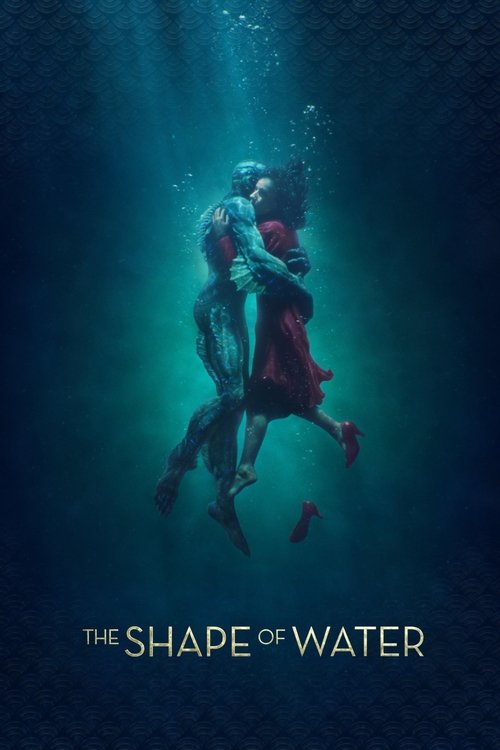
The Shape of Water
2017 · Guillermo del Toro
Pinocchio's stop-motion Oscar and his Frankenstein made him the loudest voice for handmade craft against AI ("I'd rather die than use it") — his interviews are reliably viral anti-algorithm sermons. Cinephile Twitter's beloved uncle.
For a night when you want to be swept away — a romantic, otherworldly film for viewers who like their love stories with monsters and their fantasy with real stakes. Emotionally rich but never punishing.
What it's about
Baltimore, 1962, the deep freeze of the Cold War. Elisa, a mute woman who cleans a secret government laboratory at night, discovers the facility's classified asset: an amphibious man held captive in a tank. Communicating in sign language and shared silences, she falls in love with him — and with the help of her closest friends, plots to break him out from under the eye of a brutal government agent.
The experience
A grown-up fairy tale that swings between tenderness, menace, and swooning romance — lush and strange, unafraid of both violence and sincerity. It leaves you moved in a way that feels old-fashioned in the best sense.
Performances
Sally Hawkins is extraordinary, building a full romantic lead entirely without spoken words — every feeling lives in her face and hands. Around her, Richard Jenkins, Octavia Spencer, and Michael Shannon are pitch-perfect, and Doug Jones gives the creature a soul through movement alone.
The craft
Del Toro's production design drowns the film in greens and teals, turning a Cold War lab and a shabby apartment above a movie palace into storybook spaces, while Alexandre Desplat's waltzing score carries the romance. The creature is a marvel of practical suit work and performance — this is a film to see big and hear well.
Why it matters
The surprise prestige triumph of its year — Golden Lion at Venice, then Best Picture, Director, and Score at the Oscars — it proved a monster romance could win Hollywood's top prize and crowned del Toro's career-long argument that creatures deserve love stories too.
Snapshot
The Shape of Water is Guillermo del Toro's Cold War–era fairy tale about Elisa Esposito, a mute cleaning woman at a secret Baltimore research facility circa 1962, who falls in love with an amphibious humanoid held captive there and conspires to free him. Conceived as a corrective to the thwarted romance del Toro perceived in Creature from the Black Lagoon (1954) — he has often said he wanted the woman and the creature to end up together — the film fuses monster-movie iconography with Douglas Sirk melodrama, the movie musical, and the plush romanticism of French cinema. Produced on a modest budget (widely reported at roughly $19.5 million), it became the surprise prestige triumph of its year: the Golden Lion at Venice, and four Academy Awards — Best Picture, Best Director, Best Original Score, and Best Production Design — from thirteen nominations. It stands as the fullest expression of del Toro's lifelong argument that the monster is the object of empathy and that human institutions, not the "creature," are the true horror.
Industry & production
The film was made through del Toro's own Double Dare You banner with producing partner J. Miles Dale, and financed and released by Fox Searchlight Pictures, the specialty division that had cultivated auteur-driven awards contenders. The screenplay is credited to del Toro and Vanessa Taylor, with story credit to del Toro; the collaboration paired his imagistic sensibility with a writer experienced in character-driven television and drama. Principal photography took place largely in Toronto, standing in for early-1960s Baltimore, using soundstages and location work in the city's older industrial and civic architecture.
The production is a study in constraint breeding ingenuity. Coming off the larger-scale Pacific Rim (2013) and Crimson Peak (2015), del Toro worked here at a fraction of a tentpole budget, concentrating resources on a handful of richly dressed sets — Elisa's apartment above a movie palace, the laboratory, the adjacent cinema — rather than sprawling coverage. The comparatively low cost, unusual for a film of its evident craft, was central to its industrial story: Searchlight positioned it as an artisanal event, and its awards success validated a model in which a genre-inflected art film could dominate a season traditionally reserved for realist dramas. The film also became the subject of documented legal disputes after release, including a suit brought by the estate of playwright Paul Zindel alleging similarities to his 1969 play Let Me Hear You Whisper; the claim was dismissed by a federal court. Del Toro publicly denied deriving the film from that source.
Technology
The Shape of Water is a hybrid of practical and digital craft, and del Toro — a devoted advocate of tangible effects — foregrounded the former. The Amphibian Man was realized as a full-body suit and prosthetic makeup built by Legacy Effects and performed by Doug Jones, del Toro's frequent creature collaborator. The design underwent a lengthy sculpting and testing process; the suit incorporated layered silicone, hand-painted iridescent surfacing, and animatronic elements around the eyes and gills. Digital work by companies including Mr. X augmented rather than replaced the physical creature — refining eye movement, adding subaqueous shimmer, and enabling underwater imagery — so that the being reads as a photographed body rather than a rendered one. This practical-first philosophy is inseparable from the film's emotional claim: the creature must feel embodied for the romance to land.
The film was shot digitally, and its water sequences relied on a combination of tank photography, "dry-for-wet" techniques, and compositing to sustain the sense of a world half-submerged. The technological posture is deliberately anti-spectacular: effects serve texture and tactility rather than scale.
Technique
Cinematography
Cinematographer Dan Laustsen, who had shot Crimson Peak for del Toro, photographs the film in a saturated palette dominated by teals, greens, and aqueous blues — the color of water pushed through every surface, costume, and wall — punctuated by warm reds reserved for moments of desire and rupture (Elisa's shoes, a slice of pie, blood). The camera is fluid and often floating, with slow lateral moves and gentle craning that lend even mundane spaces a submerged, dreamlike drift. Anamorphic framing and a shallow, jewel-box depth of field isolate faces against luminous, out-of-focus backgrounds. Rain streaks windows almost constantly; reflections and glass double the characters. Laustsen's lighting is high-contrast but soft-edged, sculpting the creature and Elisa in pools of light against velvety shadow — a fairy-tale chiaroscuro rather than a realist one.
Editing
Editor Sidney Wolinsky cuts the film to a melodic, unhurried rhythm that mirrors its romantic and musical impulses. Elisa's wordless daily routine is established through patterned montage — waking, bathing, boiling eggs, riding the bus — that recurs and then breaks as her life is transformed, using repetition-with-variation as a narrative engine. The pacing lingers in silence, trusting gesture and glance over dialogue, then accelerates through the heist-like escape sequence. The film's tonal pivots — tenderness, menace, comedy, violence — are managed through editorial modulation rather than abrupt gearshifts, and the black-and-white musical fantasy is stitched in as a seamless emotional escalation rather than a rupture.
Mise-en-scène / staging
Production designer Paul Denham Austerberry, with set decoration by Shane Vieau and Jeff Melvin, built a period Baltimore that is stylized rather than documentary — a heightened 1962 filtered through memory and mid-century design. Elisa's apartment, perched above the fictional Orpheum cinema, is a cocoon of aged wood, curved forms, and green light; the laboratory is a cold cathedral of tile, steel, and institutional menace. Del Toro's characteristic density of detail fills the frame: hard-boiled eggs, vintage advertisements, television sets glowing with old musicals and civil-rights news. Costume designer Luis Sequeira color-codes the ensemble, dressing Elisa increasingly in reds and the villain Strickland in the sickly greens and golds of decaying authority. Staging emphasizes verticality and thresholds — stairwells, doorways, the tub — spaces of passage between worlds.
Sound
Because the protagonist does not speak, sound design carries extraordinary weight. Diegetic music — records, radio, the constant murmur of the cinema below — substitutes for Elisa's voice, and Alexandre Desplat's score functions almost as her interior monologue. The soundscape is watery and enveloping: dripping, sloshing, the hum of machinery, rain. Sign language, foley, and the creature's clicks and trills form a vocabulary of non-verbal communication that mirrors the film's theme of love beyond speech.
Performance
Sally Hawkins anchors the film with an entirely wordless lead performance built from sign language, facial expression, and physical rhythm; her Elisa is neither pitiable nor saintly but sensual, willful, and full of appetite. Michael Shannon plays Strickland as a study in brittle, rotting American authority — controlled menace curdling into desperation. Richard Jenkins, as Elisa's closeted neighbor Giles, and Octavia Spencer, as her sharp-tongued co-worker Zelda, supply warmth, comedy, and the film's chorus of the marginalized; Michael Stuhlbarg plays the conflicted scientist Hoffstetler. Doug Jones's creature performance — expressive within a full prosthetic suit — is the film's technical and emotional keystone, conveying curiosity and tenderness through posture and eyes alone.
Narrative & dramatic mode
The film operates in the mode of the adult fairy tale, framed explicitly as such by Giles's opening and closing narration, which casts the story as a legend of "the princess without voice." Its dramatic structure is classical romance crossed with the caper: courtship through shared music and food, obstacle in the form of the state, and a liberation-heist third act. Del Toro braids parallel plots — Cold War espionage, Giles's loneliness and professional decline, Strickland's domestic and bodily disintegration — around the central love story, so that the romance becomes a lens on a whole society of outsiders. The mode is melodramatic in the honorific sense: heightened emotion, moral clarity, and a faith in feeling as truth. The ambiguous, mythic ending — Elisa revived underwater, her neck scars opening as gills — resolves the story in the register of fable rather than realism.
Genre & cycle
The Shape of Water is a deliberate genre palimpsest. Its skeleton is the 1950s creature feature — Universal's Creature from the Black Lagoon above all — reimagined from the monster's point of view. Onto that it grafts the woman's picture and Sirkian melodrama, the movie musical (culminating in a black-and-white song-and-dance fantasy), Cold War paranoia thrillers, and the fairy tale. It belongs to a small cycle of 2010s films that rehabilitate the horror or monster movie as vehicles for prestige and social allegory, alongside work by directors such as Jordan Peele, and it extends del Toro's own dark-fantasy line. Rather than parody its sources, the film treats them as sincere emotional resources, arguing that "low" genres are capacious enough for love, politics, and grief.
Authorship & method
The film is the culmination of del Toro's signature preoccupations, executed with an unusually intimate group of collaborators. As director and co-writer he brings his recurring grammar: the sympathetic monster, the child-logic of fairy tales, Catholic and sacrificial imagery, insects and machinery, ticking clocks, and fascism or authoritarian cruelty as the genuine evil. His method is famously exhaustive — dense storyboards, detailed "bibles," and hands-on supervision of creature and set design.
His key collaborators here are near-authorial in their own right. Cinematographer Dan Laustsen supplies the liquid, romantic light. Composer Alexandre Desplat contributes one of his most lyrical scores — waltzing, accordion-tinged, evoking French romance — that won the Academy Award and functions as Elisa's voice. Editor Sidney Wolinsky shapes the film's musical tempo. Co-writer Vanessa Taylor grounds del Toro's fantasia in character and dialogue. Recurring performer Doug Jones embodies the creature, and production designer Paul Denham Austerberry builds its saturated world. The film reads as the product of a director-led workshop in which every department serves a single emotional and chromatic idea.
Movement / national cinema
Del Toro is a central figure of the transnational Mexican auteur generation — with Alejandro González Iñárritu and Alfonso Cuarón, the so-called "Three Amigos" — that moved between Mexican, Spanish-language, and Hollywood production while retaining a distinctive sensibility. The Shape of Water is an American studio-specialty film in financing and setting, shot in Canada, yet steeped in a European and Latin American fantastic tradition: the political fairy tale of Pan's Labyrinth, the influence of Spanish and Mexican gothic, and the romanticism of French cinema. It thus sits at a crossroads of national cinemas rather than within any single one, exemplifying the border-crossing authorship that defines del Toro's career.
Era / period
The film is set in 1962, at the height of the Cold War and the Cuban Missile Crisis's shadow, and on the cusp of the civil rights movement — a period del Toro uses as both backdrop and subject. The chosen moment lets the film stage America's anxieties about the Soviet enemy, scientific-military secrecy, and the space race, while foregrounding the era's exclusions: Zelda's experience of racism, Giles's forced concealment of his homosexuality, Elisa's marginalization as a disabled woman. Released in 2017, the film's evocation of a smug, cruel American authority read to many critics as a deliberate mirror of the contemporary political moment, giving the period setting a pointed present-tense charge.
Themes
At its core the film argues for the dignity and desirability of the "other." Its governing theme is love across difference — between species, and by extension across the lines of speech, race, sexuality, and ability that the period polices. Del Toro inverts the horror tradition so that empathy flows to the monster and revulsion to the enforcer of normalcy: Strickland, obsessed with cleanliness, propriety, and his own decaying body, is the film's true grotesque. Water itself is the master metaphor — formless, adaptive, connective, taking "the shape" of whatever contains it, an emblem of love and of fluid identity. Voice and its absence recur throughout: the film celebrates communication beyond language and treats speechlessness as power rather than lack. Cinema and old musicals function as a redemptive dreamworld, and the ending's transformation offers a mythic vision of belonging achieved only by leaving the human order behind.
Reception, canon & influence
The Shape of Water premiered at the Venice Film Festival in 2017, where it won the Golden Lion, and rode strong critical enthusiasm through the awards season. Praise centered on Hawkins's wordless performance, Desplat's score, Laustsen's cinematography, and del Toro's control of tone; it received thirteen Academy Award nominations and won four, including Best Picture and Best Director — a landmark, as a fantasy-genre film rarely takes the top prize. Not all response was uncritical: some reviewers found the fairy-tale schematism or its politics broad, and the film drew documented plagiarism allegations (the dismissed Zindel-estate suit, and public comparisons — including from Jean-Pierre Jeunet — to the visual world of Amélie), which del Toro rejected.
Its influences ON the film are worn openly: Creature from the Black Lagoon and the Universal monster canon; Douglas Sirk's Technicolor melodramas; the Hollywood and French musicals quoted within it; the whimsy of Jean-Pierre Jeunet; and del Toro's own Pan's Labyrinth. Looking forward, the film's legacy is chiefly one of validation and permission: it confirmed that genre fantasy and monster narratives could win the industry's highest honors, strengthening a lane later occupied by other prestige-genre films, and it cemented del Toro's standing as a canonized auteur — leverage he carried into subsequent projects including his Oscar-winning Pinocchio. It has become a touchstone for arguments about empathy, monstrosity, and the political uses of the fairy tale, and a reference point for filmmakers pursuing the sincere, painterly reclamation of "low" genres. As a matter of record, its longer-term influence is still consolidating, and claims about a distinct school of imitators would outrun the evidence.
A Deleuzian reading
Elisa boils two eggs every morning while she takes her bath, timer running on the counter.
The full Deleuzian reading of The Shape of Water →
Reception
Rode a wave from Venice Golden Lion to 13 Oscar nominations and a Best Picture win — then hit the fast backlash that awaits most winners, now often ranked among the softer recent Best Picture choices while del Toro loyalists keep defending it as his tenderest film.
How The Shape of Water was received, from release to now →
How to watch The Shape of Water: what to notice on a first viewing
- Count how rarely red appears, and who is wearing it. Laustsen soaks walls, uniforms and water in teal and green until the color stops describing objects. Red is rationed: Elisa's shoes, a slice of pie. Each appearance lands like a spoken line. Color does the talking for a woman who cannot talk, which is what melodrama has always used it for.
- Watch the camera drift sideways and crane gently in dry rooms. Del Toro and Laustsen photograph corridors, apartments and the lab with the same slow floating movement they use for water. Rain streaks windows; glass doubles faces. The air seems to have weight. The whole city feels submerged before anyone gets in a tank, so the creature's element is already everywhere.
- Watch Sally Hawkins's face in the seconds before she signs anything. Hawkins builds Elisa from small accumulating movements, not held expressions. Pressure gathers in the eyes and mouth and hands until it has to go somewhere. She is hungry, not patient. With no dialogue, the face becomes the place the film stores everything the character wants.
- Track the morning routine: timer, bath, boiled eggs, bus. Wolinsky sets the sequence as patterned montage early, then repeats it with changes. The order shifts, a step drops, a new gesture appears once the creature is in her life. You measure how far Elisa has traveled by what her body does each morning, not by anyone telling you.
- Listen for dripping, sloshing, machine hum and the cinema below. Because Elisa never speaks, del Toro fills the track with water, records, radio and Desplat's waltzing accordion score. The creature answers in clicks and trills. Silence gets a lot of room. A vocabulary of sounds and signs replaces dialogue, and you learn to read it as fluently as speech.
The whole guide to watching The Shape of Water, with the keys for a rewatch →
Influences: the films it descends from and the films it influenced
- Creature from the Black Lagoon (1954) — Provides the Gill-man silhouette and the underwater-ballet camera that frames the amphibian's yearning for the woman; del Toro consciously rewrites its abduction as consummation, keeping the creature's webbed, gilled design language and its subjective floating point-of-view.
- Pan's Labyrinth (2006) — Establishes del Toro's adult-fairy-tale grammar—Doug Jones embodying a full-suit fantastical being, an authoritarian sadist (Vidal/Strickland) as the true monster, and Catholic sacrificial imagery resolved through a child-logic threshold between worlds.
- All That Heaven Allows (1955) — Models the Technicolor melodrama engine—saturated, socially-coded color and framing that make forbidden love across class/difference legible as pure visual emotion, the Sirkian palette del Toro drenches Elisa's world in.
- Amélie (2001) — Source of the green-gold storybook palette, the accordion-tinged French-romance scoring register, and the whimsical fabulist tone Desplat and Laustsen echo—an homage Jeunet himself publicly noted.
- La Belle et la Bête (1946) — The poetic template for a monstrous lover redeemed by a woman's gaze, with tactile enchanted interiors and hand-crafted practical magic rather than spectacle—del Toro's sincere, painterly fairy-tale mode.
- Frankenstein (1931) — Roots the Universal-monster inheritance: the inarticulate, wounded creature whose empathy the film demands, staged with expressionist light and a captured being brutalized by men in authority.
- King Kong (1933) — The 'beauty and the beast' structure of a captured wonder destroyed by human cruelty and desire—the sympathetic spectacle-creature whose bond with a woman indicts its captors.
- Follow the Fleet (1936) — The Astaire-era RKO musical vocabulary del Toro quotes directly in Elisa's black-and-white dream duet, borrowing its monochrome soundstage staging and 'You'll Never Know'-style yearning to give the mute heroine her voice.
- Crimson Peak (2015) — The immediate collaboration where Dan Laustsen's liquid, romantic gothic light and saturated jewel-toned production design were forged with del Toro—the visual method carried whole into the next film.
- The Elephant Man (1980) — Del Toro's Creature — sympathetic monster housed in a government laboratory coded with expressionist steam and green-tiled institutional architecture that mirrors Lynch's hospital — extends the horror-adjacent tradition of filming a being whose visible exterior triggers revulsion while the narrative insists on rich interiority the audience must be methodically taught to read past the surface.
- Edward Scissorhands (1990) — Builds a misfit-monster romance directly on Edward's danger-of-touch and the mute, gentle outsider loved by an ordinary woman and feared by the community.
- Beauty and the Beast (1979) — A literal Beauty-and-the-Beast romance built on beast-POV empathy and creature design that solicits desire, extending Herz's sympathetic-predator project.
- Nightmare Alley (2021) — Del Toro reunites Laustsen, Wolinsky and the same painterly-genre workshop, extending the anamorphic, lacquered period-noir look and department-unified chromatic control into a darker register.
- Guillermo del Toro's Pinocchio (2022) — Extends the adult-fairy-tale-with-fascist-villain project and the sympathetic non-human protagonist, leveraging the auteur canonization the earlier film's Best Picture win secured.
- Poor Things (2023) — Occupies the prestige-genre lane the film opened: a reanimated woman's fabulist coming-of-age in a hyper-saturated, artificial period-fantasy design, love-across-difference staged as an Oscar-honored adult fairy tale.
- The Devil's Backbone (2001) — Del Toro's amber-and-blue ghost-story palette and his method of treating the supernatural being as a mournful figure of loss, with fascist violence as the real horror—same director-led workshop aesthetic.
- Hellboy II: The Golden Army (2008) — Doug Jones's aquatic humanoid Abe Sapien is the direct prototype for the Amphibian Man—same performer, same practical fish-man suit engineering and expressive non-verbal creature acting.
- Delicatessen (1991) — Shares the Jeunet-Caro retro-industrial dinge—sepia-green apartment-block interiors, dripping pipes and machinery fetishized in close-up—that shapes Elisa and Giles's tenement world.
- Splash (1984) — A precedent for the human/aquatic-being romance played sincerely rather than as horror, treating the amphibious lover as an object of tenderness and comedy rather than menace.
- Pacific Rim (2013) — Descendant within del Toro's own oeuvre that re-concentrates the Pacific Rim chromatic palette (teal-amber complementary blocking) and creature-as-protagonist sincerity at intimate scale, proving the authored-genre voice survives the tentpole.
- Project Hail Mary (2026) — Sustains wordless intimacy across incompatible biologies with a non-humanoid creature, rendering communication-across-difference through creature design and gesture rather than speech.
- Frankenstein (2025) — The full atelier converges — Laustsen's chiaroscuro and Alexandre Desplat's score in service of a sympathetic non-human lover — the coordinated total-design method Frankenstein scales up.
- Remarkably Bright Creatures (2026) — Films an aquatic non-human being with tank-side and submerged intimacy so it is legible as a creature deserving empathy and interior life, not spectacle.
- Splice (2010) — Through a performer in prosthetics who never speaks and expresses everything through gesture, del Toro takes the sympathetic, sexualised lab creature held by scientists, the sensibility he brought to Splice, and plays it as romance instead of horror.
- Border (2018) — A practical prosthetic suit, performed by Doug Jones, carries a romance between a human-passing outsider and a creature held by an institution, with the cold, fluorescent light of the government facility set against the warmer world of the lovers, much as Border sets its customs hall against the forest.
Similar films
- Pan's Labyrinth (2006) — influence & lineage
- Guillermo del Toro's Pinocchio (2022) — influence & lineage
- Nightmare Alley (2021) — influence & lineage
- Frankenstein (2025) — shared sensibility
- Flow (2024) — shared sensibility
- Arrival (2016) — shared sensibility
- Moonlight (2016) — shared sensibility
- Remarkably Bright Creatures (2026) — shared sensibility