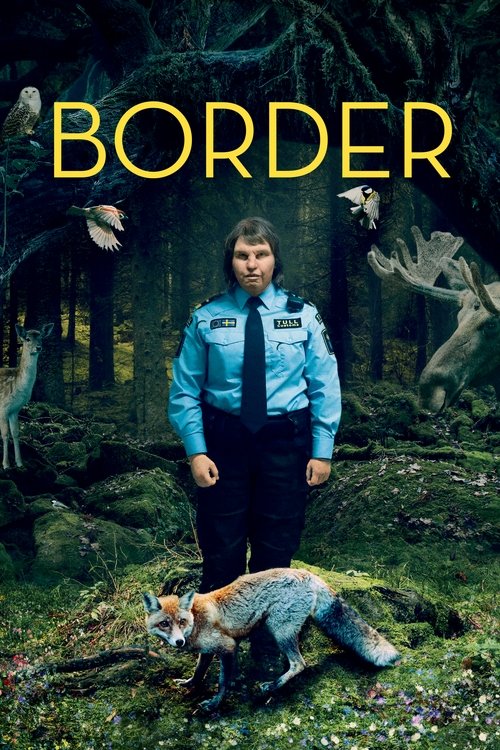
Border
2018 · Ali Abbasi
Holy Spider (Iranian serial-killer exposé shot in exile) then The Apprentice, the Trump origin film that drew legal threats from the sitting candidate and struggled to find US distribution — a director who seems to seek out radioactive material.
For when you want a film that genuinely surprises you and asks what it costs to belong — outsider cinema with teeth. A challenge, not a comfort: parts of its crime story are tough, but the emotional payoff is real.
What it's about
Tina works customs at a Swedish ferry port with an uncanny gift: she can smell shame, guilt, and fear on travellers. Unusual-looking and lifelong lonely, she's the best at her job — until Vore walks through, a stranger who shares her features and whose scent she cannot read. Drawn to him, she's pulled toward unsettling truths about who and what she really is, even as her nose drags her into a genuinely dark criminal investigation.
The experience
Earthy, strange, and unexpectedly tender — a film that keeps shifting under you, from procedural to romance to something wilder, with scenes of startling physical frankness. It leaves you unsettled and moved in roughly equal measure.
Performances
Eva Melander, under heavy prosthetics, gives Tina a full inner life using little more than her eyes, posture, and the way she sniffs the air — and Eero Milonoff matches her with a feral, magnetic strangeness.
The craft
The Oscar-nominated makeup work transforms the two leads without ever smothering them, and Ali Abbasi shoots Nordic forest, mud, and skin with a tactile realism that makes the folklore feel documentary-true. Grounding the fantastic in grey ferry terminals and damp woods is the film's signature move.
Why it matters
It won the Un Certain Regard prize at Cannes in 2018 and became a touchstone for folklore-inflected realism, launching Ali Abbasi onto the international stage.
Snapshot
Border (Swedish: Gräns) is a Swedish–Danish film that mixes Nordic folklore, crime procedural and a kind of social realism. Tina (Eva Melander) is a customs officer at a Swedish ferry port who can literally smell shame, guilt and fear on travellers. Her face looks unusual and she has always lived as an outsider. Then she meets Vore (Eero Milonoff), a traveller who shares her features and whose scent she cannot read. Through him she learns that she is not human at all. She is a troll, taken from her own kind, and her past was hidden from her by the people who raised her. The film adapts a short story by John Ajvide Lindqvist, author of Let the Right One In. It premiered at Cannes in 2018 and won the Un Certain Regard prize. It later received an Academy Award nomination for Best Makeup and Hairstyling. The film is notable because it treats a creature from fairy tale as the subject of a sober, close-up character study about identity, belonging and moral choice, rather than as a figure of spectacle.
Industry & production
The film was produced in Sweden by Meta Film Stockholm and Kärnfilm, with Danish co-production participation. It drew on the regional and national public financing that supports most Scandinavian art cinema. Producers credited include Nina Bisgaard and Petra Jönsson. Neon handled the North American release, and Neon was then building a reputation for idiosyncratic international titles. Abbasi's previous feature, Shelley (2016), was a low-budget Danish horror film about a surrogate pregnancy. Border was a step up in scale and ambition, but it remained a modest European production rather than a genre film made for the commercial market. Detailed public figures for its budget and gross are not reliably documented, so none are given here.
The project began with Lindqvist's short story "Gräns", collected in his 2006 anthology Pappersväggar (translated into English as Let the Old Dreams Die). Lindqvist shares the screenplay credit with Abbasi and Isabella Eklöf. Production centred on Swedish coastal and forest locations around a ferry terminal. The landscape of birch, moss, lakes and grey sea is central to the film's texture.
Technology
The decisive technology in Border is prosthetic makeup, not cameras or visual effects. Göran Lundström and Pamela Goldammer designed the full facial prosthetics worn by Melander and Milonoff, and their work earned the film's Oscar nomination. The appliances changed brow, nose, jaw and skin texture while still letting fine facial movement show through. The whole film depends on that: the faces have to read as non-human yet carry subtle emotion in tight close-up. Contemporary accounts describe application sessions of several hours each shooting day, and report that Melander gained weight for the role. The exact figures vary between sources. The film also used prosthetic bodies for its nude and sexual scenes, and modest digital work for the changeling infant and certain creature details. The publicly available record on the camera package and digital pipeline is thin. Broadly, the film was made with the standard tools of contemporary European art cinema, and its technical investment went mainly into the bodies on screen.
Technique
Cinematography
Nadim Carlsen, a Danish cinematographer, shoots with restraint and close attention. The port scenes are flat and institutional: fluorescent customs halls, conveyor belts, vehicle lanes and steel-grey sea light. They work almost like a documentary of bureaucratic routine. The forest is lit and framed differently. Natural light falls through the canopy, the camera stays close to skin, bare feet, insects and wet earth, and the lenses linger on texture. Carlsen often frames Tina's face in profile or three-quarter close-up, so that the prosthetic contours become ordinary to the viewer. This is not the off-kilter framing of horror. The camera neither conceals nor dramatises the characters' strangeness, and that steady gaze is how the film asks viewers to accept Tina as a subject rather than a monster. The cinematography was widely praised and, by most accounts, recognised at Sweden's Guldbagge Awards.
Editing
Olivia Neergaard-Holm and Anders Skov edited the film. Both are associated with Danish art and genre cinema. The cutting is unhurried. The film runs on two tracks: a crime plot about a child-abuse material investigation that Tina helps the police with, and a slowly revealed folkloric plot about her origins. The editing holds them in parallel and lets them converge only late, when the two turn out to be morally linked. Scenes often end on held looks or silences rather than plot beats. The film's most celebrated sequences are Tina's first immersion in the lake and the frenzied, joyous sexual encounter in the forest. These are cut for bodily rhythm rather than narrative information, which gives them an ecstatic, almost ritual quality that contrasts with the clipped procedural scenes.
Mise-en-scène / staging
The production design sets up two opposed worlds. Human spaces are cramped and drab: Tina's small house shared with Roland and his kennel of aggressive dogs, the father's care-home room, the customs office, the run-down hostel cabin where Vore stays. Tina's world beyond human life is the forest, which she has always approached barefoot and which welcomes her. Staging repeatedly puts Tina in contact with animals, including deer, foxes and the dogs that bark at her, and with insects, which Vore eats and later teaches her to relish. Food, smell and touch are built into the staging, so the viewer is pushed toward sensory identification with a body the film's humans find repellent. The key setting for the late revelations is an institution, glimpsed in documents and testimony, where trolls were confined and experimented on. It ties the fantasy to Scandinavia's real twentieth-century history of institutionalisation and eugenic policy. The film suggests this link rather than spelling it out.
Sound
Sound matters because Tina's gift is sensory, and the film has to convey a sense (smell) that cinema cannot reproduce. It does so through close-miked breathing, sniffing, ambient hums at the port, and amplified natural sound in the forest: rain, wind, insects, water. The score by Christoffer Berg and Martin Dirkov is sparse and textural, often ambient and drone-based rather than melodic. It deliberately avoids both horror stingers and fairy-tale lyricism, which helps keep the film tonally ambiguous. Thunderstorms play a recurring role, because the trolls in the film are drawn to and frightened by lightning, and the sound design treats storms as charged, elemental events.
Performance
Eva Melander's performance is the film's centre and was the most widely praised element of its reception. Under heavy prosthetics she builds Tina through posture, a forward-leaning walk, a cautious and wary gaze, and a voice pitched between gentleness and suppressed animal force. The performance carries Tina from resigned self-acceptance as a "disfigured" woman, through the shock of recognition and erotic awakening, to a final moral independence. She won the Guldbagge for Best Actress. Eero Milonoff, a Finnish-Swedish actor, plays Vore as charismatic, playful and ultimately bitter. He is a tempter whose freedom is real and whose resentment of humanity is understandable but leads to atrocity. Supporting performances, notably Jörgen Thorsson as Roland and Sten Ljunggren as Tina's father, are naturalistic and unshowy, in keeping with the film's Nordic-realist base.
Narrative & dramatic mode
The film's dramatic mode is a coming-to-self narrative wrapped in a fable. Its structure resembles a classic recognition plot: a protagonist who does not know what she is learns her true nature from a double. The film then complicates that pattern. Vore offers Tina an identity, community and pleasure. But he also reveals that he takes human infants and leaves changelings, and that he is tied to the very child-abuse network Tina has been helping to expose. The climax is therefore an ethical decision, not a battle. Tina rejects his politics of revenge without rejecting her own nature.
The tone is deliberately mixed. It combines police procedural, family melodrama, romance, folk horror and social drama without settling into any one of them. The film includes moments of grotesque comedy, erotic exuberance and genuine horror, and it treats them all with the same flat seriousness. The ending is open and quietly hopeful. A package arrives containing a troll infant, along with word of a troll community in Finland, which suggests a future beyond both human society and Vore's vengeance.
Genre & cycle
Border belongs to a twenty-first-century cycle of Nordic films that reimagine folkloric and supernatural material through art-cinema realism. The obvious ancestor is Tomas Alfredson's adaptation of Lindqvist's Let the Right One In (2008), which applied a similar method to the vampire film. The film also sits within what critics in the late 2010s often called "elevated horror", genre films premiering at festivals alongside art cinema. Within Scandinavian production it connects to a wider trend of fantastic and folkloric subjects in regional art film, including later works such as Lamb (2021, Iceland) and The Innocents (2021, Norway). It is not strictly a horror film, though, and many reviewers resisted classifying it as one. Its affinities with romance, social-problem drama and the outsider narrative are just as strong. Its treatment of the troll is also a deliberate revision of the Scandinavian fairy-tale tradition, in which trolls were stock figures of menace or comedy.
Authorship & method
Ali Abbasi was born in Iran and studied in Sweden before training at the National Film School of Denmark. He describes his own position as an outsider within Scandinavian culture. Critics frequently connected that experience to the film's interest in belonging and the arbitrariness of borders. Across his work Abbasi favours a confrontational, unembarrassed treatment of bodies and moral discomfort. This runs from the pregnancy horror of Shelley to the serial-killer procedural Holy Spider (2022) and the Donald Trump biopic The Apprentice (2024). Border is the film that brought him international recognition.
Key collaborators:
- John Ajvide Lindqvist (source author, co-writer). His fiction transplants supernatural creatures into drab Swedish suburbs and working-class settings, and Border keeps that signature pairing of folklore and social realism.
- Isabella Eklöf (co-writer). A Danish-Swedish filmmaker who made her own directing debut, Holiday, the same year. Holiday shares Border's unflinching approach to transgression.
- Nadim Carlsen (cinematographer). A Danish cinematographer who has also worked with Abbasi on later projects.
- Olivia Neergaard-Holm and Anders Skov (editors).
- Christoffer Berg and Martin Dirkov (composers).
- Göran Lundström and Pamela Goldammer (prosthetic makeup design). Their work is arguably as authorial as the direction, given how much the film depends on it.
The film's method, then, is collaborative and adaptive. It starts from an author with a strong sensibility of his own and develops through a pan-Scandinavian creative team.
Movement / national cinema
The film is a Swedish production with strong Danish creative involvement, typical of the cross-border co-production model of contemporary Nordic cinema. Its realist base draws on a long Scandinavian tradition of social-problem filmmaking, and its folkloric imagery draws on the national-romantic tradition of trolls and changelings. That tradition is most familiar visually from John Bauer's illustrations for Among Gnomes and Trolls. Within Swedish cinema, Border helped to reaffirm the international profile of genre-inflected art films after Let the Right One In. Its makers were partly first- and second-generation immigrants, and its subject is an outsider. Both helped it read as a commentary on contemporary Swedish debates about migration, assimilation and who gets to be "Swedish", even though the film never makes those references explicit.
Era / period
Border was made and released in the late 2010s, a period shaped in Europe by the 2015 refugee crisis, intensified border control and the rise of nationalist politics, Sweden included. A film about a customs officer whose job is literally to police a border was read against that background. The late 2010s were also when identity politics, gender nonconformity and bodily difference became central subjects in cultural discussion. Many critics read the film's handling of sex and gender roles (including a deliberate inversion of expected anatomy in the trolls' bodies) and of chosen versus assigned identity through those frameworks. In festival culture, it was part of the moment when genre filmmaking was being reappraised as serious art at Cannes, Venice and Sundance.
Themes
- Identity and self-recognition. The central arc is Tina learning what she is and deciding what to do with that knowledge. The film separates nature, which is given, from ethics, which is chosen.
- Borders and belonging. Literal and figurative borders run throughout: national frontiers, the boundary between human and non-human, between male and female, between the norm and the deviant. Tina polices one border while living across several others.
- Otherness and the "monstrous." The film inverts the fairy-tale association of trolls with menace. The humans include abusers, exploiters and the institution that experimented on trolls, while the trolls are shown to have rich inner lives. Vore's turn to revenge, however, keeps the film from simply romanticising victimhood.
- The body, sex and gender. Sexuality is presented as discovery and liberation, and the inverted anatomy of the trolls unsettles conventional gender expectations. Many critics read this in queer and trans terms. The film does not state those readings, but its imagery invites them.
- Institutional violence and historical memory. The backstory of trolls confined and studied in institutions evokes real histories of state abuse of marginalised groups in Scandinavia, such as the treatment of the Sámi, Roma and Travellers, and of people deemed unfit under eugenic legislation. The film alludes to this history rather than documenting it.
- Morality beyond tribe. Tina's final choice rejects both human hypocrisy and Vore's vengeance. Belonging to a group does not settle what she owes to others.
- Nature and the senses. The forest, water, insects and smell are all associated with a freedom outside human civilisation.
Reception, canon & influence
Critical reception. Border premiered in the Un Certain Regard section at Cannes in May 2018 and won the section's top prize. Critical response was strongly positive and centred on Melander's performance, the makeup work and the film's tonal daring. Reviewers frequently called it unclassifiable, and many remarked on how a story that could have been absurd was made emotionally serious. Some critics found the child-abuse subplot heavy-handed or tonally jarring against the folkloric material. The film was Sweden's submission for the Academy Award for Best Foreign Language Film. It was nominated for Best Makeup and Hairstyling, a rare recognition for a non-English-language art film in that category. At Sweden's Guldbagge Awards it won several prizes, including Best Actress for Melander. The film has since become a fixture of lists and courses dealing with contemporary folk horror, queer readings of genre cinema and the late-2010s "elevated" genre wave.
Influences on the film (backward). The clearest lineage is Lindqvist's fiction and Alfredson's Let the Right One In, which established how to treat a mythic creature with suburban realism and tenderness. Scandinavian folklore about trolls and changelings is the raw material, filtered through the national-romantic visual tradition associated with John Bauer. Critics also noted affinities with David Cronenberg's body cinema, in its interest in bodily transformation and sexuality. Others pointed to the long tradition of the sympathetic monster, running from Frankenstein through Guillermo del Toro's The Shape of Water (2017). That film appeared just before Border and also centres on a romance with a non-human. The procedural strand draws on the Nordic crime tradition (Nordic noir), whose grey palette and institutional settings the film borrows and then subverts.
Legacy (forward). Border launched Ali Abbasi into international prominence. It made possible Holy Spider, which premiered in competition at Cannes and won Best Actress for Zar Amir Ebrahimi, and later The Apprentice and his work in American television. It strengthened the market and festival standing of Nordic folkloric art cinema, and is often cited alongside later works such as Lamb, The Innocents and the 2024 adaptation of Lindqvist's Handling the Undead. Its success with practical prosthetics in an intimate, close-up drama also served as a reference point in debates about practical versus digital creature work. It is too soon to measure its longer-term influence precisely. Its established place in criticism is as one of the key films of the late-2010s convergence of art cinema and genre, and as a significant example of how folklore could be used to address questions of identity, otherness and the politics of borders.
Influences: the films it descends from and the films it influenced
- Let the Right One In (2008) — The first Lindqvist adaptation set the method Border inherits: a mythic creature is filmed in the flat, overcast light of social realism in a drab Swedish suburb, and its monstrousness is shown through quiet close-ups rather than genre spectacle.
- Shelley (2016) — In his debut, Abbasi was already shooting supernatural body horror in a Danish co-production with a restrained, chamber-drama camera, and he paired a remote rural house surrounded by nature with a woman whose body becomes a site of the uncanny.
- The Elephant Man (1980) — Christopher Tucker's full-head prosthetics let John Hurt give a fine, readable performance under heavy appliances, and the film frames the deformed man as the moral centre against the institutions that exhibit him, a model for how Border presents Melander.
- Beauty and the Beast (1946) — Jean Marais's prosthetic Beast is shot with the same lighting and tenderness as the human leads, which made the folkloric non-human an object of desire rather than fear, as Border later does with Vore.
- Bride of Frankenstein (1935) — Jack Pierce's makeup turns the creature's search for a mate of his own kind into the plot's engine, the recognition-by-a-double structure that Tina's meeting with Vore revises.
- Freaks (1932) — Browning shoots its bodily-different community at eye level and in the routines of daily life, a non-othering camera stance that Border applies to its trolls while turning the 'normal' world into the source of horror.
- The Fly (1986) — Chris Walas's stage-by-stage practical transformation ties bodily change to sexuality and appetite, and Border's bug-eating, its revealed genitalia and Tina's body coming to know itself extend that Cronenbergian body cinema.
- Thelma (2017) — This Nordic art-horror film puts a supernatural woman under clinical and medical scrutiny, cross-cuts cold institutional interiors with natural landscapes, and shows heightened senses through sound design, the same grammar Border uses for its border-post procedural.
- Lamb (2021) — A folkloric hybrid creature, made with puppetry and digital work, is placed in a deadpan, naturalistic farm drama, a Nordic art-horror model that Border's success made viable at festivals and in the market.
- The Innocents (2021) — Supernatural powers are rooted in the bland realism of a housing estate, and the sound design is tactile and close-miked to put the viewer inside the children's senses, extending Border's sensory staging of difference.
- Titane (2021) — Prosthetic bodily transformation, an indeterminate gendered body and a sexuality outside the human, presented without shame, follow Border's frank treatment of a non-normative body discovering what it is.
- Hatching (2022) — Gustav Hoegen's animatronic creature becomes the heroine's monstrous double, a Finnish recognition-through-a-double plot that uses practical creature work to stand for a self that has been repressed.
- You Won't Be Alone (2022) — A folkloric creature learns what it is to be human through touch, smell and nature, filmed in a close, sensory style, the same strategy of identifying with the other that shapes Tina's forest scenes.
- Handling the Undead (2024) — Lindqvist co-wrote this adaptation of his novel, which treats the returned dead as subjects of grief realism, with a muted palette and long takes, continuing the Lindqvist approach Border renewed.
- A Different Man (2024) — Mike Marino's facial prosthetics, nominated for the Oscar for makeup and hairstyling, carry a story about identity and a double, extending Border's case for practical, close-up prosthetic performance as the emotional centre of an art film.
- Under the Skin (2013) — Mica Levi's droning, textured score and a camera that slowly shifts the audience's sympathy to an alien misreading the human world anticipate Border's ambient drone and its sensory identification with the outsider.
- The Shape of Water (2017) — A practical prosthetic suit, performed by Doug Jones, carries a romance between a human-passing outsider and a creature held by an institution, with the cold, fluorescent light of the government facility set against the warmer world of the lovers, much as Border sets its customs hall against the forest.
- Holiday (2018) — Eklöf, Border's co-writer, directed it the same year. It uses unblinking, held wide shots that refuse to cut away from transgression, the confrontational approach to bodies and abuse that drives Border's paedophile-ring subplot.
- The Ugly Stepsister (2025) — The nearest Nordic-genre kin: it folds fairy-tale/folkloric creatures into prosthetic-heavy corporeal realism delivered in flat Scandinavian deadpan.
Similar films
- Lamb (2021) — influence & lineage
- Thelma (2017) — influence & lineage
- Let the Right One In (2008) — influence & lineage · same viewing thread
- The Medium (2021) — same viewing thread
- Goodnight Mommy (2015) — same viewing thread
- Crossing (2024) — shared sensibility
- Fjord (2026) — shared sensibility
- Green Border (2023) — shared sensibility
All the films related to Border →
Watch it with: curated runs of related films
- Whatever's Wearing That Face — A run of horror-thrillers where the real terror is that you can't trust what a person appears to be — a double, a shapeshifter, a smiling stranger, the one you desire.