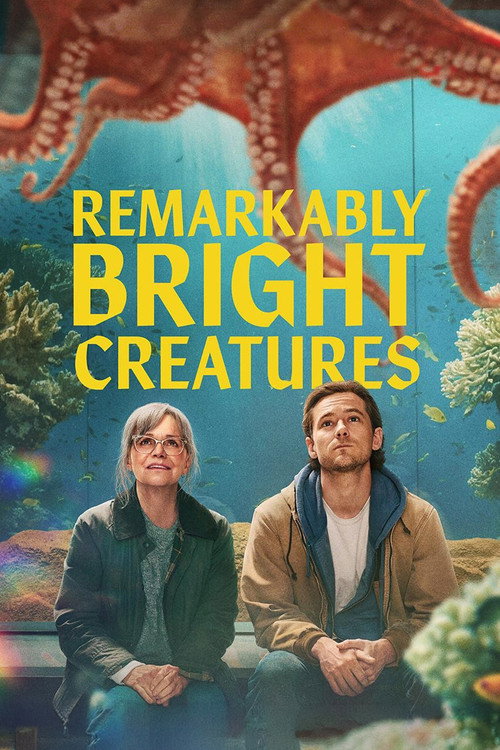
Remarkably Bright Creatures
2026 · Olivia Newman
For when you need a good cry and want to come out the other side hopeful — a tender, restorative watch for a quiet evening alone or with someone you love. Comfort, with real emotional weight.
What it's about
Tova, an elderly widow still carrying the loss of her child decades on, works night shifts cleaning a small-town aquarium in the Pacific Northwest. There, in the after-hours quiet, she forms an unlikely bond — including with a remarkably intelligent octopus — that leads her toward a discovery with the power to reopen her life. It's a mystery folded inside a story about grief, and the strange places connection finds us.
The experience
Gentle and aching, paced like those hushed night shifts — it moves you slowly and then all at once. Expect to cry, but the tears are the warm kind; wonder keeps breaking through the sorrow.
The craft
Adapted from a much-loved bestseller, it hinges on making an octopus a genuine character — expressive, watchful, half-narrator — which is a real feat of craft and restraint. The aquarium-at-night setting gives it a soft, glowing visual signature: blue light, water, silence.
Why it matters
It arrives on a wave of readers who made the novel a word-of-mouth phenomenon, part of a broader appetite for stories that treat late-life grief and unlikely friendship with tenderness rather than pity.
Snapshot
Remarkably Bright Creatures is the feature adaptation of Shelby Van Pelt's 2022 debut novel of the same name, a word-of-mouth bestseller built around one of the more unusual point-of-view devices in recent popular fiction: a giant Pacific octopus who narrates. The film follows Tova Sullivan (Sally Field), a widow who lost her son decades ago and now works the night shift cleaning a small-town aquarium on Washington's Puget Sound, where she befriends Marcellus, a giant Pacific octopus — voiced in narration by Alfred Molina — whose observant intelligence quietly threads together the story's central mystery and who occasionally escapes his tank to move events along. A young drifter, Cameron Cassmore (Lewis Pullman), enters Tova's orbit, and the film alternates perspectives among Tova, Cameron, and Marcellus, as the novel does.
The film was directed by Olivia Newman, who co-wrote the screenplay with John Whittington, and released on Netflix in May 2026 at a runtime of 111 minutes. Newman's previous feature, the 2022 adaptation Where the Crawdads Sing, had established her as a filmmaker fluent in the book-club-literary register: sincere, landscape-forward drama pitched at a broad adult audience and adapted from a beloved source. Remarkably Bright Creatures extends that method to a gentler, stranger premise, and its reception has been broadly warm — an 85% positive score across 71 reviews on Rotten Tomatoes, against a more mixed 55 on Metacritic — with particular credit going to Field's restraint and to the credibility of its digital octopus.
Industry & production
The film sits squarely within the contemporary economy of the prestige-adjacent literary adaptation — the pipeline that runs from a breakout novel to a star-anchored adult drama aimed at older audiences underserved by franchise cinema. Van Pelt's novel was a commercial phenomenon of exactly the kind that pipeline feeds on, and the choice of Newman as director followed the logic of her prior success with Where the Crawdads Sing, which converted a similarly ubiquitous book into a theatrical hit.
Where Crawdads tested the theatrical market, however, this adaptation went to streaming. The film was produced by Anonymous Content and Night Owl Stories and released directly on Netflix, which means its commercial life is measured in viewership rather than box office; no theatrical grosses attach to it. Production shot in and around Vancouver, British Columbia, wrapping in May 2025, with most of the filming centered on Deep Cove — chosen, Newman has said, for its bay, its mountains, and locations that could serve as Tova's house and the town's main street, standing in for small-town Puget Sound. The move to a streamer is itself a datum about the industrial moment: the bestseller-derived adult drama, once reliable theatrical counter-programming, now frequently finds its mass audience through the subscription platform instead, with the pre-sold readership of the novel functioning as the marketing engine either way.
Technology
The defining technical problem of adapting Remarkably Bright Creatures was always Marcellus himself. A giant Pacific octopus is a soft-bodied, near-liquid animal whose expressiveness lives in skin texture, color-shift, and the independent articulation of eight arms — precisely the register in which digital creature work is hardest to make convincing, because audiences have strong intuitions about how real octopuses move, intuitions sharpened by the cultural moment around the 2020 documentary My Octopus Teacher.
The production's solution was a fully digital octopus grounded obsessively in the real animal. Using trained live octopuses was ruled out, and roughly half a year of research preceded the shoot. Newman insisted that Marcellus appear in real spaces rather than against green screen, and the team recorded a real giant Pacific octopus named Agnetha at the Vancouver Aquarium from every available angle, accumulating hundreds of hours of reference footage. The character work was executed by the studio Untold under visual effects supervisor Chris Ritvo, who moved to Untold after the collapse of MPC; animators showed their blocking side by side with the real octopus reference, and the creature's layered coloring system allowed the team to push or pull his skin tones to signal camouflage or illness. Molina recorded Marcellus's narration while watching the finished scenes, physically moving as he spoke to feel his way into the water. The gamble paid off in exactly the terms the premise demanded: reviewers found the creature tangible enough that the effect never pulls attention from the drama — JoBlo's Alex Maidy made precisely that point — which is to say the technology works invisibly, sustaining both naturalistic aquarium behavior and legible, character-driven attention without tipping into anthropomorphic cartoon.
Technique
Cinematography
Cinematographer Ashley Connor shot the film on the Alexa 35 with Panavision Primo lenses, which she has described as gentle portrait glass — a choice consistent with a film built on faces. Her governing strategy was subjective, perspective-based coverage designed to honor the novel's multiple viewpoints, deliberately avoiding flashy camera moves. For Marcellus's own point of view, Connor built a rig that let her put the camera directly into the wet tank, and Panavision fabricated a custom lens attachment, nicknamed Octovision, to mimic the distortion of seeing through water; filtered lenses and practical tank lighting completed the underwater vocabulary, with Connor working closely alongside Ritvo so that the lighting on set would match the digital creature work. The palette runs cold and maritime: TheWrap's Matt Goldberg noted how the film's overcast gray tones work against the Hallmark-adjacent sentimentality of the material, and Newman has described grading the aquarium to feel slightly otherworldly next to the ordinary registers of Tova's domestic world — the color work was finished by colorist Nat Jenks at Picture Shop. The visual tension the material always promised — between the submarine intimacy of Marcellus's tank and the gray loneliness of Tova's town — is thus built directly into the lens and grading choices.
Editing
The novel's structure is multi-perspectival, cutting among Tova, Cameron, and Marcellus's own chapters, and the film preserves that braid. Editor Tamara Meem, a returning Newman collaborator, carried unusual authorial weight here: because Marcellus is a digital character, scenes involving him could be invented in the cutting room that were never in the script, with the creature effectively re-blocked in post to serve the rhythm the edit discovered. The editorial machinery serves the slow reveal of a mystery of kinship — information the octopus grasps before the humans do — and critics found the resulting plot notably clean; Goldberg observed that the film keeps its story neat and resists piling on complications.
Mise-en-scène / staging
The world is small and repeatable by design — the after-hours aquarium, Tova's tidy house, a coastal town — and the staging does its emotional work through routine and object: the compulsive cleaning, the geography of the tank and its lid, the shift schedule as the concrete vocabulary of grief and control. Deep Cove's bay, mountains, and main drag supply the town, with production design by Jennifer Morden and costumes by Carla Hetland dressing the film's two registers — the worn maritime ordinary and the glowing enclosure of the aquarium. The recurring staging problem, the human-octopus two-shot across glass, is solved by the production's real-spaces doctrine: because Marcellus was composited into practically lit, physically present sets rather than green-screen voids, the encounters between Field and the creature read as shared space rather than effect.
Sound
Marcellus speaks only in voice-over, and Molina's narration is the film's sonic spine — Maidy described it as a calming presence that guides the viewer through the story. Dickon Hinchliffe composed the score, and its signature creature-music came from an unexpected source: Newman chose a bass clarinet line from a Mal Waldron composition to accompany the octopus slinking across the aquarium floor, a jazz-inflected touch that gives Marcellus's nocturnal movement a wry, sinuous character. The final mix was completed in Dolby Atmos at Sony.
Performance
The film is, at its core, a lead performance for an older actress, and Sally Field's Tova carries it in exactly the register the material demands: stoic, self-contained grief that only gradually admits wonder. Goldberg credited Field with steering the role away from mawkishness through sheer authenticity, and Newman has praised her as an actor relentlessly committed to the truth of each scene. Lewis Pullman's Cameron — a rootless young man edging toward belonging — struck Maidy as genuinely easy to root for, giving the film its second pole. Around them sits a seasoned ensemble: Joan Chen as Janice Kim, Kathy Baker as Mary Ann Minetti, and Beth Grant as Barb Vanderhoof among Tova's circle, Colm Meaney as Ethan Mack, and Sofia Black-D'Elia as Avery. Molina's vocal performance completes the cast, and the acting across the board does what the material rewards: it underplays, letting the structural sentiment do the work.
Narrative & dramatic mode
The dominant mode is the intimate melodrama of reconciliation — a consolation narrative in which loss is slowly answered by unexpected connection. Structurally the film is a mystery in disguise: the engine is the decades-old question of what happened to Tova's son, and the emotional machinery converts that cold case into a story of found family. The distinctive formal gambit inherited from the novel is the non-human witness. Marcellus functions as a limited-omniscient narrator whose superior perception lets the audience hold knowledge the protagonists lack, producing dramatic irony that is warm rather than cruel — and the film literalizes his agency, letting him slip his tank to nudge events forward. Newman balances a deliberately cozy tone against real grief and death, and the film is unashamedly affective and closure-seeking: critics on both sides of the verdict agreed it aims squarely at the heart, with Goldberg conceding it is too heartwarming to dismiss and Maidy finding it sweet and harmless but low on dramatic stakes. The mode is the popular tearjerker, executed cleanly rather than ambitiously.
Genre & cycle
The film belongs to a clearly legible contemporary cycle: the bestseller-derived adult drama, kin to Where the Crawdads Sing (2022), A Man Called Otto (2022), The Notebook (2004) and its descendants, and the broader lineage of literary tearjerkers about grief, aging, and second chances. It overlaps two further traditions. First, the human-animal bond film — from Marley & Me to The Art of Racing in the Rain — in which an animal's shorter life span becomes a lesson in mortality and love. Second, and more specifically, it rides the cultural wave of octopus-as-sentient-other that My Octopus Teacher crystallized: a moment in which the octopus became popular shorthand for non-human intelligence and interspecies empathy. Its mystery elements are real but subordinate; the film is a drama that uses a mystery, not a thriller.
Authorship & method
Olivia Newman is the film's principal author, here both director and co-screenwriter with John Whittington. Her debut feature, First Match (2018), was a Brooklyn-set independent drama about a teenage girl who joins a boys' wrestling team — a story of a young woman seeking family and self-definition through discipline. Where the Crawdads Sing (2022) then scaled her sensibility up to a studio literary adaptation, and her substantial episodic television background shows in a style of clean, emotionally readable coverage and efficient scene-making. The through-line across her work is an interest in characters — often women, often isolated — who find belonging in unlikely structures, rendered in a sincere, accessible, landscape-conscious style.
On this film her method is unusually visible in the record. The screenplay's hardest problem — translating Van Pelt's first-octopus narration into cinematic form — was solved by keeping Marcellus as a voice-over narrator while grounding his body in documentary-grade reference; Newman's insistence on real locations over green screen, and her hands-on choices down to the Waldron bass clarinet cue, mark her as a director who treats the creature as a character to be directed rather than an effect to be supervised. Her key collaborators form a coherent unit: Connor behind the camera, the returning Meem in the edit, Hinchliffe on score, and Whittington on the page.
Movement / national cinema
This is mainstream American commercial cinema, part of no formal movement. It belongs to the Hollywood middlebrow — the adult literary drama — and to the specific institutional formation of the book-club film, in which the mass reading public functions almost as a production entity, guaranteeing an audience and shaping tone toward emotional accessibility and moral clarity; its Netflix release marks the streaming-era variant of that formation. Its regional identity is Pacific Northwest — Puget Sound, small-town Washington — rendered, in the familiar economics of North American production, by British Columbia, with Deep Cove supplying the bay, mountains, and main street.
Era / period
The story is contemporary, set in roughly the present day, but it is structured around a decades-long shadow — the disappearance of Tova's son, which preceded the film's action by some thirty years. That gives it a doubled temporality typical of the reconciliation drama: a present-day narrative continually reaching back into an unresolved past. As a 2026 release it also belongs to a distinct industrial moment: where Where the Crawdads Sing demonstrated the theatrical viability of the mid-budget adult literary drama, this film shows the same product migrating to the streaming platform, where the genre's older-skewing audience is now most reliably reached.
Themes
The film's governing themes are grief and its long half-life; loneliness and late-life isolation; and the possibility of renewed wonder after loss. Around these cluster several others: found and restored family; aging, mortality, and the dignity of routine, embodied in Tova's self-sufficiency and control; and interspecies connection as a route to human insight, with Marcellus as both literal creature and metaphor. Goldberg's reading of the finished film lands on exactly this cluster — connection and renewal across generations, the redemptive force of being seen by others, and community as the answer to isolation. The octopus's biologically short life becomes a thematic instrument — a being whose intelligence and mortality mirror the human characters' own reckoning with time — and underneath runs a gentle argument about attention: that being truly seen, even by a creature behind glass, is a form of rescue.
Reception, canon & influence
Backward, the film's influences are legible: the literary tearjerker and the human-animal drama, the commercial template of Where the Crawdads Sing, and the cultural elevation of the octopus as an emblem of non-human mind in the wake of My Octopus Teacher and popular science writing on cephalopod cognition. Its most immediate source is Van Pelt's novel, whose narrative architecture — the octopus narrator, the buried familial mystery, the small-town aquarium — the film adapts rather than originates.
The reception splits along a predictable seam. The aggregate verdict is warm — 85% positive at Rotten Tomatoes across 71 reviews, with an average of 6.9/10 — while Metacritic's 55 registers a more mixed critical establishment, and at least one reviewer found the whole enterprise too cutesy. Goldberg's positive notice for TheWrap conceded the film's sentimentality while arguing it is too genuinely heartwarming to dismiss; Maidy's middling 6/10 at JoBlo found it sweet but short on stakes. What is notable is where the consensus landed on the two benchmarks this adaptation was always going to be measured against. Against Where the Crawdads Sing, it reads as the quieter, odder, better-reviewed film. And on the credibility of its octopus — the question on which the whole conceit stood or fell — the craft verdict is affirmative: Marcellus registers as a genuinely bright creature rather than a gimmick, carried by Molina's voice and Untold's reference-driven animation. Its longer influence remains to be seen, but its immediate contribution to the cycle is as working proof that the non-human narrator is viable on screen, and that the sincere adult literary drama has found a durable second home on the streaming platform.
A Deleuzian reading
The aquarium is closed for the night.
The full Deleuzian reading of Remarkably Bright Creatures →
Reception
Critics shrugged at launch in May 2026 — 'Sally Field deserves better' pieces abounded — but audiences promptly cried their eyes out and made it the most-watched streaming film in the world its opening week, with the audience score running well ahead of the critics'.
How Remarkably Bright Creatures was received, from release to now →
How to watch Remarkably Bright Creatures: what to notice on a first viewing
- Watch who stands on which side of the glass. The human-octopus two-shot recurs: Field's Tova on the dry side, cleaning after hours, Marcellus behind the glass on the other. Newman composited him into practically lit, physically present sets, so the encounters read as shared space. An inch of glass is the whole relationship; feel which of them is doing the watching.
- Notice when the picture wavers as if seen through water. For Marcellus's point of view, Connor put the camera into the wet tank and Panavision built a lens attachment, nicknamed Octovision, to bend the image the way water does. Practical tank lighting and filtered lenses finish the look. The film gives a boneless animal a seat to see from, and tells you when you are sitting in it.
- Watch how gray the town is next to the tank. Connor keeps the palette cold and maritime, overcast gray for Tova's house and the coastal town, and Newman graded the aquarium to feel slightly otherworldly beside it. Goldberg noted the gray working against the material's sentimentality. The aquarium is the one place in Tova's world with a glow in it; the grade tells you where she comes alive.
- Listen for the bass clarinet when the octopus moves. Newman set a Mal Waldron bass clarinet line under Marcellus slinking across the aquarium floor, a jazz touch inside Dickon Hinchliffe's score, while Alfred Molina's voice-over narration carries his thoughts. The creature gets a sound of his own, wry and sinuous, so his movement reads as intention rather than effect.
- Watch Field's hands while Tova cleans. Field plays Tova's grief as routine: the compulsive cleaning, the tidy house, the shift schedule as her vocabulary of control. She underplays throughout, and the wonder arrives only by degrees. The grief is never explained in a speech; it is in how carefully she handles a surface.
The whole guide to watching Remarkably Bright Creatures, with the keys for a rewatch →
Influences: the films it descends from and the films it influenced
- Where the Crawdads Sing (2022) — Newman's own template for the sincere bestseller adaptation — Polly Morgan's landscape-conscious cinematography and a buried small-town mystery surfaced through clean, emotionally legible coverage — is the direct production model this film extends.
- First Match (2018) — Newman's debut established her method of filming an isolated young woman finding belonging inside an unlikely structure, rendered in restrained, character-forward staging carried over here.
- My Octopus Teacher (2020) — Its patient, tactile close-focus cephalopod cinematography and framing of the octopus as a genuine non-human mind is the visual and cultural grammar Marcellus's credibility depends on.
- Life of Pi (2012) — Pioneered the photoreal animal co-lead that must carry emotional weight and register as a real creature rather than an effect — the exact stand-or-fall problem the octopus poses, plus a survivor's frame narration.
- Babe (1995) — Model for granting a fabricated/animatronic animal full interiority and a speaking presence so it reads as a sincere protagonist, not a novelty.
- The Lovely Bones (2009) — A precedent for the decisive craft task here: converting a novel's structurally impossible first-person narrator into a workable cinematic narrating voice and gaze.
- The Notebook (2004) — Codified the recollection/framing device that slowly unspools a buried familial secret as the emotional engine of a sincere literary tearjerker.
- Marley & Me (2008) — The template for the human-animal tearjerker that converts a companion creature into a life-spanning emotional arc pegged to family milestones.
- Dolphin Tale (2011) — Establishes the small-town marine-aquarium rehabilitation setting as a sincere, landscape-conscious family-drama space built around a single charismatic sea animal.
- Finding Nemo (2003) — Turned the aquarium tank into a socially characterized world of sea creatures with distinct interior lives, popularizing the aquarium-as-community staging.
- The Art of Racing in the Rain (2019) — Solves the same adaptation problem — a novel narrated in the first person by an animal — by anchoring the human melodrama in the animal's reflective voiceover.
- A Dog's Purpose (2017) — Threads a human family drama through an animal's continuous inner-voice narration, the voiceover device translating a non-human consciousness into accessible sentiment.
- The Shape of Water (2017) — Films an aquatic non-human being with tank-side and submerged intimacy so it is legible as a creature deserving empathy and interior life, not spectacle.
- Water for Elephants (2011) — Uses an elder's late-life recollection to frame a buried past entangled with a captive animal, the same nostalgia-framed literary-adaptation structure.
- Paddington (2014) — Demonstrates the CGI animal built to register as a warm, fully realized character with agency and feeling rather than a gimmick — the benchmark Marcellus must meet.
Similar films
- Where the Crawdads Sing (2022) — influence & lineage · same viewing thread
- Finding Nemo (2003) — influence & lineage
- The Shape of Water (2017) — influence & lineage
- Touch (2024) — same viewing thread
- Finding Dory (2016) — shared sensibility
- The Wild Robot (2024) — shared sensibility
- Memoir of a Snail (2024) — shared sensibility
- Blue Heron (2026) — shared sensibility
All the films related to Remarkably Bright Creatures →
Watch it with: curated runs of related films
- The Quiet Thaw of Grief — A run of hushed, big-hearted films where a widow, a widower, or a withdrawn child is coaxed back toward life by one unlikely bond — watch them near each other when you want to be moved, not wrung out.