Finding Nemo
2003 · Andrew Stanton
Perfect for family movie night or any evening you want guaranteed comfort — big laughs, a little adventure, and a lump in your throat by the end. Zero challenge, all reward.
What it's about
A young clownfish is snatched from the Great Barrier Reef and dropped into a dentist's office aquarium in Sydney, so his anxious, overprotective father crosses an entire ocean to get him back. His only companion is Dory, a cheerful blue tang with no short-term memory, and the road trip runs through vegetarian sharks, hypnotic jellyfish, and surfer-dude sea turtles.
The experience
Buoyant and quick, genuinely funny, with flashes of real peril that keep the adventure honest — and underneath it all a father-and-son story that sneaks up on you and lands harder than you expect.
Performances
Albert Brooks pours decades of neurotic comic timing into Marlin, and Ellen DeGeneres turns Dory's forgetfulness from a gag into something unexpectedly moving — optimism as a way of surviving.
The craft
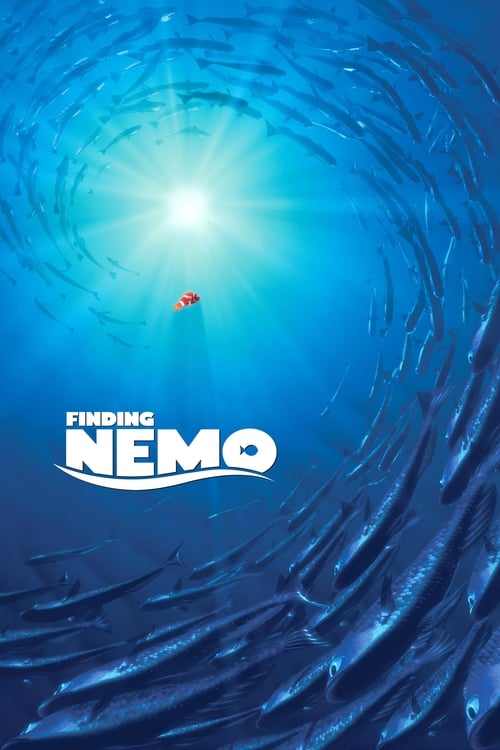
The animators studied wave physics and underwater light until the reef looked almost too real, and the film still stuns — dappled sunbeams, drifting particles, a whole living ocean. Thomas Newman's shimmering score gives it a sense of vastness that makes even the funny parts feel a little awed.
Why it matters
The film that proved Pixar's ambitions were dramatic and not just technical, and one of the defining animated features of its generation — a benchmark for how much emotional weight a family film can carry.
Pixar's fifth feature was the one that proved the studio's ambitions were dramatic, not just technological — though the technology was staggering: to render the Great Barrier Reef, the animators studied wave physics and particulate light until executives worried the water looked too real. Andrew Stanton, a core member of the studio's original brain trust, shaped a deceptively simple quest — an anxious clownfish crossing an ocean to recover his son — into a story about the impossibility, and the necessity, of letting children meet the world's dangers. Albert Brooks brings decades of neurotic screen persona to Marlin, while Ellen DeGeneres's Dory, a blue tang with no short-term memory, turns a comic device into something unexpectedly moving: optimism as a discipline. Thomas Newman's shimmering score gave the film its sense of vast, dappled depth. It won the Oscar for animated feature and briefly stood as the highest-grossing animated film ever made, but its real legacy is tonal — the mainstream family film that trusted grief and fear to carry an adventure.
A Deleuzian reading
Marlin wakes on an empty reef.
The full Deleuzian reading of Finding Nemo →
Reception
An instant, colossal hit in 2003 — it became the highest-grossing animated film ever at the time and won Pixar its first Best Animated Feature Oscar — and it's never needed a reappraisal: two decades on it's simply settled into 'peak golden-age Pixar' status.
How Finding Nemo was received, from release to now →
Influences: the films it descends from and the films it influenced
- Pinocchio (1940) — Establishes the swallowed-by-the-whale rescue climax and multiplane underwater depth staging that Nemo reprises as a father crossing the sea to recover a lost child.
- Bambi (1942) — Its abrupt off-screen killing of the mother as an inciting trauma, plus animal locomotion studied from live specimens, is the template for Nemo's opening barracuda attack and its naturalistic fish movement.
- 20,000 Leagues Under the Sea (1954) — Disney's foundational treatment of the ocean depths as an explorable adventure 'set' with scaled spectacle, a spatial logic Pixar inherited for reef, trench, and open-water sequences.
- The Silent World (1956) — Its documentary reef palettes and refracted caustic lighting were the photographic reference Pixar's art and lighting teams reverse-engineered to make the CG water read as real ocean.
- Jaws (1975) — Supplies the subjective predator-POV and suspense-by-withholding staging that Stanton borrows for the barracuda strike and the shark 'support group' menace beats.
- The Little Mermaid (1989) — Its hand-animated bubbles, god-rays, and refracted underwater light set the exact aesthetic target that Nemo's team had to reproduce procedurally in CG caustics and water simulation.
- Toy Story (1995) — Originates the Pixar Brain Trust iterative story process and the two-mismatched-travelers road structure that Nemo restages as anxious Marlin paired with forgetful Dory.
- A Bug's Life (1998) — Stanton's own directing/story apprenticeship, and its miniature-scale worldbuilding where a tiny protagonist navigates an oversized environment, feeds directly into Nemo's reef-scale staging.
- Monsters, Inc. (2001) — Advances the simulation and rendering R&D pipeline (Sulley's fur) that Nemo extends into large-scale water and particle simulation, and rehearses the reluctant-guardian-protecting-a-small-charge dynamic.
- The Incredibles (2004) — Inherits Nemo's newly built water and fluid simulation toolset for its ocean and crash sequences while pushing Pixar's rendering toward more complex human characters.
- Ratatouille (2007) — Its sewer-river torrent sweeping Remy is a direct advance on Nemo's water-simulation pipeline, extending believable fluid dynamics from open sea to turbulent current.
- WALL-E (2008) — Stanton continues his authorship with near-wordless environmental storytelling and brings in cinematographer Roger Deakins as lighting consultant to give CG the optics of real lenses, deepening Nemo's photographic ambitions.
- Finding Dory (2016) — The direct sequel refines the water-caustics and subsurface rendering and re-centers Ellen DeGeneres's Dory, extending Nemo's craft and vocal performance a generation of hardware later.
- Moana (2016) — Pushes the ocean itself into a fully simulated character with photoreal water, the maturation of the caustics-and-fluid rendering lineage Nemo launched at Disney/Pixar.
- Luca (2021) — Extends Pixar's seaside/undersea worldbuilding with refined subsurface light and sea-creature-to-human transformation, building on Nemo's reef-light rendering foundation.
- Toy Story 3 (2010) — Unkrich edited it, and its Tank Gang aquarium-escape sequence is the direct editorial rehearsal for the incarceration-and-breakout rhythm he directs in TS3.
- Remarkably Bright Creatures (2026) — Turned the aquarium tank into a socially characterized world of sea creatures with distinct interior lives, popularizing the aquarium-as-community staging.
- Shark Tale (2004) — A rival studio's rushed exploitation of the same CG reef ecosystem and anthropomorphized-fish design language that Nemo had just proven commercial.
- Ponyo (2008) — A contemporaneous fish-child undersea fable that pursues the same oceanic wonder through hand-drawn, hyper-fluid water animation — the analog counterpoint to Nemo's simulated approach.
- Toy Story 2 (1999) — Stanton, who led TS2's writing team, builds another separation-and-reunion melodrama under brain-trust critique, extending Pixar's loss-driven story architecture.
Similar films
- Monsters, Inc. (2001) — influence & lineage · same viewing thread
- WALL·E (2008) — influence & lineage · same viewing thread
- Finding Dory (2016) — influence & lineage
- Ponyo (2008) — influence & lineage
- Toy Story (1995) — influence & lineage
- Moana (2016) — influence & lineage
- Ratatouille (2007) — influence & lineage
- A Bug's Life (1998) — influence & lineage
All the films related to Finding Nemo →
Watch it with: curated runs of related films
- Animation That Aches — A run of animated films that take loneliness, grief, and memory as seriously as any live-action drama — watch them in a row and the cartoon surface stops mattering.