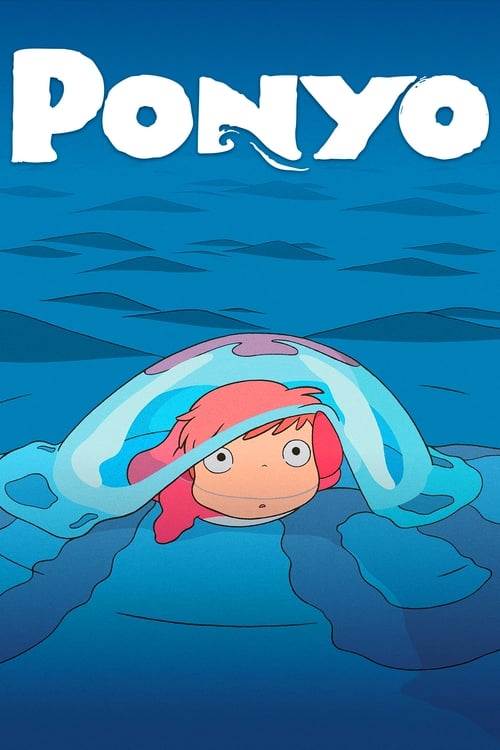
Ponyo
2008 · Hayao Miyazaki
For a cozy night in when you want to feel five years old again — with kids, after a hard week, or any time you need something wholehearted and happy. Comfort, through and through.
What it's about
A five-year-old boy living on a clifftop above a Japanese fishing town rescues a stranded goldfish — who turns out to be the runaway daughter of a sea sorcerer, and who wants, with the total conviction only a small child has, to become human. Her longing sets the ocean itself heaving, and the friendship between the two children takes on the weight of a fairy tale where the whole sea hangs in the balance.
The experience
Pure joy with an undertow of awe — buoyant, funny, and drawn with such energy that the water feels alive. It moves at a child's headlong pace and leaves you lighter than it found you.
The craft
Made with no computer effects — some 170,000 hand-drawn frames, with Hayao Miyazaki personally animating the sea as a living creature: waves with eyes, water that bulges and gallops. Joe Hisaishi's score swells to full operatic grandeur, and the whole thing sings on a big screen, where the hand-drawn surf becomes overwhelming.
Why it matters
Miyazaki's deliberate return to first principles after his denser epics, and a high-water mark for hand-drawn animation in an era that had largely abandoned it — proof of what pencil and paper could still do.
Hayao Miyazaki's loosest, most childlike late film — a Little Mermaid riff transposed to a Japanese fishing town, where a goldfish-girl's longing to be human sets the ocean itself heaving. Made after the dense mythology of Howl's Moving Castle, Ponyo was a deliberate return to first principles: no computer effects, some 170,000 hand-drawn frames, with Miyazaki personally animating the sea as a living creature — waves with eyes, water that bulges and gallops like a school of enormous fish. The result is Studio Ghibli's purest expression of animism, a world where a five-year-old's promise carries cosmological weight and the boundary between land and ocean is as porous as a crayon line. Joe Hisaishi's score swells to open Wagnerian pastiche (Ponyo's sorcerer father is named Fujimoto, but her mother is essentially a sea goddess out of opera). Beneath the candy surface runs Miyazaki's recurring anxiety about a poisoned ocean and his unshakable faith in small children as moral agents. The image to keep: a girl in a red dress running across the crests of waves.
A Deleuzian reading
A girl in a red dress runs across the tops of the waves.
The full Deleuzian reading of Ponyo →
Reception
A blockbuster in Japan in 2008 and warmly reviewed abroad, it was still filed by many Western critics as 'minor Miyazaki' — one for the toddlers. It's since been reappraised as some of his purest, most joyful filmmaking, with the hand-drawn storm sequence now routinely cited as a career highlight.
How Ponyo was received, from release to now →
Influences: the films it descends from and the films it influenced
- Panda! Go, Panda! (1972) — Miyazaki's own script and layout work here established the toddler-scaled, low-stakes domestic adventure — a small child and a benign non-human companion in a flooded, water-logged world — that Ponyo returns to as its 'first principles.'
- The Little Mermaid (Andersen adaptation lineage) (1975) — Ponyo is an explicit riff on Andersen's fish-girl-becomes-human bargain, but Miyazaki strips the tragic self-erasure and keeps only the transformation-by-love mechanic and the sea-kingdom-father who resists it.
- Future Boy Conan (1978) — Miyazaki's TV-directing debut fixed his vocabulary of drowned coastlines, elastic super-powered children running across water, and a boy-meets-otherworldly-girl rescue plot that Ponyo miniaturizes for preschoolers.
- My Neighbor Totoro (1988) — The template for child-scale wonder: a young girl, a benevolent nature-spirit, a hospitalized/absent mother, and dread dissolved into awe — Ponyo is Totoro relocated from forest to sea.
- Kiki's Delivery Service (1989) — Establishes Miyazaki's coastal-town production design and the theme of a young girl's magical agency tied to emotional confidence, plus Hisaishi's warm orchestral scoring of ordinary domestic life.
- Spirited Away (2001) — The polluted river-spirit sequence — a stinking god disgorging human garbage — is the direct precursor to Ponyo's trash-clogged sea and Fujimoto's crusade to cleanse the ocean of human filth.
- Fantasia ('Rite of Spring' / 'Sorcerer's Apprentice') (1940) — Ponyo's synchronization of surging animated water to a Wagnerian-Romantic score, and its runaway-magic flood set to music, follow Fantasia's model of animation as visual music — Hisaishi even scoring the sea like a symphonic movement.
- Der Ring des Nibelungen (Wagner) — 'Ride of the Valkyries' (1876) — Hisaishi's score is an open Wagnerian pastiche; Ponyo's charge across the waves ('Ponyo on the Cliff') is a leitmotif-driven Valkyrie-ride, and Fujimoto is Miyazaki's sorcerer-Wotan guarding a submarine kingdom.
- Lilo & Stitch (2002) — Extends the hand-painted seaside naturalism and the off-model, rubbery squash-and-stretch energy of a small chaotic creature loose in a household.
- The Wind Rises (2013) — Carries forward Ponyo's late-period commitment to hand-drawn fluid dynamics — its animated earthquake and rippling wind-fields descend from Ponyo's undulating, personified wave-fish surges.
- The Red Turtle (2016) — This Ghibli-produced film inherits Ponyo's minimalist, hand-drawn animism and its porous land/sea boundary — a human life fused with a sea-creature's, staged through wordless oceanic transformation.
- Song of the Sea (2014) — Directly channels Ponyo's hand-drawn selkie/mermaid folklore, child-scaled magic, and sea-as-living-force, using flat decorative backgrounds in the same anti-photoreal, storybook register Miyazaki reclaimed.
- Ponyo's storm sequence → Weathering With You (2019) — Shinkai's climate-flooded Tokyo and girl-who-controls-water descend from Ponyo's fusion of a supernatural child, a rising drowned cityscape, and the theme of accepting a transformed, water-covered world.
- In Waves (2026) — Hand-drawn, deliberately non-photoreal water animation that treats the sea as a living, willful character — the expressive water-as-force approach behind In Waves' custom, painterly water tooling.
- The Secret World of Arrietty (2010) — Yonebayashi key-animated it; Miyazaki's deliberate reassertion of pure hand-drawn 2D density and fluid movement on Ponyo is the exact technical stance Arrietty carries forward.
- When Marnie Was There (2014) — Yonebayashi animated on Ponyo, whose tidal seaside imagery and fascination with water surfaces feed directly into Marnie's water-reflection cinematography and its estuary-as-boundary geography.
- Luca (2021) — Hand-drawn anti-photorealist stylization paired with a sea creature morphing into a human child to live on land — the direct transformation-morph template.
- Moana (2016) — Animates the sea itself as a willful character — hand-drawn waves with eyes and intent, tidal surges that carry and reject figures as performance rather than physics — the conceptual model for Moana's Ocean, a fluid simulation art-directed to hold poses, gesture and comic timing against its own solver.
- Ponpoko / animist tanuki tradition (1994) — Shares Ghibli's house animism — nature as sentient, morally weighted agent capable of flooding the human world — though Ponyo renders the tsunami as wonder rather than Takahata's elegy.
- Porco Rosso (1992) — Shares the loving hand-drawn choreography of water — seaplanes skimming, wakes, spray — as Miyazaki's signature study of how fluid catches light and mass in 2D animation.
- Princess Mononoke (1997) — Extends the 'poisoned nature strikes back' theme — Ponyo's polluted, trawler-scarred ocean is the marine counterpart to Mononoke's despoiled forest, both framed as a moral reckoning delivered to children.
- Howl's Moving Castle (2004) — The immediately prior late-Miyazaki film against which Ponyo is a deliberate 'return to first principles' — abandoning CG compositing for an almost entirely hand-drawn, crayon-textured aesthetic and colored-pencil backgrounds.
- Finding Nemo (2003) — A contemporaneous father-searches-the-poisoned-ocean-for-his-child fish-story; Ponyo answers Pixar's photoreal water simulation with a defiantly hand-drawn, anti-realist rendering of the same marine world.
- The Boy and the Heron (2023) — His own late experiment in fully hand-drawn fluidity and childlike myth-logic, the drawn-water and metamorphosis craft the Heron's grand-uncle's fragile world reprises and darkens.
Similar films
- My Neighbor Totoro (1988) — influence & lineage · same viewing thread · often watched together
- Spirited Away (2001) — influence & lineage · same viewing thread · often watched together
- Princess Mononoke (1997) — influence & lineage · same viewing thread · often watched together
- Kiki's Delivery Service (1989) — influence & lineage · same viewing thread · often watched together
- Porco Rosso (1992) — influence & lineage · same viewing thread · often watched together
- Howl's Moving Castle (2004) — influence & lineage · same viewing thread
- Finding Nemo (2003) — influence & lineage
- Song of the Sea (2014) — influence & lineage
All the films related to Ponyo →
Watch it with: curated runs of related films
- The Studio Ghibli Canon — A run through the whole hand-drawn shelf of Miyazaki and Takahata — start with the childhood-wonder crowd-pleasers and drift toward the studio's quieter, adult, more elegiac corners.