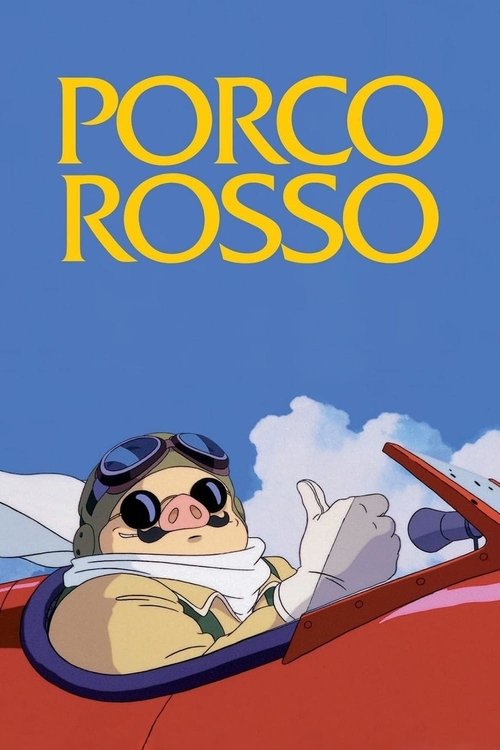
Porco Rosso
1992 · Hayao Miyazaki
For a warm, transporting evening when you want adventure with soul — comfort viewing that still gives an adult something to feel. Perfect when you want to be charmed rather than challenged.
What it's about
Over the Adriatic in the early 1930s, sky pirates in seaplanes raid cruise ships, and the best bounty hunter chasing them is a World War I flying ace who was mysteriously transformed into a pig. Marco — now Porco Rosso, the Crimson Pig — flies alone, drinks alone, and wants nothing to do with the Fascism consolidating around him, until a rivalry with a hotshot American ace and a partnership with Fio, a spirited teenage engineer, pull him back toward the world he abandoned.
The experience
Buoyant and funny on the surface — dogfights, banter, pirate crews with the menace of grumpy uncles — with a current of real melancholy underneath about lost friends and a man's shame at having survived. It's an adventure that leaves you a little wistful.
The craft
Miyazaki, a lifelong aviation obsessive, animates flight here with a lover's precision — the seaplanes bank and sputter and gleam over a Mediterranean painted in blues you want to swim in. Joe Hisaishi's score gives it a café-jazz romance, and the hand-drawn dogfights are worth the biggest screen you have.
Why it matters
A personal, idiosyncratic entry in the Studio Ghibli run of the early '90s, it revealed Miyazaki's romantic, adult side and has grown into one of the most beloved films among his devotees — the one animators and pilots tend to name first.
Snapshot
Porco Rosso (Kurenai no Buta, literally "The Crimson Pig") is the sixth feature directed by Hayao Miyazaki and the fifth produced at Studio Ghibli. It occupies a peculiar and revealing position in his filmography: a project conceived as a short in-flight entertainment for Japan Airlines that expanded, during production, into a feature-length work of considerable melancholy. The film follows Marco Pagot, a former Italian air force ace of the First World War who has withdrawn from human society — literally, having taken on the head and body of a pig by some unexplained enchantment — and now works as a freelance bounty hunter over the Adriatic, intercepting the "sky pirates" who raid Mediterranean shipping. Set against the consolidation of Italian Fascism in the early 1930s, it is a film about a man who has chosen the shame of being an animal over the shame of being a nationalist.
What distinguishes Porco Rosso within Miyazaki's body of work is its adult register. Where My Neighbor Totoro (1988) and Kiki's Delivery Service (1989) address children directly, and where Nausicaä of the Valley of the Wind (1984) and Laputa: Castle in the Sky (1986) operate in the epic-adventure mode, Porco Rosso is structured around fatigue, romantic irresolution, and the private grief of a survivor. Miyazaki himself has characterized the film as one made for tired middle-aged men — a self-description repeated widely enough in Ghibli's own materials to be treated as reliable — and the film's tonal ambivalence bears this out. It is comic, buoyant, and rapturously airborne, and it is also a ghost story about the dead of 1918.
The film was a substantial commercial success in Japan on release, and it has since consolidated a reputation as one of the essential Miyazaki works, though it circulated more slowly in the Anglophone world than Spirited Away or Princess Mononoke. Its influence runs less through direct imitation than through the enduring model it offers: animation as a medium for aviation romanticism, historical melancholy, and the depiction of adult exhaustion.
Industry & production
Porco Rosso emerged from a specific commercial arrangement rather than from a script development process. Japan Airlines had a standing relationship with Studio Ghibli, and the project began as a short film intended for in-flight screening — a format that would suit a light aviation comedy of perhaps thirty to forty-five minutes. Miyazaki's source was his own manga, Hikōtei Jidai ("The Age of the Flying Boat"), a short watercolor comic he had serialized in the model-hobbyist magazine Model Graphix, a venue where he indulged his lifelong enthusiasm for military aircraft under conditions of no narrative obligation whatsoever. The manga is loose, jokey, and technically obsessive; it supplied the world, the protagonist, and the flying boats, but not the film's emotional architecture.
The expansion from short to feature is documented in Ghibli's production history and is the crucial industrial fact about the film. As Miyazaki worked, the material darkened. The war in the former Yugoslavia broke out during production — the Adriatic setting that had been chosen as a sunlit playground was, in 1991–92, the coastline of an active conflict — and Miyazaki has spoken of this as having altered the film's tone. Whether one credits that account fully or reads it as retrospective framing, the finished film's treatment of nationalism, of the pull toward organized violence, and of the men who die in service to it is markedly heavier than the manga's.
Studio Ghibli in 1992 was in the middle of the institutional consolidation Toshio Suzuki had been engineering since Kiki's Delivery Service. That film's commercial success had established the pattern of Ghibli features as reliable summer events, backed by the Tokuma Shoten group and increasingly by tie-ups with distributors and sponsors. Suzuki produced Porco Rosso; his role across this period was less creative supervision than the construction of a business model that could sustain full-time animation staff — a genuine departure from the Japanese industry's dominant freelance economy. The JAL relationship persisted into the film's release: the airline was a sponsor, and the film screened in flight.
The film performed strongly at the Japanese box office, ranking among the year's top domestic releases. Precise figures vary across sources and I will not assert a specific number. International release was staggered and, in the English-speaking world, slow: a Disney-produced English dub featuring Michael Keaton as Porco was eventually prepared as part of the Disney–Tokuma distribution agreement, though its theatrical exposure in the United States was minimal, and the film reached most American viewers through home video. A separate French dub with Jean Reno in the title role is well regarded and, in France — a country with its own deep aviation-literature tradition — the film found a particularly receptive audience.
Technology
Porco Rosso is a fully cel-animated film, produced by traditional means: paper drawings, inked or xerographed cels, hand-applied paint, and multiplane-derived camera compositing photographed on film. It sits immediately before the technological inflection in Ghibli's history — digital ink-and-paint and computer-assisted compositing entered the studio's workflow with Princess Mononoke (1997) and became comprehensive with subsequent features. Porco Rosso therefore represents something close to the terminal state of Ghibli's analog craft: the studio's photographic and painterly resources at maximum development, with no digital augmentation.
This matters concretely for the film's most demanding sequences. Aerial combat requires objects to rotate in three dimensions while the notional camera also moves — precisely the problem that computer graphics would later solve trivially and that, in 1992, had to be solved by animators drawing each attitude of each aircraft in perspective, by hand, in sequence. The Savoia S.21 and the Curtiss R3C-derived racer that Curtis flies are drawn with a model-builder's fidelity to fuselage geometry, and they hold that fidelity through barrel rolls and banking turns. The technical achievement is not the rendering of any one frame but the maintenance of volumetric consistency across hundreds of them.
The film's sea and sky are similarly conventional in technique and exceptional in execution. Backgrounds under art director Katsu Hisamura render the Adriatic in saturated, layered watercolor-gouache, with cel-level effects animation handling wake, spray, and the shimmer of sun on water. Where a later film would composite these digitally, here they are photographed elements, and the resulting slight optical density in the image is part of the film's texture.
Technique
Cinematography
Animated cinematography is a matter of layout — the specification of camera position, lens implication, and movement in advance of animation — and Porco Rosso's layouts are among the most aeronautically literate in the medium. Miyazaki's flight sequences are constructed around the recognition that the pleasure of aviation on screen comes from relative motion: the fixed relationship of pilot to cockpit, against which the whole world pitches. The film repeatedly places the notional camera inside or immediately adjacent to the aircraft, so that horizon lines rotate and the sea swings up into frame while Porco himself remains stable in the composition.
Against this, the film deploys extreme long shots that reduce the aircraft to a speck against sea and cloud — the scale reversal that gives the flying sequences their sense of genuine altitude. The film's most celebrated single passage, Porco's account of the aerial engagement in which his squadron was destroyed, is composed almost entirely in these terms: a vertical ascent into a cloudscape, a river of aircraft passing overhead in silent formation, the dead climbing into a sky that reads as both a literal upper atmosphere and an afterlife. The staging renders this without a single line of explanatory dialogue about what is being seen.
Ground-level cinematography is comparatively restrained: eye-level framing, relatively long takes, considerable use of the middle distance. The Hotel Adriano interiors are staged in a way that keeps Gina's physical relationship to the room and to her guests legible — the camera treats her space as an actual architecture rather than as a series of expressive fragments.
Editing
Takeshi Seyama edited the film, as he did much of Ghibli's output in this period. The cutting follows Miyazaki's characteristic rhythm, which is closer to live-action classicism than to the accelerated grammar of most commercial animation: sequences are permitted to breathe, action is legible shot to shot, and the film makes generous use of what Isao Takahata and others in the Ghibli orbit termed ma — the held interval, the pause in which nothing dramatically necessary occurs.
The aerial dogfights are the exception, and they are cut with real precision: the geometry of pursuit is maintained across cuts, so the viewer always knows who is behind whom and at what altitude. The climactic Porco–Curtis duel modulates this deliberately, beginning as an aerial contest and degrading into a fistfight in the water — an editorial descent from balletic aerial cutting to comic, sodden, ground-bound slapstick that is one of the film's sharpest structural jokes.
Mise-en-scène / staging
The film's production design is its most conspicuous pleasure. Miyazaki's Adriatic is an invented composite — Dalmatian coastal architecture, Italian interwar signage and typography, an aviation culture drawn from the Schneider Trophy seaplane races of the 1920s and early '30s. The Piccolo workshop sequence, in which Fio's extended family of women assembles the rebuilt Savoia, is staged as a documentary of labor: hands, tools, spars, fabric, and the specific gestures of aircraft construction. Miyazaki's persistent interest in work as an on-screen subject — the bakery in Kiki, the boiler room in Spirited Away — finds one of its fullest expressions here.
Porco's hidden cove, a cleft of rock enclosing a private beach and a moored flying boat, is the film's spatial statement of its theme: a man who has removed himself from the map. The Hotel Adriano's terrace, by contrast, is a neutral ground where pirates, bounty hunters, and Gina coexist under a truce — a piece of staging that establishes the film's whole moral economy in a few shots.
Character design keeps Porco's porcine features expressive without cartooning them into pure comedy; the snout and small eyes are made to carry weariness, irony, and — in the scenes with Gina — a genuinely difficult tenderness.
Sound
Joe Hisaishi's score is a departure from the symphonic-pastoral idiom of his earlier Ghibli work. It draws on European light-orchestral and jazz-inflected material, with accordion, mandolin, and small-combo textures evoking a Mediterranean interwar milieu. The score alternates between propulsive adventure cues for the flying sequences and a spare, minor-key thematic material for Porco and Gina.
The film's sonic centerpiece is diegetic: Gina's performance of "Le temps des cerises," the French chanson associated with the Paris Commune of 1871 and thus with defeat, mourning, and lost revolutionary hope. The song was performed for the film by Tokiko Katō, who also voices Gina. Its placement is one of Miyazaki's most economical acts of characterization — a woman who has outlived three husbands singing an elegy for a lost cause, in a hotel full of men who fly for money.
Aircraft sound design is characteristically precise: engines are individuated, and the difference between the Savoia's note and the American racer's is audible and dramatically legible.
Performance
The Japanese vocal cast is anchored by Shūichirō Moriyama as Porco, who plays the role low, dry, and unhurried — a performance built on withholding. Tokiko Katō's Gina is warm and guarded in equal measure; Akemi Okamura's Fio supplies the film's forward energy without tipping into the shrillness that "spunky girl mechanic" invites. Akio Ōtsuka voices Curtis with an amiable, bumptious American swagger that keeps the antagonist genuinely likable.
The English dub, produced under the Disney arrangement, casts Michael Keaton as Porco — an inspired match for the character's deadpan — with Susan Egan as Gina and Cary Elwes as Curtis. The French dub's Jean Reno is often cited as the definitive non-Japanese Porco. As always with Ghibli, the animation itself carries much of the performance: the small hesitations in Porco's posture, the way Gina holds her hands, the shifts in Fio's stance from performed confidence to actual nerve.
Narrative & dramatic mode
The film's dramatic mode is picaresque romance with an elegiac substrate. Its plot machinery is deliberately slight — a rebuilt airplane, a duel with a rival, a wager over a woman's hand — and much of the film's runtime is given over to episodes that do not advance it: the workshop, the terrace, the cove, the flashback. This is a conscious structural choice rather than a slackness. The film's real subject is a condition, not a problem, and conditions do not resolve.
Crucially, the curse is never explained and never lifted in any way the film underlines. Miyazaki refuses the transformation narrative's obligatory final beat: the audience is given, at most, an ambiguous instant during the fight — a glimpse Fio may or may not have had — and Gina's final voice-over leaves the question of whether Porco ever comes to her garden deliberately unclosed. The withholding is the point. The pig is a moral condition Porco has chosen and continues to choose, and a magical cure would trivialize it.
The film's dominant emotional register is what might be called comic melancholy: the tonal blend in which jokes and grief occupy the same scenes without either canceling the other. The sky pirates are ridiculous, the duel is a farce, the wager is absurd — and behind all of it sits a squadron of dead men flying in formation.
Genre & cycle
Porco Rosso belongs to a genre with a substantial literary lineage and a much thinner cinematic one: the aviation romance. Its clearest antecedents are Antoine de Saint-Exupéry — Vol de Nuit, Terre des hommes, and Le Petit Prince, whose fusion of technical flying detail with existential meditation is the film's presiding literary model — and Roald Dahl's flying stories, particularly "They Shall Not Grow Old," whose dead-pilot cosmology strongly resembles the film's cloud sequence. Miyazaki's engagement with Saint-Exupéry is documented and long-standing.
Cinematically, the film draws on the Hollywood aviation picture of the 1930s and on the seaplane-racing culture of the Schneider Trophy, but its tonal affiliations are with European rather than American cinema: the film has the shape of a light continental comedy — a Mediterranean holiday film with an airplane in it — crossed with a war-memory picture.
Within Japanese animation, Porco Rosso is an outlier. Early-1990s anime features and OVAs were dominated by science fiction, cyberpunk, and post-apocalypse; the historically grounded, adult-addressed, essentially realist mode of Porco Rosso had few contemporaries. It stands instead as a node in Miyazaki's own private cycle of aviation films: the flight sequences of Nausicaä and Laputa on one side, and The Wind Rises (2013) — the film's most direct descendant, sharing its aeronautical subject, its interwar setting, and its deeply conflicted relationship to the beauty of machines designed for war — on the other.
Authorship & method
Porco Rosso is an unusually pure instance of Miyazaki's authorship: he wrote the screenplay, adapted it from his own manga, directed it, and supervised layout and key animation to his customary degree. His working method at Ghibli in this period involved beginning production without a completed script, developing the story through storyboards produced in parallel with animation — a practice that would have been institutional malpractice in most studios and that accounts for both the improvisatory texture of the middle sections and the film's occasional structural looseness.
The key collaborators are the Ghibli core of the period. Toshio Suzuki produced. Joe Hisaishi composed, continuing the partnership begun with Nausicaä and here stretching his idiom toward European light music. Takeshi Seyama edited. Katsu Hisamura served as art director, and the film's backgrounds — the specific quality of Adriatic light — are substantially his contribution. Toshio Kawaguchi worked as color designer; the palette's saturation is a deliberate choice against the softer schemes of Totoro and Kiki. Megumi Kagawa and Toshio Kawaguchi were among the animation supervisors, with Kagawa a longtime Miyazaki collaborator.
The film's authorship also has an autobiographical dimension worth naming carefully. Miyazaki's father worked in an aircraft-parts manufacturing concern during the Second World War, a biographical fact Miyazaki has discussed repeatedly and which underlies his lifelong, unresolved attraction to aircraft as simultaneously beautiful and instrumentally murderous. Marco's name is generally understood as a tribute to Marco and Gi Pagot, the Italian animators with whom Miyazaki had professional contact through the Italian-Japanese co-production Sherlock Hound; the connection is well established, though the extent of any deeper homage is a matter of interpretation rather than record.
Movement / national cinema
Porco Rosso is Japanese in its production and almost entirely European in its imaginative furniture — a combination that is itself characteristic of a strand of postwar Japanese animation. Miyazaki's generation at Toei Dōga and subsequently at the studios that produced Heidi, Girl of the Alps (1974) and 3000 Leagues in Search of Mother (1976) had spent years animating European settings, often after location research trips. That practice produced a body of Japanese animation grounded in careful observation of European architecture, landscape, and daily life; Porco Rosso is a late and highly personal flowering of it.
Within the history of Studio Ghibli, the film marks a consolidation. By 1992 the studio had established a house style — the specific quality of movement, the treatment of food and weather and work, the refusal of the limited-animation shortcuts standard elsewhere in Japanese television animation — and Porco Rosso deploys it with complete confidence. The film also participates in Ghibli's distinctive relationship to the "anime" category: it is unmistakably a product of the Japanese animation industry and equally unmistakably outside the genre conventions by which that industry was internationally known.
Era / period
The film is set in the early 1930s — after the First World War, after the Fascist seizure of power in Italy, and before the wars that Porco and Gina can both see coming. The historical specificity is not decorative. The Italian secret police pursue Porco as a political undesirable; the phrase attributed to him, that he would rather be a pig than a fascist, is the film's ideological center of gravity. Fascism appears not as spectacle but as bureaucratic pressure, the steady narrowing of the space in which a man can decline to belong.
The period setting also permits the film's aviation to be artisanal. The 1930s were the last moment when aircraft were built in small workshops by families with hand tools, and when the difference between a racing seaplane and a fighter was a matter of degree. Miyazaki's affection for this moment is unmistakable, and so is his awareness that it ends: the beautiful machines of the Schneider Trophy era were the direct technical ancestors of the fighters of the Second World War, a lineage that would become the explicit subject of The Wind Rises two decades later.
Made in 1991–92, the film is also a document of its own moment: Japan at the end of the bubble economy, and Europe in the first year of the Yugoslav wars, which broke out along precisely the Adriatic coast the film renders as a paradise.
Reception, canon & influence
Porco Rosso was received in Japan as a major domestic success, topping or near-topping the year's charts for Japanese releases and confirming Ghibli's status as a reliable commercial force. Japanese critical response was warm, with particular attention to the film's adult address and to Hisaishi's score.
Western reception was delayed and initially fragmentary. The film's Anglophone reputation was built retrospectively, after Princess Mononoke and Spirited Away established Miyazaki as an international auteur and prompted systematic reissue of the back catalog. In that second wave, English-language criticism recognized Porco Rosso as one of the director's most personal works, and it has since been a fixture in serious accounts of his career — in the scholarship of Susan Napier, Helen McCarthy, and others who have written extended treatments of Miyazaki and Ghibli. Common critical reservations concern the film's structural looseness and the unresolved romance; common enthusiasms concern the flight animation, the political clarity, and the melancholy.
The influences on the film are legible: Saint-Exupéry above all; Roald Dahl's aviation stories; the Hollywood flying picture; the Schneider Trophy racers and the Savoia-Marchetti and Macchi flying boats that supply the aircraft designs; the Italian animation tradition represented by the Pagots; and Miyazaki's own manga and his decades of European-set television work.
The influence of the film runs in several directions. Most directly, it is the essential precursor to The Wind Rises, which takes up its aeronautical romanticism and its moral discomfort and pushes both into explicitly biographical and explicitly Japanese territory. Within animation more broadly, Porco Rosso stands as a durable proof that the medium can sustain adult melancholy without recourse to either children's-film reassurance or the transgressive extremity that "adult animation" often signifies. Its aesthetic — interwar aviation, Mediterranean light, hand-built machines, weary competence — has recurred across games, illustration, and animation in the decades since; the specific combination is now recognizable enough that its debt to this film is generally acknowledged, though tracing individual lines of descent is more a matter of visible affinity than of documented citation.
Perhaps the film's most lasting contribution is a character type: the competent, damaged professional who has withdrawn from history and whom history will not leave alone. Porco Rosso flies well, drinks moderately, refuses politics, and cannot stop thinking about the men who died beside him in 1918. That figure has proven remarkably portable, and the film that most fully realized him remains, three decades on, its own best statement.
A Deleuzian reading
A man in an open cockpit looks up and the sky above him fills with airplanes.
The full Deleuzian reading of Porco Rosso →
Reception
A huge hit in Japan — the country's top-grossing film of 1992 — it was long filed abroad as 'minor Miyazaki,' the odd one about a middle-aged pig; it's since been reappraised as his most personal film and a favorite of grown-up Ghibli fans.
How Porco Rosso was received, from release to now →
How to watch Porco Rosso: what to notice on a first viewing
- Notice how the horizon rotates while Porco stays still in frame. Miyazaki's layouts put the camera inside the cockpit so the sea and clouds tilt around Porco while he remains fixed in the composition. Deleuze calls this the movement of world: the character holds still and the world moves around him instead.
- Listen for the different engine notes between planes. Sound design gives the Savoia and the American racer distinct engine notes, so you can identify a plane by ear alone. The dogfights stay legible because you hear who is flying before you fully see them.
- Watch how the camera holds Gina's terrace at eye level. Miyazaki keeps the hotel scenes at eye level and in long takes, so Gina's room reads as real architecture rather than expressive fragments. Deleuze calls this temps mort, dead time: scenes that advance nothing and are not wasted.
- Watch Porco's snout and eyes during quiet scenes with Gina. Moriyama plays Porco low and dry, and the pig design carries weariness and irony without turning him into a cartoon. The restraint is the performance; what Porco won't say is where the film keeps its grief.
The whole guide to watching Porco Rosso, with the keys for a rewatch →
Influences: the films it descends from and the films it influenced
- Hell's Angels (1930) — Hughes's multi-camera aerial photography set the convention Miyazaki animates by hand — dogfights staged in continuously legible airspace where cloud banks, sun position and horizon line act as spatial landmarks, so the viewer always knows which plane is behind which.
- Only Angels Have Wings (1939) — Hawks's flier's code — the dead are never discussed, competence is the only ethic, and the cantina rather than the cockpit is the film's true set — supplies both Porco's withheld 1918 grief and the Hotel Adriano's function as neutral ground where rivals drink together.
- Night Flight (1933) — The first screen translation of Saint-Exupéry, dramatizing a scheduled mail route as ordinary shift labor with weather and engine reliability as antagonists — the procedural flying-as-a-job attitude Miyazaki draws from the same source.
- Casablanca (1942) — The expatriate club as staging engine — a politically neutral watering hole where a resident singer's diegetic number halts the scene and exposes everyone's allegiances — is precisely the architecture of Gina's hotel and her performance of 'Le Temps des cerises'.
- The Spirit of St. Louis (1957) — Wilder sustains long stretches with one pilot, no interlocutor, and engine note as the only dramatic register — the model for Porco's near-wordless solo cockpit passages, where Hisaishi drops out and each aircraft is identified by its individuated motor sound.
- The Great Waldo Pepper (1975) — A barnstorming veteran who cannot stop replaying a 1918 dogfight and finally meets his German counterpart in a duel fought for its own sake, not for a cause — the same structure as the Curtis rematch and the flight-of-the-dead flashback.
- Lupin III: The Castle of Cagliostro (1979) — Miyazaki's rule for vehicle action is invented here — every chase cut preserves ground plan, screen direction and relative speed, so the register can descend into slapstick without the geography ever going vague — then reapplied to the Adriatic dogfights.
- Sherlock Hound (1984) — Made as a RAI co-production with Marco and Gi Pagot, whose name Porco borrows, it is Miyazaki's laboratory for period flying machines chased over Mediterranean rooftops with full hand-drawn perspective rotation on the airframe.
- Nausicaä of the Valley of the Wind (1984) — The mehve passages establish the Ghibli grammar of single-seat flight — body weight shifted against the wing, cast shadow tracking terrain, extreme long shots that reduce the craft to a speck — and begin the Hisaishi partnership Porco stretches toward European light music.
- Castle in the Sky (1986) — The flaptters supply Porco's mechanical vocabulary — propellers drawn frame-by-frame through rotation, each engine given a distinct sound signature — and the Dola gang supplies the comic pirate ensemble the Mamma Aiuto crew reprises.
- Kiki's Delivery Service (1989) — The immediate precursor for work-as-subject: a flier running a delivery business whose flight is invoiced labor rather than wonder, set in an invented European port whose background-art logic Katsu Hisamura carries into the Adriatic with heavier saturation.
- The Castle of Cagliostro (1979) — Most direct heir to Cagliostro's suave adventurer tone, Adriatic-Europe setting, and comic-romantic caper structure grounded in weighty flight physics.
- The Wind Rises (2013) — Takes Porco's aircraft-as-designed-object premise literally by moving from pilot to draughtsman, and radicalizes engine individuation by having human voices produce every motor, propeller and airframe rumble on the soundtrack.
- Howl's Moving Castle (2004) — Inherits the unresolved-curse device — a body transformed for reasons never fully explained and never cleanly undone — alongside a period air war whose politics the transformed hero refuses to serve.
- The Sky Crawlers (2008) — Extends Porco's dogfight craft into digital compositing while keeping its terms: pusher-prop period airframes, rigorously continuous combat space across cuts, and pilots who fly beautifully because nothing else is left to them.
- The Place Promised in Our Early Days (2004) — Descends from Porco's hangar scenes — adolescents building a flying machine in a shed, the aircraft rendered as an object of labor and affection — with flight as withdrawal from a divided political history that will not leave them alone.
- Luca (2021) — Sun-bleached Ligurian/Adriatic Mediterranean palette and seaside-town architecture supply the Italian-coast Ghibli look behind the Portorosso composite.
- The Rocketeer (1991) — A contemporaneous exercise in interwar racing-plane fetish from the practical-effects side — Gee Bee airframe, hangar-as-workshop, aviation-pulp deco — reaching the same period aesthetic through miniatures rather than layout drawings.
- Steamboy (2004) — Applies the same drafting-table discipline to machinery — hand-built engines animated as functioning mechanisms with visible linkages and pressure — so the pleasure of the shot is the machine working rather than the plot advancing.
- Redline (2009) — Carries forward the pre-digital feat Porco's dogfights demonstrate: vehicles hand-drawn through full perspective rotation at speed, with each engine given its own timbre so the race stays followable by ear.
- Ponyo (2008) — Shares the loving hand-drawn choreography of water — seaplanes skimming, wakes, spray — as Miyazaki's signature study of how fluid catches light and mass in 2D animation.
Similar films
- The Wind Rises (2013) — influence & lineage · same viewing thread · often watched together
- Castle in the Sky (1986) — influence & lineage · same viewing thread · often watched together
- Kiki's Delivery Service (1989) — influence & lineage · same viewing thread · often watched together
- Howl's Moving Castle (2004) — influence & lineage · same viewing thread
- Redline (2009) — influence & lineage
- Ponyo (2008) — same viewing thread · often watched together
- Spirited Away (2001) — same viewing thread · often watched together
- From Up on Poppy Hill (2011) — same viewing thread · often watched together
All the films related to Porco Rosso →
Watch it with: curated runs of related films
- The Studio Ghibli Canon — A run through the whole hand-drawn shelf of Miyazaki and Takahata — start with the childhood-wonder crowd-pleasers and drift toward the studio's quieter, adult, more elegiac corners.