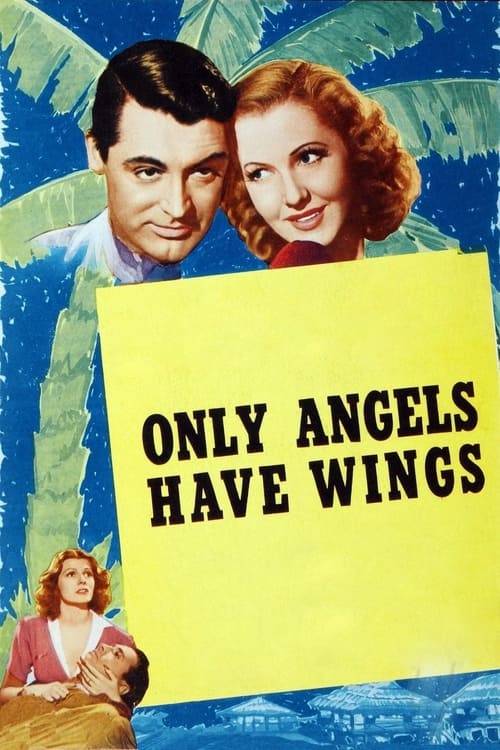
Only Angels Have Wings
1939 · Howard Hawks
For a rainy night when you want old-Hollywood romance with real weight — camaraderie, danger, and dialogue that sparkles. It's comfort cinema, but the kind where the comfort is earned against genuine loss.
What it's about
In Barranca, a fog-choked port town in the Andes, Geoff Carter runs a shoestring air-freight outfit whose pilots fly the mail through a lethal mountain pass in any weather — because missing a run means losing the contract that keeps them all alive. Into this fatalistic little brotherhood walks Bonnie Lee, a stranded showgirl who falls for Geoff, along with an aging flyer losing his eyesight and a disgraced pilot arriving with a reputation to bury and a wife who happens to be Geoff's old flame.
The experience
It's warm and doom-laced at once — men joking around a piano while listening for an engine in the fog, romance conducted in tough-guy banter that keeps almost cracking. Tense when the planes go up, wonderfully lived-in when they're on the ground.
Performances
Cary Grant is at his most complicated — charming and armored in the same breath — Jean Arthur gives Bonnie a bruised, funny resilience, Thomas Mitchell breaks your heart as the aging Kid, and a young Rita Hayworth announces herself in a handful of scenes.
The craft
Hawks shoots the flying with startling conviction — fog, cliff walls, condor strikes — but the deeper craft is in the ensemble scenes: overlapping talk, rituals around death, professionalism as a code of honor. The studio-built port at night, all mist and lamplight, is one of classic Hollywood's great atmospheres.
Why it matters
The fullest early statement of Hawks's lifelong theme — small groups of professionals doing dangerous work with grace — it became a template for ensemble adventure films and a cornerstone of his reputation among later filmmakers.
Snapshot
Only Angels Have Wings is Howard Hawks's fog-bound aviation melodrama, a Columbia Pictures production released in 1939 from a screenplay by Jules Furthman based on Hawks's own story. Set in the invented Andean port of Barranca, it follows Geoff Carter (Cary Grant), who runs a shoestring air-freight line that must fly mail through a treacherous mountain pass in all weather to secure a subsidy contract, and Bonnie Lee (Jean Arthur), a stranded traveling entertainer who falls in with his fatalistic band of flyers. Around them move Kid Dabb (Thomas Mitchell), the aging veteran mechanic-pilot losing his eyesight; Bat MacPherson (Richard Barthelmess), a disgraced flyer seeking redemption; and Judith (Rita Hayworth), Bat's wife and Geoff's former lover. The film is the fullest early statement of Hawks's lifelong subject — a professional group facing death without sentiment — and one of the definitive works of the American studio system's most celebrated single year.
Industry & production
The picture was made at Columbia, then a second-tier "major" run autocratically by Harry Cohn, and it reflects both the studio's economies and its resident craft strengths. Rather than location shooting in South America, Barranca was built as a studio set and its perpetual fog, night, and mountain weather generated on soundstages — a constraint that Hawks and his collaborators turned into an aesthetic virtue, producing a hermetic, enclosed world. The reliance on process and miniature work for the flying sequences kept the aviation spectacle within budget while allowing controlled repetition of the film's central peril.
The casting reflects the studio moment. Cary Grant, on loan and near the height of his late-1930s ascendancy, plays against his comic image in a harder, more withholding register. Jean Arthur was a Columbia contract star and Frank Capra's frequent lead; by most accounts she and Hawks were not an easy fit, Hawks reportedly preferring a more brazen "Carole Lombard" energy than Arthur's naturally vulnerable one. The film's most consequential casting was Rita Hayworth, then a rising Columbia contractee, for whom Judith functioned as a genuine breakthrough — the role that began her transformation into a major star ahead of The Strawberry Blonde and Blood and Sand. Richard Barthelmess, a major silent-era leading man whose sound career had faded, was cast as the shamed pilot Bat, his weathered presence carrying real biographical resonance of a career in eclipse.
The film received two Academy Award nominations — for Joseph Walker's black-and-white cinematography and for special effects (Roy Davidson's photographic effects and Edwin C. Hahn's sound effects) — winning neither. Precise budget and box-office figures are not something I can cite reliably here; the film is generally understood to have been a respectable success, but I will not invent numbers.
Technology
This is fundamentally a picture about aviation, and its technical program is organized around simulating flight and weather within the studio. The flying sequences combine full-scale cockpit work shot against rear projection, aerial photography, and extensive miniature and matte work for the Andean passes and crash setpieces — the domain recognized by the film's special-effects nomination. Aerial cinematography specialist Elmer Dyer, associated with a lineage of Hollywood flying pictures, contributed authentic air-to-air material that could be intercut with the process-shot studio interiors.
Equally important is the atmospheric technology: the film's signature is a dense, artificial fog that hangs over the airfield and the pass, produced and controlled on stage so that visibility itself becomes a dramatic variable. Because the story turns on whether a plane can be seen down through cloud, the effects and lighting apparatus are not decoration but plot mechanism. The picture is a standard black-and-white, Academy-ratio (roughly 1.37:1) optical-sound production, made squarely within the mature classical sound-film toolkit; its innovation is less in new hardware than in the disciplined orchestration of existing studio craft toward a single suffocating environment.
Technique
Cinematography
Joseph Walker, Columbia's premier cameraman and Capra's regular collaborator, shot the film in a low-key, shadow-heavy style that keeps Barranca in near-perpetual night and murk. Light tends to pool around the central cantina-office and the airfield lamps while the surrounding world dissolves into fog and dark, concentrating the action in warm, enclosed interiors ringed by threat. The Oscar-nominated photography is notable for making an entirely studio-built environment feel weather-real, and for the way it privileges faces gathered around tables and bars — the Hawksian architecture of a group in a room — while reserving stark high-contrast effects for the flying and crash sequences.
Editing
Cut by Viola Lawrence, a veteran Columbia editor, the film alternates two rhythms: patient, dialogue-driven interior scenes that let performance and group dynamics breathe, and tighter, more percussive assembly for the flights and disasters. The cutting is essential to the flying illusion, integrating aerial plates, miniatures, and cockpit rear-projection into legible suspense — most acutely in the recurring drama of watching a plane try to descend through cloud. The film's emotional method is also editorial: it repeatedly cuts away from grief, refusing lingering reaction shots after a death, a formal enactment of the characters' own refusal to dwell.
Mise-en-scène / staging
The staging is the film's signature achievement and a template for Hawks's career. Action is organized around thresholds and gathering places — the bar, the office window looking onto the field, the doorway to the weather. Hawks stages conversation in overlapping, casually blocked groups, actors leaning, lighting cigarettes, passing bottles, so that the ensemble reads as a working community rather than a set of soloists. Recurring physical business — asking for a match, the passing of a coin — becomes a language of intimacy and trust. The enclosed set, far from feeling cheap, produces a theatrical concentration: everything important happens in a few rooms, and the vast dangerous world exists only as sound and fog just beyond the lamplight.
Sound
Dimitri Tiomkin's score leans on Latin-American idioms appropriate to the setting, woven together with source music — Bonnie at the piano is a recurring hearth around which the men gather, and communal singing becomes a ritual of belonging and mourning. (I'd rather not over-specify individual song attributions I can't verify.) Beyond music, sound is dramaturgically central: the drone of an unseen engine overhead, the strain of a plane circling in cloud, is often the only information the characters — and we — have about a pilot's fate, so that listening becomes suspense.
Performance
The acting sits at the film's center. Grant plays Geoff as a man who has armored himself against feeling, and the performance's power lies in what it withholds; his catchphrase deflections ("Who's Joe?" after a flyer's death) are a code of stoicism the film both honors and quietly interrogates. Thomas Mitchell — in a landmark year that also included his Oscar-winning Stagecoach — gives Kid a worn tenderness that supplies the film's beating heart. Arthur's Bonnie brings the audience's ordinary human protest against the men's fatalism into the frame. Barthelmess uses his own faded stardom as texture for Bat's shame, and Hayworth, in limited screen time, registers the wounded glamour that would soon make her a star.
Narrative & dramatic mode
The film's dramatic mode is a chamber melodrama of professionalism under threat, structured less by a single rising plot than by a series of tests — flights attempted, survived, or fatal — that reveal character. Its governing ethic is grace under pressure and the suppression of open grief: when a man dies doing his job, the survivors eat his steak, refuse to speak his name, and go back to work. This is not callousness but a moral discipline the film examines from Bonnie's outsider vantage. Redemption is available strictly through action — Bat must earn his way back into the group by flying the jobs no one else will — and love is expressed obliquely, never through declaration but through the willingness to let someone stay. The famous two-headed-coin ending crystallizes the Hawksian refusal of sentiment: feeling is real precisely because it is never spoken plainly.
Genre & cycle
Only Angels Have Wings belongs to the aviation-adventure cycle that flourished from the late silent era through the 1930s, a body of films fascinated by flyers as a modern warrior caste. It is also a professional-group drama and, in its romantic triangle and exotic port setting, a melodrama in the tradition of world-weary tropical intrigue. Within Hawks's own filmography it is the middle term of an informal aviation trilogy running from The Dawn Patrol (1930) through Ceiling Zero (1936) to this film, each concerned with men who fly, die, and are replaced. The 1939 context is significant: released in Hollywood's most storied production year, it stands apart from that year's prestige literary adaptations and Technicolor spectacles as a leaner, tougher genre picture whose reputation would grow through later critical revaluation.
Authorship & method
The film is a cornerstone of the case for Hawks as an auteur. Hawks originated the story, drawing on his own aviation background — he had trained and flown in the World War I era and remained an aviator and mechanic by temperament — which lends the professional detail its authority. His method favored rewriting and reshaping dialogue on set, cultivating overlapping speech and relaxed ensemble behavior, and privileging behavior over psychology; the film's texture of shared work and coded feeling is the direct product of that approach.
His key collaborator on the page was Jules Furthman, one of Hollywood's great screenwriters, whose fingerprints link this film to a wider world: Furthman had written the fatalistic exotic romances Morocco and Shanghai Express for Josef von Sternberg, and would later script To Have and Have Not and Rio Bravo for Hawks. The "Furthman woman" — knowing, resilient, defined by her exchanges with men — runs straight through Bonnie and Judith. Cinematographer Joseph Walker supplied the enveloping low-key look; editor Viola Lawrence shaped its rhythms of suspense and suppressed grief; and composer Dimitri Tiomkin, at an early point in a long career, provided the Latin-inflected score. The result is a film in which a strong directorial signature is realized through Columbia's best resident craftsmen.
Movement / national cinema
This is a product of classical Hollywood at its most self-assured — the studio system's vertically integrated craft applied to genre storytelling. It participates in no avant-garde movement; its significance to film history is partly retrospective, as one of the American works elevated by the French auteur critics of Cahiers du Cinéma in the 1950s. Its enclosed, fog-lit exoticism does bear comparison to the studio-bound atmospherics of Sternberg, a resemblance reinforced by the shared Furthman authorship, situating the film within a strain of Hollywood romanticism that prized artificial, poeticized worlds over realism.
Era / period
Made in 1939, the film sits at the apex of the studio era and just before the Second World War would reorient Hollywood's treatment of male sacrifice and duty. Its ethos of a disciplined group facing death without complaint anticipates the wartime combat films to come — and Hawks himself would extend the material almost directly into Air Force (1943). The picture also captures a late-Depression fascination with skilled, precarious labor: men risking everything for a marginal enterprise on the edge of solvency, their professionalism a form of dignity in hard times.
Themes
The film's central theme is professionalism as a moral code — competence, reliability, and the willingness to do a dangerous job well as the true measure of a person. Bound to this is its treatment of death: fatalistic, unmourned in public, absorbed by returning immediately to work ("Who's Joe?"). It explores redemption through deeds rather than words, in Bat's arc from pariah to accepted comrade. It examines the terms on which a woman may enter a closed male world — Bonnie must learn not to ask a flyer to stay grounded — and the film's romantic ethic holds that real feeling is proven by restraint. Loyalty, self-respect, and the substitution of shared ritual (a light, a song, a coin) for spoken emotion complete its moral vocabulary.
Reception, canon & influence
The film was generally well received on release and admired for its atmosphere and its star performances, though its towering later reputation is largely the achievement of subsequent criticism. It became a central text for the auteurist reappraisal of Hawks: Jacques Rivette's landmark 1953 Cahiers du Cinéma essay championed Hawks's genius, Andrew Sarris installed him in the American pantheon, and Robin Wood's influential study of Hawks treated Only Angels Have Wings as one of his supreme achievements and a key to his worldview. Through these readings the film moved from well-made genre entertainment to acknowledged classic.
Looking backward, the film draws on Hawks's own earlier aviation pictures (The Dawn Patrol, Ceiling Zero) and his personal flying experience, on the broader 1930s flyer cycle, and — via Furthman — on the Sternbergian tradition of fatalistic exotic romance. Looking forward, it is arguably the source code for the mature Hawks: the professional-group ethic, the coded romance, and the stoic handling of death recur in Air Force, To Have and Have Not, and above all Rio Bravo, which reworks its central preoccupation with self-respect and belonging. Its model of the competent ensemble facing danger together has echoed widely through later American cinema, including the work of avowed Hawksians, and it remains a touchstone in critical accounts of classical Hollywood style and of Hawks as one of its defining artists.
A Deleuzian reading
A plane is up there in the cloud and you can't see it.
The full Deleuzian reading of Only Angels Have Wings →
Reception
A hit on release but somewhat lost in the crowded miracle year of 1939, it was later championed by the French critics and auteurists as the quintessential Hawks film — now cinephiles routinely rank it above the more famous 1939 blockbusters.
How Only Angels Have Wings was received, from release to now →
How to watch Only Angels Have Wings: what to notice on a first viewing
- Listen for the drone of a plane engine you cannot see. Whenever a pilot is up in the fog, the only information anyone in the room has about his fate is the sound of the motor. Listening becomes the suspense, because nothing about the danger can actually be located in the frame.
- Notice how light pools in the cantina and fades past it. Walker keeps the warm interior lit while the world just past the lamplight dissolves into fog and dark. The lighting draws a hard line between the room that's safe and the world that isn't.
- Watch the small physical business: passing a match, sharing a coin. Recurring gestures, lighting a cigarette, handing off a coin, become the group's actual language of trust and intimacy. These small rituals carry the feeling the dialogue is built to avoid saying outright.
- Watch how little Geoff reacts once a flyer has died. Grant plays a deflecting stoicism, deadpan lines standing in for a grief the film refuses to show directly. The withholding is the performance. Restraint is doing the work an outburst usually would.
- Notice how quickly the film moves on after a pilot's death. The editing repeatedly cuts away from grief, refusing the lingering reaction shot, and the group returns to work almost immediately. The cutting enacts the same discipline the characters practice: don't dwell, go back to the job.
The whole guide to watching Only Angels Have Wings, with the keys for a rewatch →
Influences: the films it descends from and the films it influenced
- The Dawn Patrol (1930) — Hawks's own template for handling airmen's deaths through ritual understatement — the erased name, the next man sent up without visible mourning — which Only Angels systematizes into its 'who's Joe?' refusal to grieve on camera.
- Ceiling Zero (1936) — The immediate prototype: a flyer defying weather and orders in fog-bound zero-visibility conditions, staged around a dispatch office where professional risk is measured in ceiling heights and radio talk.
- Morocco (1930) — Furthman's fatalistic exotic-romance mode — the woman who attaches herself to a fatalist and proves her worth by the terms of his code — feeding directly into Jean Arthur's Bonnie and Rita Hayworth's Judith.
- Shanghai Express (1932) — The Furthman 'knowing woman' defined entirely through clipped verbal exchange, wrapped in Sternberg/Garmes low-key atmospheric haze that anticipates Joseph Walker's fog-enveloped Barranca.
- Wings (1927) — Established the aviation-cycle grammar of combining real aircraft, miniatures and process work to sell flight peril — the studio-fog-and-miniatures technology Hawks leans on for the Andes crash and mountain-pass runs.
- Night Flight (1933) — Saint-Exupéry's airmail ethos of pilots flying storms on schedule because the mail must go through — the professionalism-as-fatalism creed Hawks converts into Geoff Carter's 'somebody has to fly it.'
- Holiday (1938) — Hawks casts the post-Holiday Grant precisely for the fusion Cukor proved out: the acrobat's physical ease held perfectly still so that grief is displaced entirely into props and business ('Who's Joe?', the steak, the match) instead of expression.
- Air Force (1943) — Transfers the competent-ensemble-facing-danger ethic to a single bomber crew, extending the professional-group code and the stoic absorption of casualties into a wartime aircraft interior.
- To Have and Have Not (1944) — Furthman again scripts the coded romance of resilient woman and withholding man — Bacall's Slim is Bonnie refined — carried on overlapping banter and behavioral testing rather than psychological exposition.
- Rio Bravo (1959) — The explicit reworking of the central preoccupation with self-respect and belonging — Dude's redemption-through-deeds mirrors the Kid's, again scored by Tiomkin and scripted with Furthman's fingerprints on the coded romance.
- Assault on Precinct 13 (1976) — Carpenter's avowedly Hawksian siege picture transplants the competent-ensemble-under-threat ethic — including a redeemed outsider earning belonging — into an urban station house.
- The Thing (1982) — Extends the Hawksian isolated-professional-crew facing lethal danger (Hawks produced the 1951 original), with survival hinging on group competence and terse behavioral trust.
- The Right Stuff (1983) — Builds an entire epic on professionalism-as-moral-code and grace under pressure among test pilots and astronauts, with the laconic understatement and empty-chair mourning descending straight from Hawks's flyers.
- The Flight of the Phoenix (1965) — Strands a group of aviators in a hostile desert where survival depends on pooled technical competence and earned respect, extending the professional-ensemble-facing-death structure into a survival crucible.
- Casablanca (1943) — Hawks's Barranca saloon as the enclosed social crossroads where a morally guarded American proprietor maintains cultivated neutrality amid the desperate needs of a cosmopolitan ensemble — with Cary Grant's stoic understatement as the performance mode for the reluctant moral arbiter — is the direct structural and performative template Curtiz and Bogart adapted for Rick's Café and Rick Blaine.
- Top Gun (1986) — Establishes the aviation-professional template Top Gun inherits — male flyers measured by competence and grace under pressure, with romance subordinated to the code of the group and death processed as stoic ritual rather than tragedy.
- Top Gun: Maverick (2022) — Originates the Hawksian flyer code — men measured by competence under fatalistic risk, grief managed through professionalism — that governs Maverick's squadron ethics.
- El Dorado (1966) — Establishes the Hawksian creed El Dorado dramatizes — the self-sufficient professional group in a confined outpost where competence is the sole moral currency and a woman is admitted only by meeting the men on their terms.
- Bull Durham (1988) — Establishes the template Shelton runs on: a closed professional enclave where shop talk is the only language, and an outsider woman earns erotic standing by demonstrating she understands the work — Annie's mound-visit authority is Bonnie Lee's piano-bar authority transposed to the Carolina League.
- Test Pilot (1938) — Contemporary aviation-melodrama sibling built on the woman forced to watch her man court death professionally, dramatizing grace under pressure as a marital-emotional test rather than combat.
- Red River (1948) — Reapplies the professional-group-under-strain structure to a cattle drive, with the same privileging of shared competent work and coded loyalty over plot mechanics.
- Hatari! (1962) — Late-Hawks distillation of the same recipe: a mixed professional crew doing dangerous work in an exotic locale, plot dissolved into observed group behavior and relaxed overlapping talk.
Similar films
- Rio Bravo (1959) — influence & lineage
- The Flight of the Phoenix (1965) — influence & lineage
- Red River (1948) — influence & lineage
- Hell's Angels (1930) — shared sensibility
- To Have and Have Not (1945) — shared sensibility
- Twelve O'Clock High (1949) — shared sensibility
- El Dorado (1966) — shared sensibility
- The Treasure of the Sierra Madre (1948) — shared sensibility