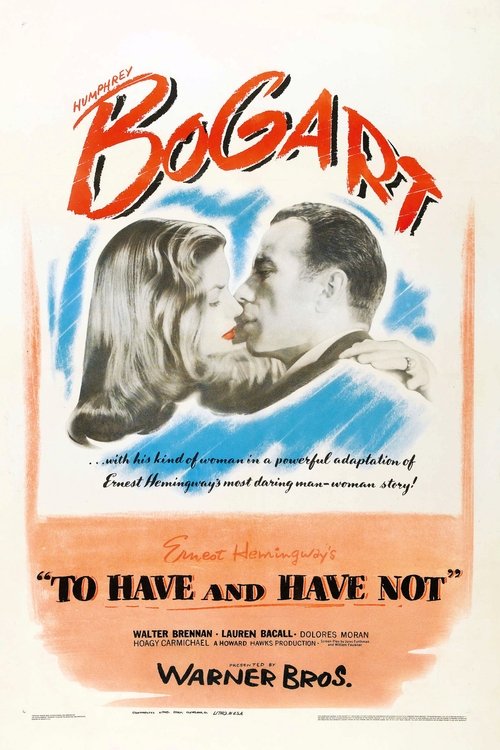
To Have and Have Not
1945 · Howard Hawks
For a cozy night in when you want to fall in love — or just watch two movie stars do it in real time. Pure comfort viewing with wit to spare.
What it's about
Harry Morgan runs a charter fishing boat out of Vichy-controlled Martinique during World War II, minding his own business and taking no sides — until money troubles and a stubborn conscience pull him into smuggling French Resistance operatives past the authorities. Complicating everything is Marie, a young drifter with a low voice and no illusions, who matches him line for line from the moment she asks for a light.
The experience
Breezy, smoky, and effortlessly cool — the danger is real but the film wears it lightly, coasting on banter, barroom songs, and two people visibly falling for each other on camera. It feels like the most relaxed great movie ever made.
Performances
This is the film that introduced 19-year-old Lauren Bacall, and her scenes with Humphrey Bogart — teasing, unhurried, electric — are among the most famous romantic sparring in Hollywood history. Their chemistry wasn't acting, and you can tell.
The craft
Howard Hawks turned a Hemingway novel — with William Faulkner on the screenplay — into something loose, funny, and completely his own: tight two-shots, overlapping talk, songs around a barroom piano, and not a wasted scene. The pleasure is in the rhythm of people who are good at their jobs being good at them.
Why it matters
It launched Bacall, began the Bogart-Bacall partnership on and off screen, and stands as a peak example of how the studio system could spin genre material into something iconic.
Snapshot
Howard Hawks's To Have and Have Not is a Warner Bros. romantic adventure set in Martinique during the Vichy occupation of the French Caribbean — and it is, before anything else, a star-birth document. The film introduced Lauren Bacall to the world, inaugurated one of Hollywood's most celebrated screen partnerships, and demonstrated Hawks's genius for converting generic material into something that feels effortless and inevitable. Adapted from Ernest Hemingway's 1937 novel by William Faulkner and Jules Furthman, the screenplay keeps Hemingway's title and anti-hero name while gutting his politics, relocating his Florida Keys rum-runner to Martinique, and grafting onto the remaining chassis a plot that rhymes uncomfortably — and productively — with Casablanca (1942). The result is a film of pure Hawksian texture: laconic, sexually charged, group-bound, and devoted to the performance of competence under pressure.
Industry & production
Warner Bros. acquired the rights to Hemingway's novel in the early 1940s, and the project came to Hawks partly through his longstanding productive relationship with the studio and partly through his personal connection to Hemingway. The widely repeated anecdote — that Hawks told Hemingway over a card game that he could make a good film out of Hemingway's worst novel, and that Hemingway dared him to try — has circulated in enough credible accounts of their friendship to be treated as essentially accurate in outline, though the precise occasion varies in the telling. What is certain is that Hawks approached the material with the confidence of a director who saw the novel not as a text to be honored but as raw tonnage to be stripped and rebuilt.
The production faced a structural challenge that shaped the film's final form: Hemingway's novel is set in Cuba and the Florida Keys, centered on a boat captain's increasingly desperate involvement in smuggling operations during the Depression, and it ends in fatalism and class grievance. The wartime climate required a different frame. The setting was moved to Martinique under Vichy authority, which allowed the screenplay to substitute the morally clarifying conflict between Vichy collaborationism and Free French resistance for Hemingway's bleaker story about economic desperation. The relocation also allowed direct comparison with Casablanca, which Hawks and Bogart clearly knew they were courting. Filming took place largely on Warner Bros. studio lots in Burbank, with art direction standing in for the island exterior.
Lauren Bacall, born Betty Joan Perske in 1924, was nineteen when Hawks cast her. She had been discovered by Slim Keith — Hawks's wife at the time, born Nancy Gross — from a Harper's Bazaar cover photograph. Hawks developed her persona deliberately, lowering her social register, coaching her vocal quality, and building a character around her instinctive sexual self-possession. He named Bacall's character "Slim" after his wife, a gesture that inscribed his domestic triangle directly into the film's surface. During production, Bogart and Bacall fell in love; they married in 1945, shortly after filming concluded. The romantic chemistry on screen is not simulated. This biographical fact gives the film its electrical charge and makes it unique in the Bogart filmography: it is the only one of his films in which the love story feels genuinely unguarded.
Technology
To Have and Have Not was shot in black and white on standard 35mm stock, using the studio-interior infrastructure Warner Bros. had refined through the 1930s and early 1940s. No innovations in camera technology or photographic process distinguish the production; the film belongs to the mature classical Hollywood apparatus rather than to any technological frontier. What is notable is how efficiently that apparatus is deployed: Sidney Hickox's cinematography achieves consistent, assured studio glamour without calling attention to itself. The production's most significant technical achievement is sonic — the recording and deployment of Bacall's voice, around which considerable deliberate effort was organized.
Technique
Cinematography
Hickox, a Warners contract cinematographer who worked frequently on the studio's crime and adventure pictures, brings a clean, high-key efficiency to the film's interiors. The hotel bar and café spaces that anchor most of the film are shot with a practical, sociable approach: wide enough to register the ensemble, close enough to catch the faces. The key-light arrangements for Bacall — particularly the famous low-angle setups that allowed her to deliver lines while tilting her chin down and casting her eyes upward, the pose that became her signature — are among the most precisely calibrated in classical Hollywood portraiture. This was partially a practical response to Bacall's initial camera nerves, which caused her head to tremble under direct gaze; Hawks or Hickox (accounts differ on who first suggested the solution) instructed her to press her chin toward her chest and look up, which steadied her head and simultaneously produced an expression of composed, slightly challenging intimacy. The "look" that audiences and critics seized on as Bacall's essential quality was thus born partly out of technical problem-solving.
Editing
Christian Nyby, who worked as Hawks's editor through much of this period and would later direct (or co-direct, depending on one's reading of the production history) The Thing from Another World (1951), cuts the film with the invisible, rhythmically alert precision Hawks's style required. The pacing never labors; scenes end before their energy depletes. The editing is particularly effective in the musical sequences, where Nyby cuts between Bacall singing, Hoagy Carmichael at the piano, and Bogart listening — a triangle of observation that builds the central romantic geometry without declaring it.
Mise-en-scène / staging
Hawks's staging throughout the film reflects his fundamental conviction that professional competence is the primary human value, and that watching people perform tasks well is one of cinema's essential pleasures. The hotel spaces function as Hawks's characteristic arena: a contained social world in which alliances form through demonstrated ability. The blocking consistently places Bacall on equal footing with Bogart — she enters his space and holds it, sits where he sits, turns departures into small theatrical events. The famous whistling speech ("You know how to whistle, don't you, Steve? You just put your lips together and blow") is delivered in a doorway, Bacall already leaving, giving her the scene's last word and the spatial advantage. The staging of that moment is inseparable from its effect.
Sound
The musical dimension of To Have and Have Not is unusually rich for a Hawks film. Hoagy Carmichael, cast as Cricket the hotel pianist, performs several numbers including "Hong Kong Blues" and "How Little We Know," the latter sung by Bacall. The question of how much of Bacall's vocal performance is wholly her own has attracted some dispute over the years — the singer Andy Williams later claimed to have dubbed portions of her vocals, a claim that has never been definitively verified or refuted. What is documentable is that Bacall's speaking voice, the instrument Hawks spent considerable effort cultivating, was thoroughly her own. Her vocal register — low, slightly rough, controlled — is the film's most powerful sound effect. It functions as a constant pitch of adult sexuality, against which the film's wartime intrigues seem like background noise.
Performance
Bogart's Harry Morgan (called "Steve" throughout, as Bacall's Marie is always "Slim") is a relaxation of the Bogart persona into maximum ease. He had already played Rick Blaine in Casablanca; Morgan is Rick without the wound, a man whose cynical neutrality is a professional stance rather than a psychic defense. He performs it with the settled authority of an actor who has fully inhabited a type. Walter Brennan, a three-time Oscar winner by this point, plays Eddie the rummy — a figure of comic pathos, constitutionally unreliable, whose loyalty to Morgan is absolute and whose sobriety is permanently deferred. Brennan's performance operates on a different register from the rest of the film, broadly comic where everything else is cool, and the contrast serves Hawks's purposes by giving Morgan something genuinely needful to protect. Marcel Dalio, who had played the croupier in Casablanca, appears here as Frenchy the café owner — an in-joke or casting convenience that further deepens the film's dialogue with its predecessor.
Narrative & dramatic mode
The plot is familiar enough to be schematic: reluctant American in a compromised foreign port, underground resistance contact needing help, romantic complication, moral conversion from neutrality to commitment. The narrative engine owes more to Casablanca than to Hemingway, and the film does not trouble to disguise this. What distinguishes Hawks's treatment is that the political stakes are handled with near-contempt — they exist to create the conditions for the character relationships, not to generate genuine dramatic weight. The film's real subject is the testing and validation of competence: Can Harry Morgan hold his nerve? Can Slim hold hers? The resistance subplot is the occasion; the courtship is the text.
Dramatically, the film operates in Hawks's preferred mode of comedy-inflected adventure — situations that might produce tension are defused by wit, crises are met with professional calm, and sentiment is rigorously controlled. The closest the film comes to overt emotion is in the scenes with Brennan's Eddie, and even these are undercut by humor.
Genre & cycle
To Have and Have Not sits at the intersection of several early-1940s cycle formations. It is a WWII home-front/resistance picture of the kind Warner Bros. had been producing since Pearl Harbor, and it shares ideological terrain with Casablanca, Passage to Marseille (1944), and other Vichy-set narratives of American awakening to European necessity. It is also a romantic adventure in the Bogart mold established by Casablanca and Sahara (1943), and a precursor to the harder-edged film noirs Bogart would inhabit for the rest of the decade. It is perhaps most productively understood as the founding text of a micro-cycle: the Bogart-Bacall film, a distinct four-picture unit (To Have and Have Not, The Big Sleep, Dark Passage, Key Largo) that constitutes its own coherent genre formation defined by star chemistry and the negotiation of masculine authority in the presence of an equal female intelligence.
Authorship & method
Howard Hawks is the dominant authorial presence, and To Have and Have Not is among the most studied of his films precisely because his signature is so legible. The Hawksian woman — sexually self-sufficient, capable of male-coded behavior, earning entry into the professional group on merit — finds her definitive early expression in Bacall's Slim. The homosocial dynamics of the male group (Morgan, Eddie, Frenchy) are disrupted and ultimately enriched by her presence rather than threatened by it. The overlapping dialogue that Hawks favored, and that gives his films their naturalistic conversational density, is deployed throughout.
William Faulkner's contribution to the screenplay presents a persistent interpretive puzzle. Faulkner was a Nobel-level literary intelligence working in a collaborative commercial form; his specific contributions to the To Have and Have Not screenplay, as opposed to Jules Furthman's, are impossible to disaggregate from the finished text. Furthman was a veteran Hollywood craftsman who had worked on Morocco (1930) and Only Angels Have Wings (1939), and the polished, witty, forward-moving quality of the dialogue feels more consistent with his known work than with Faulkner's literary style. Faulkner and Hawks worked together again on The Big Sleep (1946), and the partnership is better understood as a productive professional arrangement than as a meeting of equal artistic sensibilities.
Sidney Hickox's cinematography and Christian Nyby's editing are collaborative instruments rather than expressive individualities — which is precisely what Hawks's directorial authority required and received.
Hoagy Carmichael's musical contributions are genuine artistic additions: his on-screen presence as Cricket gives the film a jazz-adjacent atmosphere that anchors its pleasure principle, and the songs he wrote or performed create an emotional undertow beneath the film's witty surface.
Movement / national cinema
To Have and Have Not is a product of the classical Hollywood studio system at the height of its confidence and industrial organization: genre-coded, star-driven, efficiently produced, and commercially calibrated. It reflects Warner Bros.' particular identity as the most politically engaged of the major studios during the war years — the studio that made Confessions of a Nazi Spy (1939), Sergeant York (1941), and Casablanca, and that positioned itself as the house of American commitment. The Martinique setting allows the studio's wartime politics to surface while Hawks's temperamental conservatism (his distrust of ideology, his preference for professional values over political ones) keeps the film from becoming a tract.
Era / period
The film was shot in 1944 and released in January 1945, during the final phase of the European war. Paris had been liberated in August 1944; the Vichy government had effectively collapsed. This means that by the time audiences saw To Have and Have Not, the political stakes its narrative had dramatized were already resolved in history. The film thus arrived as a retrospective wartime romance rather than a live propaganda document — a distinction that may partly explain why its romantic and personal dimensions register more powerfully than its resistance plot. It belongs to the transitional moment when Hollywood was beginning to process the war's end while still operating in the generic vocabulary the war years had established.
Themes
The film's governing theme is the conversion of neutral self-sufficiency into committed solidarity — but Hawks handles this less as moral argument than as social observation. Morgan's movement from "I don't take sides" to active assistance for the Resistance tracks the official American ideological narrative of the 1940s (isolationism overcome by moral necessity), but the film is not really interested in this as political content. What interests Hawks is how people behave under pressure, how group membership is earned and maintained, and how competence functions as a form of ethics. To be good at one's job — to be reliable, cool, skilled — is in Hawks's world the primary moral category.
The relationship between Morgan and Slim articulates a fantasy of erotic equality that runs through Hawks's work: a woman who matches the male protagonist in cool, in wit, in self-possession, and who therefore constitutes a genuine partner rather than a dependent. The film's erotic charge derives from mutual recognition of competence rather than from differential vulnerability.
Reception, canon & influence
Influences on the film (backward): Casablanca is the overwhelmingly obvious antecedent, structurally and atmospherically. Hawks and Faulkner's plotting draws directly on Michael Curtiz's film, including the Vichy-territory setting, the cynical American hero reluctantly drawn into resistance activity, the romantic complication, and the casting of Bogart. Only Angels Have Wings (1939), Hawks's own earlier picture, established the template for the professional male group into which a new woman must prove her worth. Hemingway's novel contributes the protagonist's name, the charter-boat occupation, and the general atmosphere of masculine self-sufficiency under economic pressure, while losing nearly everything else.
Critical reception: Contemporary reviews were largely positive, with particular attention paid to Bacall's debut. Critics recognized the Casablanca parallels and were generally willing to accept them as a feature rather than a flaw. The Bogart-Bacall chemistry received immediate notice as something genuine and uncommon. Over subsequent decades, the film has been consistently addressed in auteurist accounts of Hawks and in studies of classical Hollywood's wartime cycle. It is not typically ranked among Hawks's very greatest films — that argument tends to center on His Girl Friday (1940), Red River (1948), Rio Bravo (1959) — but it is universally included in serious assessments of his work and is one of the most-discussed films in the Bogart canon.
Legacy and forward influence: The film's most consequential legacy is the Bogart-Bacall partnership itself, which generated three subsequent films and established a template for the sexually equal romantic pair that inflected Hollywood casting and characterization for years. Bacall's "Slim" — the woman who is cool before cool was a cultural concept, who initiates desire rather than receiving it, who leaves before she can be dismissed — is one of the most influential female performances of the classical period. The whistling speech, written by Furthman, entered the permanent repertoire of Hollywood quotation and continues to be cited as one of the most effectively insolent lines ever delivered on screen. Hawks's integration of music into the film's fabric — the piano bar as social space, the song as erotic communication — anticipated the role similar spaces would play in later romantic films noir. The Big Sleep (1946), made with the same director, star partnership, and many of the same collaborators, is in many ways a continuation and intensification of what To Have and Have Not established.
A Deleuzian reading
She's already leaving when she turns in the doorway.
The full Deleuzian reading of To Have and Have Not →
Reception
A hit on release riding Bogart's post-Casablanca stardom, it was long dismissed as Casablanca-lite — now it's cherished on its own terms as the movie where the Bogart–Bacall electricity was actually happening in real time, on camera.
How To Have and Have Not was received, from release to now →
Influences: the films it descends from and the films it influenced
- Casablanca (1942) — Hawks and Faulkner's script borrowed the Vichy-occupied-territory setting, the cynical American loner drawn into resistance activity, the romantic complication structure, and the Bogart casting almost wholesale from Curtiz's film — the dossier acknowledges this debt is so total it became a feature rather than a flaw.
- Only Angels Have Wings (1939) — Jules Furthman scripted both films, and Hawks's template of the male professional group into which a new woman must earn entry through competence — not femininity — is fully operational here, with overlapping dialogue already at full density and the Hawksian woman in her pre-Bacall form.
- Morocco (1930) — Furthman scripted both Morocco and To Have and Have Not, and Dietrich's Amy Jolly — the nightclub performer who controls desire through insolent detachment and uses a diegetic song as erotic communication — is the direct character template that Bacall's Slim refines fifteen years later.
- His Girl Friday (1940) — Hawks's overlapping dialogue achieves its fastest tempo here — two actors speaking simultaneously and naturally rather than sequentially — and that technique is carried directly into To Have and Have Not's conversational scenes as a rhythm device operating on the audience's nervous system, not a naturalism device.
- The Maltese Falcon (1941) — Huston's film codified Bogart's underplayed, competence-forward screen persona — the man who is dangerous precisely because he remains calm — that Hawks adopts wholesale for Harry Morgan rather than constructing the character from scratch.
- Bringing Up Baby (1938) — Hawks's template for the fast-talking woman who enters male professional space uninvited and ultimately reshapes it through erotic force is established here with Hepburn's Susan Vance; Bacall's Slim is the cooler, more controlled descendant of this character type, with the screwball velocity stripped out and the erotic charge concentrated.
- Shanghai Express (1932) — Inherits the von Sternberg craft through screenwriter Jules Furthman, who carries forward the terse, ironic, double-edged dialogue and the cool self-possessed woman that defined the Shanghai Express script.
- The Big Sleep (1946) — The same Hawks-Bogart-Bacall-Furthman-Faulkner-Warner Bros. unit intensifies every technique from To Have and Have Not, including scenes written specifically to exploit Bacall's screen presence after the earlier film's test previews revealed her power; the overlapping-dialogue erotic exchanges become more elaborately structured.
- Gilda (1946) — Rudolph Maté's low-angle glamour cinematography applies the same studio-era star-portraiture grammar to Hayworth that Sidney Hickox applies to Bacall, and the 'Put the Blame on Mame' number operationalizes diegetic performance as sexual provocation in direct parallel to Bacall's singing scenes — the piano bar as the site where desire is both staged and controlled.
- Key Largo (1948) — Huston recasts To Have and Have Not's Vichy-territory reluctant-hero structure into a postwar Florida Keys hostage scenario with the same Bogart, the same Warner Bros. production grammar, and the same arc of converting cynical disengagement into moral commitment through female pressure — the politics have changed but the mechanism is identical.
- The African Queen (1951) — Hepburn's Rose performs the Hawksian woman's structural function — using moral insistence rather than erotic pressure to transform the reluctant male professional — and Bogart's Charlie Allnut extends Harry Morgan's arc of the cynical loner drawn into heroism by a woman who refuses to accept his self-presentation as a limitation.
- Rio Bravo (1959) — Hawks distills the professional-group-under-siege template and directly extends the diegetic musical sequence: the jail singalong ('My Rifle, My Pony and Me') functions as a group-cohesion and character-revelation ritual in exactly the structural position the Crickets piano-bar session occupies in To Have and Have Not, and Angie Dickinson's Feathers is the Hawksian woman in her most formally explicit statement.
- Breathless (1960) — Godard cited Hawks explicitly, and the film's transposition of casual-American-genre cool into a French setting — including Jean Seberg's Patricia as the woman who controls the dynamic through insolent detachment — extends the Hawksian overlapping-dialogue and diegetic-music-as-social-ambiance grammar into the Nouvelle Vague as a deliberate formal inheritance.
- The Long Goodbye (1973) — Altman's actors-on-open-mics overlapping-dialogue technique is a direct extension of Hawks's approach, and Elliott Gould's Marlowe — the competent professional whose studied informality reads simultaneously as cool and as catastrophically out of step — extends To Have and Have Not's relaxed-persona tradition into 1970s disillusionment while making the gap between self-presentation and outcome fatal rather than endearing.
- Body Heat (1981) — Kasdan stages Kathleen Turner's Matty Walker as a conscious descendant of Bacall's Slim — the woman who initiates the erotic contract through voice texture and physical self-possession rather than receiving desire — in a film whose period-inflected cinematography deliberately evokes the studio-glamour key-light portraiture of classical Hollywood noir as both homage and trap.
- Army of Shadows (1969) — Hawks's Vichy-occupation thriller — set in the identical historical moment — gave Melville his professional-code template: loyalty expressed through operational competence rather than declaration, men who protect each other without explaining why, dialogue that communicates by withholding; Hawks is the single most-cited influence in Melville's own statements.
- The Breaking Point (1950) — The direct textual predecessor at the same studio: Hawks, Furthman and Faulkner kept only the title and a boat, so MacDougall's script is built as a corrective — it restores Hemingway's charter-boat economics, the fee-per-charter arithmetic and the wife and daughters, making the 1950 film a structural argument against the 1944 one.
- Notorious (1946) — Ted Tetzlaff's low-angle key-light portraiture grants Bergman the same luminous star-body treatment that Sidney Hickox gives Bacall, while the WWII-resistance-as-backdrop structure converts romantic thriller stakes into political ones through the same mechanism — the woman's sexual agency driving the plot into territory the man is too cynical to enter voluntarily.
- Pickup on South Street (1953) — Widmark's pickpocket refuses political meaning with the same aggressive cynicism as Morgan — 'I don't know from Commies' as the Cold War equivalent of Morgan's neutrality — and the erotic entanglement that converts that cynicism into commitment does so without sentimentalizing it, substituting Cold War stakes for Vichy ones through an identical mechanism.
Similar films
- The Big Sleep (1946) — influence & lineage
- The Maltese Falcon (1941) — influence & lineage
- Key Largo (1948) — influence & lineage
- Only Angels Have Wings (1939) — influence & lineage
- Notorious (1946) — influence & lineage
- Casablanca (1943) — shared sensibility
- The Breaking Point (1950) — shared sensibility
- The African Queen (1952) — shared sensibility