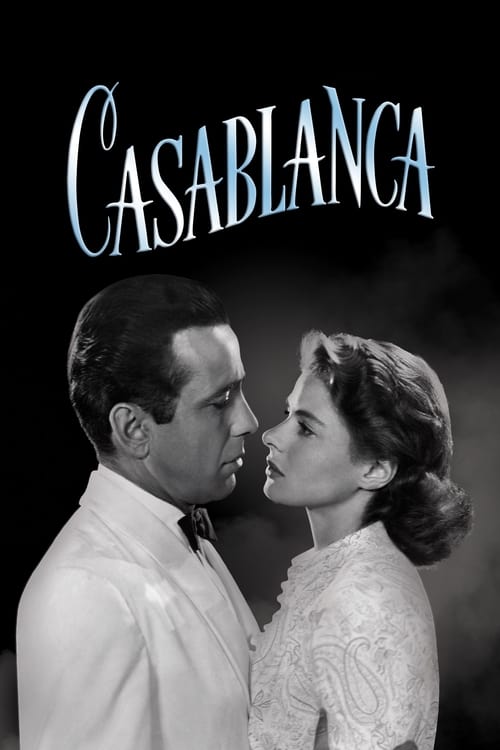
Casablanca
1943 · Michael Curtiz
For a classic-movie night when you want to fall in love and feel a lump in your throat — pure comfort viewing that still leaves you thinking about what sacrifice means. If you've never seen it, save it for an evening you can give it your full attention.
What it's about
December 1941, Casablanca: a cynical American runs the most popular saloon in a city thick with refugees, spies, and Vichy police, all scrambling for exit visas to escape the Nazis. Then the woman who broke his heart walks in — on the arm of a Resistance hero — and his carefully maintained neutrality starts to crack.
The experience
Romantic, quotable, and impossibly smooth — wit and longing in every scene, with real moral stakes underneath the glamour. It builds to an ache that has lost none of its power.
Performances
Humphrey Bogart's wounded cynicism and Ingrid Bergman's luminous, torn Ilsa are the template for screen romance; the chemistry between them is the whole engine of the film.
The craft
Michael Curtiz's direction is Hollywood studio craftsmanship at its absolute peak — glowing black-and-white photography, razor-sharp dialogue where nearly every line has entered the language, and a bar set that feels like a whole world. The songs and score are inseparable from the film's spell.
Why it matters
Released weeks after the Allied landings in North Africa, it caught its wartime moment perfectly, then grew over decades from popular hit into one of the most beloved and most-quoted films ever made.
Snapshot
Casablanca is the distillation of a particular Hollywood dream: that personal sacrifice and political commitment can be made to rhyme with erotic longing, and that this rhyme can be made to feel inevitable. A cynical American saloonkeeper in occupied Morocco is forced, by the reappearance of a lost love and the proximity of a Resistance hero, to choose between neutrality and engagement. The film arrived in wide release in January 1943, weeks after the Allied landings in North Africa, and its wartime resonances were immediately felt. Its reputation, however, only deepened with time — through repertory screenings, television broadcasts, and a sustained critical reappraisal that elevated it from popular entertainment to canonical monument. It now regularly appears among the highest-ranked films in critical surveys, while simultaneously remaining one of the most broadly recognized titles in all of cinema.
Industry & production
Casablanca originated in an unproduced stage play, Everybody Comes to Rick's, written by Murray Burnett and Joan Alison circa 1940. Warner Bros. story editor Irene Lee is credited with flagging the property; the studio purchased the rights in January 1942. Producer Hal B. Wallis oversaw the production and his involvement was substantial — he contributed creative decisions at every stage, including the final line of dialogue. The Epstein brothers (Julius J. and Philip G.) began the adaptation, and Howard Koch later joined the writing effort; the degree of each writer's contribution to specific scenes remains contested in film history.
The production began shooting in late May 1942 and continued through August. It was, by many accounts, an unusually turbulent shoot: the ending was not fixed during principal photography, and pages were frequently delivered to actors on the day of filming. This improvisational pressure was compounded by the demands of a large ensemble cast and the wartime restrictions that constrained studio resources. The film was shot almost entirely on the Warner Bros. lot in Burbank, with the Moroccan atmosphere constructed through set design, costume, and the casting of actual European refugees — many of them actors who had fled Nazi occupation — in minor roles. This last detail is not incidental; it saturated the production with biographical authenticity that no amount of location shooting could have supplied.
The cast was assembled with efficiency typical of the major-studio contract system. Humphrey Bogart had been established at Warner Bros. through The Maltese Falcon (1941); Ingrid Bergman was on loan from David O. Selznick. Paul Henreid, Claude Rains, Conrad Veidt, Sydney Greenstreet, and Peter Lorre — each a recognizable type within the period's genre vocabulary — formed an ensemble of unusual density. Dooley Wilson, cast as Sam, could not in fact play piano; his performance was dubbed in post-production.
Technology
The film was shot in 35mm on the standard studio equipment of the period. For the airport sequence that closes the film, production constraints led to a well-documented sleight-of-hand: the tarmac set was scaled down and shorter actors were employed to simulate depth and distance, with a fog machine obscuring the join between the physical set and the miniature aircraft. This solution, necessitated by budget and wartime material restrictions, is now one of the most discussed instances of studio-era practical ingenuity.
There is no significant technological innovation to report in the film's production, which is itself a kind of distinction: Casablanca represents a late flowering of the classical Hollywood apparatus, using established tools with exceptional craft rather than pushing against their limits.
Technique
Cinematography
Arthur Edeson served as director of photography, bringing to the film a visual vocabulary shaped by his earlier work on Frankenstein (1931) and The Maltese Falcon (1941). His lighting for Casablanca draws on the Expressionist tradition — shadow-heavy, high-contrast, with pools of darkness that carry psychological weight. The film's visual grammar is classical and controlled, privileging close-ups that anchor emotional beats. Bergman in particular is photographed with a soft, heavily diffused light that borders on idealization; her face becomes a site of projection, her expressions deliberately held at the edge of readability. This approach was intentional, reinforcing the film's structural ambiguity about Ilsa's inner life.
The chiaroscuro of Rick's Café — the neon, the smoke, the stratified social geography of the room — gives the interior setting a visual richness that sustained, legible geography. The camera is not especially mobile, but Edeson and Curtiz use blocking and rack focus to choreograph complex ensemble scenes without confusion.
Editing
Owen Marks edited the film using the conventions of Hollywood continuity. Shot-reverse-shot patterns govern most of the dramatic exchanges; the cutting is efficient and legible rather than expressive. The Paris flashback sequence introduces a brief tonal shift — softer imagery, a looser associative logic — that distinguishes the remembered past from the film's present tense. The editing's most notable quality is its pacing: the film moves with a compression unusual even for the period, rarely allowing a scene to run beyond its dramatic function.
Mise-en-scène / staging
The central set — Rick's Café Américain — is among the most socially and visually elaborate interiors in the classical Hollywood repertoire. Art director Carl Jules Weyl organized the space into visible strata: the gambling room, the main floor, the bar, the piano, Rick's private office above. This geography is morally coded from the outset. The staging frequently isolates characters within the crowd or uses the crowd as a contrasting register of need and desperation against which the principals' private drama plays out.
Curtiz's staging of the "Marseillaise" sequence — in which Laszlo leads the café's international clientele in drowning out a German anthem — is perhaps the film's most celebrated set piece, and the one where the alignment between blocking, performance, and sound achieves its greatest force. The tears on the faces of the actors, many of them genuine refugees, are among the most documented instances of performed and felt emotion coinciding in Hollywood cinema.
Sound
Max Steiner composed the score, working within the studio's standard post-production timeline. Steiner reportedly wished to replace "As Time Goes By" — a song written by Herman Hupfeld in 1931 and incorporated into the Burnett-Alison play — with an original composition. This was rendered impossible because Ingrid Bergman had already cut her hair for her next production (For Whom the Bell Tolls), making reshoots prohibitive. The song consequently remained, and its diegetic repetition — Sam plays it as a memory trigger, it resurfaces in Steiner's underscore — binds the film's temporal structure together. The leitmotif logic is not subtle, but it is deeply effective.
The "battle of the anthems" sequence works as sound design as much as staging: the volume swells of "Die Wacht am Rhein" against "La Marseillaise" are calibrated so that the shift in dominance registers as a physical event.
Performance
Bogart's performance as Rick Blaine established a template for a certain American male type — the wounded idealist performing cynicism — that his subsequent work in the period would consolidate. His understatement is the film's tonal anchor; in scenes of maximum emotional pressure, he narrows rather than expands. Claude Rains as Captain Renault constructs an entirely different register: mordant, amoral, and finally, in the film's closing gesture, capable of a kind of honor. The interplay between Bogart and Rains generates the film's sharpest exchanges. Bergman's Ilsa is more constrained by the script's structural ambiguity about her desires, but her luminosity in close-up carries a weight of interiority that the writing does not always supply. Henreid's Laszlo is the film's most one-dimensional figure — necessarily so, functioning as an ideological ideal more than a psychological subject.
Narrative & dramatic mode
The film operates within the conventions of romantic melodrama while absorbing the wartime moral framework that made sacrifice legible to its immediate audience. The letters of transit function as a classic MacGuffin, but the film's real mechanism is the forced triangulation of private desire and political obligation. Rick's arc — from practiced neutrality to decisive commitment — mirrors, with a precision that can hardly be coincidental, the trajectory of American isolationism through December 1941. The ending, in which Rick surrenders Ilsa to Laszlo and engineers Laszlo's escape, resolves the romantic triangle not through a reversal of feeling but through a renunciation that elevates politics above love without quite extinguishing the love.
The script's structural ambiguity — Ilsa's true allegiances, the sincerity of her feelings in Paris versus Casablanca — is not a flaw but a productive instability that has sustained the film's interpretive life for decades.
Genre & cycle
Casablanca sits at the intersection of several cycles: the wartime conversion narrative (the reluctant American brought into the Allied cause), the romantic melodrama, and an early inflection of what would be retroactively identified as film noir (the doomed romance, the morally compromised setting, the femme fatale figure). It was produced within Warner Bros.' house tradition of socially engaged, fast-moving entertainment, and it participated in Hollywood's substantial wartime propaganda effort without being reducible to it. The film's generic hybridity — the way its tonal registers shift between comedy (Renault's scenes), melodrama (the Paris flashback), thriller (the visa chase), and civic rhetoric (the Marseillaise sequence) — is central to its durability.
Authorship & method
Assigning authorship to Casablanca has been an enduring problem in film criticism. Curtiz was a technically proficient and prolific director whose output across genres and decades resists easy auteur characterization. His contribution to the film's visual and spatial intelligence is real but was historically undervalued relative to the screenplay. The Epstein twins and Howard Koch shared the Academy Award for Adapted Screenplay, and the texture of the dialogue — particularly its wit — is a major source of the film's appeal. Hal B. Wallis's producer credit encompasses creative interventions substantial enough that some accounts treat him as a co-author in a meaningful sense.
Max Steiner's score and Arthur Edeson's cinematography each exert a strong shaping influence on the film's emotional register. Casablanca is, in this sense, a collaborative object in ways that resist the auteurist framework — a product of the classical studio system functioning at high capacity.
Movement / national cinema
Casablanca belongs to Hollywood cinema of the studio era, but its production circumstances give it an unusual relationship to European cinema. The cast and crew included a substantial number of European emigres — directors, actors, and technicians who had fled fascism in Germany, Austria, Hungary, and France. Curtiz himself was Hungarian-born. Conrad Veidt, who played Major Strasser, had been a central figure in the German Expressionist cinema of the Weimar period. The film's visual and tonal affiliations with European traditions — particularly German Expressionism and French Poetic Realism — are not coincidental; they are partly the consequence of the biographical trajectories of the people who made it.
Era / period
The film is a product of the height of Hollywood's wartime production cycle (roughly 1942–1945), a period in which the studios operated under explicit coordination with the Office of War Information and produced large numbers of films oriented around Allied themes and sacrifice narratives. Casablanca is not simply propaganda, but it participates in the era's ideological structures with fluency.
Themes
The film's major preoccupations are: neutrality and commitment (Rick's refusal to act, and its eventual reversal); the relationship between private desire and political obligation; exile and displacement (the film's setting is a transit zone, populated by the stateless and the hunted); and the ethics of collaboration and resistance under occupation. The Renault figure, who collaborates with the Nazis while maintaining a private code of self-interest that is ultimately convertible to decency, represents a more nuanced engagement with the moral complexity of occupation than the film's popular reputation tends to suggest.
Reception, canon & influence
Casablanca received strong reviews on release and won three Academy Awards in the spring of 1943: Best Picture, Best Director, and Best Adapted Screenplay. Its immediate success was genuine but unremarkable by the standards of a major Warner Bros. release; its elevation to canonical status was a slower, more complex process.
The film's reputation was substantially consolidated through the 1950s and 1960s via television broadcasts, which introduced it to audiences who had not seen it in first run, and through repertory screenings — most notably the sustained programming at the Brattle Theatre in Cambridge, Massachusetts, which made Casablanca a fixture of American cinephile culture. This second life in repertory and on television is arguably more responsible for the film's canonical position than its original theatrical release.
Critically, the film attracted serious attention as its cultural weight accumulated. Umberto Eco's essay "Casablanca: Cult Movies and Intertextual Collage" (1984) offered one of the most searching accounts of why the film works — arguing that it achieves its effects precisely through an accumulation of archetypes so dense that the viewer cannot resist, that the film becomes a kind of mythological repository rather than a coherent narrative machine.
The influences on the film run toward French Poetic Realism — particularly the fatalistic romanticism and refugee milieu of Marcel Carné and Julien Duvivier — and toward German Expressionism for its visual grammar. The Warner Bros. tradition of social melodrama provided the institutional template.
Casablanca's forward influence is both direct and diffuse. It shaped the conventions of the wartime sacrifice narrative and contributed substantially to the screen persona of Humphrey Bogart, which in turn influenced a generation of American male performance styles. Lines from the film — "Here's looking at you, kid," "Round up the usual suspects," "I think this is the beginning of a beautiful friendship" — entered the popular lexicon to a degree unusual even for canonical films. Woody Allen's Play It Again, Sam (1972) is the most sustained direct engagement with the Casablanca myth, staging a neurotic's attempt to inhabit the Bogart persona and finding, predictably, that the myth does not survive contact with ordinary life. The film appears in the American Film Institute's 1998 ranking of the greatest American films at number two, and has occupied comparable positions in most major critical surveys conducted since.
A Deleuzian reading
The light is too soft on her face.
The full Deleuzian reading of Casablanca →
Reception
A hit and Best Picture winner on release, but nobody involved thought they were making a masterpiece — it was one of dozens of studio pictures Warner Bros. shipped that year. Decades of revival screenings and TV airings turned it into the consensus pick for the greatest Hollywood studio film ever made.
How Casablanca was received, from release to now →
Influences: the films it descends from and the films it influenced
- Morocco (1930) — Sternberg's colonial nightclub as moral limbo — the Legionnaire café where political allegiances and romantic fatalism converge among cosmopolitan exiles — established both the spatial template for Rick's Café and the soft-diffusion portrait lighting of Dietrich as a figure of withheld interiority, the precise techniques Curtiz and Edeson applied to Bergman and the Café Américain.
- Frankenstein (1931) — Arthur Edeson, who photographed Casablanca, developed his shadow-pool lighting technique here — high-contrast key illumination with minimal fill creating psychologically weighted darkness in enclosed studio interiors — and carried the identical technical approach into Rick's Café's expressionist chiaroscuro a decade later.
- Shanghai Express (1932) — Lee Garmes's soft-focus diffusion-filter close-ups of Dietrich — rendering her face a screen for audience projection rather than a legible emotional surface — established the cinematographic convention Edeson applied to Bergman: the idealized overlit female close-up as a structural device for sustaining romantic ambiguity and withholding the heroine's inner life.
- Grand Illusion (1937) — Renoir's ensemble staging of multi-national characters in shared confined interiors, where class and allegiance intersect under mortal pressure, established the blocking grammar Curtiz inherited; specifically, the scene where French POWs rise to sing the Marseillaise in collective defiance of their German captors is the direct formal and political model for Casablanca's anthem-battle sequence.
- Pepe le Moko (1937) — Duvivier's staging of the Algiers Casbah as a liminal colonial neutral zone — where multiple national and criminal allegiances suspend hostilities at café tables and an exiled protagonist is trapped between an irrecoverable past and an untenable present — supplied Casablanca its fundamental dramatic geography and the logic of the café as moral and political crossroads.
- Only Angels Have Wings (1939) — Hawks's Barranca saloon as the enclosed social crossroads where a morally guarded American proprietor maintains cultivated neutrality amid the desperate needs of a cosmopolitan ensemble — with Cary Grant's stoic understatement as the performance mode for the reluctant moral arbiter — is the direct structural and performative template Curtiz and Bogart adapted for Rick's Café and Rick Blaine.
- The Maltese Falcon (1941) — Edeson photographed this Warner Bros. production using the same chiaroscuro vocabulary he brought to Casablanca, while Bogart established here the specific performance mode Rick inherits: affectless surface deployed as armor for residual sentiment, a cultivated cynicism the plot systematically unmasks as a moral position rather than moral absence.
- Passage to Marseille (1944) — Curtiz deliberately reassembled the Casablanca apparatus — Bogart, Rains, Greenstreet, Lorre, Edeson's cinematography — and extended the flashback structure to its formal limit: nesting flashbacks within flashbacks within flashbacks, taking Casablanca's single Paris insert and making temporal displacement the film's primary structural device rather than a single emotional punctuation.
- To Have and Have Not (1944) — Hawks consciously transplanted the Casablanca formula — Bogart's expatriate barkeep refusing political engagement in an occupied colonial port, the leitmotif pianist (Hoagy Carmichael replacing Dooley Wilson), the wartime-conversion arc — with Sid Hickox photographing Bacall in the same diffused close-up register Edeson used for Bergman, demonstrating the soft-portrait technique's reproducibility across cinematographers and studios.
- Mildred Pierce (1945) — Curtiz carries the flashback-as-confession-counterpoint structure and the stratified social interior — Pierce's restaurant as Rick's Café analog, with morally coded levels and dense ensemble crowd choreography — into the femme noir; Ernest Haller's expressionist lighting extends Casablanca's shadow grammar into the domestic and commercial spaces of postwar Los Angeles.
- Notorious (1946) — Hitchcock extends Casablanca's structural technique of rendering the female protagonist's interiority opaque — Bergman again, photographed with soft diffusion — but converts melodramatic ambiguity into psychothriller mechanics: the audience's sustained uncertainty about Alicia's loyalty replicates Rick's uncertainty about Ilsa's, and what in Casablanca generates romantic yearning here generates sustained suspense.
- Letter from an Unknown Woman (1948) — Ophüls inherits the flashback as the film's entire structural frame — the confession letter as romantic memory counterpoint to a present-tense reckoning — and photographs Joan Fontaine in gaslit Vienna with the same diffused idealization Edeson applied to Bergman; the sacrifice arc pushes Casablanca's melodramatic structure to its ironic extreme: she dies for a man incapable of remembering her.
- The Third Man (1949) — Anton Karas's zither is deployed exactly as Steiner deploys 'As Time Goes By' — a single diegetic melodic motif whose repetition and variation define a character's moral aura and the film's emotional atmosphere; Robert Krasker's Oscar-winning expressionist chiaroscuro extends Casablanca's shadow-pool lighting to its postwar extreme in the Viennese sewers.
- Chinatown (1974) — Robert Towne's screenplay consciously inherits Casablanca's narrative architecture — a cynical American operator whose self-protective neutrality is broken by erotic attachment to a woman of withheld interiority, drawn into a historical crime larger than either of them, whose intervention ends in the sacrifice of the innocent — transposing the wartime-conversion arc into neo-noir with systemic corruption replacing political occupation as the irresistible force.
- The English Patient (1996) — Minghella transplants Casablanca's formal architecture into the prestige art film: wartime North African setting, amnesia-driven flashback structure as romantic memory counterpoint to a brutal present, John Seale's soft-diffusion photography of Kristin Scott Thomas as a female lead whose interiority is structurally withheld, and a sacrifice arc in which erotic attachment overrides political obligation — here ending not in redemption but catastrophe.
- The Empire Strikes Back (1980) — The wartime melodrama's refusal to resolve its romantic triangle — the hero conceding love through terse deflection rather than declaration — provides the template for Han and Leia's irresolution, and Ford's improvised 'I know' is explicitly a Bogart-mode act of romantic understatement within that tradition.
- Key Largo (1948) — Rick's arc of cynical disengagement surrendering to political commitment under wartime pressure is the structural prototype for McCloud's paralysis-to-action moral recovery — both films using genre confinement to externalize a postwar allegory of civic obligation.
- Cold War (2018) — A single diegetic source song ('As Time Goes By') deployed as the romance's leitmotif within a love story sundered by political history — the song-as-emotional-anchor device Cold War rebuilds around its folk melody.
- What's Up, Doc? (1972) — Supplies the 'As Time Goes By' musical quotation, folded in as one node of the film's dense classic-Hollywood citation network.
- Now, Voyager (1942) — Paul Henreid plays a nearly identical role — the cultivated married European who cannot have the woman he loves and chooses honorable renunciation — and Max Steiner applies the same leitmotif technique at Warner Bros. in the same production year, building a recurring romantic theme that undergoes harmonic variation to track the relationship's emotional arc, making the two films craft twins in their melodramatic scoring.
- Arsenic and Old Lace (1944) — The Epstein brothers' dialogue-shaping and Max Steiner's emphatic orchestral cueing are the same authorship layer — Steiner's score frames both pictures, here underlining the macabre farce with the studio's characteristic scoring.
- Black Book (2006) — Supplies the classical-Hollywood occupation-melodrama gloss and the diegetic cabaret/nightclub as a stage where romance and resistance politics collide, an idiom Black Book adopts unashamedly rather than ironizing.
- The Mask of Dimitrios (1944) — Shares the émigré-ensemble casting method — Lorre and Greenstreet slotted into a continental intrigue populated by exiled European character actors on Warner soundstages.
Similar films
- The Third Man (1949) — influence & lineage · often watched together
- The Maltese Falcon (1941) — influence & lineage
- Grand Illusion (1937) — influence & lineage
- Notorious (1946) — influence & lineage
- Schindler's List (1993) — same viewing thread · often watched together
- Inglourious Basterds (2009) — same viewing thread
- 8½ (1963) — often watched together
- The Rules of the Game (1939) — often watched together
All the films related to Casablanca →
Watch it with: curated runs of related films
- In the Shadow of the Reich — A run of films about ordinary people inside the Nazi era — surviving it, resisting it, or trying to reckon with how it happened — that rhyme on conscience, complicity, and who chooses to act.