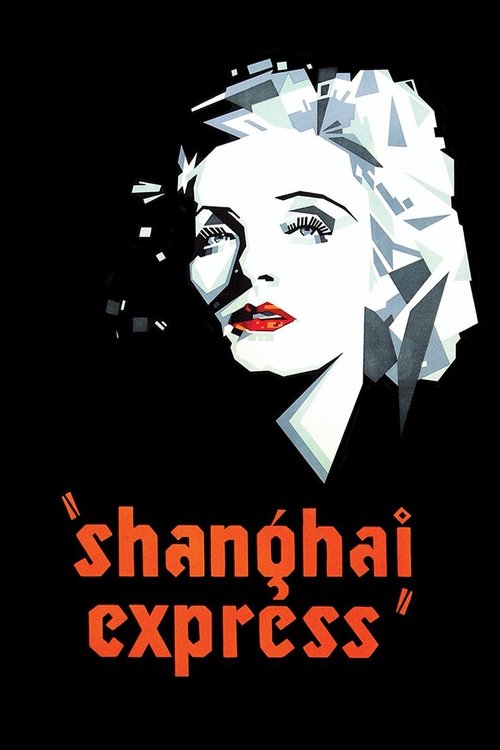
Shanghai Express
1932 · Josef von Sternberg
For a stylish night with old Hollywood at its most glamorous — when you want atmosphere, longing, and a little danger in under ninety minutes.
What it's about
Aboard a train from Peking to Shanghai during the chaos of the Chinese Civil War, a notorious woman who lives by her reputation finds herself sharing the journey with the British officer who once loved and left her. As rebels close in and the passengers' secrets surface, the trip becomes both a hostage drama and a second chance neither of them knows how to take.
The experience
Sleek, smoky, and surprisingly tense — a chamber piece where every glance is loaded and the danger builds car by car. It's romantic in the grand, doomed, cigarette-lit way, with a wit that keeps it moving.
Performances
Marlene Dietrich, as Shanghai Lily, gives one of the defining star performances of the era — every line delivered like a challenge, her face lit like a landscape. Anna May Wong nearly steals the film as her enigmatic traveling companion.
The craft
Josef von Sternberg turns light itself into the subject: veils, smoke, feathers, and shadow sculpt Dietrich's face into pure iconography, and the cinematography remains some of the most celebrated of the black-and-white era. Made pre-Code, it's franker about sex, sin, and survival than Hollywood would be again for decades.
Why it matters
One of the peaks of the legendary Dietrich–von Sternberg collaboration, it helped define what movie-star glamour means and became a touchstone for how lighting and costume can carry a film's meaning.
Snapshot
Shanghai Express is the fourth of the seven films Josef von Sternberg made with Marlene Dietrich, and the one in which their collaboration arrives at a kind of distilled equilibrium between narrative and spectacle. Set almost entirely aboard a train running from Peking to Shanghai through the chaos of the Chinese Civil War, it is at once a tense hostage thriller, a chamber drama of wounded lovers, and an extended meditation on faith, reputation, and the unreadability of the human face. Dietrich plays "Shanghai Lily," a notorious "coaster" — a woman who lives by her charms along the China coast — who finds herself sharing a compartment-lined corridor with Captain Donald Harvey (Clive Brook), the British officer who once loved and left her. Around them von Sternberg assembles a gallery of travelers whose pieties and hypocrisies the journey will test. The film is famous for its photographic surfaces: smoke, lace, feathers, steam, and barred light filtered through veils and louvers, photographed by Lee Garmes in images so dense they seem to retard the story's forward motion. It won the Academy Award for Cinematography and was nominated for Best Picture and Best Director. More than nine decades on, it remains a touchstone for what cinema can do with light, texture, and the close-up of a luminous, withholding face.
Industry & production
Shanghai Express was a Paramount Pictures production, made at the studio's Hollywood lot during the early sound era when Paramount's house style — sophisticated, European-inflected, visually opulent — was at its height. By 1932 von Sternberg and Dietrich were among the studio's most valuable assets: he the prestige auteur, she the manufactured star whose persona he had built across Morocco (1930) and Dishonored (1931) after their German triumph in The Blue Angel (1930). The picture exemplifies the studio system at its most controlled: an exotic locale realized entirely within the studio, an elaborate train set and a recreated Chinese railway station built on the lot, and a polished roster of contract craftspeople — among them art director Hans Dreier and costume designer Travis Banton — shaping every frame.
The production also reflects the Hollywood economy of exoticism. China here is a backlot abstraction, assembled from sets, extras, and atmosphere rather than location or documentary fidelity; the film belongs to a cycle of Orientalist studio fantasies, and modern viewers should read its China as a designed dreamscape, not a place. As a commercial proposition it was a substantial success and consolidated the von Sternberg–Dietrich brand, though precise box-office figures should be treated cautiously given the unreliability of period accounting, and I will not assign numbers the record does not firmly support.
Technology
The film was made early in the sound period, and its technology bears the marks of that transitional moment. It is a single-system synchronized-sound picture shot on orthochromatic-to-panchromatic black-and-white stock, with the deep, velvety blacks and controlled grays that von Sternberg and Garmes pushed to an extreme. The era's heavy, noise-blimped cameras and the constraints of microphone placement shaped the staging — long stretches play in measured, relatively static set-ups — yet von Sternberg turned these limitations into an aesthetic, lavishing attention on what stood between the lens and the actor. The train itself is a piece of production technology as much as a setting: a sectioned, dressable set that let the camera move through corridors and compartments and that mechanized the film's rhythm, the locomotive's motion supplying a pulse the largely scoreless soundtrack does not. The much-discussed lighting was achieved with conventional incandescent units, but deployed with unusual density — gauzes, scrims, practical louvers, and atmospheric haze used to carve and diffuse the beam.
Technique
Cinematography
The cinematography is the film's signal achievement and the reason it is still taught. Lee Garmes received the Academy Award for it, though by von Sternberg's own later account the director was intimately, even obsessively, involved in the lighting — a division of labor impossible to fully adjudicate now, and one best described as a genuine collaboration. The images are built in layers: foreground obstructions — netting, shadow, feathers, the slats of a window — sit between us and the actors, so that we seem always to be looking through something to reach Dietrich's face. Light is sculptural rather than illustrative, modeling cheekbone and gauze with equal care, and the famous "Dietrich face" — lit from above to hollow the cheeks and catch the eyes — is here perfected. Atmosphere is a constant medium: steam, smoke, and dust thicken the air so that light becomes visible as substance. The effect is to slow perception, to make every composition a thing to be read.
Editing
The cutting is unhurried and tied to the train's mechanical rhythm rather than to action-film acceleration. Scenes are allowed to breathe; von Sternberg favors holding on a face or a charged composition over fragmenting it. There are bursts of faster cutting at moments of crisis — the train's stoppage, the rebel takeover — but the dominant tempo is one of suspended attention, the editing subordinated to the photographic image. I am not able to confirm the credited editor with confidence and will not invent an attribution; what can be said securely is that the film's rhythm reads as authored by its director and its photographic conception.
Mise-en-scène / staging
Von Sternberg's mise-en-scène is famously maximalist in detail and claustrophobic in space. The train corridor is a perfect von Sternberg environment: a long, compartmentalized tube that lets him stack planes of action and obstruction, frame characters through doorways and windows, and keep the camera threading among bodies and objects. Every surface is dressed — luggage, birdcages, religious objects, the costumes' own textures — so the frame teems. Dietrich is staged as an icon: posed, lit, and costumed (Travis Banton's plumed black ensembles and veils) to be looked at, often held at the center of a composition that everything else is arranged to present. The staging continually thematizes looking and being looked at, surface and concealment.
Sound
The soundtrack is characteristic of early-1930s Hollywood in its sparing use of non-diegetic music; long passages carry only the diegetic clatter, hiss, and whistle of the train, which functions almost as a score. Dialogue is delivered in the clipped, deliberate cadence the period favored, and von Sternberg exploits the contrast between Dietrich's slow, ironic line readings and the surrounding clamor. The result is a sound design in which the locomotive's mechanical noise becomes an emotional pulse and silences land with weight. Specific music credits for the picture are something I would not assert without certainty; the salient point is the relative absence of orchestral underscoring and the prominence of environmental sound.
Performance
Dietrich's performance is a masterclass in withholding. Shanghai Lily reveals almost nothing through conventional expression; she trades in stillness, the raised eyebrow, the half-smile, the line delivered as if from behind glass. Her most quoted line — "It took more than one man to change my name to Shanghai Lily" — encapsulates the persona: a reputation worn as armor and as wit. Clive Brook plays Harvey as a study in repressed English rectitude, his stiffness the dramatic counterweight to Lily's languor; the romance turns on his inability to believe in her, and the film's emotional question is whether faith can survive evidence. Anna May Wong, as the fellow coaster Hui Fei, gives a performance of guarded dignity that the screenplay underwrites but her presence enlarges, and it is her decisive act of violence that resolves the plot — a notable instance of a Chinese American actress given real agency, even within a film that otherwise renders China as backdrop. Warner Oland, soon to become Hollywood's Charlie Chan, plays the Eurasian rebel leader Henry Chang with silken menace.
Narrative & dramatic mode
Structurally the film is a confined-space ensemble thriller — strangers thrown together in transit, their secrets surfacing under pressure — fused to a melodrama of reunited lovers. The dramatic mode is ironic and elliptical rather than expository: motivation is implied, backstory withheld, and the audience is made to read faces and surfaces for meaning the dialogue refuses to spell out. The plot machinery (the train halted by revolutionaries, a hostage crisis, Chang's designs on Lily and on Hui Fei) supplies suspense, but von Sternberg treats incident as occasion for tableau and for testing the central relationship. The governing tension is epistemological: can Harvey know Lily, believe in a woman whose entire social identity is a performance? The film answers in the register of faith — belief without proof — and its emotional climax is not the action's resolution but a private restoration of trust.
Genre & cycle
The picture sits at the intersection of several early-1930s cycles: the exotic-Orient adventure-romance, the "fallen woman" / sophisticated-vamp melodrama, and the confined-journey thriller (the train film as a microcosmic society). It belongs squarely to the pre-Code moment, frank about sexual reputation and commerce in a way the Production Code would soon foreclose; Lily and Hui Fei are coasters whose trade is understood and not moralized into punishment. It is also part of the distinct von Sternberg–Dietrich cycle — a run of films built around her constructed image — which forms a genre almost unto itself within the studio's output.
Authorship & method
Shanghai Express is a near-paradigmatic auteur film, the product of von Sternberg's total command of the image and his Pygmalion project with Dietrich. His method was pictorial first: he conceived in terms of light, texture, and obstruction, often subordinating narrative clarity to visual density, and he was famously hands-on with lighting — a tendency that complicates the credited authorship of the photography. The key collaborators were essential to realizing that vision: cinematographer Lee Garmes, whose Oscar-winning work gives the film its luminous surface; screenwriter Jules Furthman, a frequent von Sternberg and later Hawks collaborator, who adapted a story by Harry Hervey and supplied the terse, ironic dialogue; art director Hans Dreier, architect of Paramount's European look; and costume designer Travis Banton, whose plumed, veiled gowns are inseparable from the Dietrich icon. The film is best understood as von Sternberg orchestrating these talents toward a single, image-centered conception.
Movement / national cinema
Though made in Hollywood, the film is steeped in the European, particularly German, sensibility von Sternberg and Dietrich carried with them: the chiaroscuro and atmospheric density owe a clear debt to Weimar cinema's expressionist lighting and to the Kammerspiel tradition of intimate, confined drama. It thus represents a kind of transplanted European art-cinema aesthetic operating inside the American studio system — a hybrid that helped define Paramount's "continental" prestige brand. It is not part of an organized movement so much as an instance of émigré sensibility shaping classical Hollywood from within.
Era / period
The film is a quintessential artifact of the early sound, pre-Code, Depression-era studio system (1929–1934). Its technical character — measured staging, sparing score, deep black-and-white photography — reflects the constraints and discoveries of the first sound years. Its candor about sex and reputation marks the pre-Code window before the Production Code's 1934 enforcement tightened. And its lavish escapism speaks to a Depression audience for whom exotic, glamorous fantasy held particular appeal. It belongs to a brief, distinctive moment when technological limitation, relative censorship freedom, and high studio craft coincided.
Themes
At its core the film is about faith and the unknowability of others. Harvey cannot believe in Lily because her identity is a performance and her past a rumor; the drama asks whether love can rest on belief rather than proof, and stages a literal prayer at its crisis. Reputation and the woman's name recur as motifs — the constructed self ("Shanghai Lily") versus the buried private one ("Madeleine"). Surface and concealment are thematized at every level, from the veils over Dietrich's face to the corridor's layered obstructions: the film is about the difficulty of seeing through to truth, and its style enacts that difficulty. Secondary themes include colonial anxiety and the chaos of revolution as a backdrop against which Western certainties are tested, and the parallel dignity granted to Hui Fei, whose violent agency rebalances the film's moral economy.
Reception, canon & influence
On release the film was a critical and commercial success and the most honored of the von Sternberg–Dietrich pictures, taking the Academy Award for Cinematography and earning nominations for Best Picture and Best Director. Contemporary praise centered, as later criticism would, on its extraordinary visual surface, though some critics then and since have charged von Sternberg with privileging décor over drama — a debate the film itself seems to anticipate and embrace.
Looking backward, the film's influences are legible: Weimar expressionist lighting and the German chamber-drama tradition; the studio Orientalism of earlier exotic romances; and the accumulated craft of the von Sternberg–Dietrich films that preceded it. Looking forward, its legacy is large and durable. It helped fix the iconography of the glamorous, enigmatic screen woman lit to perfection, a template that shaped the visual treatment of stars for decades and fed directly into the look of 1940s film noir, whose chiaroscuro and atmospheric obstruction it anticipates. It stands as a foundational text in the canon of pictorial, image-driven filmmaking — repeatedly invoked in discussions of cinematography and mise-en-scène — and its confined-train-as-society structure recurs across the thriller tradition. Within film scholarship it remains central to debates about authorship, the von Sternberg–Dietrich partnership, the construction of stardom, and the politics of Hollywood's exotic imaginary, including renewed attention to Anna May Wong's place within and against that imaginary. It endures less as a story than as a way of seeing — a demonstration that in cinema, light and surface can themselves be the subject.
A Deleuzian reading
Watch the first time the camera finds Shanghai Lily, and notice what is in the way.
The full Deleuzian reading of Shanghai Express →
Reception
No reappraisal needed at the box office — it was one of the biggest hits of 1932 and a Best Picture nominee. What's shifted is the spotlight: modern viewers increasingly watch it for Anna May Wong, whose performance is now widely seen as the film's secret weapon.
How Shanghai Express was received, from release to now →
Influences: the films it descends from and the films it influenced
- The Last Laugh (1924) — Established the Weimar chamber-drama (Kammerspiel) tradition of telling story through expressive lighting and atmosphere rather than intertitle exposition — the soft-modeled, mood-saturated studio light von Sternberg absorbed.
- Sunrise (1927) — Pioneered the fog-diffused, atmospheric-haze studio environment with foreground scrim and mist softening the frame — the diffusion and density Garmes and von Sternberg push to an extreme in the train compartments.
- Pandora's Box (1929) — Fixed the template of the enigmatic woman lit as a luminous, unreadable surface (Louise Brooks), where the camera contemplates her as icon rather than psychology — the 'woman-as-icon' staging Dietrich inherits.
- Variety (1925) — Used confined performance milieu and layered nets, hanging fabrics and apparatus as foreground obstruction shot through toward the subject — the cluttered, veiled depth-staging von Sternberg systematizes.
- Underworld (1927) — His own prototype for atmospheric crime milieu built from smoke, shadow and reflected glints, prizing pictorial density over narrative legibility.
- The Docks of New York (1928) — His fog-bound waterfront where diffused haze, hanging ropes and nets, and overhead pools of light dissolve space into texture — the direct atmospheric rehearsal for Shanghai Express.
- Morocco (1930) — First constructed the Dietrich icon via overhead glamour key-lighting, veils and withholding stillness, opening the von Sternberg–Dietrich cycle's method of sculpting a star with light.
- The Blue Angel (1930) — Originated the von Sternberg–Dietrich collaboration and the persona of the impassive, surface-glamorous woman as the camera's central object of contemplation.
- Dishonored (1931) — Immediately prior Dietrich vehicle developing the masked/veiled spy-melodrama and elliptical, terse staging von Sternberg carries straight into Shanghai Express's confined-thriller mode.
- The Scarlet Empress (1934) — Extends the layered-foreground-obstruction aesthetic to its limit — gauze, veils, grotesque statuary and nets crowding the lens — the logical escalation of the train film's pictorial density.
- To Have and Have Not (1944) — Inherits the von Sternberg craft through screenwriter Jules Furthman, who carries forward the terse, ironic, double-edged dialogue and the cool self-possessed woman that defined the Shanghai Express script.
- Gilda (1946) — Translates the overhead-glamour-lit, enigmatic woman-as-icon into 1940s noir — Hayworth posed and keyed exactly as Dietrich was, surface concealing motive.
- Casablanca (1942) — Reworks the exotic confined-crossroads-as-society structure with atmospheric haze, fog and slatted light, the contained-ensemble-in-transit thriller von Sternberg modeled.
- Murder on the Orient Express (1974) — Directly continues the confined-train-as-microcosm-society ensemble thriller, the claustrophobic-corridor staging of strangers sealed in a moving compartment.
- The Conformist (1970) — Storaro's pictorial design revives von Sternberg's mise-en-scène of light raked through layered foreground elements (blinds, leaves, fabric), where composition and texture become the subject.
- In the Mood for Love (2000) — Christopher Doyle shoots through layered foreground obstruction (doorframes, drapes, mirrors) with atmospheric haze and a withholding, iconized woman — the surface-and-concealment aesthetic of von Sternberg in slowed, elliptical form.
- Blade Runner (1982) — Extends the noir lineage Shanghai Express seeded — atmospheric haze, fan-light and smoke, and light filtered through layered foreground slats glamorizing the femme figure as luminous surface.
- Witness for the Prosecution (1957) — Von Sternberg develops Dietrich's performance method of playing a character who performs a constructed identity — the fallen woman revealed as something else — with expressionist chiaroscuro as her character marker; Wilder recruits this established Dietrich persona and its conventions wholesale, counting on audiences to misread her.
- Stage Fright (1950) — Codifies the von Sternberg/Dietrich glamour-lighting grammar — veiling and key light sculpting her face — which Dietrich effectively dictated for her own scenes in Stage Fright.
- Only Angels Have Wings (1939) — The Furthman 'knowing woman' defined entirely through clipped verbal exchange, wrapped in Sternberg/Garmes low-key atmospheric haze that anticipates Joseph Walker's fog-enveloped Barranca.
- Nightmare Alley (1947) — Lee Garmes' Oscar-winning smoke-and-scrim chiaroscuro here is the exact low-key visual signature he carries forward to Nightmare Alley, sculpting faces out of darkness rather than lighting them evenly.
Similar films
- Dishonored (1931) — influence & lineage
- The Blue Angel (1930) — influence & lineage
- The Scarlet Empress (1934) — influence & lineage
- Murder on the Orient Express (1974) — influence & lineage
- Lust, Caution (2007) — shared sensibility
- Hangmen Also Die! (1943) — shared sensibility
- Leave Her to Heaven (1945) — shared sensibility
- Flowers of Shanghai (1998) — shared sensibility
All the films related to Shanghai Express →