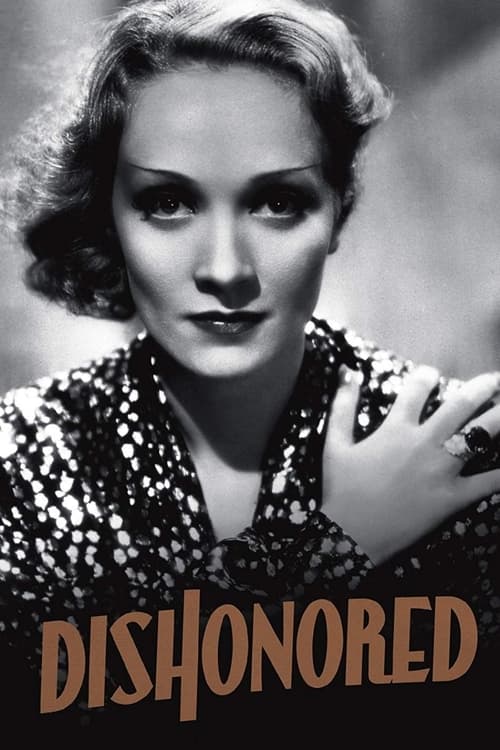
Dishonored
1931 · Josef von Sternberg
When you're in the mood for old-Hollywood glamour with teeth — champagne-cool star power, pre-Code frankness, and a heroine who answers to nobody. A stylish night in for anyone curious about where screen cool comes from.
What it's about
In First World War Vienna, a soldier's widow surviving as a streetwalker is recruited by the Austrian Secret Service and reborn as Agent X-27 — a spy sent to seduce and unmask traitors. Brilliant at the work and loyal to no one's rules but her own, she meets her match in a Russian officer playing the same game from the other side, and duty and desire start pulling in opposite directions.
The experience
Sly, glamorous, and unexpectedly moving — an espionage yarn conducted through masquerades, piano codes, and heavy-lidded glances. It's playful on the surface and quietly defiant underneath, building to a finish with real emotional force.
Performances
Marlene Dietrich is the whole show: ironic, fearless, and completely in command, treating espionage, seduction, and death alike with the same unbothered poise. It's one of the definitive demonstrations of what star presence means.
The craft
Von Sternberg drowns the frame in shadow, veils, streamers, and smoke — every image composed like a fever dream of Vienna — and Dietrich is lit like no one else in cinema history. The film's texture is the point: costumes, masks, and light doing the storytelling that dialogue won't.
Why it matters
A key entry in the legendary Dietrich–von Sternberg cycle that defined an entire idea of screen glamour, and a pre-Code portrait of female autonomy that still feels startling.
Snapshot
Dishonored is the third of seven films Josef von Sternberg made with Marlene Dietrich, produced at Paramount in 1931 between Morocco (1930) and Shanghai Express (1932). Dietrich plays a Viennese widow turned streetwalker recruited by the Austrian Secret Service during the First World War and given the designation Agent X-27 — a number the film prefers to a name, and the title under which the picture was sometimes promoted. Sent to seduce, deceive, and surveil, she falls for her Russian counterpart, the officer Kranau (Victor McLaglen), and the espionage plot bends toward a study of erotic loyalty against institutional duty. The film is best remembered for its final movement: condemned as a traitor, X-27 faces a firing squad, declines a chaplain and a blindfold, calmly repairs her makeup in the reflection of a young lieutenant's sword, and dies on her own terms. It is a spy melodrama in outline and a Sternbergian poem of surface, irony, and fatalism in execution — minor in scale, but central to understanding the director's collaboration with Dietrich at its most distilled.
Industry & production
Dishonored was a Paramount Publix production made during the studio's early-sound boom and at the height of Sternberg's creative autonomy there. Having delivered the prestige and commercial success of Morocco — the film that introduced Dietrich to American audiences and earned multiple Academy Award nominations — Sternberg enjoyed unusual latitude to shape vehicles around her. Dishonored was conceived explicitly as a Dietrich star vehicle, engineered to consolidate the persona of the worldly, self-possessed woman that Morocco had established.
The original story is credited to Sternberg himself; the screenplay and dialogue are credited to Daniel N. Rubin. This authorship pattern — director-as-originator, with a writer engaged to build dialogue around a conception that was visual and tonal from the start — is characteristic of Sternberg's Paramount period, where he functioned as the controlling intelligence over story, design, and image. The film arrived in a year when the figure of the female spy was conspicuously in the air: MGM released Mata Hari with Greta Garbo the same year. Sternberg consistently denied that X-27 was a portrait of Mata Hari, and the film names no historical original, but the cultural proximity is part of its reception context and was surely part of its commercial logic.
The exact budget and box-office returns are not reliably documented in the accessible record, and I will not invent figures; what is clear is that the film was positioned as a major release built on a proven star pairing rather than as a programmer.
Technology
The film was made roughly three years into Hollywood's conversion to synchronized sound, and it shows both the constraints and the growing fluency of that transitional moment. By 1931 the worst immobilities of the earliest talkies — the boxed-in camera, the frozen microphone setup — had begun to ease, and Sternberg, working with one of the era's finest cinematographers, was able to keep his camera more mobile and his lighting more sculptural than the first wave of sound pictures allowed. The film is a product of the panchromatic black-and-white, optical-soundtrack standard of its day. There were no exotic technical novelties; rather, the interest lies in how conventional 1931 tools were pushed toward an unusually dense, atmospheric image. Any account of the film's surviving materials and restoration history should be treated cautiously, as early Paramount titles have had uneven preservation.
Technique
Cinematography
The photography is by Lee Garmes, Sternberg's key cameraman of this period, who also shot Morocco and Shanghai Express and whose work is inseparable from the look these films achieved. Garmes and Sternberg built the image out of layered light and intervening matter: smoke, veils, netting, lace, foliage, falling snow, and ornamental clutter placed between lens and subject so that the frame is rarely a clean window but a textured screen. Dietrich is lit with the careful modeling — key light shaping the cheekbones, eyes set in shadow — that the two men refined into a signature. The result is an image that is simultaneously glamorous and slightly veiled, withholding as much as it reveals, which suits a story about a woman whose profession is concealment. Garmes's contribution to the Dietrich "look" is large enough that the visual authorship of these films is best understood as a genuine collaboration, even as Sternberg directed every element of the staging.
Editing
The film's cutting is largely subordinate to Sternberg's preference for the sustained, composed shot in which action unfolds within the frame rather than across cuts. Sternberg tended to think in terms of pictorial density and duration; montage in the aggressive Soviet sense is not his idiom. The editing therefore serves continuity and rhythm rather than calling attention to itself. I do not have a confidently attributable editor credit to cite here, and rather than guess I note that the cutting's character is best described through its effect — patient, image-led — than through documented authorship.
Mise-en-scène / staging
This is the film's deepest level of expression and the truest register of Sternberg's authorship. The frames are crowded with significant objects and surfaces: a cat that accompanies X-27, a piano, masks and costumes for a masquerade ball, military regalia, the apparatus of cipher and disguise. Sternberg stages Dietrich as a figure who performs across identities — prostitute, peasant, society woman, prisoner — and the décor shifts to mark each masquerade while the woman beneath remains ironic and unreadable. The famous staging coups are built into the setting: the spy who reads coded music at the piano, so that espionage becomes performance; the seduction scenes shot through ornamental barriers; and above all the execution, staged with a cool symmetry in which the instruments of death (rifles, a sword) double as the instruments of feminine self-presentation (a mirror, a tube of lipstick). The mise-en-scène is the argument.
Sound
Sternberg used sound selectively and pointedly rather than continuously, in keeping with the still-experimental practice of 1931. Music is woven into the plot rather than merely accompanying it: Dietrich's character plays the piano, and musical notation functions as a vehicle for code, fusing the diegetic and the thematic. Dialogue is spare and often laconic, leaving silences and ambient detail to carry mood. The film does not rely on a wall-to-wall symphonic score in the manner that became standard later in the decade. I cannot reliably attribute a single composer credit for Dishonored and will not invent one; the safer claim is that the film exemplifies early-sound restraint, treating music as a story element and a source of irony as much as an emotional underline.
Performance
Dietrich's performance is the film's center and one of the purest distillations of the persona Sternberg built for her. She plays X-27 with amused detachment, an erotic confidence that never tips into sentiment, and a fatalism that makes her composure at the firing squad feel inevitable rather than theatrical. The androgynous undertones the team cultivated elsewhere recur here in costume and bearing. Victor McLaglen, a more robust and conventional screen presence, is cast as the Russian officer Kranau; the pairing is sometimes judged uneven, with critics noting that McLaglen lacks the ambiguity Sternberg's design seems to want from the romantic counterpart. The supporting players — including Gustav von Seyffertitz as the spymaster and Warner Oland among the officers — provide the rigid institutional surfaces against which Dietrich's irony registers.
Narrative & dramatic mode
The narrative is a linear espionage melodrama organized around a series of assignments and masquerades, each a set-piece of seduction and deception, culminating in betrayal and execution. But Sternberg subordinates plot mechanics to a dramatic mode that is ironic, elliptical, and tableau-driven. Motivation is left deliberately opaque: why X-27 finally allows Kranau to escape, whether out of love, contempt for her masters, or sheer self-determination, is never spelled out. The film withholds psychological explanation in favor of gesture and image, asking the viewer to read interiority off surfaces. This is melodrama emptied of its usual moral signposting and refilled with ambiguity — closer to a fable about a woman's sovereignty over her own life and death than to a conventional thriller.
Genre & cycle
Dishonored belongs to the early-1930s cycle of spy melodramas and "fallen woman" pictures, and specifically to the brief vogue for female-spy narratives crystallized by the Mata Hari legend. It sits alongside MGM's contemporaneous Mata Hari as evidence of how readily the period married wartime intrigue to star glamour. Within Sternberg's own output it is part of the exotic-melodrama cycle he built with Dietrich, each entry transposing a similar erotic-fatalist scenario to a different setting — Morocco, China, imperial Russia, Spain. Read through the "fallen woman" genre, X-27 is the type's apotheosis and its critique: a woman defined by sexual transaction who converts that very condition into agency, and who is punished by the state but never by the film.
Authorship & method
Dishonored is a director's film in the strongest sense. Sternberg originated the story, controlled the design, lit and staged it in collaboration with cinematographer Lee Garmes, and built every element around Dietrich, whom he was in the process of fashioning into one of cinema's great constructed icons. His method was pictorial and intuitive: he composed in light and texture, favored the loaded long take, and treated narrative as a clothesline for images. The screenwriter Daniel N. Rubin supplied dialogue and dramatic scaffolding, but the film's sensibility is Sternberg's. Garmes is the indispensable creative partner on the image; the Dietrich persona is itself a co-authored artifact, dependent on her own intelligence and physical control as much as on Sternberg's framing. This concentration of authorial control — a near-total fusion of director, star, and cameraman — is precisely what later critics, especially the auteurist generation, would prize in the cycle.
Movement / national cinema
Sternberg was an American director of Austrian birth, and his work forms a bridge between Hollywood studio production and the German visual culture of the 1920s. Though Dishonored is a Paramount picture, its aesthetic lineage runs through the chiaroscuro and atmospheric density associated with German Expressionist and Weimar cinema — the world that produced The Blue Angel (1930), the first Sternberg-Dietrich film, made in Germany. Dishonored thus belongs to the broader story of Weimar-influenced émigré style migrating into 1930s Hollywood, where it shaped studio glamour and, later, the visual grammar of film noir. It is not a film of any organized movement; it is the work of a singular stylist importing a European pictorial sensibility into American genre filmmaking.
Era / period
The film is a quintessential product of the pre-Code early 1930s, made before the Production Code's enforcement tightened in 1934. Its frank treatment of prostitution, its unrepentant heroine, and its refusal to moralize about her sexuality are markers of that brief permissive window. It is also a transitional-sound film, exhibiting the period's characteristic blend of silent-derived pictorial richness with newly available but still selectively used sound. Set during the First World War, it looks back at the collapse of the old European empires from the vantage of a Depression-era America fascinated by aristocratic decadence and wartime intrigue — a retrospective imperial milieu Sternberg would revisit, most lavishly, in The Scarlet Empress (1934).
Themes
The film's governing themes are performance and identity — the self as a series of masks, with espionage as the literalization of a woman who is always playing a role. Closely bound to this is the theme of feminine sovereignty: X-27 controls her own body, her allegiances, and finally her death, and the film grants her a dignity the state denies her. Love and duty are set in irreconcilable opposition, with eros consistently privileged over institutional loyalty; patriotism appears as a hollow apparatus served by rigid men, while the woman's private code proves the more compelling. Death is aestheticized rather than feared — the execution becomes a final performance, an act of self-possession. Running beneath all of this is Sternberg's recurring irony about surfaces: that truth, if it exists, is something glimpsed through veils, never plainly shown.
Reception, canon & influence
On release, Dishonored was received as a glamorous Dietrich vehicle and has often been ranked among the lesser entries in the Sternberg-Dietrich cycle, partly on the grounds that the espionage plot is thin and that Victor McLaglen is a mismatched romantic lead. That contemporary verdict should be held loosely, as the detailed critical record is uneven and I will not reconstruct specific reviews or quotations I cannot verify. The film's lasting reputation owes much to the auteurist reappraisal of Sternberg in the 1960s, when critics such as Andrew Sarris elevated the entire Dietrich cycle as a body of personal, stylistically unified work; within that framework Dishonored gained standing as a concentrated example of Sternberg's method, and its final sequence became a frequently cited set-piece.
The influences on the film run backward to Weimar and German Expressionist visual culture, to The Blue Angel and Morocco as immediate antecedents in the construction of the Dietrich persona, and to the Mata Hari legend as cultural raw material (however much Sternberg disavowed the link). Looking forward, its legacy lies in three directions: in the iconography of the glamorous female spy, which it helped codify; in the lineage of chiaroscuro studio style that fed into film noir; and most enduringly in the Dietrich myth itself, which these films jointly authored and which outlived the cycle that created it. The image of a woman calmly applying lipstick before a firing squad has become one of the durable emblems of pre-Code Hollywood's fascination with the self-determining woman — the clearest measure of a modest film's outsized place in the Sternberg-Dietrich canon.
A Deleuzian reading
A young lieutenant stands at attention while the woman he is about to help kill uses the polished blade of his drawn sword as a mirror.
The full Deleuzian reading of Dishonored →
Reception
Treated in 1931 as a lesser entry in the Dietrich–von Sternberg cycle — just another spy picture in the Mata Hari craze — it's since been reappraised as one of the pair's boldest films, with the 2018 Criterion 'Dietrich & von Sternberg in Hollywood' box set fueling its rediscovery.
How Dishonored was received, from release to now →
Influences: the films it descends from and the films it influenced
- The Blue Angel (1930) — First Sternberg-Dietrich collaboration that established the constructed-icon method — sculpting Dietrich's face with directional key light and veiling foreground gauze that Dishonored carries directly into its chiaroscuro modeling.
- Morocco (1930) — Codified the loaded long take and objects-as-masquerade staging (the cabaret tableau, costume cross-dressing) that Dishonored extends into the spy's serial disguises and lipstick-before-execution gesture.
- The Last Command (1928) — Sternberg's pre-Dietrich mastery of textured set-dressing and layered planes of action — snow, smoke, scrims — establishing the cluttered, light-filtering frame that becomes Dishonored's signature veiling.
- Pandora's Box (1929) — Weimar template of the self-possessed fallen woman lit in expressionist contrast (Louise Brooks), the German visual culture and feminine-sovereignty persona Sternberg imported into the Dietrich cycle.
- Metropolis (1927) — German Expressionist chiaroscuro and architectural shadow-staging that fed the studio lighting grammar Lee Garmes deploys in Dishonored's high-contrast modeling.
- Sunrise (1927) — Murnau's atmospheric soft-key lighting and moving-camera pictorialism in Hollywood — the imported Weimar luminosity that Garmes and Sternberg refine into Dietrich's glowing isolation within dark frames.
- Shanghai Express (1932) — Garmes-shot follow-up that perfects the layered-veiling and feather/smoke-filtered close-up, pushing Dishonored's chiaroscuro portraiture and elliptical staging to its luminous peak.
- Dishonored's successor Blonde Venus (1932) — Extends the fallen-woman melodrama and objects-and-masquerade staging (the gorilla-suit cabaret reveal) within the same near-total director-star-cameraman fusion.
- The Scarlet Empress (1934) — Carries Dishonored's pictorial maximalism to its extreme — narrative-as-clothesline-for-images, the frame choked with grotesque statuary and veiling, Dietrich as sovereign masked construct.
- The Devil Is a Woman (1935) — Final cycle entry where Sternberg himself shot the layered carnival veiling, the apotheosis of objects-and-masquerade and feminine sovereignty descended directly from Dishonored's masks.
- Dishonored Lady — Notorious (1946) — Transposes the female-spy melodrama into expressive chiaroscuro and the woman-who-performs-love-as-espionage plot, inheriting Dishonored's moral ambiguity around a sacrificial fallen-woman agent.
- Gilda (1946) — Noir descendant of the glamorous performing woman lit as luminous spectacle against shadow — the cabaret-as-masquerade and 'self-determining woman' persona routed through Dishonored's iconography.
- Double Indemnity (1944) — Inherits the Garmes-lineage chiaroscuro studio style — venetian-blind slat lighting and the calculating self-possessed woman — that flowed from the Sternberg cycle into film noir.
- The Shanghai Gesture (1941) — Late Sternberg restating the smoke-and-veil layered frame and execution/fate tableau, sustaining Dishonored's atmosphere of decadent masquerade after Dietrich.
- Mata Hari, Agent H21 (1964) — New Wave reworking of the spy-legend material self-consciously aware of Dishonored's codification — the female agent as constructed image, performance-and-masks foregrounded as theme.
- Black Book (2006) — Modern apotheosis of the female-spy melodrama — seduction-as-espionage, the agent who performs identities and applies makeup as armor — extending Dishonored's masquerade-and-sovereignty craft into explicit wartime register.
- Mata Hari (1931) — Same-year Garbo vehicle drawing on the identical spy-legend raw material, codifying the glamorous-female-spy iconography Dishonored helped define — exotic dancer cover, seduction-as-espionage.
Similar films
- Shanghai Express (1932) — influence & lineage
- The Scarlet Empress (1934) — influence & lineage
- The Blue Angel (1930) — influence & lineage
- Gilda (1946) — influence & lineage
- Spies (1928) — shared sensibility
- Midnight (1939) — shared sensibility
- The Earrings of Madame de... (1953) — shared sensibility
- The Girl with the Needle (2024) — shared sensibility