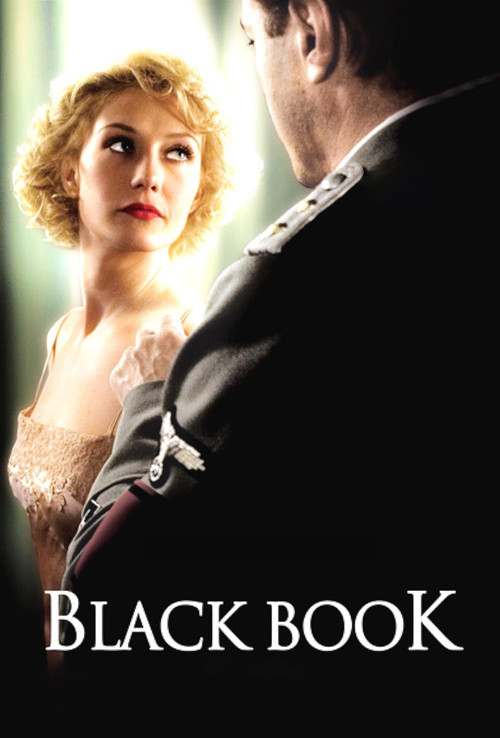
Black Book
2006 · Paul Verhoeven
For when you want a big, twisty, grown-up thriller with real stakes — something to argue about afterward. Not comfort viewing: it's entertainment that plays rough with your sympathies.
What it's about
In the occupied Netherlands near the end of World War II, Rachel Stein — a Jewish singer whose family is killed in an ambush — reinvents herself as Ellis de Vries and joins the Dutch resistance. Her assignment: get close to an SS officer, which she does far too well. As liberation approaches, the neat lines between heroes, traitors, and profiteers dissolve, and betrayal seems to be coming from every direction at once.
The experience
Propulsive, lurid, and morally queasy — a wartime thriller that moves like an adventure film while steadily pulling the ground out from under every certainty. It's gripping in the moment and leaves a bitter, complicated aftertaste.
Performances
Carice van Houten is ferocious as Rachel — resourceful, sensual, and never a victim — a star-making turn she carries through every register from cabaret numbers to raw survival. Sebastian Koch gives the SS officer an unnerving, ambiguous humanity.
The craft
Verhoeven directs with old-fashioned narrative sweep — plot twists arriving on schedule like a wartime serial — while smuggling in genuine moral corrosion. The production is lavish, the pacing relentless, and the script, decades in the making, draws on documented episodes of Dutch wartime betrayal. It plays big and looks handsome on a big screen.
Why it matters
Verhoeven's triumphant return to Dutch filmmaking after twenty years in Hollywood, it became a landmark of Dutch cinema and revived the debate about collaboration and heroism in the country's war memory.
Snapshot
Black Book (Dutch: Zwartboek) is Paul Verhoeven's return to Dutch-language filmmaking after two decades in Hollywood, a lavish and morally corrosive World War II thriller set in the occupied and newly liberated Netherlands of 1944–45. It follows Rachel Stein (Carice van Houten), a Jewish singer who survives an ambush that kills her family, joins the resistance under the alias Ellis de Vries, and is tasked with seducing an SS officer, Ludwig Müntze (Sebastian Koch), only to discover that the lines between resistance heroism and collaborationist profiteering are hopelessly blurred. Conceived by Verhoeven and his longtime screenwriter Gerard Soeteman over many years and drawing on documented episodes of wartime betrayal, the film reworks the territory of Verhoeven's 1977 Soldier of Orange with far greater cynicism. It reportedly ranked among the most expensive Dutch productions ever mounted at the time, premiered at the Venice Film Festival, and was widely received as a career-capping vindication of Verhoeven's belief that pulp entertainment and serious historical inquiry need not be opposed.
Industry & production
The project's gestation is central to its identity. Verhoeven and Soeteman had circled the material for years — the pair reportedly discussed a wartime story built around a Jewish protagonist and the ambiguities of the Dutch resistance long before it reached the screen — repeatedly setting it aside as other projects intervened, including Verhoeven's long Hollywood run (RoboCop, Total Recall, Basic Instinct, Showgirls, Starship Troopers, Hollow Man). The finished film was a European co-production, principally Dutch with German, British, and Belgian participation, reflecting both the scale of financing required and the transnational nature of the story. It was, by contemporary reporting, the costliest Dutch feature produced up to that point, with a budget commonly cited in the region of €18 million — a figure that dwarfed typical Dutch production norms and that Verhoeven leveraged into large-scale period reconstruction, crowd scenes, and action set-pieces rare in national cinema. The film premiered in competition at the 2006 Venice Film Festival. I would flag that precise, verified box-office totals are not something I can cite with confidence here; the film was generally understood to have performed strongly in the Netherlands and to have achieved a substantial international art-house release, but exact grosses should be checked against primary sources rather than taken from this account.
Technology
Black Book is a conventionally photographed 35mm production rather than a technological experiment, and that is a deliberate aesthetic choice. Verhoeven pursued the glossy, saturated, classical look of studio-era filmmaking rather than the desaturated, handheld realism that had become the default register for prestige WWII drama in the era of Saving Private Ryan and its imitators. Digital tools were used in the service of invisible period recreation — set extensions, the erasure of anachronisms, and the augmentation of crowds and wartime destruction — rather than as a visible stylistic signature. The result is a film that reads as materially rich and "old-fashioned" in the best sense: its technology is marshalled to make 1944 Netherlands feel physically present and cinematically heightened rather than documentary-raw.
Technique
Cinematography
Karl Walter Lindenlaub, a German cinematographer with a Hollywood action pedigree, shot the film in a bright, high-key, richly colored style that is almost provocative given the subject. Where the reigning convention treats the Holocaust and occupation in muted grays, Lindenlaub and Verhoeven opt for warm, sometimes glamorous lighting, glossy skin, and vivid production color. This visual confidence is thematically loaded: the beauty of the images refuses to let the audience take refuge in the moral clarity that a grimmer palette would imply. The camera is fluid and classical, favoring clean coverage and legible geometry over disorienting immediacy, which keeps the film's dense, twist-laden plot readable across its considerable length.
Editing
The film is cut for propulsion. Framed by a 1956 Israeli kibbutz prologue and epilogue, the central wartime narrative unfolds as an extended flashback structured like a thriller, with the editing sustaining a relentless forward drive across espionage, seduction, betrayal, and reversal. Job ter Burg and James Herbert are credited with the cutting, and the achievement is one of control: the picture juggles a large cast, multiple double-crosses, and a plot whose central mystery — who inside the resistance is feeding Jews to the Germans for profit — is withheld until late, yet the film rarely loses coherence. The pacing is brisk enough that the film's substantial runtime seldom registers as long.
Mise-en-scène / staging
Verhoeven stages the occupation as a world of surfaces and masquerade. Rachel's transformation into Ellis — bleaching her hair (including, in a characteristically frank Verhoeven touch, her body hair) to pass as a gentile and infiltrate SS headquarters — makes disguise the film's organizing visual idea. Costume, uniform, cabaret glamour, and interior décor are deployed to signal the performative nature of every allegiance. The staging repeatedly places bodies in situations of exposure and vulnerability, and the production design renders both the plush spaces of German command and the improvised hideouts of the resistance with equal specificity, insisting on the material texture of the period.
Sound
Anne Dudley's score is lush and thriller-forward, reinforcing the film's embrace of genre momentum rather than solemn understatement. Diegetic music matters too: Rachel/Ellis is a performer, and the cabaret and song sequences fold her survival-through-performance into the soundtrack itself. The sound design supports the film's action beats — the boat ambush, the raids, the executions — with visceral impact consistent with Verhoeven's action background.
Performance
Carice van Houten's performance as Rachel/Ellis is the film's engine and its breakout achievement, a role demanding erotic bravado, grief, terror, and moral endurance, often within a single sequence; the part made her an international presence. Sebastian Koch plays Müntze as a war-weary, humane, stamp-collecting officer whose sympathy complicates every easy judgment — a portrayal that, arriving close to his role in The Lives of Others, cemented his association with morally textured German characters. The supporting ensemble — including Thom Hoffman, Halina Reijn, Waldemar Kobus, and Derek de Lint — populates a world in which nearly everyone is compromised.
Narrative & dramatic mode
The dramatic mode is the espionage melodrama pushed toward tragedy and pulp thriller. The framing device — Rachel encountered years later in Israel — signals from the outset that she survives, so the suspense lies not in whether she lives but in how thoroughly her faith in the "good" side will be betrayed. The narrative is built on a chain of reversals: the escape that turns out to be a set-up, the enemy who proves more honorable than the allies, the trusted comrade who is the true predator. Verhoeven and Soeteman withhold the identity of the internal traitor until late, but the film's deeper structure is not a whodunit so much as a systematic dismantling of the audience's assumption that resistance equals virtue. The revelation that a resistance insider has been colluding with the Germans to rob and murder wealthy Jews turns the war story into an indictment of opportunism that recognizes no national uniform.
Genre & cycle
Black Book sits at the intersection of the WWII resistance drama, the femme-in-peril espionage thriller, and the occupation melodrama. It belongs to a long European tradition of resistance cinema but pointedly subverts its heroic conventions, aligning more with the morally skeptical strain of occupation storytelling than with celebratory national myth. Within Verhoeven's own filmography it forms a clear diptych with Soldier of Orange (1977), revisiting the resistance milieu with the disillusionment of an older filmmaker who no longer believes the war produced clean heroes. Its arrival also coincided with a broader mid-2000s wave of European films re-examining the moral complexity of the war years from within occupied and defeated nations.
Authorship & method
The film is a reunion of Verhoeven's core Dutch collaborators, above all screenwriter Gerard Soeteman, his partner across Turkish Delight, Soldier of Orange, Spetters, and The Fourth Man. Their method here was research-driven: the screenplay reportedly grew out of documented wartime incidents of betrayal and collaboration that the two had accumulated over years, then shaped into a thriller framework. Verhoeven's authorial signature is unmistakable — the fusion of explicit sexuality, graphic violence, satirical suspicion of authority, and a refusal of sentimental moralism, all deployed in the register of unashamed popular entertainment. Karl Walter Lindenlaub supplies the glossy, action-inflected cinematography; composer Anne Dudley the propulsive score; editors Job ter Burg and James Herbert the thriller pacing. The through-line uniting these collaborators is Verhoeven's conviction that the most serious moral questions are best posed through, not against, the pleasures of genre.
Movement / national cinema
As a work of Dutch national cinema, Black Book is a landmark of scale and ambition, a homecoming that let Verhoeven bring Hollywood production values back to the industry that formed him. It engages directly with Dutch national memory of the occupation — a memory long organized around narratives of resistance and victimhood — and complicates it by foregrounding collaboration, profiteering, and the ugly post-liberation treatment of women accused of consorting with Germans, including the public humiliation Rachel suffers after the war. In doing so it participates in a wider European reckoning with occupation-era complicity, but its specific charge comes from being made by a Dutch director interrogating Dutch myths.
Era / period
The film is set principally in September 1944 through the liberation of 1945, with a framing narrative in 1956 Israel. This periodization is meaningful: by locating its frame in the young state of Israel, the film gestures toward the long aftermath of the events it depicts and toward a survivor's perspective that has already learned to distrust easy resolutions. The wartime setting in the still-occupied Netherlands, after the southern liberation but before the north was freed, places the action in a liminal moment of maximum danger and shifting loyalties, when the outcome of the war is no longer in doubt but the machinery of occupation — and of opportunistic betrayal — is still fully operational.
Themes
The film's governing theme is the corrosion of moral certainty by war. Verhoeven systematically denies the audience a stable division between good and evil: a sympathetic SS officer, a murderous resistance insider, and a heroine forced into serial performance and compromise to survive. Survival itself is a theme — Rachel endures by shedding identities, and the film treats this adaptability as both admirable and costly. Betrayal, the ledger of collaboration (the "black book" of the title functions as a record of complicity and blackmail), the intertwining of sex, money, and power, and the persistence of antisemitism even among the ostensibly virtuous all run through the narrative. The post-liberation sequences extend the critique forward, exposing the vengeful, hypocritical treatment meted out to accused collaborators and refusing to let "victory" launder the participants' behavior.
Reception, canon & influence
Critically, Black Book was widely received as a return to form and among Verhoeven's finest achievements, praised for its narrative momentum, its refusal of pieties, and Carice van Houten's performance; it restored the director's reputation as a serious filmmaker after the divisive reception of some of his later Hollywood work. In the Netherlands its stature has been substantial — it has featured prominently in assessments of the best Dutch films, and I understand it topped at least one poll of Dutch cinema, though the exact provenance of such rankings should be verified against primary sources.
Its influences run backward to Verhoeven's own Soldier of Orange and to the broader tradition of resistance and occupation cinema whose conventions it inverts, as well as to the classical Hollywood thriller and melodrama whose gloss it deliberately adopts. Looking forward, its most concrete legacy is career-making: it launched Carice van Houten internationally, contributing to the visibility that carried her to English-language work, and it reaffirmed Verhoeven's viability, helping set the stage for his later European features such as Elle. More diffusely, it stands as an influential counter-model for how to dramatize the Second World War — proof that the period could be handled with saturated color, sexual candor, thriller mechanics, and profound moral skepticism rather than the reverent gravity that had become the genre's default. Where the historical record on its precise commercial and awards footprint is thinner than one would like, this dossier flags that gap rather than filling it with unverified figures.
A Deleuzian reading
A woman opens a bottle of peroxide and turns herself blonde.
The full Deleuzian reading of Black Book →
Reception
In 2006 it did solid business and got respectful-but-wary reviews — plenty of critics side-eyed Verhoeven for turning WWII resistance drama into a lurid pulp thriller. Now, with the great Verhoeven reappraisal in full swing, it's routinely called one of his very best and one of the standout European films of the 2000s.
How Black Book was received, from release to now →
How to watch Black Book: what to notice on a first viewing
- Watch Rachel bleach her hair to become someone else. The transformation into Ellis is shown as thorough and physical, not just a wig or a name change, disguise treated as total reconstruction. She isn't hiding a true self under a costume. She is manufacturing a new one that has to hold up completely.
- Notice how bright and glamorous the lighting stays throughout. Lindenlaub shoots the occupation in warm, saturated color and glossy light instead of the desaturated grays most war films use to signal seriousness. The beauty of the image refuses to hand you an easy way to tell who is on the right side.
- Watch Ellis perform for the German officers in the cabaret. The same song, the same smile, the same gestures work as pure entertainment and as espionage at once, with nothing in the image separating the two. You cannot tell from what's on screen whether she is charming them or working them, because it looks identical either way.
- Notice how clean and legible the camera stays during chases. Even with a dense plot full of double-crosses, Lindenlaub's camera favors clear coverage over disorienting handheld immediacy, so you can always follow where everyone stands. The clarity of the image is what lets a plot this tangled move at full speed without losing you.
- Notice the film tells you upfront that Rachel survives. A 1956 prologue in Israel shows Rachel alive years later, before the wartime story even begins, spending any suspense about her survival immediately. The tension shifts from whether she lives to how much her faith in the good side will cost her.
The whole guide to watching Black Book, with the keys for a rewatch →
Influences: the films it descends from and the films it influenced
- Notorious (1946) — The template for the woman weaponizing seduction as espionage — infiltrating the enemy's bed and household as an agent, sustaining suspense on the fear of exposure — which Rachel's dyeing, singing and seduction of Müntze directly reprise.
- Dishonored (1931) — Modern apotheosis of the female-spy melodrama — seduction-as-espionage, the agent who performs identities and applies makeup as armor — extending Dishonored's masquerade-and-sovereignty craft into explicit wartime register.
- The Last Metro (1980) — A glamour-lit performer running a double game inside an occupied city, with suspense keyed entirely to which member of the company knows what — Truffaut's restricted narration and star-lighting scheme pushed into thriller tempo.
- The Forgotten Battle (2021) — Dutch occupation resistance constructed in multilingual scene blocks with ironic parallelism—sequences depicting the German officer's genuine affection positioned adjacent to sequences depicting the same man's administrative atrocities—as the moral crosscutting device.
- The Resistance Banker (2018) — Immediate national-cinema predecessor for the high-craft resistance thriller: procedural suspense, meticulous occupied-Netherlands reconstruction, and clandestine-identity tension as a sustained engine.
- Soldier of Orange (1977) — The direct Verhoeven–Soeteman prototype: a WWII resistance narrative built as a chain of betrayals where allegiance is provisional and survival is amoral, using classical thriller propulsion instead of memorial reverence — Black Book is explicitly its darker diptych answer.
- Turkish Delight (1973) — Established the Verhoeven–Soeteman method of fusing explicit sexuality and bodily candor with high-melodrama emotion, the frank use of the female body as narrative engine that Rachel/van Houten inherits.
- The Fourth Man (1983) — Soeteman-scripted machine of reversals and unreliable appearances — the disguise/masquerade staging and the plot that keeps flipping who is deceiving whom is the same reversal architecture Black Book runs at feature length.
- Casablanca (1942) — Supplies the classical-Hollywood occupation-melodrama gloss and the diegetic cabaret/nightclub as a stage where romance and resistance politics collide, an idiom Black Book adopts unashamedly rather than ironizing.
- To Be or Not to Be (1942) — Pioneered playing Nazi-occupation survival as performance and impersonation — actors passing as officers — the disguise-masquerade staging Verhoeven treats with lethal rather than comic stakes.
- Army of Shadows (1969) — The resistance-cinema benchmark of compromised heroism, informers, and executions of one's own; Black Book inverts its solemn tone but extends its refusal to let the Resistance be morally clean.
- Rome, Open City (1945) — Founding occupation-cinema grammar — collaboration, torture, betrayal within the resistance cell — the genre conventions Black Book self-consciously plays against with saturated color and thriller mechanics.
- Cabaret (1972) — Model for using diegetic cabaret performance as ironic counterpoint to fascist menace, the singing-body-on-stage as both seduction and camouflage that Rachel's nightclub numbers echo.
- Elle (2016) — Descendant that carries forward Black Book's refusal of the female victim as moral innocent — a woman navigating violation and power with unsentimental agency, posed through genre rather than sanctioned pieties.
- Benedetta (2021) — Extends the Verhoeven signature of explicit sexuality plus institutional-power satire plus popular genre pleasure into another historical setting, the same conviction that serious moral questions ride best on transgressive entertainment.
- Inglourious Basterds (2009) — Sibling counter-model that also dramatizes WWII as pulpy suspense entertainment, staging tension through masquerade and language among Nazis and running the cabaret/cinema-as-battleground device with relish over reverence.
- Lust, Caution (2007) — Contemporary sibling running the same engine as Notorious and Black Book — a female operative seducing the enemy officer, where sexual candor becomes the thriller's core mechanism and loyalty dissolves into genuine attachment.
Similar films
- Army of Shadows (1969) — influence & lineage
- Lust, Caution (2007) — influence & lineage
- Inglourious Basterds (2009) — influence & lineage
- The Resistance Banker (2018) — shared sensibility
- The Girl with the Needle (2024) — shared sensibility
- Revanche (2008) — shared sensibility
- The 4th Man (1983) — shared sensibility
- The Girl with the Dragon Tattoo (2009) — shared sensibility