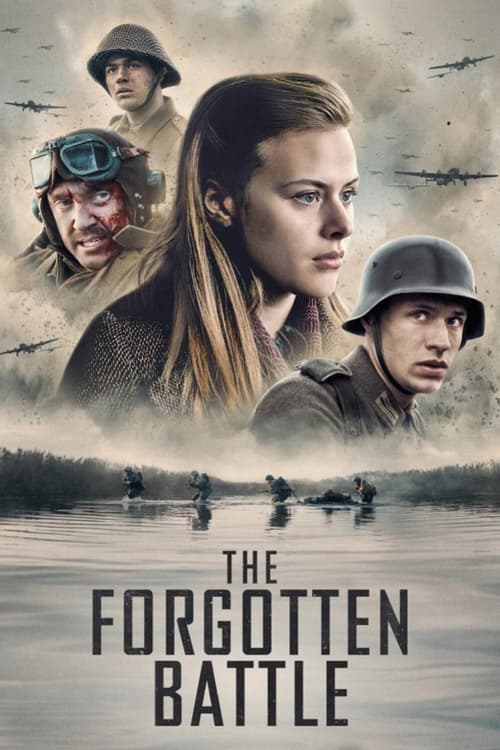
The Forgotten Battle
2021 · Matthijs van Heijningen Jr.
For when you want a serious, full-scale war film that honors a chapter of WWII you've probably never heard of — a lean-in evening, not comfort viewing. Reach for it when you're in the mood to be moved and a little wrecked.
What it's about
In the autumn of 1944, Allied forces fight to clear German troops from the Scheldt estuary in the southwest Netherlands — the battle that will decide whether the port of Antwerp can supply the push into Germany. The story braids three lives caught in that campaign: a British glider pilot stranded behind enemy lines, a young Dutch woman reluctantly drawn into the Resistance, and a German soldier on the losing side of a fight he can't leave. Their paths bend toward the same flooded, shell-torn stretch of Zeeland.
The experience
Grim, muddy, and mournful rather than rousing — the combat is chaotic and frightening, and the film keeps cutting back to ordinary people forced into impossible choices. It builds a slow dread as the three storylines converge, and it treats every death like it costs something.
The craft
One of the largest-scale Dutch productions of the streaming era, and it shows: flooded polders, glider crashes, and pitched fighting staged with real heft. The three-strand structure is handled cleanly, and the battle scenes reward a big screen and loud speakers.
Why it matters
It brought the Battle of the Scheldt — a costly campaign long overshadowed by D-Day and Arnhem — to a global audience, and marked a new scale of ambition for Dutch cinema on streaming.
Snapshot
The Forgotten Battle is a Dutch-language war film that dramatizes the Battle of the Scheldt—an autumn 1944 engagement in Zeeland, in the southwest corner of the Netherlands, fought to clear German forces from the estuary so the Allies could use the vital port of Antwerp. The film braids three perspectives across the carnage of October and November 1944: a British glider pilot, a young Dutch woman pulled into the Resistance, and a German soldier on the losing end of the same campaign. Produced for Netflix Netherlands by Rinkel Film, it was released on the streaming platform in October 2021 and became one of the largest-scale Dutch war productions of the streaming era. Its title announces its thesis: this was a battle that cost thousands of Allied lives and opened the supply corridor that sustained the final push into Germany, yet it remains poorly known outside specialist military history circles.
Industry & production
The Battle of the Scheldt was fought primarily by Canadian forces, with British, Polish, and Flemish Belgian elements, at a cost of roughly 13,000 Allied casualties over five weeks. It ended on November 8, 1944, when Walcheren Island was secured. The battle's strategic significance—it restored a working deep-water supply route to the Allies at the precise moment a fuel and materiel crisis was threatening the entire Western Front—was recognized at the time but swiftly eclipsed in public memory by Operation Market Garden (September 1944), the larger and more chaotic airborne gamble that preceded it, and by the Ardennes offensive (December 1944) that followed.
Rinkel Film, one of the Netherlands' more commercially ambitious production companies, led the project in co-production with Belgian partners and Netflix. The streaming platform's direct involvement in Dutch-language content was part of a broader early-2020s expansion into European national cinema, analogous to its investments in German, Spanish, and Scandinavian productions. The budget, while not confirmed in published sources, was understood in Dutch industry coverage to be among the largest ever allocated to a domestic war film, with resources directed primarily toward large-scale practical battle sequences and period-accurate production design. Shooting took place in Belgium as well as the Netherlands, with locations chosen to approximate the polder landscape of Zeeland. The film's release on Netflix rather than through theatrical channels reflected both the pandemic conditions of production and the platform's distribution logic, which prioritized simultaneous global availability over the festival circuit.
Technology
The film was shot digitally, in keeping with contemporary European production norms. The broad, flat geography of Zeeland—much of it below sea level, much of it deliberately flooded by both sides during the actual battle—demanded location work in practical water and mud environments. The period design encompasses British gliders of the type deployed in the Arnhem and Walcheren operations (Airspeed Horsas were the standard vehicle for British glider infantry in this period), German defensive fortifications on Walcheren, and the amphibious causeway assaults. Visual effects supplemented practical sets, particularly for aerial sequences and large-scale engagement backgrounds. The RAF's 617 Squadron breached the Walcheren sea dykes in October 1944, flooding the island to neutralize its German garrison—a historical fact the film incorporates—and rendering such effects work essential. The overall technology profile is consistent with mid-tier European prestige war production rather than the fully digital battlefields of American studio output.
Technique
Cinematography
The visual strategy of The Forgotten Battle leans toward a desaturated, gray-green palette appropriate to the autumnal Zeeland landscape: overcast skies, waterlogged fields, flooded polders, mud. This is not the golden-hour nostalgia of older Hollywood WWII cinema but a colder register of color, placing the film closer in feel to Clint Eastwood's Letters from Iwo Jima (2006) or the British television tradition exemplified by Foyle's War. Handheld camera is used selectively in combat sequences to introduce instability and disorientation, but the film does not fully commit to the shaky-cam grammar established by Saving Private Ryan (1998) and subsequently imitated widely; it alternates between this observational mode and more composed, wide-frame shots that emphasize the spatial claustrophobia of the dykes and causeways through which troops had to advance into fixed fire. The specific cinematographic contribution is difficult to assess in detail from published English-language sources, which have not extensively documented the technical credits for this production.
Editing
The three-strand narrative structure creates a cross-cutting grammar throughout: the film regularly moves between its British, Dutch, and German threads in ways designed to produce ironic parallelism and dramatic convergence rather than simple alternation. The pacing in the first half is deliberate, establishing the three protagonists in their respective circumstances before the threads begin to intersect. Battle sequences in the second half tighten the rhythm considerably. This structural approach—braiding enemy perspectives across a single engagement—requires editorial restraint to avoid melodramatic coincidence, and the film is for the most part careful not to force its convergences prematurely. As with the cinematography, the specific editor's credit is not well documented in the available scholarly or critical record.
Mise-en-scène / staging
Van Heijningen's staging reflects the particular physical conditions of the actual battle. The Walcheren causeway assault—in which Canadian infantry had to advance along a narrow road barely wider than a tank, with flooded fields on either side, under direct German fire with no flanking option—is staged with clear spatial logic that honors the historical topography. This geographic honesty gives the film's action sequences a different character from the more kinetic maneuvering available in settings like Hacksaw Ridge (2016) or the rolling French countryside of 1917 (2019): the attacker here is exposed in a particular and historically specific way, and the film does not pretend otherwise. The German protagonist's arc is staged, in the film's earlier sections, with a degree of interiority unusual for a Wehrmacht soldier in mainstream WWII cinema: he is given domestic and ideological texture before he becomes a combatant in the specific engagements the film depicts. Production design maintains period consistency, with German fortifications on Walcheren and the civilian infrastructure of occupied Zeeland rendered in credible detail.
Sound
The sound design follows contemporary war-film convention in using acoustic scale—the distinction between the contained crack of a rifle and the physical compression of artillery—as a register of emotional stakes. The Scheldt engagement involved heavy naval and air bombardment, and the film incorporates the scale of these events alongside the intimate acoustics of small-unit combat. The score underscores the human-cost dimensions of the narrative without aggressively telegraphing emotion; its specific authorship is not well-documented in the sources available for this entry.
Performance
The film's casting reflects its trilingual structure. Tom Felton, best known internationally from the Harry Potter franchise, plays the British glider pilot—a piece of casting that imports recognizable Anglophone stardom into an otherwise European ensemble, serving the film's Netflix distribution strategy. The Dutch and German roles are filled by performers from those respective national acting traditions. The decision to have each character speak their own language—English, Dutch, German—is essential to the film's dramatic premise: that this battle was an encounter between people who could not understand each other's words, only each other's actions and suffering. This multilingual authenticity is consistent with a strand of European war cinema running from Das Boot (1981) through Enemy at the Gates (2001) and Fury (2014), and represents a meaningful departure from the Hollywood convention of having all nationalities speak accented English.
Narrative & dramatic mode
The film operates in the multi-protagonist ensemble mode that became standard for prestige European war cinema after Das Boot and was consolidated by American productions such as The Thin Red Line (1998) and HBO's Band of Brothers (2001). Rather than following a single hero through a campaign, it presents the battle as a shared catastrophe whose meaning cannot be contained within any single national or ideological perspective. This structure has an implicit ethical argument: the battle's cost was distributed across nationalities, and any account that privileges one viewpoint exclusively falsifies the historical experience.
The convergence of the three characters toward a common fate in the film's climax is staged as tragedy rather than triumph—liberation at the price of individual lives—which places the film within a tradition of European war cinema that resists the narrative of heroic victory even when depicting Allied success. The film belongs formally to a dramatic mode of witness rather than adventure: it is interested in what the battle felt like from inside, for individuals with incomplete knowledge of events, rather than in operational or strategic overview. The resistance protagonist's arc—the transformation of a civilian into a combatant under occupation—draws on a well-established Dutch literary and cinematic tradition of reckoning with the moral choices of the occupation years.
Genre & cycle
The Forgotten Battle sits at the intersection of two overlapping genre cycles. The first is the prestige European war film, which has experienced periodic revivals—Das Boot in the early 1980s, a wave of post-reunification German productions including Stalingrad (Joseph Vilsmaier, 1993) and Downfall (Oliver Hirschbiegel, 2004), and more recently 1917 (Sam Mendes, 2019) and All Quiet on the Western Front (Edward Berger, 2022). The second is the rehabilitation narrative, in which a battle or campaign marginalized in popular memory is given cinematic attention—a cycle that includes Dunkirk (Christopher Nolan, 2017) and, further back, films that recovered the Pacific theater from the shadow of the European campaigns.
The film also participates in a specifically Dutch reckoning with WWII memory. Dutch cinema has long engaged with occupation and liberation—Paul Verhoeven's Soldier of Orange (1977) charted Dutch collaboration and resistance with unusual moral complexity; Fons Rademakers' The Assault (1986), winner of the Academy Award for Best Foreign Language Film, traced the long aftermath of a wartime atrocity across decades—but the Battle of the Scheldt specifically had received very limited cinematic treatment before this production, which is precisely the condition its title names.
Authorship & method
Matthijs van Heijningen Jr. is the son of Matthijs van Heijningen, a prominent Dutch advertising and film producer. His directorial debut was The Thing (2011), an American-produced prequel to John Carpenter's 1982 classic, which positioned him as a craftsman capable of working within established genre frameworks at studio scale. The Forgotten Battle represents a return to Dutch-language production and to the subject matter of his national history, a significant pivot in ambition and register.
The available record on Van Heijningen's specific directorial methodology—his rehearsal practice, his relationship to the screenplay, his mode of historical research and consultant collaboration—is thin in published English-language film scholarship. He is a director whose reputation rests primarily on execution rather than an articulated aesthetic program or a body of writings and interviews that would allow a detailed account of his working method. His background in genre cinema is perhaps legible in the film's structural clarity and its commitment to physical setpiece construction over abstract formal experiment.
The contributions of key collaborators—cinematographer, editor, composer, screenwriter—are less well-documented in scholarly literature than for comparable festival-circuit productions, in part because the film's primary reception occurred within Dutch-language media and streaming-platform contexts rather than the international festival circuit where technical attributions are more systematically recorded. This is a genuine gap in the publicly available record, not an editorial omission.
Movement / national cinema
The film belongs to Dutch national cinema's tradition of WWII reckoning but is distinguished by its production scale and its streaming-first distribution model. The Dutch film industry has historically operated with budgets modest by international standards, producing intimate psychological dramas and literary adaptations alongside occasional prestige productions. The direct partnership with Netflix effectively internationalized a Dutch subject, making a film about a specifically Dutch and Belgian experience available to a global audience simultaneously with its domestic release.
This is a model that has simultaneously empowered and complicated European national cinema in the early 2020s: enabling larger-scale production while potentially orienting subject-matter and tonal choices toward platform expectations. The film also connects to the Flemish Belgian dimension of the battle's history. Zeeland and the Scheldt were a contact zone between the Dutch and Belgian experiences of occupation and liberation—the causeway at South Beveland linked the two countries in the geography of the campaign—and the co-production structure reflects this shared historical terrain.
Era / period
The film was produced during the COVID-19 pandemic years, which conditioned its path to release: like several major productions of 2020–2021, it was oriented toward streaming rather than theatrical distribution. The early 2020s also saw significant WWII anniversary commemorations (the 75th anniversary of the liberation of the Netherlands fell in 2020), generating renewed public appetite for underrepresented episodes of the conflict. The critical and commercial success of All Quiet on the Western Front on Netflix the following year (2022) demonstrated that European-language war films could achieve significant streaming-era impact; The Forgotten Battle was an earlier iteration of the same argument.
Themes
The film's central theme—announced in its title—is historical forgetting and the obligation of memory. That the Battle of the Scheldt cost thousands of Allied and civilian lives, opened the port that sustained the final Allied advance, and flooded large parts of Walcheren—displacing and killing Dutch civilians as a result of deliberate Allied bombing of the dykes—while remaining obscure in popular consciousness is the film's opening charge against its audience.
Subordinate to this is the theme of the price of liberation. The film does not treat liberation as an unambiguous good: it registers the cost paid by liberators and liberated alike, and the German protagonist's arc ensures that the defeated are not simply abstracted into an ideological enemy. This is consistent with a post-Cold War tendency in European war cinema to treat the Wehrmacht's rank-and-file with individual complexity—not exculpation but humanization—visible across productions from Das Boot through All Quiet on the Western Front.
The resistance strand develops the theme of involuntary heroism: the Dutch protagonist does not seek the role of combatant but is drawn into it by circumstance and by the moral claims of those around her. This figure—the ordinary person confronted with extraordinary moral demands—is familiar from Dutch literary and cinematic memory of the occupation, and it connects the film to a longer tradition of Dutch self-examination about collaboration, resistance, and the vast middle ground between them that The Assault had already dramatized a generation earlier.
Formally, the near-miss and the unseen encounter—moments where characters approach each other without recognition—carries the film's deepest thematic weight: war as a structure that brings human beings into lethal proximity while denying them the conditions for mutual understanding.
Reception, canon & influence
The film was received positively in the Netherlands and Belgium, where it was recognized as a significant achievement of domestic production scale and as an act of historical rehabilitation. It received recognition at the Netherlands Film Festival, including awards that constituted formal acknowledgment of its technical ambition within national film culture. International critical reception in English-language media was more limited: the film circulated on Netflix without sustaining attention from major critical venues, which is a common fate for non-English-language streaming acquisitions regardless of quality—a structural condition of the platform's release model rather than a judgment on the work.
The films that most clearly informed The Forgotten Battle include Das Boot (Wolfgang Petersen, 1981), which established the template for humanized enemy-perspective WWII cinema in Europe; Saving Private Ryan (Steven Spielberg, 1998) and Band of Brothers (Steven Spielberg and Tom Hanks, 2001) for the grammar of visceral, physically honest large-scale combat staging; Dunkirk (Christopher Nolan, 2017) for the rehabilitation of an underrepresented British engagement and for the structural use of multiple perspectival strands converging on a single event; and Enemy at the Gates (Jean-Jacques Annaud, 2001) for the multinational ensemble organized around a single battle. Within Dutch national cinema, Soldier of Orange and The Assault are the canonical antecedents for both the resistance protagonist's arc and the broader ethical frame in which the occupation is held.
As of this writing, the film's forward influence—what it may have shaped in subsequent productions—remains difficult to assess, both because of its relative recency and because its primary circulation was through streaming rather than the festival and theatrical networks through which cinematic influence conventionally propagates. It represents, however, a significant early instance of Netflix's investment in European national war cinema at prestige scale, and its production model—domestic historical subject financed by a global streaming platform—is likely to recur. Whether The Forgotten Battle will eventually be cited by future filmmakers as a direct influence remains open; that it helped establish the commercial viability of the form is the more certain claim.
A Deleuzian reading
Picture the causeway.
The full Deleuzian reading of The Forgotten Battle →
Reception
Barely registered outside the Netherlands on its COVID-delayed 2021 release — then Netflix picked it up that October and it rocketed into the platform's all-time top 10 non-English films, turning a local production into a global word-of-mouth hit.
How The Forgotten Battle was received, from release to now →
Influences: the films it descends from and the films it influenced
- Das Boot (1981) — Established the European template of humanizing an enemy-perspective WWII ensemble; van Heijningen directly inherits this by crosscutting a Wehrmacht officer's arc against Dutch resistance, extending Petersen's moral-complexity structure into a dual-occupier/occupied frame.
- Saving Private Ryan (1998) — The bleach-bypass desaturated palette and close-range handheld staging that physicalizes combat geography; The Forgotten Battle's color grade and combat syntax descend directly from this template, including the technique of using selective focus during firefights to deny the audience tactical orientation.
- Soldier of Orange (1977) — Dutch resistance protagonist whose moral arc is defined by proximity to particular occupiers and collaborators; the three-strand ethical architecture of occupation, complicity, and refusal originates here as the foundational structure of Dutch national WWII cinema.
- The Assault (1986) — The rehabilitation narrative in which a suppressed wartime incident is recovered from collective national amnesia; the emotional payoff structured as historical restitution—the 'forgotten' event finally named and mourned—is the direct genre precedent the film's title announces.
- Dunkirk (2017) — Three perspectival strands crosscutting a single underrepresented Allied engagement, each strand operating at a different temporal compression rate; the direct structural model for the film's three-protagonist convergence toward the Scheldt Estuary flooding.
- Enemy at the Gates (2001) — Multinational ensemble cast each speaking their own language across a single-battle theater, establishing the practical trilingual casting model—characters never translating for each other—that The Forgotten Battle replicates with Dutch, Belgian, and German performers.
- Come and See (1985) — Witness-mode staging in which the protagonist observes mass military action without tactical agency, unable to alter outcomes; progressive desaturation of the color palette keyed to cumulative exposure to violence, a technique the film inherits for its civilian-trapped sequences.
- Black Book (2006) — Dutch occupation resistance constructed in multilingual scene blocks with ironic parallelism—sequences depicting the German officer's genuine affection positioned adjacent to sequences depicting the same man's administrative atrocities—as the moral crosscutting device.
- Black Hawk Down (2001) — Selective-handheld crosscutting across simultaneous multi-strand combat actions within a compressed geographic theater; the specific technique of using camera movement as an index of tactical confusion rather than individual subjective distress, denying the audience a stable orientation point.
- A Bridge Too Far (1977) — Multi-protagonist ensemble organized around a specific Netherlands-set WWII operation, with geographic location authenticity—actual Dutch bridges and waterways—deployed as both production value and moral argument about the ground where men died.
- Letters from Iwo Jima (2006) — Hollywood-financed WWII film shot entirely in a non-English language with multilingual authenticity as a deliberate humanization of the enemy perspective; the prestige precedent for van Heijningen's casting of German-speaking performers without forcing English dialogue.
- The Thin Red Line (1998) — Multi-protagonist ensemble where witness-mode narration distributes moral weight across several soldiers simultaneously, using collective sacrifice as the organizing structural principle rather than resolving the ensemble into a single hero's arc.
- Fury (2014) — Geographic honesty in small-unit European theater combat staging with multilingual dialogue authenticity—German soldiers speaking German without subtitles in key sequences—and practical location-based construction that refuses back-lot substitution.
- All Quiet on the Western Front (2022) — Netflix-financed German-language national war film using the identical production model—domestic historical subject, non-English language, prestige streaming release—with matching desaturated palette and physical location staging, confirming the commercial form The Forgotten Battle helped establish as a viable streaming category.
Similar films
- Dunkirk (2017) — influence & lineage
- A Bridge Too Far (1977) — influence & lineage
- All Quiet on the Western Front (2022) — influence & lineage
- Enemy at the Gates (2001) — influence & lineage
- The Thin Red Line (1998) — influence & lineage
- Saving Private Ryan (1998) — influence & lineage
- Das Boot (1981) — influence & lineage
- Black Book (2006) — influence & lineage