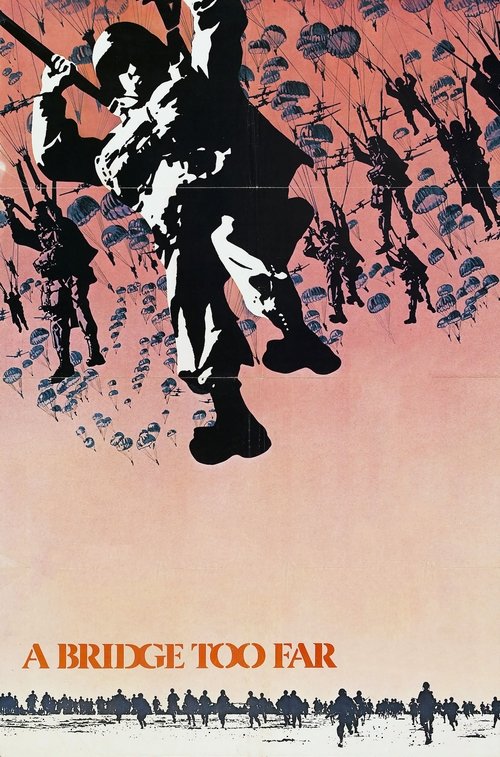
A Bridge Too Far
1977 · Richard Attenborough
For when you want a big, serious Sunday-afternoon war epic — not a rousing one, but the kind that leaves you quietly angry at how plans fail. Commit the full evening; it earns the runtime.
What it's about
September 1944: the Allies gamble on ending the war by Christmas, dropping thousands of paratroopers into occupied Holland to seize a chain of bridges while a ground column races up a single road to relieve them. Everything hinges on the last bridge, at Arnhem — and on intelligence that has badly misjudged what's waiting there. The film follows officers and soldiers across the whole operation, American, British, Polish, German and Dutch, as a bold plan meets reality one bridge at a time.
The experience
It's a slow-tightening epic — nearly three hours that shift from confident briefing-room swagger to mud, smoke and dwindling radio contact. The scale is genuinely awesome, but the feeling underneath is dread: you watch good soldiers pay for decisions made far above them, and the film never lets you off that hook.
Performances
The cast is a who's-who of 1970s stardom, deliberately spread so no one dominates, and the ensemble discipline is the point. Anthony Hopkins is quietly superb as the paratroop colonel holding the far end of the bridge, and Edward Fox nearly steals the film as a breezily confident corps commander whose pre-battle pep talk is a small masterclass.
The craft
Attenborough stages the airborne drops, tank columns and street fighting with real aircraft, real vehicles and thousands of extras — practical spectacle on a scale nobody attempts anymore, and it shows on a big screen. William Goldman's script does the harder work, braiding a dozen storylines into one legible mosaic so you always know which bridge, whose plan, and what's gone wrong.
Why it matters
It stands as the last of the grand all-star WWII epics, and one of the few to build that machinery around an Allied defeat — a revisionist streak that made it controversial in 1977 and respected since. It remains the definitive screen account of Operation Market Garden.
Snapshot
Richard Attenborough's adaptation of Cornelius Ryan's 1974 account of Operation Market Garden is the last great monument of the all-star prestige war epic—a form that had defined the genre since The Longest Day (1962). Clocking in at nearly three hours, populated by a cast of such star wattage that no single performer can anchor it, and staging an Allied defeat on a scale previously unattempted in British or American war cinema, A Bridge Too Far is simultaneously a logistical marvel and a structural argument: that the operation it dramatizes, and perhaps the form it inherits, had stretched beyond what any single intelligence could contain. William Goldman's adaptation distills Ryan's encyclopedic oral history into a mosaic of parallel catastrophes, and Attenborough orchestrates the chaos with a discipline that the Allies themselves famously lacked. The film's very excess is its meaning.
Industry & production
The film was produced by Joseph E. Levine and his son Richard P. Levine for Joseph E. Levine Presents Inc., distributed through United Artists. Levine had made his fortune by acquiring and dubbing foreign spectacles—most notably Hercules (1958)—and had graduated into prestige production with The Graduate (1967) and Carnal Knowledge (1971). A Bridge Too Far represented his most extravagant personal investment: the production budget was widely reported at the time as among the largest ever committed to a single film, figures commonly cited in the range of twenty to twenty-five million dollars, though the studio has never released a definitive accounting. Levine assembled his ensemble cast through individual deals that reportedly accounted for a significant portion of that sum—Robert Redford alone commanded a fee that drew press attention.
Cornelius Ryan, who had already seen The Longest Day (1959) turned into a hit film, sold the rights to A Bridge Too Far before the book's publication. Ryan died of cancer in 1974, the same year the book appeared, and did not live to see the adaptation. William Goldman, already among Hollywood's most sought-after screenwriters following Butch Cassidy and the Sundance Kid (1969) and All the President's Men (1976), was brought in to compress Ryan's sprawling interviews with hundreds of survivors into something that could fit within a three-hour frame. Goldman later discussed the screenplay in his memoir Adventures in the Screen Trade (1983), treating it as one of the more structurally intractable problems he had faced: a story with no protagonist, an outcome known to every viewer, and a moral that amounted to institutional failure at the highest command levels.
Principal photography took place in the Netherlands, with the Dutch city of Deventer standing in for Arnhem—the original bridge over the Rhine had been replaced after the war, and the Deventer road bridge bore a sufficient resemblance to the wartime structure to serve the production's purposes. Nijmegen, where the Waal river crossing by the 82nd Airborne was among the operation's most dramatic episodes, was filmed at or near its actual location. The Dutch cooperation was extensive, reflecting both national pride and the complex memory of the occupation and liberation.
Technology
Geoffrey Unsworth, one of the most technically accomplished British cinematographers of his generation, served as director of photography. Unsworth's career had taken him from the elegant wide-screen compositions of Becket (1964) and 2001: A Space Odyssey (1968) to the warm, desaturated palette he developed for Bob Fosse's Cabaret (1972), for which he received the Academy Award for Best Cinematography. For A Bridge Too Far he worked in Panavision anamorphic, using the wider aspect ratio to stage the massed military movements and the spatial horror of the Arnhem perimeter contracting around the trapped paratroopers. Unsworth was known for his use of diffusion filters and careful control of natural light, and the film's autumnal palette—gray skies, ochre grass, the flat Dutch light of September—gives it an elegiac quality that reinforces the subject's funerary weight. Unsworth died in 1978, during post-production on Superman, before the decade closed on what was among the most celebrated runs of any British cinematographer.
The parachute drop sequences presented the most significant logistical and technical challenges. Large numbers of paratroopers—a mix of military personnel and trained extras—were coordinated across multiple drop zones. Period-correct Dakota transport aircraft were sourced and flown, and aerial photography was extensive. The scale of the airborne armada visible in these sequences represents a kind of practical filmmaking that CGI would later replace; the image of the sky filled with descending canopies remains among the most impressive aerial sequences of the decade.
Technique
Cinematography
Unsworth's compositions consistently use the wide frame to underscore isolation and dispersal. Characters are frequently dwarfed by landscape or embedded in crowds that the camera cannot fully resolve. At the Arnhem bridge, where Lt. Col. John Frost's diminishing force occupies one end while German armor accumulates at the other, Unsworth and Attenborough use long lenses to compress distance and stack threat. The contrast between the clean geometry of the briefing rooms—where the operation appears rational, the maps coherent—and the visual entropy of the battlefield is developed throughout with intention. Night photography at the Rhine crossing and in the Arnhem streets is handled practically, preserving the period's inability to illuminate what lay beyond the firelight.
Editing
Antony Gibbs's editing faces the problem that bedeviled Goldman's script: multiple simultaneous plotlines whose intercut progression must register as calamity accumulating rather than mere narrative jumble. The solution is largely chronological, with the film's rhythm shifting from the deliberate, even stately pace of the planning sequences to an increasingly compressed cutting pattern as the operation fractures. The cross-cutting between XXX Corps's ground advance—repeatedly stalled on a single road through Dutch countryside—and the encircled paratroopers in Arnhem operates as a structural analogy to the operation's own communications failure: the parts cannot reach each other in time. The editing is professional without being notably innovative; the film's three-hour length has drawn repeated criticism that tighter assembly would not have resolved, given the structural obligation to honor multiple narrative threads.
Mise-en-scène / staging
Attenborough's staging throughout foregrounds the mismatch between institutional optimism and material reality. The briefing sequences at Browning's headquarters are staged with a theatrical rigidity—officers arranged around maps in well-lit rooms—that Attenborough contrasts with the subsequent chaos he depicts on location. The Arnhem bridge sequences, confined to a small area of street frontage and building interiors, gain intensity through restriction rather than spectacle. The film's most discussed staging choice is its treatment of the senior command: Dirk Bogarde's Lieutenant General Browning is shown throughout in postures of contained elegance that read, in retrospect, as complicity. The film never accuses him directly—this would violate the Ryan book's oral-history method—but the mise-en-scène accumulates implication.
Sound
The sound design and John Addison's score work in counterpoint. Addison, who had won the Academy Award for Best Original Score for Tom Jones (1963) and was a reliable craftsman of the British film industry, composed a march theme of unmistakable pomp—brass-heavy, confident, designed to recall the martial optimism of earlier war-film scores. The irony of that theme playing over images of defeat is intentional and consistent with the film's mode of retrospective tragedy. The battlefield sound work, handled practically and on location where possible, provides counterweight: the percussion of tank fire, the sound of aircraft engines at the drop zones, the compression of combat in the Arnhem streets. The interplay between Addison's triumphalist scoring and the representational sound of material failure constitutes the film's most sustained tonal argument.
Performance
The ensemble presents a structural problem as well as an opportunity. No actor appears enough to build an arc in the conventional sense; most characters are identified by rank and function and granted two or three scenes of consequence. Within these constraints, Anthony Hopkins as Lieutenant Colonel John Frost delivers the film's most sustained performance—internally pressured, precise in its containment, registering the compounding weight of unsupported command. Edward Fox as Lieutenant General Horrocks brings an officer-class crispness that could tip into caricature but is saved by the writing's refusal to make Horrocks a villain. Gene Hackman, cast against type as the Polish General Sosabowski, received commentary at the time about the plausibility of his accent; the casting reflects the Hollywood practice of the period and the Levine production's requirement for American-market bankability alongside the British ensemble. Robert Redford's brief but structurally pivotal appearance as Major Julian Cook during the Waal crossing was designed to give the sequence the star emphasis the film's American distributor required.
Narrative & dramatic mode
A Bridge Too Far operates in the mode of historical tragedy as collective catastrophe, a form with antecedents in ancient drama rather than Hollywood narrative. There is no protagonist, no redemptive arc, and no climax that resolves toward victory. The film ends with the evacuation of fewer than two thousand survivors from what had been a force of ten thousand; the bridge at Arnhem remains in German hands. Ryan's book, and Goldman's adaptation, derive their structure from the accumulated testimonies of survivors on both sides, and this polyphonic approach resists the individualism that sustains most war films. The dramatic mode is elegiac and forensic simultaneously—asking how, and implying why, without permitting the comfort of assignable blame. The famous phrase "a bridge too far," attributed in the film to Browning himself as a pre-operational reservation he voiced to Montgomery, places institutional awareness of risk at the center of the tragedy: the people who sent men to die may have known the plan was overextended.
Genre & cycle
The film is the culmination of the all-star multi-strand war epic as developed by Darryl F. Zanuck's production of The Longest Day (1962), a format predicated on the idea that the Second World War was too large and too important to be dramatized through a single perspective. That format had yielded Battle of the Bulge (1965), Midway (1976), and others of varying ambition and quality. What distinguishes A Bridge Too Far within this cycle is its subject: not a victory but a defeat, not a turning point but an overreach. By 1977, the genre's conventions—the recognizable faces in discrete vignettes, the period hardware, the orchestral score—had accumulated enough cultural weight that their deployment in service of failure carries its own meaning. The film belongs equally to a late-1970s cycle of institutional-failure narratives—All the President's Men (1976), Three Days of the Condor (1975), Network (1976)—that read the betrayals of the Vietnam era into other historical contexts.
Authorship & method
Richard Attenborough arrived at A Bridge Too Far as an actor-turned-director of growing ambition. His first feature, Oh! What a Lovely War (1969), had adapted Joan Littlewood's anti-war theatrical satire, and his second, Young Winston (1972), had tackled Churchill's early biography with similar prestige-production resources. Attenborough's directorial instinct was consistently toward large-scale historical subjects treated with a certain institutional seriousness—the same instinct that would produce Gandhi (1982) and his Academy Awards. His method on A Bridge Too Far was collaborative rather than auteurist; the production's complexity required delegating extensively to his department heads, and Unsworth's cinematography and Goldman's script carry as much of the film's meaning as Attenborough's direction in the narrower sense. What Attenborough provided was the organizational intelligence to marshal an enterprise of this scale toward something coherent—a skill that corresponds, not accidentally, with his subject matter.
Goldman's script is the film's most studied element. His decisions about which testimony to include, which character to follow into which scene, and where to cut away are all arguments about what the operation meant and who bore responsibility. Goldman was working against the screenplay convention of the clear protagonist and the resolving climax; that he produced something watchable was remarked upon at the time. The published screenplay has been studied in screenwriting pedagogy as an example of structure under constraint.
Movement / national cinema
The film is a transatlantic production, financed by American money, directed by a Briton, shot in the Netherlands, and featuring a cast drawn from Hollywood, British cinema, and the European art-film world (Liv Ullmann, Maximilian Schell, Hardy Krüger). It belongs to no single national cinema but is most productively situated in the tradition of British prestige filmmaking oriented toward American distribution—a tradition that ran from the Korda productions of the 1930s through the Lean epics of the 1950s and 1960s. Its Dutch setting gave it a significance in the Netherlands, where Market Garden remains a subject of both pride and contested memory, that its American reception could not replicate.
Era / period
Released in summer 1977, A Bridge Too Far opened into a changed marketplace. Star Wars had debuted in May of that year and redefined audience expectations for the summer blockbuster in ways that made a three-hour, star-heavy historical tragedy seem less contemporary than it might have three years earlier. The timing compressed its commercial performance relative to its production cost, and this outcome is frequently cited in accounts of the period as marking the end of the Levine-style prestige spectacular as a bankable Hollywood bet. The film's structural pessimism—its refusal of redemption—also placed it at odds with the recovering confidence that Star Wars and its successors would encode, though it aligned with the revisionist historical mood that had characterized American and British cultural production through the mid-1970s.
Themes
The film's central theme is institutional hubris: the willingness of command structures to commit men to plans whose deficiencies are knowable and, in some instances, known. The phrase "a bridge too far" names the threshold beyond which ambition exceeds capacity, and the film is organized around the progressive failure to recognize that threshold. Field Marshal Montgomery's determination to achieve a decisive breakthrough—to vindicate the northern strategy over Eisenhower's broader front—is the operational backdrop against which individual courage and sacrifice is rendered meaningless. This structural irony is the film's governing moral: valor cannot compensate for intelligence failures and command rigidity.
Secondary themes include the experience of the occupied civilian population—Ullmann's Kate ter Horst, who sheltered wounded soldiers in her home near the Arnhem bridge, represents the Dutch civilian presence that the Ryan book documented extensively—and the systemic failure of communication that allowed the disaster to compound. The dropped radios, the frequencies that couldn't reach through the trees, the headquarters that didn't receive the warnings: these are the film's material symbols of a larger failure to hear what the evidence was saying.
Reception, canon & influence
Backward (influences on the film): The Longest Day (1962) established the template—ensemble cast, multiple theaters, historical fidelity as a value—that A Bridge Too Far inherits and subjects to retrospective irony. Ryan's method for the book, which involved extensive interviews with survivors on both sides, also shaped the narrative's structure: the German command perspective (Schell as SS General Bittrich, Krüger as his subordinate) is given enough screen time to function as something other than enemy backdrop. This documentary impulse connects the film to the semi-documentary British war films of the 1950s—The Dam Busters (1955), Reach for the Sky (1956)—that had also treated the war as recent history rather than myth.
Critical reception: Contemporary critical response was divided. The film's ambition and scale drew respect; its length and structural diffusion drew skepticism. The absence of a central protagonist was noted both as a formal fidelity to the source and as a commercial liability. Performances were selectively praised, with Hopkins and Fox drawing consistent approval. The casting of Hackman as Sosabowski attracted comment. In the United Kingdom, where the operation carried particular national resonance, reception was attentive to the film's handling of Montgomery's role—a subject that remained sensitive—and Attenborough navigated the question with characteristic diplomatic tact, implicating without accusing.
Forward (legacy): A Bridge Too Far effectively closed the cycle of large-scale all-star war epics as a commercially viable Hollywood form. The combination of its difficult subject, its length, and the market conditions of 1977 persuaded studios that the format had reached its natural limit. The war epic did not disappear—Apocalypse Now (1979), Das Boot (1981), Platoon (1986) represent its continuation in altered forms—but the specific template of the prestige ensemble historical reconstruction did not recur at comparable scale until Steven Spielberg's Saving Private Ryan (1998) and the HBO/Spielberg productions Band of Brothers (2001) and The Pacific (2010), which owe an acknowledged debt to the Ryan-book tradition. The film's treatment of Operation Market Garden remains the definitive cinematic account of the operation; the subsequent history of that representation in film and television occurs in its shadow. Its portrait of command failure and the gap between strategic aspiration and operational reality has kept it in circulation as a teaching text in military history contexts, which may constitute its most durable legacy.
A Deleuzian reading
Start with the map.
The full Deleuzian reading of A Bridge Too Far →
Reception
Critics in 1977 were lukewarm — too long, too starry, too downbeat — and it was seen as a domestic box-office disappointment for producer Joseph E. Levine. Now it's widely reappraised as the last of the great old-school WWII epics, admired precisely for its bleak honesty about a military failure and its all-practical scale.
How A Bridge Too Far was received, from release to now →
Influences: the films it descends from and the films it influenced
- The Longest Day (1962) — Established the Cornelius Ryan polyphonic-oral-history adaptation format — multiple simultaneous Allied and German plotlines, ensemble-no-protagonist casting, action dispersed across geography rather than focused on a single hero — that Goldman's screenplay explicitly continues and formally exhausts.
- Paths of Glory (1957) — Pioneered the military institutional-failure narrative in which the chain of command is the antagonist — the geometric confidence of the officers' briefing room set against the carnage they have ordered — a structural opposition Attenborough inherits directly for his own briefing-room-versus-battlefield staging throughout the Arnhem sequences.
- Dr. Strangelove or: How I Learned to Stop Worrying and Love the Bomb (1964) — Established the template for scoring military catastrophe with triumphalist music — sentimental anthems playing against imagery of institutional madness — that John Addison's score for A Bridge Too Far inherits: orchestral fanfares and martial confidence deployed against operational failure, the gap between sonic confidence and visual chaos as primary ironic register.
- Battle of Britain (1969) — Established the British prestige all-star war epic built around practical aerial armadas as documentary-scaled spectacle — real Spitfires, Hurricanes, and Bf 109s in formation at altitude, no model substitution — a production philosophy A Bridge Too Far's Dakota airborne sequences adopt at even greater logistical cost.
- Tora! Tora! Tora! (1970) — Developed the cross-cutting institutional-failure model — parallel editing between American and Japanese command levels dramatizing how bureaucratic overconfidence and communications failure produce military catastrophe — that directly informs Gibbs's editorial strategy for A Bridge Too Far's simultaneous theater-level crises across three Allied corps.
- Waterloo (1970) — Attempted the large-scale all-star prestige epic of a famous historical military defeat using massed practical troop movements on location — establishing both the commercial template and the production methodology for staging a catastrophic Allied failure that Levine and Attenborough directly inherited and applied to a larger canvas.
- Patton (1970) — Established the Panavision anamorphic visual grammar for WWII command-level drama — long-lens compression stacking armor columns into oppressive depth, wide compositions dwarfing individual officers against operational landscape — that Unsworth adopts as his baseline compositional mode for A Bridge Too Far.
- Cabaret (1972) — Geoffrey Unsworth developed the diffusion-filtered, deliberately desaturated palette — draining primary color toward elegiac amber and pewter gray — that he transplants directly into A Bridge Too Far's autumnal Dutch cinematography, giving both films their quality of beauty already in the process of dying.
- Das Boot (1981) — Extends the institutional-failure military narrative with the same ensemble-no-protagonist structure and chronological escalation toward sealed catastrophe, but inverts A Bridge Too Far's wide-frame spatial dispersal into claustrophobic compression — the shrinking U-boat hull a structural echo of the contracting Arnhem perimeter, catastrophe as enclosure rather than overextension.
- Gallipoli (1981) — Transplants A Bridge Too Far's structural critique — high command's overconfident planning destroying the soldiers assigned to execute it, briefing-room geometry opposed to battlefield chaos — into an ANZAC context, using the same escalation-toward-institutional-betrayal editorial rhythm for a different famous Allied defeat.
- Gandhi (1982) — Attenborough's own formal sequel deploys the same Panavision anamorphic wide-frame choreography of mass movement, diffusion-filtered natural light, and polyphonic ensemble structure — redirecting the ironic-triumphalist scoring and briefing-room-versus-reality contrast from military overreach to political spectacle.
- The Thin Red Line (1998) — Inherits A Bridge Too Far's ensemble-no-protagonist WWII dispersal and polyphonic perspective distributed across many soldiers, but dissolves Goldman's clear causal chain of institutional failure into interior-monologue fragmentation — collective catastrophe retained while chain-of-command critique is dissolved into metaphysics.
- Black Hawk Down (2001) — The most structurally direct descendant: a doomed U.S. military operation told through polyphonic cross-cutting between a command HQ whose confident planning unravels and ground units absorbing the consequences — ensemble-no-protagonist dispersal and chronological escalation toward encirclement, A Bridge Too Far's formal logic applied to Mogadishu with digital cinematography replacing Unsworth's diffusion.
- Dunkirk (2017) — Radicalizes A Bridge Too Far's cross-cutting-parallel-catastrophe editing — multiple simultaneous timelines of a failed military operation, no protagonist who anchors meaning, collective survival as the only available consolation — while the triptych temporal structure pushes Attenborough and Gibbs's parallel montage to its formal extreme.
- The Forgotten Battle (2021) — Multi-protagonist ensemble organized around a specific Netherlands-set WWII operation, with geographic location authenticity—actual Dutch bridges and waterways—deployed as both production value and moral argument about the ground where men died.
- All the President's Men (1976) — William Goldman's screenplay for both films deploys the same polyphonic institutional-failure architecture — multiple parallel threads whose convergence reveals systemic overreach rather than individual villainy, no single protagonist who wins — the political-thriller version of the structural method he applied simultaneously to A Bridge Too Far.
- Midway (1976) — Assembles the same all-star prestige ensemble around a historically known naval battle, using polyphonic cross-cutting between American and Japanese command levels and Sensurround practical sound design as spectacle — the same commercial template as A Bridge Too Far, without its commitment to depicting an Allied defeat or its formal ambiguity about institutional blame.
- Cross of Iron (1977) — Released the same year and equally preoccupied with institutional failure and ensemble-no-protagonist structure on the Eastern Front, Cross of Iron pursues the same critique through fragmented slow-motion editing and expressionist close-ups — the aesthetic counterargument to Attenborough's controlled long-lens classicism, the two films bracketing the decade's anti-heroic war cycle.
Similar films
- The Longest Day (1962) — influence & lineage
- Dunkirk (2017) — influence & lineage
- Waterloo (1970) — influence & lineage
- Black Hawk Down (2001) — influence & lineage
- Cross of Iron (1977) — influence & lineage
- Patton (1970) — influence & lineage
- Paths of Glory (1957) — influence & lineage
- The Forgotten Battle (2021) — shared sensibility