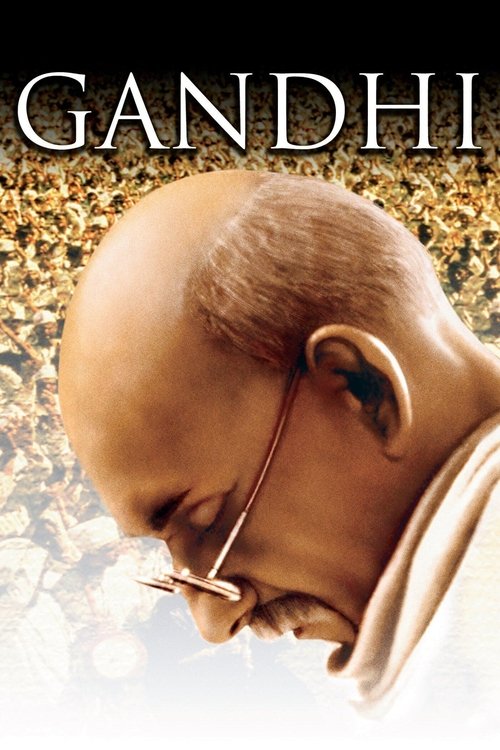
Gandhi
1982 · Richard Attenborough
For a long, absorbing evening when you want to be swept up in a great life story and come out inspired — think of it as an event, not a casual watch. Comfort viewing in the grand-epic sense, though it doesn't soften the brutality of colonial rule.
What it's about
The life of Mohandas K. Gandhi across half a century — from a young British-trained lawyer thrown off a South African train for the color of his skin to the leader of India's independence movement. It follows his wager that an empire could be defeated without bloodshed: strikes, marches, fasts, and prison terms, waged against armed colonial power. An epic in the full old sense, with crowd scenes involving hundreds of thousands of real people.
The experience
Stately, sweeping, and sincere — a long film that moves with the patience of its subject, punctuated by moments of shocking violence and genuine moral force. It leaves you moved and a little awed at the sheer scale of both the man and the production.
Performances
Ben Kingsley's Gandhi is one of the great biographical performances — physically precise, aging across five decades, radiating stubbornness and warmth in equal measure. It won him the Oscar and it's still the reason to watch.
The craft
Attenborough mounts it on a scale almost impossible now: real locations across India, vast crowds of actual extras, three-plus hours of old-fashioned epic craftsmanship. The widescreen pageantry — the Salt March, the funeral — genuinely rewards the biggest screen you can find.
Why it matters
Winner of eight Academy Awards including Best Picture, it defined the template for the prestige historical biopic and brought Gandhi's story to a global mass audience.
Snapshot
Richard Attenborough's Gandhi is a British-Indian co-production of staggering logistical ambition: a three-hour-eleven-minute biographical epic that traces Mohandas K. Gandhi's life from his 1893 ejection from a South African train car through his assassination in New Delhi in January 1948. Ben Kingsley's title performance — calibrated, physically precise, spiritually luminous — anchors a film that won eight Academy Awards including Best Picture, Best Director, and Best Actor, and that established for a generation the grammar of the prestige historical biopic. It is simultaneously a work of British "quality cinema," a monument to Indian national self-representation on the world stage, and a deliberate act of popular pedagogy: Attenborough wanted Gandhi's story taught in schools, and he made a film that felt like it already had been.
Industry & production
Gandhi was produced by Attenborough's own company, Goldcrest Films, in association with International Film Investors and India's National Film Development Corporation — the NFDC's co-production stake giving the project both government-level access to locations and a degree of Indian authorial ownership unusual for an Anglo-American prestige picture of this scale.
The production's prehistory is almost as remarkable as the film itself. The project originated when Motilal Kothari, a London-based Indian diplomat and Gandhi devotee, first approached Attenborough in the early 1960s with the idea of a major English-language film on the Mahatma. Prime Minister Jawaharlal Nehru offered early encouragement before his death in 1964, and Attenborough spent the better part of two decades assembling financing, commissioning and revising scripts, and watching the project collapse or stall at every turn. Hollywood studios — including various iterations of interest from Columbia Pictures, which ultimately distributed the finished film — repeatedly declined. The gap between Attenborough's previous prestige directorial effort, A Bridge Too Far (1977), and Gandhi thus represents not indolence but sustained, frustrated development work.
Principal photography finally began in November 1980, with the bulk of production in India — Delhi, Rajasthan, Gujarat, Porbandar — supplemented by some British studio work. The production's scale was extreme: an estimated three hundred locations, a crew of hundreds, and a cast of thousands of Indian extras for the mass spectacle sequences. The recreation of Gandhi's 1948 funeral procession, which opens the film in a structural inversion that announces death before life, required one of the largest crowd assemblies in motion-picture history; Guinness records cited it as such, though verifying precise headcounts for sequences of this scale is inherently approximate.
Columbia Pictures' eventual distribution commitment, crucial to the production's feasibility, gave Gandhi its path to wide American release. The film's commercial performance was strong, though it opened modestly and built through awards momentum — a pattern of slow-burn prestige success that would become a template.
Technology
Gandhi was shot in anamorphic widescreen, the format's characteristic 2.39:1 aspect ratio enabling the landscape vistas and crowd geometries central to the film's visual argument. Attenborough and cinematographers Billy Williams and Ronnie Taylor (who shared the Academy Award for Best Cinematography) used spherical and anamorphic lenses across the production.
The film was among the larger photochemical productions of its era, with the complexities of shooting across two continents in variable light requiring meticulous laboratory and negative management. No exotic imaging technologies were deployed; the choice was deliberately classical, aligned with the prestige epic tradition rather than any contemporary formal experimentation. The production design by Stuart Craig, executed on a budget that required genuine ingenuity — recreating early twentieth-century Delhi and Amritsar, as well as Edwardian South Africa, without CGI or digital augmentation — relied on practical construction, extensive location dressing, and the collaboration of the Indian film industry's substantial craft infrastructure.
Post-production was completed in London. John Bloom's editing — also Oscar-winning — worked with an unusually large amount of footage to assemble a film that, at over three hours, still feels compressed given the half-century of history it encompasses.
Technique
Cinematography
Williams and Taylor faced the challenge of imbuing a film about renunciation, poverty, and moral struggle with images capacious enough for epic cinema without glamorizing either colonial India or Gandhi's asceticism. Their solution is a visual rhetoric of contrast: wide Panavision landscapes that dwarf figures — the Salt March stretching to a horizon of dust, the Jallianwala Bagh massacre filmed with a terrible geometry of enclosure — balanced against intimate close-up work that registers the detail of Kingsley's physical transformation. The Indian light is used with documentary honesty; the film does not filter its way to pictorialist warmth. The Amritsar sequence, in which General Dyer orders troops to fire into an unarmed crowd in a walled garden, is blocked and lit with a deliberate reportorial flatness that heightens its horror.
Editing
Bloom's editing is classical continuity cutting in service of biographical compression. The film spans roughly fifty-five years and must render its subject's development through selective scenes that each carry disproportionate historical weight. What is notable is the restraint: Gandhi resists the temptation of montage sequences to paper over temporal jumps, preferring instead to trust individual scenes to accumulate. The structure — beginning with the assassination, then cutting back to South Africa — allows the film to begin with consequence and move through cause, lending everything that follows an elegiac weight. Scene transitions frequently use dissolves that rhyme images or actions across decades, a technique that quietly reinforces the film's thesis about repetition and constancy of character.
Mise-en-scène / staging
Attenborough came from theater and from acting — he had been a character performer for decades before directing — and the staging in Gandhi reflects both lineages. Mass scenes are organized with a near-military precision (Attenborough had, after all, made A Bridge Too Far), but intimate scenes are blocked with an actor's attention to proximity and body language. Gandhi's encounters with British officials, with Congress colleagues, with the Aga Khan and Muhammad Ali Jinnah, are staged as psychological duels in which distance, position, and costume carry clear semiotic weight: the bare-chested man in a dhoti who refuses to dress for others, always at the physical center of the frame even when outnumbered.
Sound
The sound design uses the ambient sonic texture of India — crowds, birds, railway stations, chanting — as a consistent environmental presence that grounds the film in place and period. The silence that precedes and follows the assassination in the opening sequence is carefully constructed: sound drops away before the gunshots, a formal device that isolates violence from context and renders it as rupture.
George Fenton's orchestral score and Ravi Shankar's contributions to the music track occupy somewhat uneasy territory — a Western symphonic idiom with Indian melodic inflections — that reflects the film's own Anglo-Indian hybridity. Both composers received Academy Award nominations. The score is at its most effective in the quieter passages; it becomes conventionally swelling in the larger set-pieces in ways that are difficult to distinguish from the generic prestige-epic soundtrack of the era.
Performance
Ben Kingsley's Gandhi is the film's most enduring achievement. Born Krishna Pandit Bhanji to an Indian father, Kingsley brought a physical and physiognomic plausibility to the role that casting a white actor could never have provided, and his preparation was extensive: he lost significant weight, studied photographs and archival film of Gandhi, and worked with advisers on the specific cadences of Gandhi's English speech, which had its own distinctive rhythm. The performance operates on multiple registers — the young barrister's social confidence in South Africa, the middle-aged politician's wry humor, the old man's exhaustion and grief — and Kingsley conveys Gandhi's peculiar combination of vulnerability and immovability without sentimentality. The supporting cast is large and variable; John Gielgud's brief appearance as Lord Irwin, Edward Fox's chilling Dyer, and Rohini Hattangadi's Kasturba Gandhi (Oscar-nominated as Best Supporting Actress) are particularly notable.
Narrative & dramatic mode
Gandhi works within the classical biographical epic mode, which subordinates formal experiment to the demands of historical representation. Its narrative posture is that of the comprehensive life-survey: birth to death (or in this case, through an inversion, death to death), with key historical events staged as scenes of sufficient duration and dramatic completeness to stand alone while also functioning as episodes in a larger arc.
The film's central dramatic argument is about moral consistency: Gandhi's positions — on non-violence, on truth, on self-sacrifice — remain stable across radical changes of circumstance, and the drama arises from the world's resistance to those positions. This makes the film episodic in structure but not picaresque: each episode is a test of the same set of convictions. The political and the personal are not fully integrated; Gandhi is more comfortable with the public figure than with the private man, and its representation of domestic life and psychological interiority is thin compared to the richness of its political staging. This is a film about what Gandhi did in the world rather than what he was in himself — a choice coherent with its pedagogical intent but limiting as character study.
Genre & cycle
Gandhi belongs to the prestige historical biopic, a genre whose conventions it did much to reinforce and whose prestige-awards-circuit mode it helped codify for the following decade. Its immediate context is the early-1980s revival of the British epic, a mini-cycle that included Chariots of Fire (1981, which won Best Picture the year before Gandhi), Hugh Hudson's Greystoke (1984), and David Lean's final A Passage to India (1984). These films collectively represented British cinema reconsidering the imperial past from the safe distance of post-imperial retrospect — sometimes critically, sometimes nostalgically, often with a kind of wistful grandeur that the period's conservative cultural politics could accommodate.
Gandhi is unusual within this cycle in that its critical attitude toward British imperialism is explicit and sustained. It is not a film that mourns empire; it is a film that indicts it, while simultaneously routing that indictment through the British institutions of prestige filmmaking and Academy Awards distribution.
Authorship & method
Richard Attenborough had spent over thirty years as a respected British character actor before establishing himself as a director with Oh! What a Lovely War (1969) and Young Winston (1972), both large-scale productions with political ambitions. His directorial sensibility is that of the craftsman-producer rather than the auteur: he assembles and marshals expert collaborators, maintains confident classical mise-en-scène, and subordinates his own stylistic signature to the material. Gandhi is not a film that announces itself as a Attenborough film in the way that a Lean or a Kubrick announces its maker; its authority derives from cumulative historical weight and performance rather than from distinctive formal choices.
John Briley, the American-born screenwriter, had written the project through multiple drafts over years of development and won the Academy Award for Best Original Screenplay. His script's achievement is structural: the management of fifty-five years of history into a legible dramatic arc, the selection of incidents to stand for decades of political activity, and the writing of dialogue that can deliver political philosophy without becoming a lecture.
Billy Williams (whose prior credits included On Golden Pond and Ken Russell's Women in Love) and Ronnie Taylor divided the cinematography across the production's two major shooting phases. Stuart Craig's production design would go on to define the visual language of the Harry Potter franchise, but Gandhi demonstrates his earlier, more historically grounded work.
John Bloom's editing and the dual music collaboration of George Fenton and Ravi Shankar complete the key craft tier. Bhanu Athaiya, who shared the Academy Award for Best Costume Design with John Mollo, became the first Indian national to win an Oscar — a historical fact that underlines the film's significance as an Anglo-Indian co-production at the level of craft as well as narrative.
Movement / national cinema
Gandhi occupies an ambiguous position in national cinema terms. It is a British production — financed primarily through British companies and the British television and film industry infrastructure of the early 1980s — but it was co-produced with the Indian government's NFDC, shot predominantly in India, staffed by Indian crew and performers, and concerns itself entirely with Indian history and Indian national identity. It is neither Bollywood nor Hollywood nor straightforwardly British heritage cinema.
What it represents most accurately is a mode of post-colonial British filmmaking in which the empire's history is re-narrated from the perspective of its subjects, though still largely through British directorial and narrative authority. This is a tension the film does not fully resolve. The gaze of Gandhi is sympathetic and politically progressive by the standards of its moment, but it remains, structurally, a British film explaining India to a primarily Western audience — a dynamic reinforced by the choice of an English-speaking, British-Indian lead and an English-language script.
Era / period
The film belongs to the cultural moment of early Thatcherite Britain, which provides a paradoxical context: a government rhetorically committed to British greatness and national confidence co-existed with a film culture that was critically reexamining the costs of that greatness. Gandhi was financed partly through the same Goldcrest Films structure that supported Chariots of Fire and Local Hero, a brief flowering of British prestige cinema before Goldcrest's near-collapse in the mid-1980s. The success of Chariots of Fire at the 1982 Oscars had demonstrated that British historical subjects could succeed internationally, and Gandhi followed that proof of concept with far greater ambition.
The Cold War context is also present, if subdued: a film celebrating non-violent resistance, the moral authority of the colonized, and the bankruptcy of armed imperial power carried political valence in 1982 that reviewers and audiences recognized.
Themes
The film's thematic architecture is organized around satyagraha — Gandhi's concept of truth-force, the idea that non-violent resistance carried moral authority sufficient to shame even armed power into retreat. The film stages this thesis repeatedly across different contexts (South Africa, the Rowlatt protests, the Salt March, the independence movement) and tests it against both British recalcitrance and the failure of Hindu-Muslim unity that Gandhi could not prevent.
Colonialism and its dismantling are treated with an unusual directness for a mainstream prestige film: British officials are not merely misguided; General Dyer is a war criminal, and the film does not soften the Amritsar massacre. Religious tolerance is a persistent theme — Gandhi's ecumenical practice, his horror at Partition violence, his fast unto death — treated as the film's unresolved tragedy: the one domain where Gandhi's moral authority ultimately failed to alter history.
Personal renunciation and public action are in constant dialogue; the film's Gandhi is a man who achieves political power precisely by refusing to exercise it in conventional ways, and the irony of that paradox is registered, if not fully interrogated. The relationship between individual conscience and historical force — whether one person's moral clarity can redirect collective violence — is the film's deepest question, and it is asked most honestly in the sequences following Partition, where the answer is painfully equivocal.
Reception, canon & influence
Critical reception on release was predominantly laudatory, with particular attention to Kingsley's performance and the production's scale. Some critics, including those sympathetic to the subject, found the film hagiographic — insufficiently attentive to Gandhi's contradictions, his complexities around caste, his evolving positions on race in South Africa, his difficult domestic life. These criticisms have been elaborated at length by subsequent scholars and filmmakers, and represent the film's primary limitation as history: it is biography as monument rather than as inquiry.
The 55th Academy Awards ceremony (1983, for 1982 films) saw Gandhi win eight of its eleven nominations — Best Picture, Director, Actor, Original Screenplay, Cinematography, Editing, Art Direction, and Costume Design. Its victory over E.T. the Extra-Terrestrial (and, to a lesser extent, over Sidney Lumet's The Verdict) was controversial at the time and has remained a periodic subject of revisionist debate among film historians and audiences, though both positions have defensible grounds.
Influences on the film are primarily structural and generic. David Lean's Lawrence of Arabia (1962) is the inescapable precedent — the British historical epic with a charismatic and ambiguous central figure, a vast canvas of empire and resistance, and a cinematographic investment in landscape as moral argument. Lean's The Bridge on the River Kwai (1957) and Doctor Zhivago (1965) are also latent presences. The Italian neo-realist tradition's insistence on location shooting and non-studio authenticity exerts a distant influence on the production's documentary texture. Attenborough's own theatrical background shapes the performance-centered direction.
Legacy and forward influence are substantial and somewhat double-edged. Gandhi's success codified a formula — the epic biographical film about a morally exemplary historical figure, structured around set-piece historical events, anchored by a transformative star performance, aimed at awards-season release — that proved enormously influential on subsequent decades of prestige cinema. Films from The Last Emperor (1987) through Schindler's List (1993), Amistad (1997), Lincoln (2012), and into the current era of historical biopics bear its structural imprint. The film also arguably demonstrated to studios that non-white historical subjects could achieve maximum mainstream prestige, though the speed with which that lesson was applied to projects not centered on white Western perspectives was disappointingly slow.
Ben Kingsley's career was transformed; the performance remains a benchmark against which biographical acting is measured. Bhanu Athaiya's Oscar opened a door for Indian craft professionals in international co-productions. And for two decades of Western audiences, Gandhi served as the primary frame through which Gandhi the historical figure was encountered — a responsibility the film bears with the seriousness it deserves, if not always with the complexity the man himself warrants.
A Deleuzian reading
A man stands at the dead center of a Panavision frame, bare to the waist in a hand-spun dhoti, ringed by officials who have dressed for power.
The full Deleuzian reading of Gandhi →
Reception
In 1982 it was the prestige event of the year, sweeping 8 Oscars including Best Picture; today it's the textbook case cinephiles cite when arguing the Academy rewards 'important' over great — the film that beat E.T. in one of the most stacked movie years ever.
How Gandhi was received, from release to now →
Influences: the films it descends from and the films it influenced
- Lawrence of Arabia (1962) — Freddie Young's Panavision technique of dwarfing the protagonist against vast colonial geography — the Salt March filmed as a horizon-filling human tide inherits directly from Young's compositions of Lawrence's camel charges; Lean also established the British-made anamorphic epic centered on a figure morally caught between colonizer and colonized.
- Doctor Zhivago (1965) — Lean and Young's use of dissolves to compress decades of political upheaval into a single transition — cutting from a young Zhivago to middle age against Russian winter — establishes the cross-decade dissolve grammar that John Bloom deploys throughout Gandhi to bridge fifty years of activism.
- A Man for All Seasons (1966) — Robert Bolt's screenplay and Zinnemann's staging codified the prestige British historical biopic's grammar of moral constancy — a protagonist who refuses political compromise unto death, rendered through theatrical precision and classical restraint — the template Attenborough directly inherited with a similarly RSC-trained lead.
- The Battle of Algiers (1966) — Pontecorvo and Marcello Gatti's available-light, handheld staging of colonial violence — applying a flat reportorial texture that refuses aesthetic distance to military repression — pioneered the documentary-lighting approach to anti-colonial atrocity that Williams and Taylor directly deploy in the Amritsar massacre sequence.
- Young Winston (1972) — Attenborough's own prototype biographical epic rehearses Gandhi's episodic structure — a great man's formative years compressed into moral-development episodes — using anamorphic widescreen locations in South Africa and India that directly anticipate his approach to Gandhi's South African chapters.
- Reds (1981) — Beatty's hybrid structure intercutting dramatized biography with real-contemporary documentary testimony established the immediate precedent for radical political figures as subjects of prestige epic cinema; Vittorio Storaro's ambient lighting for crowd sequences directly influenced Williams and Taylor's approach to Gandhi's mass political meetings.
- A Bridge Too Far (1977) — Attenborough's own formal sequel deploys the same Panavision anamorphic wide-frame choreography of mass movement, diffusion-filtered natural light, and polyphonic ensemble structure — redirecting the ironic-triumphalist scoring and briefing-room-versus-reality contrast from military overreach to political spectacle.
- Lion of the Desert (1981) — Extends the anti-colonial martyrology into the biopic, staging vast practical crowd scenes as the visual proof of a foredoomed-yet-triumphant principled resistance.
- Cry Freedom (1987) — Attenborough transfers Gandhi's entire formal apparatus intact — wide anamorphic South African locations, documentary-style lighting for crowd violence (the Soweto riots staged with the same reportorial flatness as Amritsar), biographical compression through selected episodes, costume as political marker — making this the most direct formal continuation of Gandhi's prestige anti-colonial grammar.
- Malcolm X (1992) — Lee's 202-minute life-survey biopic inherits Gandhi's biographical compression grammar, structuring a life through episodic moral development, using costume as a systematic semiotic register of political becoming (zoot suit → prison clothes → NOI dress → final conservative suit), and building to a prologue that reframes the biography as living history — the structural inversion of Gandhi's assassination opening.
- Chaplin (1992) — Attenborough repeats Gandhi's central performance methodology: Robert Downey Jr.'s physical transformation — facial mimicry, gait retraining, vocal calibration — mirrors Kingsley's process, and the film uses the same episodic life-survey structure with anamorphic widescreen historical recreation treating embodiment of a known figure as the biopic's primary authenticating act.
- Schindler's List (1993) — Janusz Kamiński's strategy of available-light, non-Hollywood-fill cinematography — refusing glamorizing key lights in favor of practical and ambient sources to authenticate historical horror — extends Gandhi's documentary-lighting approach to the moral-witness biopic, deploying deliberate visual austerity as an ethical stance rather than a technical limitation.
- The English Patient (1996) — Walter Murch's editing deploys cross-temporal dissolves to collapse personal memory against historical catastrophe — cutting between the desert past and the Italian hospital present — extending Gandhi's cross-decade dissolve grammar as both a narrative compression tool and an emotional device for registering time's passage as accumulated loss.
- Lagaan (2001) — Gowariker internalizes Gandhi's visual grammar for British-Indian colonial encounter — wide anamorphic Rajasthan landscapes, A.R. Rahman's hybrid score mixing Indian classical instrumentation with Western strings, and the staging of Indian collective resistance against British authority — transposing the prestige historical epic syntax Gandhi established into Indian commercial cinema.
- Lincoln (2012) — Tony Kushner's screenplay structures Lincoln's final months through Gandhi's episodic moral-development pattern — selected encounters that accumulate character across historical pressure — while Daniel Day-Lewis's physical vocal transformation (the carefully researched high pitch) extends Kingsley's method-biopic template as the definitive mode of prestige political biography.
- Darkest Hour (2017) — Gary Oldman's prosthetics-and-weight-gain physical transformation to inhabit Churchill directly extends the Kingsley-Gandhi transformation as the defining performance method of British prestige biography; Delbonnel's use of extreme close-ups against cavernous parliamentary wides to dramatize a leader's spiritual isolation inherits Gandhi's wide-to-closeup contrast as a grammar of moral interiority.
- Shadowlands (1993) — Same authorship and the George Fenton scoring partnership reaching back here; Shadowlands deliberately subordinates this film's epic instinct to a self-effacing, actor-centered method.
- Selma (2014) — Established the nonviolence-as-strategy biopic, dramatizing marches (the Salt March) engineered to make state brutality visible to the world — the exact 'leadership-as-strategy' logic Selma applies to Bloody Sunday.
- Lagaan: Once Upon a Time in India (2001) — Direct collaborator debt: costume designer Bhanu Athaiya's authoritative British-Raj period surface, honed here, is the same authorial hand that dresses Lagaan's 1893 village.
- Sardar Udham (2021) — Its reconstruction of the Jallianwala Bagh massacre as a discrete atrocity set-piece is the direct precursor sequence Sircar re-stages, but slows and de-dramatizes into durational witness.
- The Mission (1986) — Produced by Goldcrest (Gandhi's own production company), the film shares Gandhi's Western-indigenous score hybridization grammar — Morricone mixing baroque orchestration with South American indigenous instrumentation exactly parallels Ravi Shankar and George Fenton's fusion — and stages colonial violence against native spiritual resistance with equivalent ceremonial framing.
- The Last Emperor (1987) — Vittorio Storaro deploys an identical wide-to-closeup contrast — extreme widescreen shots of the Forbidden City dwarfing Pu Yi, cut to extreme close-ups registering interior dissolution — and the film's epochal life-survey structure and Chinese government co-production mirrors Gandhi's NFDC partnership, using state-granted location access as documentary authentication of historical scale.
Similar films
- Lincoln (2012) — influence & lineage
- Lawrence of Arabia (1962) — influence & lineage
- Schindler's List (1993) — influence & lineage
- The Last Emperor (1987) — influence & lineage
- Malcolm X (1992) — influence & lineage
- The Battle of Algiers (1966) — influence & lineage
- The Mission (1986) — influence & lineage · often watched together
- Darkest Hour (2017) — influence & lineage · often watched together
All the films related to Gandhi →